Sweden is 1,600 km long and hangs off the top of Europe, so “how do I get there” is really five questions. Every realistic route, compared on what you actually decide on: door-to-door time, how the cost is structured, and what you can bring.
When you need this
You are booking the first leg and cannot choose between a two-hour flight and a fifteen-hour sleeper. You are bringing a car, two bikes and a dog, and half the options just disappeared. Or three guides disagree about whether Sweden taxes plane tickets.
Flying: the default, and cheaper than it was
For anything beyond a day’s travel, flying wins. Stockholm Arlanda handles the great majority of Sweden’s air traffic — just over 1.6 million of the 2.2 million passengers who passed through Swedavia’s ten airports in February 2026 — with Göteborg Landvetter a distant second and Malmö serving the south.
Freshness note: Sweden no longer taxes air travel. Lag (2017:1200) om skatt på flygresor was repealed by SFS 2024:1138 with effect from 1 July 2025, and Skatteverket says so on its own page. Any guide, calculator or forum answer still quoting a per-passenger flygskatt is describing a repealed law. Carriers have added Swedish capacity since — which is also why route lists written before mid-2025 understate what you can book today.
Fares are fully dynamic, so we publish none; what matters structurally is that no Swedish ticket tax sits inside the price any more.
The catch with flying is the far end. From Arlanda you have three tiers into Stockholm — express train, airport bus, or the SL commuter train — and the commuter train carries a separate station passage charge on top of an ordinary SL ticket, which is why the “cheap train” is often not the cheapest. That charge is reset annually, so check it on the day. Detail in the Arlanda airport guide and Arlanda to Stockholm.
Copenhagen: the gateway most guides forget
For Skåne, Blekinge and much of southern Sweden, the best Swedish airport is in Denmark.
Copenhagen Airport has its own railway station under Terminal 3. Öresundståg regional trains run from it into Malmö in about 20 minutes and continue across six southern Swedish counties to Lund, Helsingborg, Gothenburg, Kalmar and Karlskrona — no change of system, no transfer to arrange. That routinely beats both a connecting flight into Malmö and a long drive down from Gothenburg, so search Copenhagen alongside the Swedish airports for any southern destination. For Stockholm or the north, fly to Arlanda. More in Copenhagen Airport into Sweden.
Ferries: the mode that takes your car
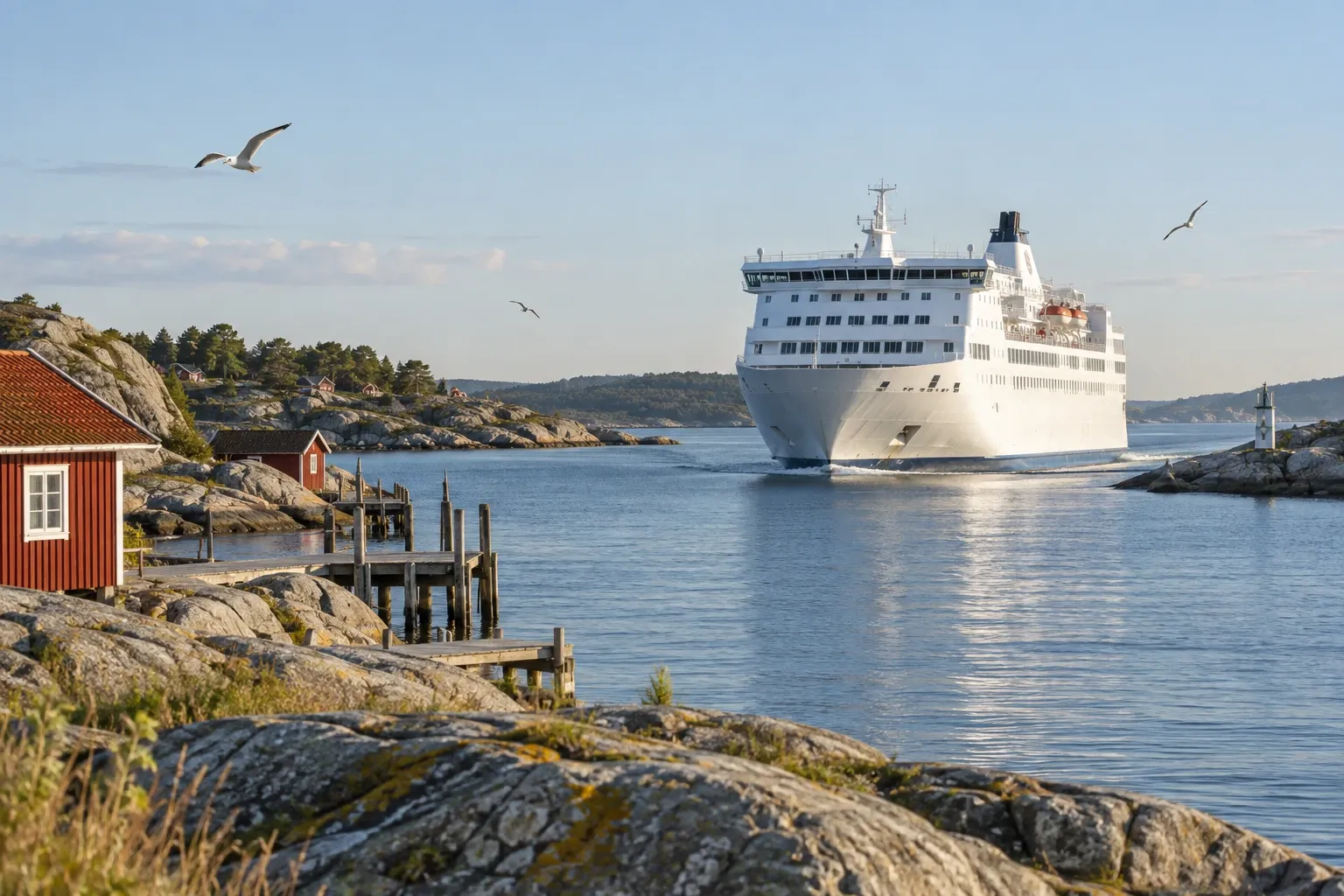
The ferry is not the romantic option; it is the practical one whenever you are traveling with things a plane cannot take — a car, a roof box, bicycles, skis, a dog. Nothing gets repacked, and on the long crossings the overnight cabin replaces a hotel night.
| From | Crossings that currently run | Operators |
|---|---|---|
| Germany | Travemünde–Trelleborg, Travemünde–Malmö, Rostock–Trelleborg, Kiel–Gothenburg | TT-Line, Finnlines, Stena Line |
| Denmark | Helsingør–Helsingborg, Frederikshavn–Gothenburg | Öresundslinjen, Stena Line |
| Poland | Świnoujście–Ystad, Świnoujście–Trelleborg, Gdańsk–Nynäshamn, Gdańsk–Karlshamn, Gdynia–Karlskrona | POLSCA Baltic Ferries (ex-Polferries), TT-Line, Stena Line |
| Baltics | Ventspils–Nynäshamn, Klaipėda–Karlshamn | Stena Line, DFDS |
| Finland & Estonia | Helsinki, Turku and Tallinn to Stockholm, via the Åland archipelago | Viking Line, Tallink Silja |
A foot passenger, a car and a cabin are three separately priced products, which is why “the ferry costs X” is never a useful sentence. Compare a short daylight crossing plus a hotel against a long night sailing before booking a cabin you may not need — but on Kiel–Gothenburg and on Finnlines’ night sailings a cabin is compulsory, so there is no choice to make (see ferries from Germany).
Warning: Ferry routes close. Stena Line ended Halmstad–Grenaa on 30 April 2026 by board decision, so anyone routing through Halmstad on a 2024 guide arrives at a port with no ferry. Confirm any crossing on the operator’s own current timetable — not on an aggregator, and not on a blog.
The friendliest Denmark crossing is Helsingør–Helsingborg: 20 minutes, turn up and go, and the sane choice with a bicycle. Corridor detail in ferries from Germany, from Denmark and from Poland and the Baltics.
Trains: two night trains, and one handover
You can sleep your way from Berlin to Stockholm — on either of two entirely separate trains, which is the detail almost every English page misses.
Snälltåget runs Berlin–Hamburg–Copenhagen–Malmö–Stockholm overnight in about 15 and a half hours, with some departures reaching down to Dresden. It is commercial and independent.
The EuroNight Berlin–Hamburg–Stockholm is the one in transition.
Warning: Check who runs your night train before you book. SJ’s last departure is 31 August 2026, after the Trafikverket funding agreement ends on 31 July 2026. From 1 September 2026 RDC Deutschland takes the route over commercially, running three times a week in each direction instead of daily, and selling through its own channels rather than SJ’s. Searching SJ after that date will not find the train.
Both trains share one argument: the sleeper is a hotel night as well as a journey, removing an overnight stay and a travel day at once. In winter, when driving means darkness and winter-tyre law, that argument gets stronger.
By day the rail chain from the continent runs Hamburg to Copenhagen overland via Jutland. The Fehmarnbelt tunnel is still years off — Femern A/S confirmed in May 2026 that it will open in two stages, road first, with no replacement date published after Germany said its rail facilities could not be ready for the planned 2029 opening.
From Norway, just take the train: Oslo–Gothenburg and Oslo–Stockholm both run direct, and since 15 June 2026 Snälltåget has run a daily Malmö–Gothenburg–Oslo service connecting into its Berlin sleeper. Full picture in taking the train to Sweden.
Driving and the coach
Driving from Germany means a crossing either way — a ferry, or the Danish route ending at the Öresund Bridge. The toll is paid per crossing: full rate at the plaza, or a large discount under an annual-fee agreement registered to your number plate, so register before you travel if you will cross more than once. Before choosing the car “because ferries are expensive”, price the whole chain: fuel, the crossing you still have to make, the toll, two nights of accommodation, and Swedish congestion tax at the far end. See driving to Sweden from Germany and the Öresund Bridge.
Warning: You cannot cycle or walk across the Öresund Bridge — it is a motorway, and people attempting it have shut it down. Bicycles cross by train, with a separate bicycle ticket for the cross-border leg, or on the Helsingør–Helsingborg ferry.
The long-distance coach is the budget backstop: Berlin or Hamburg to Stockholm in roughly 15 to 16 hours, most services changing in Hamburg or Copenhagen. Cheapest on the corridor, longest by some margin.
Traveling with a dog? From within the EU it is straightforward: a microchip fitted before vaccination, a valid rabies vaccination, an EU pet passport, and a 21-day wait after the primary vaccination, with the dog at least 12 weeks old when vaccinated. Sweden requires no tapeworm treatment — that rule was dropped, because the parasite is already established here. More in bringing a dog to Sweden.
The border you will actually meet
Sweden has run temporary internal border controls for a decade. The current government decision covers 12 May to 11 November 2026, and the police decide where and how to check. In practice, Sweden-bound travelers from Denmark are checked on arrival: trains at Hyllie, cars at the Lernacken toll plaza.
Carry a passport even as an EU citizen: a Nordic driving licence is usually accepted from Nordic citizens, but the passport is the only document that always works. Each renewal is decided close to the expiry date, so the position for a spring trip is settled the previous autumn.
This is an identity check, not an EES registration. The EU’s biometric Entry/Exit System fires only at Sweden’s external borders — airports with non-Schengen flights, and sea arrivals from outside Schengen. Ferries from Germany, Denmark, Poland, Finland and the Baltics are internal crossings, so a non-EU visitor’s biometrics were taken at their first external border, usually a connecting hub. Assuming the ferry “logged” your entry will put your 90/180-day count out. The system is explained in EES border checks; check your paperwork separately from your route in visa requirements and passport rules.
Which route should you take?
| Your situation | Best route | Why |
|---|---|---|
| Coming from outside Europe | Fly, connecting via a European hub | Your border queue is at the hub, not at Arlanda — budget the connection |
| Anywhere in Europe, no car | Fly to Arlanda or Landvetter | No Swedish flight tax since July 2025; capacity has grown |
| Southern Sweden, no car | Fly to Copenhagen, train onward | Station under Terminal 3; Malmö in about 20 minutes |
| Bringing a car, bikes or a dog | Ferry | Nothing gets repacked, and the night cabin replaces a hotel |
| Germany, want to arrive rested | Night train from Berlin | ~15.5 hours; check whether it’s Snälltåget or RDC |
| Denmark, short hop | Helsingør–Helsingborg ferry | 20 minutes, no booking, bicycle-friendly |
| Norway | Direct train | Oslo–Gothenburg or Oslo–Stockholm, no crossing at all |
| Cost is the only constraint | Long-distance coach | Cheapest on the corridor, roughly 15–16 hours |
Practical information
| Item | Detail |
|---|---|
| Swedish aviation tax | None — repealed with effect from 1 July 2025 |
| Main gateway | Stockholm Arlanda; Göteborg Landvetter second; Malmö for the south |
| Southern alternative | Copenhagen Airport, station under Terminal 3, Malmö in ~20 min |
| Night trains from Berlin | Snälltåget (seasonal: none early January to Easter) and the EuroNight — SJ until 31 Aug 2026, RDC from 1 Sept 2026, 3×/week |
| Ferry pricing | Per person, per vehicle and per cabin, priced separately |
| Route closed 2026 | Stena Line Halmstad–Grenaa, ended 30 April 2026 |
| Öresund Bridge | Toll per crossing; discount agreement tied to your number plate; no cyclists or pedestrians |
| Internal border control | 12 May – 11 November 2026; ID check at Hyllie (train) and Lernacken (road) |
| EES biometrics | External borders only — never on a ferry from Germany, Denmark, Poland or the Baltics |
| Dog from the EU | Microchip, rabies vaccination, EU pet passport, 21-day wait; no tapeworm treatment required |
| Fehmarnbelt tunnel | Staged opening confirmed May 2026, road first; no new opening date published |
FAQ
What is the cheapest way to get to Sweden?
Usually a low-cost flight, and more so since Sweden repealed its aviation tax on 1 July 2025 and carriers added capacity. The long-distance coach from Germany is cheaper still but takes about 15 hours. If you are bringing a car, a ferry with an overnight cabin often beats driving once you count fuel, tolls and a hotel night.
Is there still a flight tax in Sweden?
No. Lag (2017:1200) om skatt på flygresor was repealed by SFS 2024:1138 and stopped applying on 1 July 2025, so no Swedish ticket tax is charged on departures from Swedish airports. Pages still quoting a per-passenger flygskatt are describing a repealed law. The old rules still cover flights taken before that date.
Can I take a night train to Sweden from Germany?
Yes — two of them. Snälltåget runs Berlin–Hamburg–Copenhagen–Malmö–Stockholm overnight in about 16 to 17 hours (seasonal, not early January to Easter), with some departures from Dresden. The separate Berlin–Hamburg–Stockholm EuroNight passes from SJ to RDC Deutschland on 1 September 2026, running three times a week each way instead of daily. Check which one you are booking.
Should I fly into Copenhagen instead of Sweden?
For southern Sweden, often yes. Copenhagen Airport’s railway station sits under Terminal 3, and Öresundståg trains reach Malmö in about 20 minutes, then continue to Lund, Helsingborg, Gothenburg and Kalmar. You will pass a Swedish ID check at Hyllie on the way in. For Stockholm or the north, fly to Arlanda instead.
Do I need my passport to enter Sweden from Denmark?
Carry it. Sweden has temporary internal border controls in force from 12 May to 11 November 2026, and Sweden-bound travelers are checked — trains at Hyllie, cars at the Lernacken toll plaza. A Nordic driving licence is usually accepted from Nordic citizens, but a passport is the only document that always works. It is an ID check, not an EES registration.
Which ferry routes actually run to Sweden?
From Germany: Travemünde, Rostock and Kiel. From Denmark: Helsingør–Helsingborg and Frederikshavn–Gothenburg. From Poland: Świnoujście, Gdańsk and Gdynia. From the Baltics and Finland: Ventspils, Klaipėda, Tallinn, Helsinki and Turku. Routes do close — Stena Line ended Halmstad–Grenaa on 30 April 2026 — so confirm on the operator’s own timetable.
Can I bring my dog to Sweden?
Yes, and it is straightforward from within the EU: a microchip fitted before vaccination, a valid rabies vaccination, an EU pet passport, and a 21-day wait after the primary vaccination. The dog must be at least 12 weeks old to be vaccinated. Sweden requires no tapeworm treatment — that rule was dropped. Ferries and trains are the easy modes.
Can I cycle across the Öresund Bridge?
No. The fixed link is a motorway, closed to cyclists and pedestrians. Bicycles cross by train — Öresundståg carries them, with a separate bicycle ticket for the cross-border leg — or on the Helsingør–Helsingborg ferry, a 20-minute crossing that is the friendliest option for cycle tourists.
Related guides
- EES border checks in Sweden — what the biometric system does, and why the Öresund check is not it
- The Öresund Bridge — tolls, plate registration and the ferry alternative
- Ferries from Germany to Sweden — the corridor most surface travelers use
- Arlanda to Stockholm — the transfer that decides whether flying really was faster
- Getting around Sweden — the domestic network, once you have arrived
- What a Sweden trip costs — the budget this decision feeds into
Facts verified 2026-08-01. Sources: Skatteverket and Riksdagen (the aviation-tax repeal), Regeringen (border controls), Jordbruksverket (pets), Swedavia, Femern A/S, Øresundsbron and the operators themselves (Stena Line, TT-Line, Finnlines, Öresundslinjen, Polferries, DFDS, Tallink, Viking Line, Snälltåget, RDC Deutschland) — full register in this topic’s source file. International routes change fast; this page is on a 6-month review cycle, and the night-train operator changes on 1 September 2026. Found something outdated? Tell us and we’ll fix it.