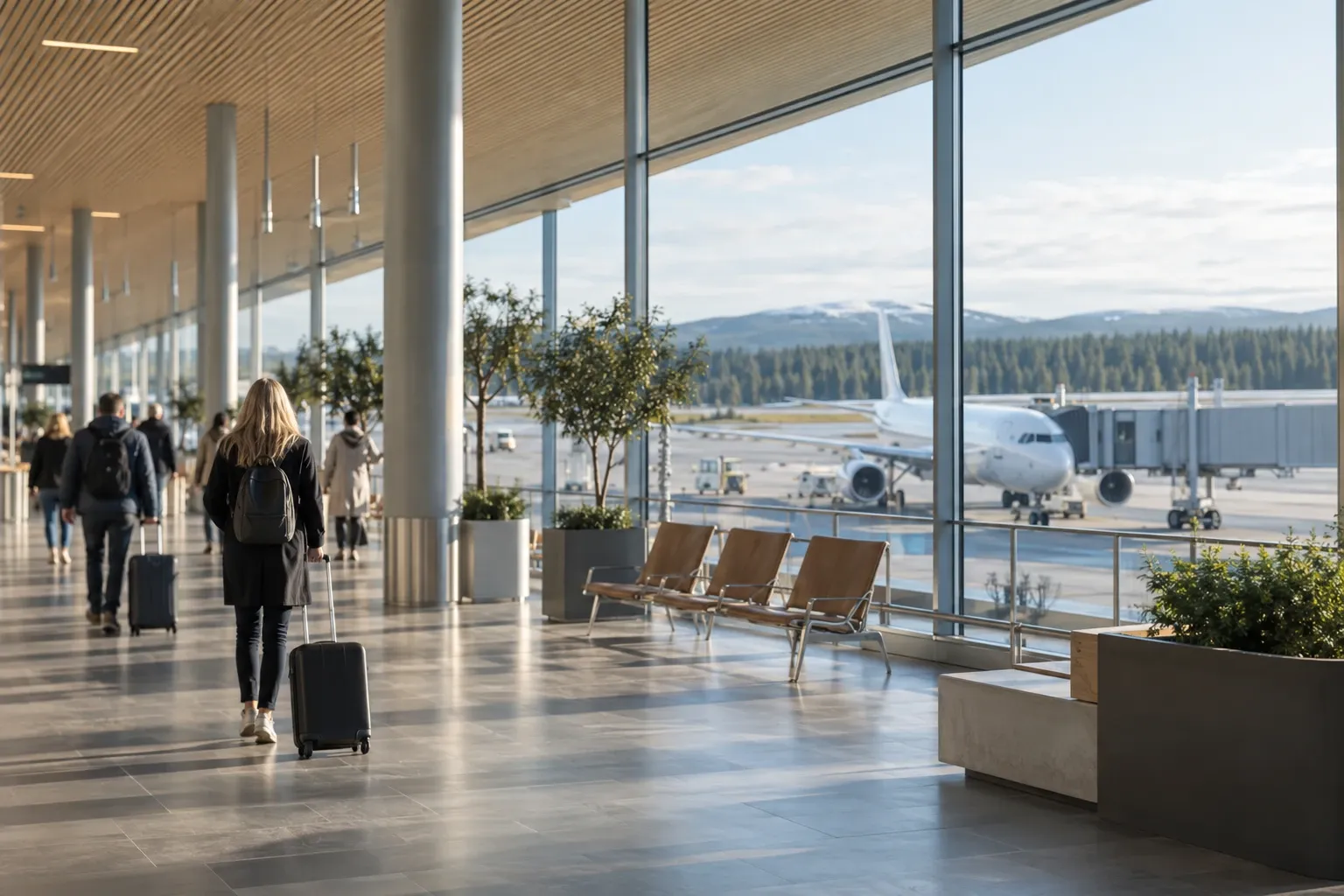
This is the walk from the aircraft door to the exit, in the layout Arlanda actually has in 2026 — which is not the layout most guides describe. Border control, bags, customs, and the first hour that follows.
When you need this
You have landed, it is 06:00, and the corridor signs are in two languages you can only half-read. You are connecting to a domestic flight and cannot tell whether it leaves from the building you are standing in. You are meeting someone off a long-haul flight and trying to time the drive. Or you are carrying duty-free, a wheel of cheese and more cash than you thought about, and you are approaching a row of colored channels.
Arlanda is two terminal areas, not one building
Start here, because everything else follows from it. Arlanda is organized as two terminal areas roughly a rail-minute apart, and Swedavia’s own signage groups them exactly this way:
| Area | Terminals | Rail station |
|---|---|---|
| Arlanda South | Terminals 2 and 3 | Arlanda South (Arlanda Express) |
| Arlanda North | Terminal 5, including gates C30–C44 | Arlanda North (Arlanda Express); Arlanda Central in SkyCity |
Terminal 5 is the big one: most long-haul, most non-Schengen traffic, and a rebuilt security control and marketplace.
Now the part that is wrong nearly everywhere else. Terminal 4 is no longer a stand-alone terminal. Its own check-in and security control closed on 28 October 2025, and Swedavia now states that Terminal 4 “is now part of Terminal 5”, covering gates C30–C44, carrying domestic and international traffic in the same zone. Arriving passengers at those gates walk out through Terminal 5’s customs. The two have been joined airside since 2022, so a connection between them needs no second security check.
So if a guide tells you to check in at Terminal 4 for a domestic flight, it is describing a building that stopped working that way in October 2025. And if a guide tells you Terminals 2, 3 and 4 are closed, it is quoting the pandemic. There is no Terminal 1.
The airport’s own airline list settles it: every carrier serving Arlanda is assigned to Terminal 2, 3 or 5, and none to Terminal 4. It also kills the other half of the folk model — Terminal 2 is not the domestic terminal. It carries Air France, KLM, British Airways, easyJet, Iberia, TAP, Vueling and more, while Braathens, the domestic operator, flies from Terminal 5.
Terminal 3 is the one nobody explains. It reopened on 1 October 2024 and serves four small regional airlines — Jonair, PopulAir, Sola Air and Västflyg — on a split procedure worth knowing before you arrive: you check in and drop bags at counters 57–60 in Terminal 2, then clear security in Terminal 3. If you have never heard of your airline, that is where you are. Everyone else is in Terminal 2 or Terminal 5.
The one number that matters is on your boarding pass. Read it before you leave the aircraft, and read it again for your onward leg.
Border control: the Schengen fork
What happens after the gate depends on one question: is this your first entry into the Schengen area?
Arriving from inside Schengen — Amsterdam, Copenhagen, Frankfurt, Helsinki, or another Swedish airport — there is no border check at all. Swedavia says it plainly: travelling within the Schengen cooperation area, there is no border check on arrival. Walk from the gate to the baggage belt. A domestic Swedish flight needs only an ID card or driving licence.
Arriving from outside Schengen — the US, the UK, the Gulf, Asia — you meet Swedish border police first, and you need a valid passport. EU, EEA and Swiss citizens take the lanes marked EU passport. Everyone else takes the all-passports lanes.
If you are a non-EU national, that is where the EU Entry/Exit System happens: you show your passport and any visa, a live photo is taken, and you give fingerprints. Children under 12 are registered but not fingerprinted. It is free, there is nothing to apply for, and anyone selling you “EES registration” is not official. Refusing the photo or fingerprints means being refused entry.
One thing saves most Sweden-bound travelers the whole exercise: EES fires at your first Schengen crossing. Connect through Frankfurt or Amsterdam and you were registered there, which makes the Stockholm leg an internal flight with no border check. The full picture — what is stored, for how long, and how to fix a wrong record — is in EES: Sweden’s biometric border checks.
You can also pre-register in the official Travel to Europe app, which the Swedish police offer for arrivals at Arlanda. It is free and voluntary, and it moves the passport-data and photo steps off the booth.
There are no e-gates at Arlanda
This one is worth its own heading, because plenty of pages tell you otherwise.
Sweden has not deployed automated border-control gates at Arlanda. Swedavia’s own passport page tells EU and Swedish citizens to follow the lanes marked EU passport and mentions no gates anywhere; its EES page describes no self-service process either. And the 2025 Swedish government inquiry into Arlanda recommends that the Government task the Police Authority with preparing and introducing automated, digitalized border control at Arlanda, Gothenburg and Malmö — a proposal, which is another way of saying it does not exist yet.
Warning: Budget a non-Schengen arrival for a staffed booth, not a gate. A first EES enrolment adds a photo and fingerprints on top. We publish no queue times — they change by hour, season and inbound bank, and any figure printed here would be wrong within a month.
Baggage reclaim
Standard bags come off the belts shown on the screens. Oversized items — skis, golf bags, pushchairs, instruments — are collected at the special-baggage pick-up points beside the belts, not from the carousel.
If a bag does not arrive, report it before you leave the baggage hall, and report it to your airline’s baggage service rather than to the airport. The airline is legally responsible for your bag; the airport cannot retrieve it for you, and chasing the claim from a hotel the next day is much harder.
Customs: three channels, not two
After the belts you choose a channel. Most guides describe two. Swedish Customs operates three.
| Channel | Sign | Who takes it |
|---|---|---|
| Green | “Nothing to declare” | Arrived from outside the EU, within your allowances |
| Blue | EU symbol, “Travelling directly from an EU country with no goods to declare” | Flew in directly from another EU country with nothing to declare |
| Red | “Goods to declare” | Anything over an allowance, restricted goods, an animal, or EUR 10,000 or more in cash |
The blue channel exists because an EU arrival is not a customs-free arrival — Tullverket controls intra-EU travel as well as the external border.
From outside the EU, the duty-free allowances are 1 L of spirits over 22% ABV or 2 L of fortified or sparkling wine, plus 4 L of still wine, plus 16 L of beer, and SEK 5,000 of other goods for an air arrival. Meat, milk and egg products may not be brought in from outside the EU at all. The full table is in customs allowances for Sweden.
Warning: Choosing green or blue while carrying goods over the allowances is smuggling, not a paperwork slip — the goods are seized and the offence carries fines or up to two years in prison. If the red channel is unstaffed, use the telephone there or call Swedish Customs’ command centre on +46 (0)8 405 05 70. Declaring costs you minutes and nothing else.
One rule has changed recently enough that most travel advice has not caught up: since 1 April 2026 the EUR 10,000 cash declaration duty applies to arrivals from other EU countries too.
Your first hour: money, phone, luggage
Money. You very likely need none. Sweden is card-first to a degree that surprises people, and the airport’s own left-luggage lockers take cards and nothing else. A contactless card or phone covers the train, the coffee and the taxi. If you want a small reserve, use an ATM after landing rather than an exchange desk — airport exchange desks set their own rates, and an ATM is usually cheaper. The full argument is in cash in Sweden.
Phone. Airport wifi is free for three hours: one hour when you connect, two more once you confirm your email address. Connect before the border queue, not after — that queue is exactly when you want to message whoever is meeting you. A prepaid SIM needs your passport to activate, so an eSIM bought before departure removes the errand entirely. See SIM cards and eSIMs for Sweden.
Luggage. Left-luggage lockers are in Terminals 2, 4 and 5 and in SkyCity, in several sizes including lockers that take skis and golf bags. Payment is by card. Rates are set by the concession operator and change, so check them live rather than trusting a figure printed in any guide, including this one.
Onward: a connecting flight, or the door
Connecting. Stay airside if your connection allows it — Terminals 4 and 5 are joined airside, so that leg needs no second security check. Between Terminals 2 and 5 there is an airside transfer bus you summon by pressing the button at the stop: the Schengen route runs Gate 61C to Gate F5, the non-Schengen route Gate 70 to Gate F1, daily 05:30 to 22:00, arriving within 20 minutes.
Changing terminal landside. Arlanda Express runs between Arlanda South and Arlanda North in about a minute, free of charge as an inter-terminal hop, and Swedavia’s own buses circulate the airport area free too. With a pushchair and a tired child, the train beats any improvised walk.
Leaving. Three railway stations and a bus terminal serve the airport, and which you want depends on your ticket and your destination — that comparison, with fares, is in getting from Arlanda to Stockholm. If someone is collecting you by car, use Swedavia’s own timing: 30 minutes after landing for flights from within Europe, 45 minutes for flights from outside Europe.
Practical information
| Item | What it costs |
|---|---|
| Border check and EES registration | Free — nothing to apply for, nothing to pay |
| Travel to Europe app pre-registration | Free, official, voluntary |
| Arlanda Express between Arlanda South and North | Free as an inter-terminal hop, about one minute |
| Swedavia buses within the airport area | Free |
| Airside transfer bus, Terminal 2 to Terminal 5 | Free, on request by button, 05:30–22:00 |
| Airport wifi | Free for three hours; paid extension by card |
| Left-luggage lockers (T2, T4, T5, SkyCity) | Set by the concession operator — card payment only; check the live rate |
| Duty-free allowance, other goods from outside the EU | Up to SEK 5,000 for air arrivals |
| Cash declaration threshold | EUR 10,000 or more, EU arrivals included since 1 April 2026 |
| Train, bus and taxi into the city | See our Arlanda transfer guide — fares live there |
FAQ
Which terminal will I arrive in at Arlanda?
Whichever your airline uses — check your boarding pass. Arlanda is two areas: Arlanda South holds Terminals 2 and 3, Arlanda North holds Terminal 5 and the gate zone C30–C44 that used to be Terminal 4. Terminal 5 takes most long-haul and non-Schengen traffic. A free one-minute train links the two areas.
Do I go through passport control when I land at Arlanda?
Only if you arrived from outside the Schengen area. Swedavia states there is no border check on arrival from a Schengen country, and Swedish domestic flights count as Schengen. From the US, the UK, the Gulf or Asia you meet Swedish border police first, and non-EU nationals are registered in the EU Entry/Exit System.
Are there e-gates at Arlanda passport control?
No. Sweden has not deployed automated border-control gates at Arlanda: every passport is checked at a staffed booth. Swedavia tells EU and Swedish citizens to follow lanes marked “EU passport” and mentions no gates. Automated border control at Arlanda is a 2025 government-inquiry recommendation — a proposal, not a facility.
How do I get between Arlanda’s terminals?
Free, two ways. Outside security, Arlanda Express runs between Arlanda South (Terminals 2, 3) and Arlanda North (Terminal 5) in about a minute at no charge, and Swedavia’s own buses circulate the airport area free too. Airside, a request-button transfer bus links Terminals 2 and 5 daily from 05:30 to 22:00.
Which customs channel do I take at Arlanda?
Three exist. Green “Nothing to declare” if you flew in from outside the EU within your allowances. Blue, marked with an EU symbol, if you flew directly from another EU country with nothing to declare. Red “Goods to declare” for anything over an allowance, restricted goods, an animal, or EUR 10,000 or more in cash.
Do I need cash when I land at Arlanda?
No. Sweden is card-first and the airport’s own left-luggage lockers take cards only. A contactless card or phone covers the train, the coffee and the taxi. If you want a small reserve, use an ATM after landing rather than an exchange desk — airport exchange desks set their own rates, and an ATM is usually cheaper.
Where can I leave my luggage at Arlanda?
In left-luggage lockers, which Swedavia lists in Terminals 2, 4 and 5 and in SkyCity, in several sizes including lockers that take skis and golf bags. Payment is by card. Rates are set by the concession operator and change, so check them live rather than trusting a figure printed in any guide.
How long does it take to get out of Arlanda after landing?
Swedavia publishes the only sensible answer as pick-up guidance: allow about 30 minutes after landing for flights from within Europe and 45 minutes for flights from outside Europe, since baggage and border control sit in between. First-time EES enrolment adds time. We publish no queue figures — they change by hour and season.
Related guides
- Arlanda to Stockholm city — the transfer decision this page deliberately leaves alone: train, bus or taxi, with fares.
- EES: Sweden’s biometric border checks — what is registered at that booth, how long it is kept, and how to correct a wrong record.
- Customs allowances for Sweden — the full table behind your channel choice, including food, medicines and pets.
- Cash in Sweden — why you probably need none, and what to do if you want some anyway.
- Getting around Sweden — trains, buses and the rest, once you are out of the airport.
Facts verified 2026-08-01. Sources: Swedavia, Polismyndigheten (the Swedish Police), Tullverket (Swedish Customs) and Sveriges riksdag — full register in this topic’s source file. Found something outdated? Tell us and we’ll fix it.