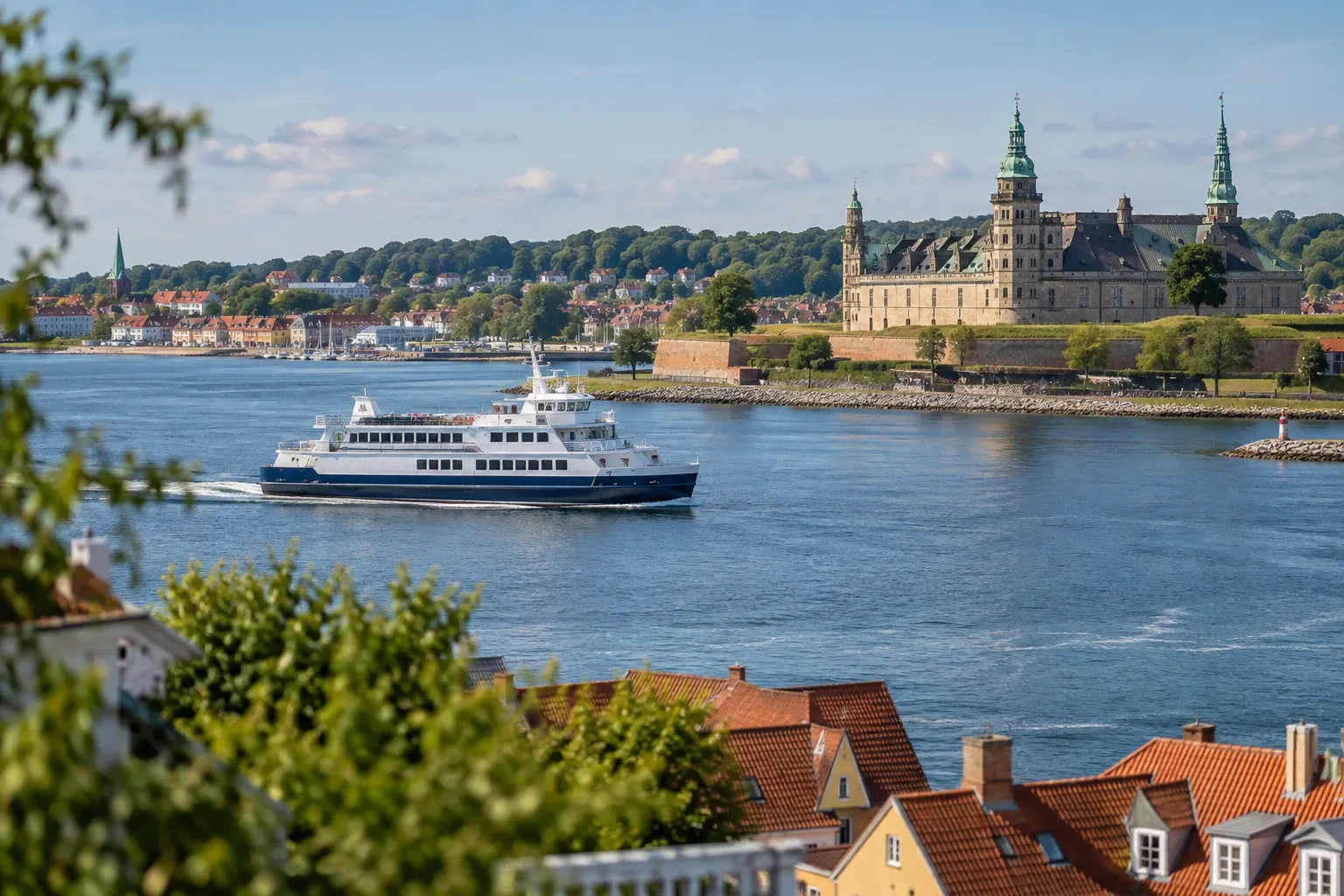
Three ferry routes cross from Denmark to Sweden, and they do very different jobs: a 20-minute hop across the Øresund, a three-and-a-half-hour sailing from Jutland to the west coast, and the Bornholm link. Here is which to take, when the bridge wins, and what happens on arrival.
When you need this
You are driving from Denmark, or through Denmark from Germany, and want to know which crossing to use. Or you are on foot or on a bike and need a way over that is not a motorway. Or you are starting in northern Jutland with Gothenburg in mind, or you are combining Sweden with Bornholm. Or an older guide has sent you to Grenaa for the Halmstad ferry. That ferry no longer runs.
The three routes from Denmark to Sweden
| Route | Operator | Crossing time | Lands in |
|---|---|---|---|
| Helsingør–Helsingborg | Øresundslinjen | 20 minutes | North-west Skåne |
| Frederikshavn–Gothenburg | Stena Line | 3 hours 30 minutes | The west coast |
| Rønne (Bornholm)–Ystad | Bornholmslinjen | 80 minutes | South-east Skåne |
Pick the route by where you start and where you are going. From Zealand, the short crossing puts you in Helsingborg. From northern Jutland, Frederikshavn–Gothenburg saves the drive down through Denmark and lands you on Sweden’s west coast. Rønne–Ystad only makes sense if Bornholm is part of the trip.
Helsingør–Helsingborg: the short crossing
This is the short crossing: 20 minutes across four kilometers of water, around the clock, with daytime departures every twenty minutes for passengers and cars. It is run by Øresundslinjen, part of the Danish ferry group Molslinjen. If an older guide or map calls the operator ForSea or Scandlines, it is out of date.
Five ferries work the route, the three largest of them electrically powered. The ferry carries foot passengers, cars and bicycles, which makes it the only way across the Øresund for anyone walking or cycling.
You can simply turn up, but a ticket bought at the terminal is for the next available departure, with no guaranteed place. To secure a sailing, book online or in the app, and check in on time:
| You are traveling | Check in at the latest |
|---|---|
| By car | 10 minutes before departure |
| On foot | 5 minutes before departure |
The operator says advance online tickets give the best prices.
Frederikshavn–Gothenburg: Jutland to the west coast
Stena Line sails from Frederikshavn, at the top of Jutland, to Gothenburg in 3 hours 30 minutes, with two ships on the route, Stena Danica and Stena Jutlandica. Since Grenaa–Halmstad closed, this is the only ferry from Jutland to Sweden.
It suits anyone heading for Gothenburg or the west coast without driving the length of Denmark first. Stena’s route page does not set out its terms for foot passengers or bicycles, so confirm those on your sailing when you book.
Bornholm: Rønne–Ystad
Bornholm is Danish, but its fastest link to the outside world lands in Sweden. Bornholmslinjen, another Molslinjen company, sails Rønne–Ystad in 80 minutes. It also runs Rønne–Køge on Zealand (5 hours 30 minutes) and Rønne–Sassnitz in Germany (3 hours 20 minutes).
At Ystad, check-in closes 10 minutes before departure for cars, foot passengers and cyclists alike; foot passengers board at Hamntorget 2. Because a Bornholm trip via Ystad passes through Sweden, bring passports: Bornholmslinjen says the authorities regularly check travelers to and from the island.
What happened to Grenaa–Halmstad?
Warning: Grenaa–Halmstad has not run since 30 April 2026. Stena Line closed it by board decision, and Destination Halmstad confirms the line was discontinued. No new operator has been announced. Booking sites still carry pages for the route, which is why it keeps turning up in trip plans.
From Jutland, your choices are now Frederikshavn–Gothenburg or the drive east across Denmark to the Øresund.
Ferry or bridge?
Between Copenhagen and Malmö, the Öresund Bridge is the direct line: a toll motorway, paid per crossing and priced by vehicle length. The ferry is the better choice in two situations:
- You are on foot or on a bike. The bridge, the island of Peberholm and the tunnel are closed to pedestrians and have no cycle path. The ferry carries both.
- You are heading north. Helsingør–Helsingborg lands you in north-west Skåne rather than Malmö.
If you are driving from Germany, driving to Sweden from Germany sets out the full route through Denmark, and ferries from Germany covers the direct sailings that skip Denmark entirely.
Dogs on the ferry
The rules differ by route, so plan the dog’s crossing with your own.
| Route | Where the dog travels | Booking |
|---|---|---|
| Helsingør–Helsingborg | On a leash on passenger decks; not in shops or restaurants | No ticket needed |
| Frederikshavn–Gothenburg, Stena Jutlandica | In your car on the open car deck, or the dog-friendly lounge | Pre-book; places limited |
| Frederikshavn–Gothenburg, Stena Danica | In your car, except May–August; or the dog-friendly lounge | Pre-book; places limited |
| Rønne–Ystad | Welcome on board under Bornholmslinjen’s own pet rules | Check with the operator |
On Stena Line, cats travel in a carrier, and without a pre-booked place the pet does not travel. Assistance dogs are exempt from the shop and restaurant ban on Øresundslinjen.
The short crossing does not shorten the paperwork. A dog coming from Denmark needs a microchip, an EU pet passport and a rabies vaccination given from 12 weeks of age and at least 21 days old, so a puppy is at least 15 weeks old at the border. Some copies of the ferry rules online say “15 months”; the operator’s own page says weeks. The full rules are in bringing your dog to Sweden.
Arriving in Sweden
Every crossing from Denmark is inside Schengen and the EU, which sets what happens on the Swedish side:
- ID check: Sweden’s temporary internal border control runs from 12 May to 11 November 2026, and the police decide where to check. Øresundslinjen warns of possible checks in both Helsingør and Helsingborg, including random checks on passengers coming from either country. Carry a passport or national ID card; Nordic citizens are usually accepted with a Nordic driving licence, but a passport is the safe choice.
- No EES registration: the EU’s biometric Entry/Exit System applies at external borders only. See EES border checks.
- Dogs and cats: register the animal with Tullverket (Swedish Customs) on every entry, online in advance if you live in the EU and travel on an EU pet passport, otherwise in the red channel. An unregistered animal can be refused entry.
- Coming from Germany: Denmark runs its own temporary control toward Germany, extended in June 2026 by four months beyond 11 July.
What you can bring is covered in Sweden’s customs allowances.
Practical information
| Item | Detail |
|---|---|
| Helsingør–Helsingborg | Øresundslinjen, 20 minutes, around the clock; check in 10 min (car) / 5 min (foot) |
| Frederikshavn–Gothenburg | Stena Line, 3 hours 30 minutes; pets pre-booked |
| Rønne–Ystad | Bornholmslinjen, 80 minutes; check in 10 minutes |
| Grenaa–Halmstad | Not running since 30 April 2026 |
| Fares | Dynamic, per sailing and ticket type; check the operator |
| Pets on Øresundslinjen | No ticket needed |
| Dog registration | Tullverket, on every entry, no fee listed |
| Swedish internal border control | 12 May – 11 November 2026 |
FAQ
Which ferries go from Denmark to Sweden?
Three routes in 2026. Øresundslinjen sails Helsingør–Helsingborg in 20 minutes, Stena Line sails Frederikshavn–Gothenburg in three and a half hours, and Bornholmslinjen sails Rønne–Ystad from Bornholm in 80 minutes. Grenaa–Halmstad, still listed in older guides, closed on 30 April 2026. Between Copenhagen and Malmö, the Öresund Bridge replaces the ferry.
Who runs the Helsingør–Helsingborg ferry?
Øresundslinjen, part of the Danish ferry group Molslinjen. The route has changed names over the years, so older guides may still call it ForSea or Scandlines. Crossings take 20 minutes, around the clock, with departures every twenty minutes for passengers and cars in the daytime. Book online to secure a departure; a terminal ticket gives the next available one.
Is the ferry or the Öresund Bridge better?
It depends on how you travel and where you are going. Copenhagen to Malmö is the bridge’s direct line, and it is paid per crossing by vehicle length. On foot or by bicycle there is no choice: the bridge is closed to both, and Helsingør–Helsingborg carries them. Heading north toward Helsingborg, the short ferry is the natural route.
Does the Grenaa–Halmstad ferry still run?
No. Stena Line closed Grenaa–Halmstad on 30 April 2026 after a board decision, and Destination Halmstad confirms the line was discontinued. No new operator has been announced. From Jutland, the remaining crossing to Sweden is Frederikshavn–Gothenburg, about three and a half hours, or the drive across Denmark to the Øresund.
Can I take my dog on the ferry from Denmark to Sweden?
Yes. On Helsingør–Helsingborg the dog needs no ticket but must be leashed. On Frederikshavn–Gothenburg the pet place must be pre-booked, and the dog rides in the car or the dog lounge depending on ship and season. Before arrival, register it with Swedish Customs and carry its EU passport with a valid rabies vaccination.
Is there a passport check on the ferry to Sweden?
There can be. Sweden’s temporary internal border control runs from 12 May to 11 November 2026, and Øresundslinjen warns that police carry out random checks in both Helsingør and Helsingborg. Carry a passport or national ID card. It is an identity check only, not an EES biometric registration, because the crossing is inside Schengen.
Related guides
- Getting to Sweden: every route compared — flights, trains and ferries side by side
- The Öresund Bridge — tolls, discounts and the border check on the fixed link
- Driving to Sweden from Germany — the full route through Denmark
- Bringing your dog to Sweden — the paperwork before any crossing
- Ferries from Germany to Sweden — the direct sailings that skip Denmark
Facts verified 2026-09-24. Sources: Øresundslinjen, Stena Line, Bornholmslinjen, Destination Halmstad, Øresundsbron, Tullverket (Swedish Customs), Jordbruksverket, Polismyndigheten, Regeringen, Justitsministeriet (Denmark) — full register in this topic’s source file. Fares and departure times change constantly and are never published here; always check the operator. Found something outdated? Tell us and we’ll fix it.