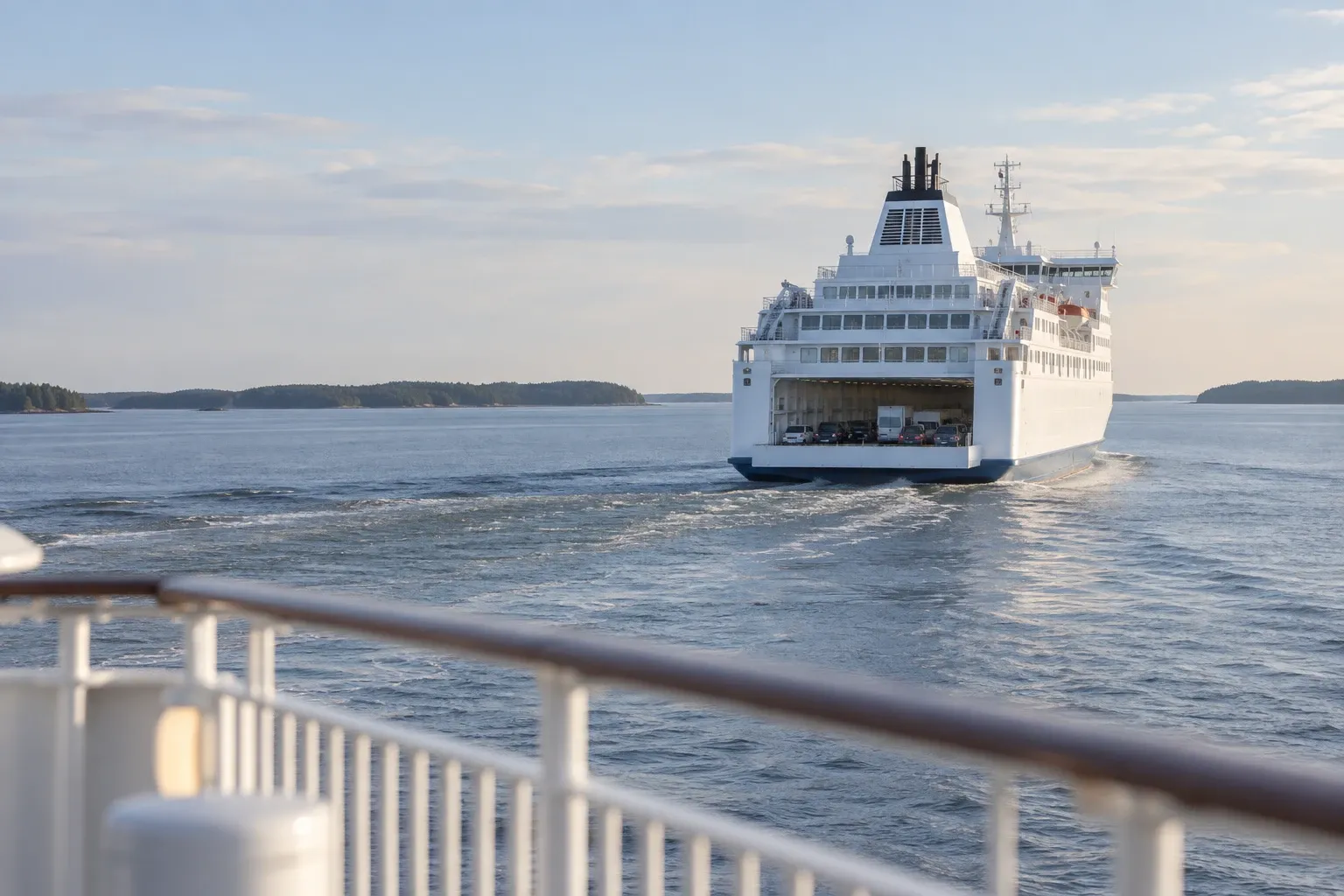
Four ferry routes link Germany directly to Sweden, and which one you want depends mostly on where in Sweden you are going, whether you want to sleep on board, and whether a dog is coming. Here is how they differ, and what happens when you drive off in Sweden.
When you need this
You are driving your own car, motorhome or motorcycle north from Germany and want to skip most of Denmark. Or you are choosing between landing on the west coast and landing in Skåne. Or you have a dog, and need to know where it spends the night. Or an older guide has sent you to Sassnitz on Rügen, and you want to know whether that ferry still runs. It does not.
The four routes from Germany to Sweden
Three operators run four routes in 2026. Two of them share Rostock–Trelleborg, so there are really five timetables to compare.
| Route | Operator | Crossing time | Sailings |
|---|---|---|---|
| Kiel–Gothenburg | Stena Line | About 14 hours | Overnight |
| Rostock–Trelleborg | Stena Line | About 6 hours | Day and night |
| Rostock–Trelleborg | TT-Line | About 6–7 hours | Day and night |
| Travemünde–Trelleborg | TT-Line | About 7–9 hours | Day and night |
| Travemünde–Malmö | Finnlines | About 9 hours | Up to three a day |
Pick the route by where you are going, not by the port you have heard of. Kiel–Gothenburg puts you on the west coast, with Norway within reach. The other three land in Skåne, Sweden’s southern tip, which suits the south and south-east. Rostock–Trelleborg is the shortest direct crossing and the natural choice from Berlin and eastern Germany.
Because Stena Line and TT-Line both sail Rostock–Trelleborg, a date that is sold out with one operator may still have space with the other. Check both before you give up on it.
Day crossing or night crossing?
The short routes to Trelleborg run both day and night sailings, so you can choose. A day crossing costs you most of a day but no bed. A night crossing takes a hotel night off the budget and puts you in Sweden rested with the whole day ahead.
Kiel–Gothenburg makes the choice for you: it is an overnight sailing of about 14 hours. On the Danish route (below) the crossing is 45 minutes, but the driving comes on top.
When a cabin is compulsory
This is where most guides go wrong. On some sailings a cabin is part of the ticket, not an extra:
| Route | Cabin rule |
|---|---|
| Kiel–Gothenburg (Stena Line) | Compulsory, booked with the ticket |
| Travemünde–Malmö (Finnlines), evening and night | Compulsory |
| Travemünde–Malmö (Finnlines), with a pet | Compulsory (a pet cabin) |
| Travemünde–Malmö (Finnlines), daytime | Optional, in advance or on board if available |
| TT-Line night crossings | Recommended, not required |
| Daytime Trelleborg sailings | Optional |
So there is no cheap seat on Kiel–Gothenburg or on a Finnlines night sailing. The fair comparison is the whole night crossing against a day sailing plus a hotel. TT-Line’s range includes family cabins and wheelchair-accessible cabins on the Travemünde route; ask for one when booking.
Cars, motorhomes, bikes and foot passengers
TT-Line carries cars, motorcycles, motorhomes, caravans, trailers and bicycles, and sells foot-passenger tickets. Finnlines carries foot passengers, who check in at the terminal and are bussed to the ship, and cyclists, who must wear a high-visibility vest in the port area.
Vehicle fares are banded by size. Finnlines’ passenger-car product covers vehicles up to 6 meters, so a bike rack or a towbar can push you into another band. Measure the whole rig, not the car alone, before you book. Stena Line’s pages checked for this guide do not set out its foot-passenger terms, so confirm those on your sailing when booking.
Dogs on the ferry
Plan the dog’s crossing before your own. On Stena Line’s Kiel–Gothenburg route, the pet cabin must be pre-booked, the dog may not stay in the car, a cabin takes at most two pets, and the animal is registered at check-in. Stena’s Rostock–Trelleborg ships have a limited number of pre-bookable pet cabins too; if none is left, the pet cannot travel. Finnlines requires a pet cabin, and TT-Line has pet cabins on some ships.
Pet cabins are the first thing to sell out in summer, so book yours when you book the car. The paperwork is covered in bringing your dog to Sweden.
What happened to Sassnitz–Trelleborg?
Warning: Sassnitz–Trelleborg has not run since 30 September 2024. FRS Baltic, which had revived the route with a fast catamaran in 2023, withdrew it citing fuel costs, new CO2 taxes and pilot fees in Sassnitz. The port of Trelleborg said it would look for another operator; none had been announced when this guide was checked. Booking sites still carry pages for the route, which is why it keeps turning up in trip plans.
The alternative: through Denmark
You do not have to take a long ferry at all. Scandlines’ Puttgarden–Rødby crossing takes 45 minutes, and Rostock–Gedser takes two hours; be at the harbor at least 15 minutes before departure. From there you drive across Zealand and over the Öresund Bridge to Malmö. The bridge toll is paid per crossing, or at a discount under an annual agreement registered to your number plate.
Which is cheaper depends on the whole chain, not the fare. The Danish route adds fuel, a short ferry, the bridge toll and often a hotel night; a long night ferry adds a cabin but replaces the hotel and the driving. Price both for your dates and vehicle. The Fehmarnbelt tunnel that will eventually replace Puttgarden–Rødby is not open; it will open in stages, road first, and no new opening date has been published. The full drive is in driving to Sweden from Germany.
Arriving in Sweden
A ferry from Germany crosses an internal Schengen and EU border, and that decides what happens on the quay:
- ID check: Sweden’s temporary internal border control runs from 12 May to 11 November 2026 and may be prolonged. Carry a passport or national ID card.
- No EES registration: the EU’s biometric Entry/Exit System applies at external borders only. A ferry from Germany does not log your entry. See EES border checks.
- Dogs and cats: register the animal with Tullverket (Swedish Customs) on every entry, online in advance if you live in the EU and travel on an EU pet passport, otherwise in the red channel. An unregistered animal can be refused entry.
- Alcohol: EU own-use rules apply, with no fixed limit. Tullverket’s guide levels (10 L spirits, 90 L wine, 110 L beer) are where questions start. Details in Sweden’s customs allowances.
- Cash: EUR 10,000 or more must be declared even when arriving from another EU country, a duty in force since 1 April 2026.
Once you are off the ship, driving in Sweden covers the rules of the road.
Booking tips
- Book on the operator’s own site. It is the only timetable that is certainly current, and it is where a closed route shows up as closed.
- Price the parts separately. The vehicle fare usually includes the driver; extra passengers, the cabin and the pet cabin are added on top. Fares are dynamic per sailing, so the same crossing costs different amounts on different days.
- Book early for summer. In peak season, car decks and pet cabins go first.
- Recheck your sailing before you travel. Departures vary by season, day of the week and schedule, and weather can lengthen a crossing.
Practical information
| Item | Detail |
|---|---|
| Kiel–Gothenburg | Stena Line, about 14 hours overnight, cabin compulsory |
| Rostock–Trelleborg | Stena Line about 6 hours; TT-Line about 6–7 hours; day and night |
| Travemünde–Trelleborg | TT-Line, about 7–9 hours, day and night |
| Travemünde–Malmö | Finnlines, about 9 hours, up to three a day; cabin compulsory evening/night |
| Sassnitz–Trelleborg | Not running since 30 September 2024 |
| Puttgarden–Rødby / Rostock–Gedser | Scandlines, 45 minutes / 2 hours, into Denmark |
| Fares | Dynamic; vehicle, passengers, cabin and pet cabin priced separately |
| Dog registration | Tullverket, on every entry, no fee listed |
| Internal border control | 12 May – 11 November 2026, may be prolonged |
FAQ
Which ferries go from Germany to Sweden?
Four routes in 2026. Stena Line sails Kiel–Gothenburg overnight and Rostock–Trelleborg; TT-Line sails Rostock–Trelleborg and Travemünde–Trelleborg; Finnlines sails Travemünde–Malmö. Sassnitz–Trelleborg, still listed in many older guides, ended on 30 September 2024. The Danish route — Puttgarden–Rødby plus the Öresund Bridge — is the land-based alternative.
How long is the ferry from Germany to Sweden?
It depends on the route. Rostock–Trelleborg is the shortest at about six hours, Travemünde–Trelleborg takes about seven to nine, Travemünde–Malmö about nine, and Kiel–Gothenburg about fourteen hours overnight. For comparison, the Puttgarden–Rødby hop into Denmark takes 45 minutes, but the drive and the bridge come on top.
Do I have to book a cabin on the ferry to Sweden?
On some sailings, yes. Stena Line makes cabins compulsory on Kiel–Gothenburg, and Finnlines requires one on evening and night departures from Travemünde to Malmö, and whenever you bring a pet. On daytime sailings a cabin is optional, and TT-Line recommends one on its night crossings rather than requiring it.
Can I take my dog on the ferry to Sweden?
Yes, but usually in a pet cabin rather than your car. On Kiel–Gothenburg the pet cabin must be pre-booked, the dog may not stay in the vehicle, and cabins are limited per sailing. Before arrival, register the dog with Swedish Customs — online if you live in the EU and use an EU pet passport.
Can I take the ferry to Sweden as a foot passenger or cyclist?
Yes on the routes checked. TT-Line sells tickets for bicycles and foot passengers, and Finnlines carries both, with foot passengers taken to the ship by shuttle bus and cyclists required to wear a high-visibility vest in the port area. Stena Line’s pages checked here do not state its foot-passenger terms, so confirm on your sailing when booking.
Is the ferry cheaper than driving through Denmark?
It depends on the whole chain, not the fare. The Danish route adds fuel, a short Scandlines crossing, the Öresund Bridge toll and often a hotel night; a long night ferry adds a cabin but replaces the hotel and the driving. Fares on every option are dynamic, so price both routes for your dates and vehicle.
Related guides
- Getting to Sweden: every route compared — flights, trains and ferries side by side
- The Öresund Bridge — the toll and the crossing on the Danish route
- Bringing your dog to Sweden — the paperwork before you book the pet cabin
- Sweden’s customs allowances — what you can bring off the ship
- Ferries from Denmark to Sweden — the short crossings on the other side
Facts verified 2026-09-24. Sources: Stena Line, TT-Line, Finnlines, Scandlines, Trelleborgs hamn, Tullverket (Swedish Customs), Polismyndigheten, Regeringen — full register in this topic’s source file. Fares and departure times change constantly and are never published here; always check the operator. Found something outdated? Tell us and we’ll fix it.