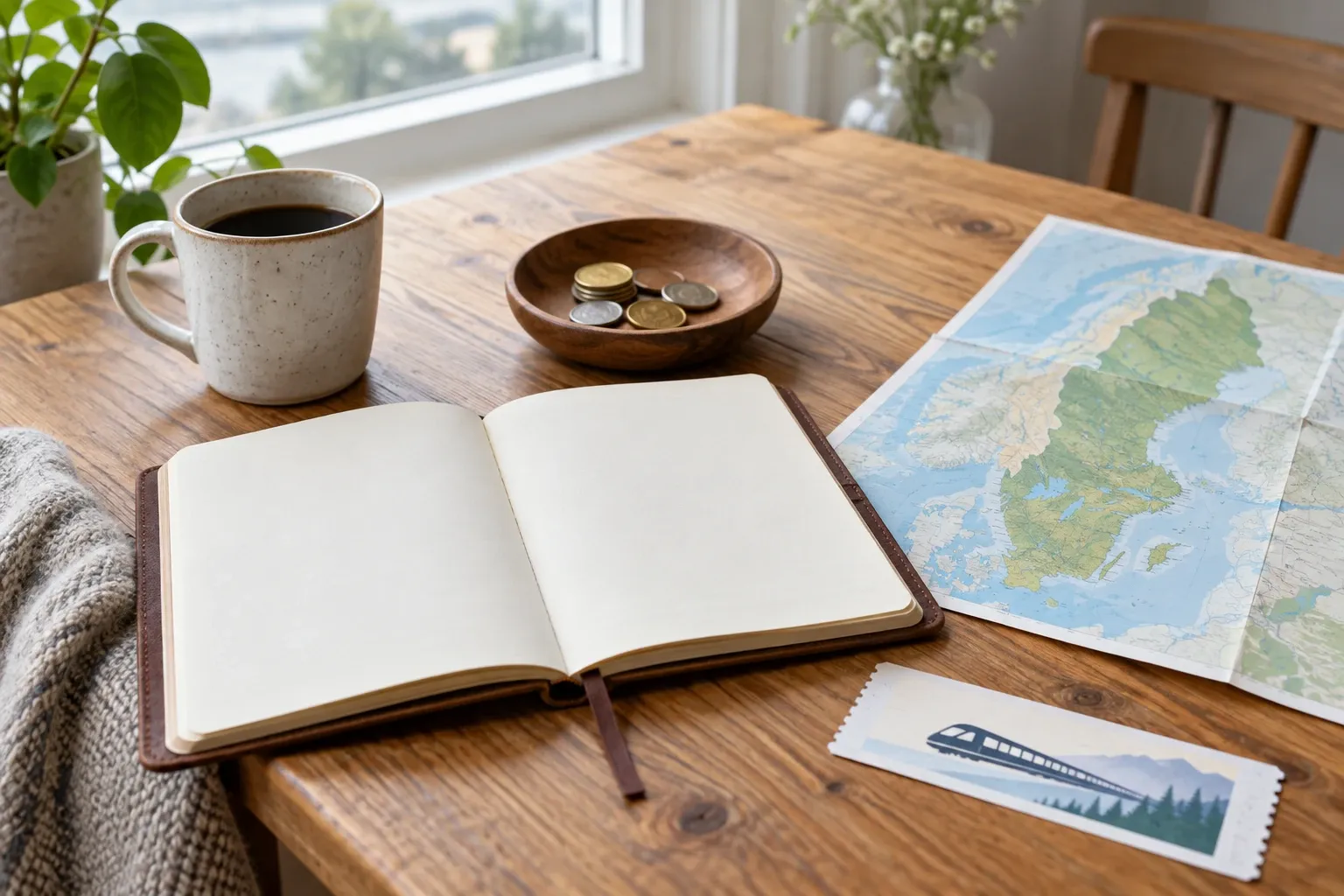
Sweden’s reputation scares off people who could comfortably afford it, then ambushes the ones who come anyway — because the expensive part isn’t where they expect. Here is what a day actually costs, dated, and the structure behind the numbers.
When you need this
You’re deciding whether Sweden fits the budget at all. Or the trip is booked and you need a daily number to plan around. Or you’re mid-trip, watching spending outrun the plan, and want to know what to cut. Or you’ve just read a blog post from 2019 quoting prices in dollars and something feels off — it should.
Dearer than average, cheaper than the myth
Start with the honest calibration. Eurostat’s 2025 comparison puts Sweden’s price level for household consumption at index 121 against an EU average of 100 — about a fifth above the norm. That is expensive. It is also nowhere near the top: Denmark sits at 140, Ireland at 136, Luxembourg at 132.
So Sweden is not the budget-vaporizing outlier of legend. What it is, is unevenly expensive — and the unevenness is the whole game:
| Genuinely expensive | Surprisingly manageable | Actually free |
|---|---|---|
| Restaurant dinners | Groceries and cooking | Nature, hiking, swimming |
| Alcohol out | The dagens lunch deal | Tap water, everywhere |
| Taxis | Hostels, cabins, camping | Tipping (not expected) |
| City hotels midweek | City hotels on weekends | Wild camping, by right |
A visitor who eats dinner out nightly with wine pays Sweden’s reputation in full. A visitor who eats the lunch deal, cooks some evenings and lets nature carry the sightseeing spends closer to what they’d spend in Germany. Same country, same week.
What a day costs: three realistic bands
These are planning bands, not statistics — per person, per day, two people sharing, checked 2026-08-01. They cover sleeping, eating, local transport and sights. Getting to Sweden, intercity legs and drinks out come on top.
| Style | Per person per day | What it assumes |
|---|---|---|
| Budget | roughly 600–1,000 kr | Hostel bed or shared campsite cabin, supermarket self-catering plus a dagens lunch, city transport, free sights |
| Mid-range | roughly 1,500–2,500 kr | Mid-range hotel double with breakfast, lunch out, one casual dinner, a paid admission most days |
| Comfortable | roughly 3,000–5,000 kr and up | Nicer hotels, restaurant dinners, taxis, tours — open-ended upward |
Two footnotes that matter. Solo travelers: add 30–50%, because a single room rarely costs half a double. Campers who cook: the floor drops below the budget band entirely — with wild camping free by right, campsite cabins as the cheap roofed fallback and groceries as the only food line, under 300 kr a day is genuinely achievable. No other country in Europe hands you a zero-cost accommodation tier as a legal right.
Why ranges instead of exact figures? Because exact figures rot. Swedish accommodation demand set records in 2025 — 70.8 million guest nights, according to Tillväxtverket — and hotel and train prices move with demand daily. The bands are wide enough to survive a year of drift; for your actual dates, check live prices with the operator.
Where the money actually goes
The tax structure explains most of what surprises visitors, and it’s worth sixty seconds.
Every price you see is final. VAT is always included in displayed prices, menus add no service charge, and tipping is not expected — so unlike in North America, the advertised number is what leaves your account. Budgeting is honest here.
But the VAT rates differ by what you’re doing. Since 1 April 2026 one café counter carries three rates: 6% on food you take away (a temporary cut running to the end of 2027), 12% on the same food eaten at a table, and 25% on any beer, wine or spirits beside it. That staircase — 6, 12, 25 — is a map of where your money goes. Cooking is taxed least, dining more, drinking most.
Alcohol is the budget’s predator. Roughly half of a Systembolaget shelf price is tax — excise duty plus 25% VAT — and restaurants add their own markup on top of that, which is why two or three drinks can outweigh the food they came with. If drinks out are part of your trip, budget them as their own line. The alcohol price guide explains the structure, including why mid-range bottles are relatively better value than cheap ones.
Eating out is where the reputation was earned. Between 1999 and 2022, Swedish restaurant lunch prices rose about 90% while groceries rose 62% — the cook-versus-eat-out gap is wider here than almost anywhere in Europe. Grocery prices are near-normal Western European; the restaurant dinner is not. Which is exactly why the lunch institution matters so much — more below.
What’s genuinely free
The half of the Swedish budget answer nobody writes down:
- Nature, all of it. Allemansrätten — the right of public access — makes hiking, swimming, paddling, berry picking and camping wild for a night or two free by right on most natural land. National parks charge no entry. In most countries the outdoors is an industry; in Sweden it’s a right.
- Tap water — excellent, and served free at restaurants on request. Say “kranvatten, tack.”
- Tipping — not expected, anywhere. Delete the line.
- City walking and much of the architecture, churches and waterfronts that would be ticketed elsewhere.
- Museum free slots. Several museums run free evenings — Nationalmuseum on Thursday evenings, for instance — and under-19s enter most state museums free. But note the trap in the next section.
Four levers that cut the bill
- Make lunch the restaurant meal. The weekday dagens lunch buys a hot main, salad buffet, bread, a drink and coffee for one posted price — the same kitchens charge a multiple of it at dinner, for the main alone. This single habit is the largest saving available in Sweden.
- Cook some dinners. The unusually wide cook-versus-eat-out gap means the same behavior change saves more here than at home. Hostels have guest kitchens as standard; do the big shop at a discounter.
- Book trains at release. SJ’s prices are demand-driven and cheapest the moment tickets are released, months ahead — the opposite of hoping for last-minute deals. Travel off-peak, against the Friday and Sunday flows.
- Time the hotels against their own market. Business-district city hotels are commonly cheapest on weekends; leisure Sweden — coasts, campsites, family attractions — peaks in July, so May–June and September are the value window. January–February city breaks are the year’s cheapest sleep.
What changed recently
Old guides fail on three specific points, all checkable:
State museums stopped being free in 2023. The 2016 free-admission scheme was scrapped for adults in the 2023 budget — a 99 million kronor cut — yet “free museums in Stockholm” lists predating it still circulate everywhere. Today adults pay at most state museums; under-19s typically go free; a shortlist of smaller museums remains free, and several big ones run free weekly slots. Check the museum’s own page, not a blog.
The VAT split arrived in April 2026. Food VAT dropped to 6% while restaurant meals stayed at 12% — takeaway is now legitimately taxed less than the same food eaten in. No pre-2026 guide describes this.
Cash is over, and that’s a saving. With 92% of in-store purchases made by card, the traditional holiday cash float — bought at exchange-desk rates, spent under pressure, converted back at a loss — is simply unnecessary. Bring a contactless card and pay in kronor, always. One more structural note: the krona floats, so a budget set in your home currency months ahead drifts. Recheck the rate the week you travel and keep ~10% headroom.
Practical information
| Item | Detail |
|---|---|
| Price level vs EU | Index 121 (EU = 100, 2025); Denmark 140, Ireland 136 |
| Currency | Swedish krona (kr/SEK) — floating rate, check live; not the euro |
| VAT | 25% standard · 12% restaurant meals · 6% food/takeaway (to Dec 2027) — always included in the displayed price |
| Dagens lunch | Roughly 135–145 kr nationally in 2026, weekdays ~11:00–14:00 |
| Alcohol | About half the shelf price is tax; same price at every Systembolaget |
| Tipping | 0 — not expected; round up only if you want to |
| Tap water | Free on request in restaurants |
| Museums | Adults pay at most state museums since 2023; under-19s typically free; free evenings exist |
| Trains | Dynamic pricing — cheapest at ticket release, dearest near departure |
| Payment | Card country: 92% of in-store purchases by card; no cash float needed |
| Wild camping | Free by right, a night or two, most natural land |
FAQ
How expensive is Sweden compared to the rest of Europe?
About a fifth above the EU average: Eurostat’s 2025 comparison puts Sweden at price index 121 against EU = 100. That makes it clearly expensive but not extreme — Denmark (140), Ireland (136) and Luxembourg (132) are all higher. The reputation is earned by restaurants, alcohol and taxis rather than by supermarkets, which are manageable.
How much money do I need per day in Sweden?
As 2026 planning bands, per person sharing: roughly 600–1,000 kr a day for hostel-and-lunch-deal travel, 1,500–2,500 kr for a mid-range hotel trip with restaurant lunches and casual dinners, and 3,000 kr upward for comfort with dinners out. Campers who cook can get under 300 kr. Intercity trains and drinks out come on top.
Is food expensive in Sweden?
Split the question. Groceries are near normal Western European levels and cooking is affordable. Restaurant dinners are genuinely expensive, and alcohol out even more so — tax is roughly half a shelf price before the restaurant’s markup. The fix is the dagens lunch: a full weekday restaurant lunch for roughly 135–145 kr in 2026.
Are museums in Sweden free?
No longer, mostly — old guides are out of date here. The free-admission scheme at state museums was abolished in the 2023 budget, so adults now pay at most of them. Children and teenagers under 19 typically still enter free, several museums run free evenings or days, and a shortlist remains entirely free. Check the museum’s own page.
Can I visit Sweden on a budget?
Yes, more easily than its reputation suggests. Wild camping is free by right, tap water is free, tipping is not expected, nature costs nothing, and the lunch deal puts restaurant meals within reach. Hostels have guest kitchens; discount supermarkets cut the food line further. Sweden rewards exactly the habits budget travelers already have.
How much cash should I bring to Sweden?
Essentially none. 92% of in-store purchases are made by card, card-only businesses are lawful and common, and a contactless Visa or Mastercard covers the whole country. Budgeting a cash float — and paying to exchange it twice — is one of the classic unnecessary Swedish trip costs. Since July 2026 grocery stores and pharmacies must accept cash, so a small reserve is optional, not necessary.
When is Sweden cheapest to visit?
It depends which Sweden. City business hotels are cheapest on weekends and in deep winter; leisure Sweden — coasts, campsites, family attractions — peaks in July, making May–June and September the value window with long days and open attractions. Train tickets are cheapest when released, months ahead, whatever the season.
Related guides
- Money in Sweden: the complete guide — currency, cards and the payment landscape this budget assumes
- Eating out in Sweden — the full lunch-versus-dinner picture behind the biggest lever
- The dagens lunch deal — how to find and read Sweden’s built-in budget meal
- Grocery prices in Sweden — the manageable half of the food budget, chain by chain
- Alcohol prices in Sweden — why drinks dominate, and how to buy smart
- Sweden on a budget — the full savings playbook this page’s bands feed into
Facts verified 2026-08-01. Sources: Eurostat (price levels), Skatteverket (VAT), Sveriges Riksbank (currency and payments), Tillväxtverket (accommodation statistics), Naturvårdsverket (allemansrätten), Systembolaget, SVT Nyheter (museum admission policy) — full register in this topic’s source file. Found something outdated? Tell us and we’ll fix it.