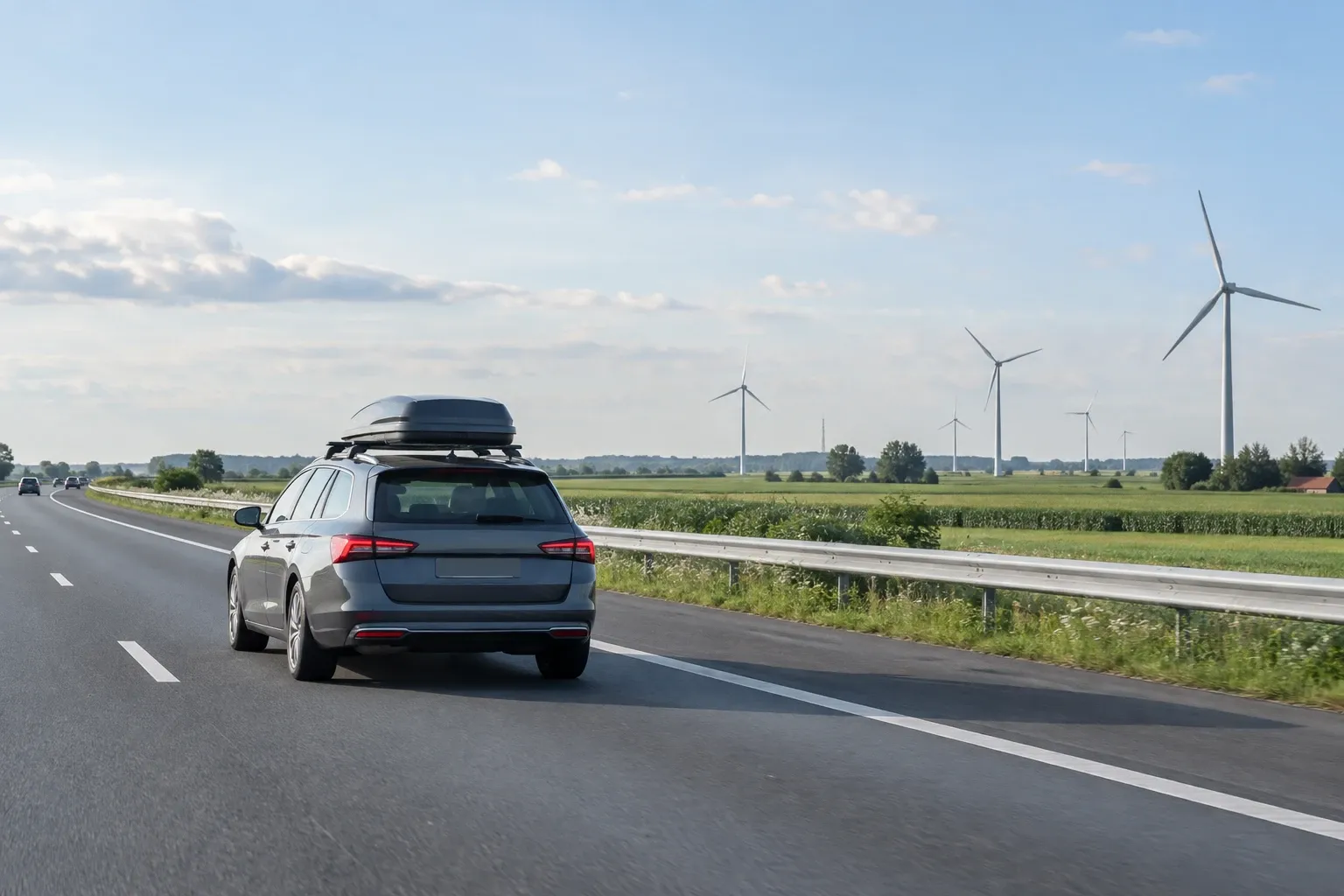
Every road from Germany to Sweden crosses water at least once. The real decision is where the car goes on a ferry, if at all. Then there is what you pay, where the police check you, and which rules change on the way.
When you need this
You’re planning a road trip to Sweden from Germany, the Netherlands, Austria or Switzerland, and wondering whether a long ferry beats driving through Denmark. Maybe you’re towing a caravan. Maybe you’ve read that the Fehmarnbelt tunnel will fix everything. Or you just want the bridge tolls before you set off.
The three ways to drive from Germany to Sweden
| Route | Water crossings | Booking needed? | Lands you in |
|---|---|---|---|
| Direct ferry | One, 6–14 hours | Yes | Gothenburg, Trelleborg or Malmö |
| Puttgarden–Rødby + Øresund Bridge | 45-minute ferry, then the bridge | Ferry, yes | Malmö |
| Jutland + Great Belt + Øresund Bridge | Two bridges | No | Malmö |
Choose by where you’re going in Sweden, not by the port you know. Gothenburg and the west coast favor the Kiel ferry. For Skåne and the south-east, look at the Trelleborg and Malmö ferries or the two Danish routes, which both end at Malmö.
Route 1: a direct ferry
Four routes run from Germany in 2026. Stena Line sails Kiel–Gothenburg overnight in about 14 hours. TT-Line sails Rostock–Trelleborg in about six to seven hours and Travemünde–Trelleborg in seven to nine. Finnlines sails Travemünde–Malmö in about nine hours.
The car travels the whole way and you skip a day of driving. On some sailings a cabin is compulsory, which is part of why the fare comparison is never simple. Timetables, cabin rules and dogs on board are covered in ferries from Germany to Sweden.
Route 2: Puttgarden–Rødby and the Øresund Bridge
Scandlines’ “bird line” ferry from Puttgarden on Fehmarn to Rødby on Lolland takes 45 minutes. From there, Danish motorways cross Lolland, Falster and Zealand to Copenhagen and the Øresund Bridge into Malmö. Rostock–Gedser, about two hours, is the eastern alternative.
This is the natural route from Hamburg and Lübeck. A combi ticket covers the Scandlines crossing and the Øresund Bridge in one booking, but you can’t stack it with other bridge discounts. Weather can change crossing times, so don’t build a tight onward connection on it.
Route 3: through Jutland over the Great Belt
The all-road route runs north into Jutland, east across Funen, over the Great Belt Bridge (Storebæltsbroen) to Zealand, then over the Øresund Bridge. Nothing to book, no weather-dependent crossing, and you can stop wherever you like. The price is two bridge tolls instead of one.
The Great Belt freshness point: from 1 January 2026, the lower express price applies automatically whenever you pay by Bizz tag or number-plate payment, from any provider. You no longer need a separate Storebælt private agreement, whatever older guides say. Card or cash in the blue and yellow lanes costs more.
Both bridges price by vehicle length. A car towing a caravan or trailer falls into a higher class, so a car-only ticket doesn’t cover it.
Driving through Denmark: no vignette, different limits
Denmark has no vignette or motorway toll for cars. Its distance-based road toll applies to trucks of 12 tonnes and over. For a car, the Danish costs on the way to Sweden are the Great Belt Bridge, the Øresund Bridge, and the Scandlines ferry if you take the bird line.
Danish rules sit close to German habits, but not on everything:
| Rule | Denmark | Sweden |
|---|---|---|
| Motorway speed | Statutory maximum 130 km/h; stretches signed 130 or 110 | 110 km/h maximum |
| Outside built-up areas | 80 km/h | 70 km/h base speed unless signed |
| With trailer or caravan | 80 km/h outside towns; 100 on motorways with a Tempo 100 trailer | 80 km/h with a braked trailer |
| Alcohol limit | 0.5 per mille | 0.2 per mille |
On Danish motortrafikveje (expressways) the limit is 80 km/h, raised to 90 in places. Towing at 100 km/h because your trailer is 100-approved at home is the classic mistake: in Denmark the Tempo 100 conditions have to be met, or it’s 80.
Two border checks, not one
Most guides mention one check, if any. There are two.
Denmark runs temporary border control toward Germany. Justitsministeriet extended it on 12 June 2026 by a further four months beyond 11 July 2026. Sweden runs its own control on Sweden-bound traffic from 12 May to 11 November 2026. On the road, Swedish police check at the Lernacken toll station on the Øresund Bridge, often right at your car window.
What to carry:
- Non-Nordic EU/EEA citizens: a valid passport or national ID card. A driving licence is not a travel document for you.
- Nordic citizens: a Nordic driving licence is usually accepted, but the Swedish police recommend a passport or ID card.
- Everyone: keep the documents in the front of the car, not in a suitcase in the trunk. Full detail is in passport and ID-card rules.
None of these crossings is an EES biometric registration: every border on the drive is internal to Schengen. Both control periods end around 11 November 2026 unless they’re renewed, so check again if you travel after that.
The Fehmarnbelt tunnel is not open yet
The tunnel under the Fehmarn Belt isn’t open, and there is no published opening date. Femern A/S, the Danish state company building it, confirmed in May 2026 that it will open in two stages, road first and rail later. Its news through September 2026 reports tunnel elements still being immersed.
Guides that promise a 2029 tunnel are out of date. Plan on the ferry.
What changes when you reach Sweden
The full rules are in driving rules in Sweden. The ones that catch German drivers:
- Alcohol: 0.2 per mille, not 0.5. A beer at a Danish lunch stop can put you over the Swedish limit an hour later.
- Dipped headlights whenever the car is on the road.
- Congestion tax in Stockholm and Gothenburg is charged by camera, and the invoice follows a German car home.
- Winter tyres, 1 December – 31 March, in winter road conditions, foreign cars included.
The good news for German tyres: since October 2024 Germany, like Sweden, accepts only tyres with the alpine (3PMSF) symbol in winter conditions, all-season tyres included. M+S alone no longer counts in either country. The catch is tread depth. Germany’s legal minimum is 1.6 mm. In Swedish winter conditions it’s 3 mm. A set that’s legal at home can earn a fine in Sweden for both driver and owner. See Swedish winter-tyre rules.
Traveling with a dog? It has to be registered with Swedish Customs before you arrive. See bringing a dog to Sweden.
Driving electric
We deliberately publish no charger lists or charging prices: networks and tariffs change too often. Plan charging around the fixed points of the trip: ferry check-in, the approaches to each bridge, and your first night in Sweden. Check networks and payment methods for Denmark and Sweden separately before you leave. Sweden’s side is covered in charging an EV in Sweden.
Practical information
| Item | Cost or rule | Checked |
|---|---|---|
| Great Belt Bridge, car under 6 m | 235 DKK card/cash · 205 DKK express (Bizz or number plate) | 2026-09-24 |
| Great Belt Bridge, car over 6 m | 360 DKK card/cash · 314 DKK express | 2026-09-24 |
| Great Belt Bridge, motorcycle | 125 DKK card/cash · 109 DKK express | 2026-09-24 |
| Øresund Bridge, car up to 6 m | 470 DKK booth · 420 DKK online · 182 DKK ØresundGO (370 DKK annual fee) | 2026-09-24 |
| Puttgarden–Rødby / combi ticket | Dynamic; book with Scandlines | 2026-09-24 |
| Direct ferries | Dynamic per sailing | 2026-09-24 |
| Danish vignette for cars | None | 2026-09-24 |
| Danish border control toward Germany | Extended 12 June 2026 by four months after 11 July | 2026-09-24 |
| Swedish border control | 12 May – 11 November 2026 | 2026-09-24 |
Great Belt prices apply from 1 January 2026; Øresund prices from 14 September 2026. Towing a trailer or caravan raises both. Check the operators’ pages before you leave, and see the Øresund Bridge toll and ID check for lanes and discounts.
FAQ
What is the best way to drive from Germany to Sweden?
It depends on your destination. For Gothenburg and the west coast, the overnight Kiel–Gothenburg ferry carries the car all the way. For Skåne, a Trelleborg or Malmö ferry, or the 45-minute Puttgarden–Rødby crossing and the Øresund Bridge. The all-road route through Jutland over the Great Belt needs no booking but pays two bridge tolls.
How much are the bridge tolls from Germany to Sweden?
Through Denmark by road you pay two bridges. The Great Belt costs 235 DKK for a car under 6 m by card or cash, 205 DKK with Bizz or number-plate payment. The Øresund Bridge costs 470 DKK at the booth, 420 DKK online, 182 DKK with ØresundGO. Towing raises both. Prices checked 24 September 2026.
Do I need a vignette to drive through Denmark?
No. Denmark has no vignette or motorway toll for cars; its distance-based road toll applies to trucks of 12 tonnes and over. On the way to Sweden, a car pays only the Great Belt and Øresund bridge tolls, plus the Scandlines ferry fare if you take Puttgarden–Rødby instead of driving through Jutland.
Is the Fehmarnbelt tunnel open?
No. Femern A/S, the Danish state company building it, confirmed in May 2026 that the tunnel will open in two stages, road first and rail later, and it has published no opening date. Its news pages in September 2026 report tunnel elements still being immersed. Until it opens, Puttgarden–Rødby by Scandlines ferry is the crossing.
Are there border checks driving from Germany to Sweden?
Yes, possibly two. Denmark runs temporary border control toward Germany, extended in June 2026 by four months beyond 11 July. Sweden checks Sweden-bound traffic at the Øresund Bridge toll station under a decision running to 11 November 2026. Carry a passport or national ID card; a driving licence is not a travel document for non-Nordic EU citizens.
Are German winter or all-season tyres legal in Sweden?
Usually on the marking, not always on the tread. Since October 2024 Germany, like Sweden, only accepts tyres with the alpine symbol in winter conditions. But Sweden requires 3 mm of tread from 1 December to 31 March in winter conditions, against Germany’s 1.6 mm legal minimum. Worn tyres legal at home can be fined in Sweden.
What is the speed limit on Danish motorways?
The statutory maximum is 130 km/h, and each motorway stretch is signed either 130 or 110 km/h, so follow the signs. Outside built-up areas the general limit is 80 km/h, in towns 50. Towing a trailer or caravan you may not exceed 80 km/h outside towns, or 100 km/h on motorways with a Tempo 100-approved trailer.
Related guides
- Ferries from Germany to Sweden — if the direct ferry wins, this compares the four routes and their cabin rules.
- The Øresund Bridge toll and ID check — lanes, ØresundGO and what happens at Lernacken.
- Driving rules in Sweden — everything that applies once you’re across.
- Swedish winter-tyre rules — dates, symbols and the 3 mm test.
- Every way to get to Sweden — if the car is still an open question.
Facts verified 2026-09-24. Sources: Sund & Bælt (Storebælt), Øresundsbron, Scandlines, Femern A/S, Justitsministeriet, Regeringen, Polismyndigheten, Transportstyrelsen, Sveriges riksdag, Rådet for Sikker Trafik, ADAC — full register in this topic’s source file. Found something outdated? Tell us and we’ll fix it.