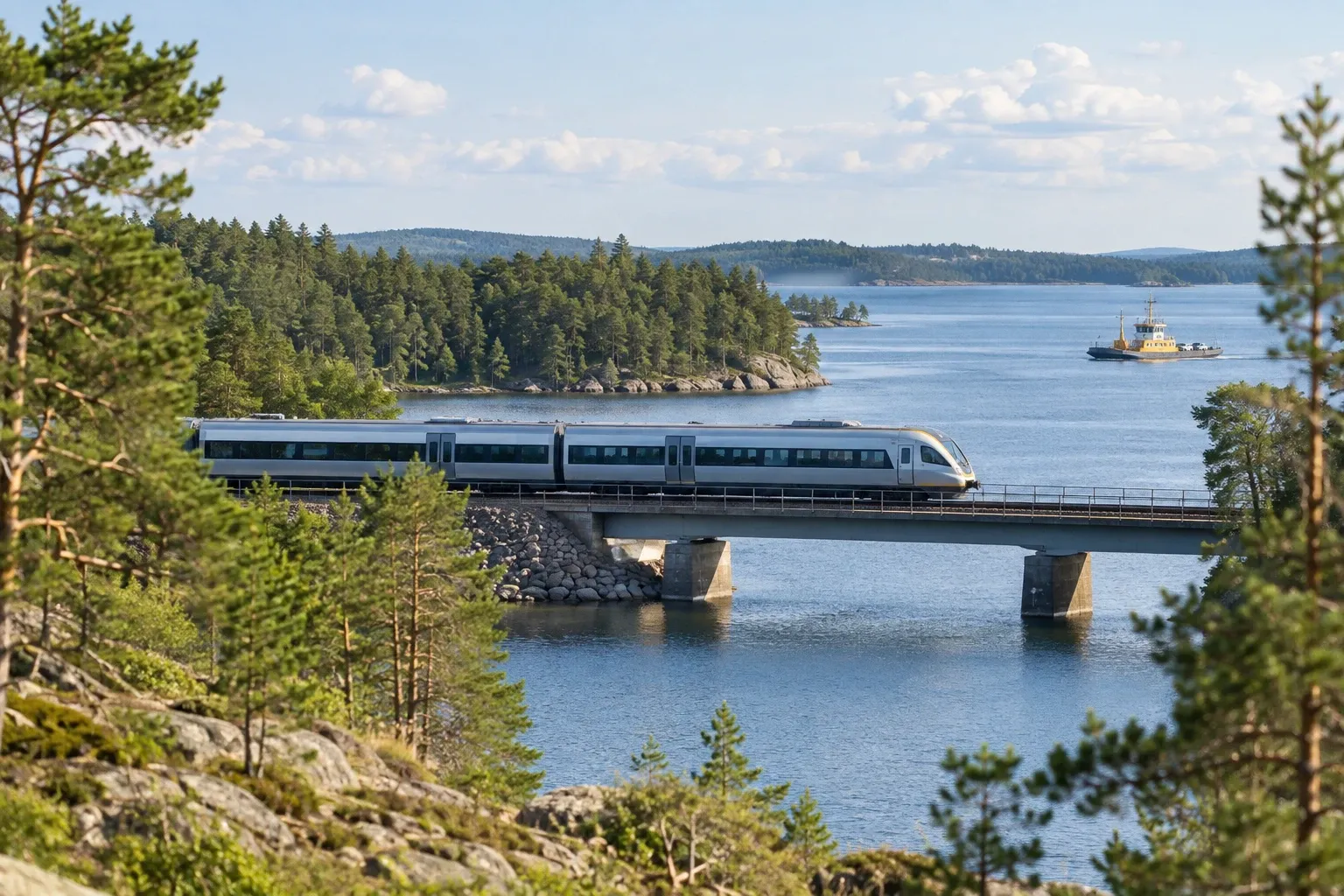
Sweden runs on excellent trains, cash-free city transport, free yellow ferries and quiet roads with strict rules. The one thing it doesn’t have is a national ticket. Here’s how the system fits together — and which mode to pick for each leg.
When you need this
You’re sketching a route from Stockholm to the Arctic Circle and wondering whether to drive. You’ve landed in a second city and your first city’s transport app is suddenly useless. Or your guidebook just recommended a train company that stopped existing two years ago.
One country, no national ticket
Swedish transport splits cleanly in two. Local and regional public transport is public: each of Sweden’s 21 regions runs its own operator — SL in Stockholm, Västtrafik around Gothenburg, Skånetrafiken in the south — with its own app, tickets, zones and prices. Long-distance travel — intercity trains, coaches, domestic flights — is a commercial market where operators compete and price dynamically.
Nothing connects the two except information. Every operator is legally required to feed its timetables into a national database, and the result is Resrobot (resrobot.se), a journey planner run by the industry body Samtrafiken that covers roughly 50,000 stops — every train, bus, tram, metro and boat in the country, door to door. It even sells tickets for many interregional trips.
So the working method for any Swedish journey is simple: plan in Resrobot, buy from the operator. There is no national pass to hunt for, and anyone selling you “one ticket for Sweden” is selling something that doesn’t exist.
Trains: the fast way between cities
The state operator SJ carries most long-distance traffic, with fast trains linking Stockholm, Gothenburg and Malmö in a few hours. Pricing is fully dynamic — every seat starts at a base price and climbs as the departure fills — and tickets are released in seasonal batches a few months ahead (the 2026 summer batch went on sale on 28 January, with some departures held back until the summer track-work plan is final). The consequence is one rule: book as soon as your dates are firm. Mid-week and midday departures are cheapest; Christmas, Easter, Midsummer and the February ski weeks sell out.
On the two biggest corridors, competition works in your favor. Stockholm–Gothenburg is shared between SJ and VR — the Finnish state operator that bought MTRX in 2024 and renamed it, so ignore guides still using the old name. Stockholm–Malmö is contested by Transdev’s Snälltåget, which continues to Copenhagen daily and adds seasonal night trains, including new routes in 2026. Check both operators on a shared corridor; same-day prices diverge widely. FlixTrain, by contrast, left Sweden in 2024 — its green trains went to Germany, though FlixBus coaches remain.
The night trains to Lapland are the network’s flagship long haul, and here stale advice is everywhere: they have been operated by SJ since December 2024, not Vy, under a state contract that from December 2026 guarantees daily Stockholm–Narvik and Stockholm–Umeå trains with through sleeping cars. You board in the evening and wake up above the Arctic Circle — and in winter, these berths are the first thing in the whole system to sell out.
Traveling on an Interrail or Eurail pass? It works here, but fast and night trains need paid seat reservations — see Interrail in Sweden.
City and regional transport
Inside cities, forget advance planning — and forget cash, which no Swedish bus accepts. In Stockholm, one SL ticket covers metro, buses, trams, commuter trains and city ferries, and you can simply tap a contactless card or phone on any reader across the network. In Gothenburg, tapping works in Zone A (Gothenburg, Mölndal, Partille and Öckerö) on readers showing the contactless symbol. A tap buys a single adult ticket only, and only inside the advertised zone — families, discounts and longer trips need the operator’s app or a travel card. Everywhere else in the country, the app is the method: install it while you still have Wi-Fi. The full system, including what happens at inspection, is in how to pay for buses in Sweden.
Stockholm’s archipelago boats are the one half-integrated oddity: Waxholmsbolaget tickets are sold inside the SL app, and Every SL ticket, even a single, is valid on Waxholmsbolaget boats between Strömkajen and Vaxholm year-round; beyond that you need a Waxholmsbolaget ticket (sold in the SL app or on board), except from 14 September to 29 April with an SL ticket of 30 days or longer. Details in the archipelago ferry guide.
Taxis deserve one warning: pricing is legally uncapped. Your protection is the mandatory yellow jämförpris sticker — the comparison price for a standard 10 km, 15-minute trip — displayed on every car, plus a binding maximum quote that drivers must give when that reference price exceeds 710 kr (the 2026 figure — the threshold is 1.2% of the price base amount and is recalculated every January). Read the sticker, not the brand. More in taxis in Sweden.
Ferries: the free ones and the booked ones
Sweden’s roughly 40 yellow road ferries are free. They are legally part of the road network — Trafikverket runs them like floating bridges — so you drive or walk aboard with no ticket, no booking, nothing. The two exceptions are Ekeröleden and Visingsöleden; Visingsöleden (Gränna–Visingsö) must be booked before you drive on, and a few routes sail only when called. On the west coast, in the archipelagos and at crossings like Öregrund–Gräsö they are genuine sightseeing at zero cost; ride them on purpose. See the free yellow road ferries.
The paid exception is Gotland. Destination Gotland sails from Nynäshamn and Oskarshamn to Visby, a crossing of about three hours, and it is the island’s lifeline rather than a cruise: a service procured by Trafikverket, with capped fares for residents and dynamic fares for visitors.
Warning: Summer car places on the Gotland ferry sell out months in advance. Foot passengers usually travel without drama; a car in July does not. Book the crossing when you book the accommodation — see taking the ferry to Gotland.
Coaches and domestic flights
Long-distance coaches are the budget backstop: FlixBus and Vy Bus4You link the big cities for less than the train, slower — and they sell out later, which makes them the rescue option when a holiday train is full.
Domestic flights matter for one thing: the north. SAS is the main domestic carrier and Norwegian flies several trunk routes from Stockholm Arlanda to Umeå, Luleå, Kiruna and Skellefteå. Two changes have outdated older guides: BRA no longer flies its own scheduled network (since 2025 it operates aircraft for SAS instead), and virtually all scheduled domestic flying has moved from Bromma to Arlanda, leaving Bromma a handful of small regional routes. For Stockholm–Lapland, the honest comparison is flight versus night train: the plane wins on time, the train on cost per night and carbon — see domestic flights in Sweden.
Driving: easy roads, strict rules
Driving in Sweden is genuinely pleasant — light traffic, disciplined drivers, moose warnings instead of road rage. The rules, however, are criminal law and enforced. Traffic drives on the right, and lights stay on whenever the car is moving, day and night (daytime running lights are enough in daylight).
Winter tyres are mandatory from December 1 to March 31 whenever winter conditions prevail — snow, ice, slush or frost on any part of the road, judged on the spot by police. Studded tyres are allowed October 1 to April 15.
Warning: All-season tyres marked only M+S do not count as winter tyres on a car in Sweden — since December 2024, studless winter tyres must carry the alpine symbol (3PMSF). This catches German and Dutch drivers bringing their own cars: driving in winter conditions on non-compliant tyres is fined and weakens your position with insurers after a crash. Details in winter tires in Sweden.
The drink-driving limit is 0.2 per mille — effectively zero, and it includes the morning after a late evening. At 1.0 per mille or more, courts weigh the offence toward aggravated drink-driving, which carries up to two years in prison.
Congestion tax applies in Stockholm and Gothenburg, charged per weekday passage by number-plate cameras. There are no booths and nothing to do at the gantry: the vehicle’s owner is invoiced afterwards, which means rental companies rebill you, and foreign-registered cars are invoiced via Epass24. One scam to know: Transportstyrelsen never demands payment by email or SMS. Rates and times are in congestion charges in Sweden.
Warning: Hitting a moose, deer, roe deer or wild boar is not just bad luck — driving on without reporting it is a crime. Call 112 and mark the spot, even if the animal ran off. Sweden logged about 73,300 such collisions in 2025, roughly 200 a day, so this rule is not theoretical. See wildlife collisions.
Renting? Swedish rental cars come winter-tyred in season — verify studs versus friction tyres if you’re heading onto ice-prone northern roads, and never assume a car rented in Germany or Denmark meets Swedish winter rules. The full rulebook is in driving in Sweden.
Which mode should you pick?
| Your leg | Best pick | Why |
|---|---|---|
| Between the big cities | Train | Fastest center to center; book early, compare SJ vs VR or Snälltåget |
| Within a city | Regional transport | Tap contactless in Stockholm or Gothenburg Zone A; operator app elsewhere |
| Stockholm to Lapland | Night train or flight | SJ night train (book berths first) or SAS/Norwegian from Arlanda |
| Rural coast, forests, mountains | Rental car | Buses run a few times a day; rent locally instead of dragging a car between cities |
| Gotland | Ferry | Destination Gotland from Nynäshamn/Oskarshamn; summer car deck books out months ahead |
| Short hops over water | Yellow road ferry | Free, no booking — part of the road network (except Ekeröleden and Visingsöleden; Visingsö is booked ahead) |
| On a tight budget | Coach | FlixBus or Vy Bus4You: slower, cheaper, sells out later than trains |
Most good Sweden itineraries mix modes: train for the long legs, taps and apps in town, a local rental only where the map turns green and roadless.
Practical information
| Item | Detail |
|---|---|
| National journey planner | Resrobot (resrobot.se) — all operators, all modes, door to door |
| National ticket or pass | None exists — buy per operator |
| Long-distance train pricing | Dynamic; released in seasonal batches; cheapest well ahead |
| Night trains north | Operated by SJ under state contract (since Dec 2024) |
| Cash on buses | Not accepted anywhere |
| Contactless tap | Stockholm system-wide; Gothenburg Zone A on marked readers |
| Yellow road ferries | Free, ~40 routes, no booking — except Ekeröleden and Visingsöleden (Visingsö is booked ahead) |
| Gotland ferry | Destination Gotland; book summer car places months ahead |
| Congestion tax | Stockholm and Gothenburg; automatic; rentals rebilled, foreign cars via Epass24 |
| Winter tyres | Mandatory Dec 1–Mar 31 in winter conditions; alpine symbol required |
| Alcohol limit | 0.2 per mille — treat as zero |
| Wildlife collision | Mandatory: call 112 and mark the site |
| Taxi pricing | Uncapped — check the yellow jämförpris sticker |
FAQ
What is the best way to get around Sweden?
Train between cities, the regional operator’s app or a tapped contactless card within them, and a car only where the rails thin out — mainly rural areas and the far north. Sweden’s distances are serious: for Stockholm to Lapland, compare the night train against a flight rather than driving. Plan every leg door-to-door in Resrobot first.
Is there one ticket or app for all public transport in Sweden?
No. Long-distance trains are sold by competing operators, and local transport is run region by region, each with its own app, zones and prices. Resrobot, the national journey planner, shows every mode and operator in one search and sells tickets for many interregional trips — but no country-wide pass exists.
How far in advance should I book train tickets in Sweden?
As soon as your dates are firm. SJ’s prices are dynamic — they start low and climb with demand — and tickets are released in seasonal batches a few months ahead. Holiday peaks around Christmas, Easter and Midsummer sell out, and winter night-train berths to Lapland are the ones to book earliest of all.
Are ferries really free in Sweden?
The yellow road ferries are, with two exceptions — Trafikverket’s roughly 40 routes count as part of the public road network, so you drive or walk aboard with no ticket and no booking, except on Ekeröleden and Visingsöleden (Gränna–Visingsö, booked ahead). A few routes, such as Arnöleden and Holmöleden, sail only when called. Commercial routes are different: Destination Gotland charges for the Visby crossing, and archipelago boats require a normal public transport ticket.
Can I pay cash on public transport in Sweden?
No — Swedish buses do not take cash, and the same holds across metros and trams. In Stockholm you can tap a contactless card or phone on any reader across the whole network; in Gothenburg’s Zone A the same works on marked readers. Everywhere else, buy in the regional operator’s app before boarding.
Do I need a car in Sweden?
Not for cities or city-to-city travel — trains beat the car there, which mostly collects parking fees and congestion tax. A car earns its keep in rural Sweden: the small-road coast, inland forests and the mountains, where buses may run a few times a day. Many visitors mix modes: train for the long legs, a local rental where it counts.
What are the most important driving rules in Sweden?
Drive on the right with headlights or daytime running lights on at all times. The drink-driving limit is 0.2 per mille — treat it as zero. Winter tyres are mandatory in winter conditions from December through March, and any collision with moose, deer, boar and similar wildlife must be reported to 112 and the site marked.
Related guides
- How to pay for buses in Sweden — the cash-free system in practice, region by region
- Train travel in Sweden — the mode that carries most of your trip, in depth
- Night trains to Swedish Lapland — booking the flagship long leg right
- Driving in Sweden — the full rulebook behind this page’s summary
- Taking the ferry to Gotland — the one crossing you must book early
Facts verified 2026-08-01. Sources: Trafikverket, Transportstyrelsen, Samtrafiken and the operators themselves (SJ, Västtrafik, Snälltåget, Destination Gotland, Waxholmsbolaget) — full register in this topic’s source file. Transport operators change fast in Sweden; this page is on a 6-month review cycle. Found something outdated? Tell us and we’ll fix it.