Almost every English-language page about the EU’s Entry/Exit System still describes it in the future tense. It has been fully operational since April 2026. Here is what actually happens to you, what is kept, for how long, and how to fix it when it is wrong.
When you need this
- You are flying into Sweden on a US, UK, Canadian, Australian or other non-EU passport for the first time since April 2026.
- You are trying to work out how much extra time to allow at the airport.
- You are wondering whether the ID check at Hyllie or on the Öresund Bridge counts as an EES registration.
- You are traveling with children and unsure whether they are fingerprinted.
- You suspect your exit was never recorded and that Schengen now thinks you overstayed.
- You are connecting through Frankfurt, Amsterdam or Copenhagen on the way to Sweden.
What EES actually is, and since when
The Entry/Exit System is an EU database that records every entry and exit of non-EU travelers on short stays. It replaced the passport stamp.
The two dates matter more than they look. EES began a progressive start of operations on 12 October 2025 and became fully operational on 10 April 2026. That progressive start was a legal state, not a slogan: Regulation (EU) 2025/1534 defined it as a 180-day period, required border authorities to keep stamping travel documents all the way through it, and suspended the automated identification of overstayers. The regulation ceased to apply 180 days after the start — and on that day the derogations expired with it. Stamping stopped. The machine started counting.
That is why a page written in 2025 is not merely dated but wrong: it describes a transitional regime that no longer exists.
What happens at the border, step by step
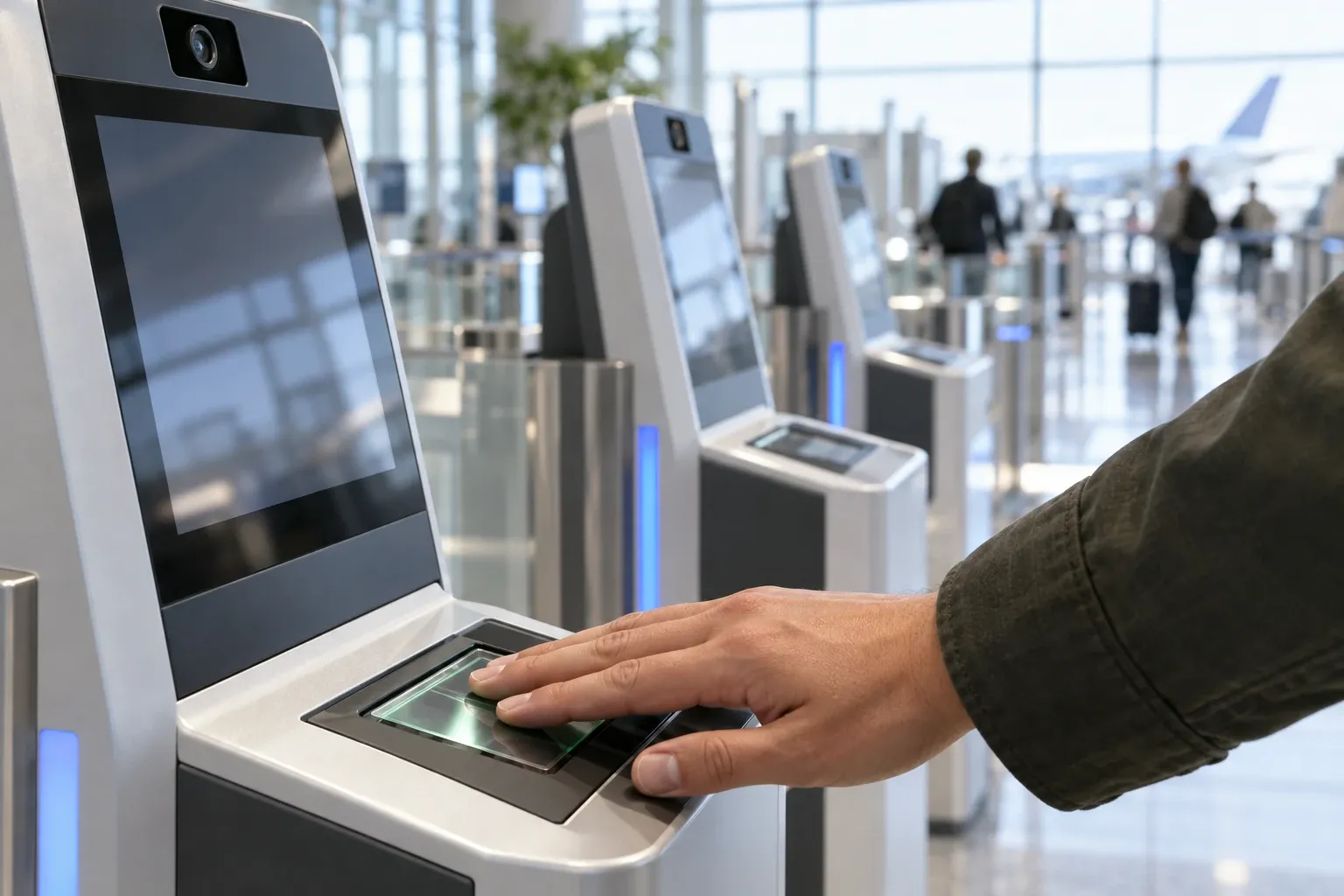
- Your file is created on your first crossing. The border officer takes your travel-document data, a live photo of your face, and — if you are visa-exempt — four fingerprints.
- Later crossings verify rather than enrol. Within the life of your file, your biometrics are compared against the existing record. This is why the second crossing is markedly faster than the first.
- You are told your remaining days. The border authority must inform you of the maximum duration of your authorised stay, either out loud or via equipment at the crossing point.
- Nothing goes in your passport. No stamp, no sticker, no receipt you can wave at anyone later — which is exactly why you should keep your boarding passes.
You can shorten step 1 slightly. Sweden supports the EU’s free Travel to Europe app for arrivals at Arlanda, Bromma, Landvetter, Malmö/Sturup and Skavsta: you pre-register your passport data, a facial image and the entry questionnaire up to 72 hours before crossing. It is voluntary, it carries no fingerprints, and it does not let you skip the booth. Unlike several other countries, Sweden has not deployed EES self-service kiosks — the app is the whole of Sweden’s published speed-up.
Warning: Refusing to give your photo or fingerprints means being refused entry. The Swedish police state it plainly, and the law is a two-step chain: providing biometric data is an entry condition under the Schengen Borders Code, and entry shall be refused to anyone who does not meet the entry conditions. You are sent back to where you traveled in from, and the refusal itself goes into the EES.
What is registered about you
| What | Detail |
|---|---|
| Travel document | Name, document data, and the date and place of every entry and exit |
| Facial image | Taken live at the crossing; extraction from the passport chip is an exceptional fallback that must be verified against the live image |
| Fingerprints | Four — index, middle, ring and little finger of the right hand where present, otherwise the left. That is the regulation’s own definition, not a rumor |
| Refusals of entry | Recorded with the grounds, and visible to every border authority in the system |
Two variants are routinely mis-stated online. Schengen visa holders are not fingerprinted again at the EES booth: the system stores the facial image and the visa data can be pulled from the Visa Information System, where the fingerprints already sit from the visa application. And children under 12 are exempt from fingerprints — they are still registered with document data and a facial image, and the fingerprint field is simply marked “not applicable”. The same exemption covers travelers physically unable to give prints; if the difficulty is temporary, it is recorded and the prints are taken at the next crossing.
Who is registered — and who never is
EES applies to non-EU nationals admitted for a short stay. Outside it entirely:
- Citizens of EU member states and of Iceland, Liechtenstein, Norway and Switzerland
- Non-EU family members of EU citizens who hold a residence card under the free-movement directive (the Article 10 or 20 card)
- Holders of a residence permit or a long-stay visa issued by an EES country
- Nationals of Andorra, Monaco and San Marino, and holders of a Vatican or Holy See passport
- People exempt from border checks or enjoying privileges, local border traffic permit holders, certain international train crew and rail transit document holders, and intra-corporate transferees, students and researchers under the relevant EU directives
If you live in Sweden on a residence permit, you are out — and so is your non-EU spouse, provided they carry the residence card. That card is what keeps them out of the biometric lane.
Where EES applies in Sweden — and where it never does
This is the part no generic EU explainer can tell you, and it decides what most Sweden-bound readers experience.
Sweden has no external land border. Norway and Finland are both Schengen states, and the Commission’s notified list of Swedish border crossing points contains air and sea crossings only — there is no land section. So:
| Crossing | EES? | What actually happens |
|---|---|---|
| Arlanda, Landvetter, Bromma, Malmö/Sturup, Skavsta and other airports, on non-Schengen routes | Yes | Full border check with biometric registration |
| Sea arrivals from outside the Schengen area (cruise calls) | Yes | Border check at the port |
| Öresund from Denmark — Lernacken road check, Hyllie train check, Helsingborg ferry | No | Sweden’s temporary internal border control: an identity check, running to 11 November 2026 |
| The Norway and Finland land borders | No | Internal Schengen border |
| Ferries from Germany, Poland, Denmark, Finland and the Baltic states | No | Internal Schengen crossings |
The practical consequence is bigger than it sounds. A traveler who assumes the ID check at Hyllie “logged” their entry will miscount their Schengen days in the wrong direction — see our guide to how the Schengen 90/180 days are counted.
And one more: EES fires at your first crossing of the Schengen external border. Fly Chicago–Frankfurt–Stockholm and you are enrolled in Frankfurt; the Stockholm leg has no border check at all. Budget your time at the hub, not at Arlanda.
Do you still get a passport stamp?
No — not if EES registers you. But stamping is not quite extinct, and travelers who meet one of the three surviving cases often think something has gone wrong:
- System outage. When it is technically impossible to use the EES, the fall-back procedure requires the border authority to record the data manually and affix an entry or exit stamp. Biometrics cannot be stored manually and are taken at your next crossing.
- Residence permits and long-stay visas. A country may, where its national law expressly provides, stamp the document of someone holding a residence permit or long-stay visa that it issued itself.
- Countries not fully applying the Schengen acquis. National short-stay visas issued by a state that operates EES without yet fully applying the acquis are still stamped on entry and exit.
How long your data is kept
“Three years” is the headline, and it is only the top of a ladder.
| Situation | Retention |
|---|---|
| Normal entry/exit record, or a refusal of entry | Three years from the exit or refusal record |
| A file with an exit record and no new entry within three years | Three years and one day |
| Authorised stay expired with no exit record | Five years from that expiry |
| The family-member category without a residence card | Up to one year after exit |
Erasure is then automatic. The three-year design is deliberate: a repeat visitor inside three years is verified against the existing file rather than enrolled again, which is what makes later crossings quicker.
Warning: A missing exit record is the failure mode that hurts an innocent traveler. If your authorised stay expires and the EES holds no exit record, the file is kept five years instead of three and the case looks exactly like an overstay to every future border check. Fix it in writing rather than hoping.
If your record is wrong or your exit is missing
You have enforceable rights over this data: access, rectification, completion, erasure and restriction. You may exercise them with the competent authority of any member state, and the request must be answered within 45 days. Data must be corrected where it is factually inaccurate, incomplete or unlawfully recorded, and a refusal has to come as a written decision explaining why, together with information on how to complain or go to court.
For a Swedish border crossing, the route is concrete:
- Polismyndigheten (the Swedish Police) is Sweden’s border authority and publishes a dedicated EES request form for access, rectification, completion, erasure and restriction, linked from its Entry Exit System page.
- The 45-day clock is statutory, not a service promise.
- IMY — Integritetsskyddsmyndigheten, the Swedish privacy protection authority — is Sweden’s supervisory authority for EES data processing, and the route for a complaint.
Attach your evidence. Boarding passes, tickets and hotel confirmations are what turn “I definitely left” into a correctable record. The border booth, incidentally, is not where rectification happens — do not plan to argue it at your next crossing.
How long it takes — and why we won’t print a number
We publish no queue times. They vary by airport, by hour and by season, and any figure printed here would be wrong within a month. What is stable is the structure: the first crossing, when your file is created, is the slow one; later crossings verify against it and move faster. Pre-registering in the app moves some steps off the booth.
For context rather than planning: in the first summer of full operation, European airport and airline bodies complained publicly about border waiting times and pressed the Commission to ease the process, and Sweden saw localized queues, mainly at Arlanda departures for non-Schengen passengers. Check your airport’s live information on the day you fly.
Practical information
| Item | Cost |
|---|---|
| EES registration at the border | Free — nothing to apply for, nothing to pay |
| Travel to Europe app (pre-registration) | Free — the official EU app; Arlanda, Bromma, Landvetter, Sturup, Skavsta |
| Checking your remaining authorised stay online | Free — the EU’s official EES page |
| Request for access, rectification, erasure or restriction | Free — the Swedish Police’s EES form; statutory answer within 45 days |
| Complaint to the supervisory authority | Free — IMY supervises EES processing in Sweden |
| “EES registration services” sold online | There is no EES application to buy. Any site charging for one is not official |
Two caveats on the EU’s online “check how long you can stay” tool, both published by the EU itself and both easy to miss: it does not reflect Schengen time from visits that began before 10 April 2026, and up to and including 6 October 2026 its “OK” answer may be unreliable for holders of single- or double-entry visas who used entries between 12 October 2025 and 9 April 2026. Use it, but not alone.
FAQ
Will they take my fingerprints when I enter Sweden?
If you are a non-EU visitor on a short stay and this is your first crossing since your file was created, yes: four fingerprints — index, middle, ring and little finger — plus a live photo of your face. Schengen visa holders give only the photo, because their fingerprints already sit in the visa database. Children under 12 give none.
Do I still get a passport stamp when entering Sweden?
No. Since 10 April 2026 the EES record replaces the stamp for every traveler it registers. Stamping survives only in edge cases: when the system is technically unavailable, border guards fall back to manual records and a stamp, and a country may still stamp holders of residence permits or long-stay visas that it issued itself.
Does EES happen at Arlanda or at my connecting airport?
At whichever is your first crossing of the Schengen external border. Fly Chicago to Frankfurt to Stockholm and you are registered in Frankfurt, with no border check at all on the Stockholm leg. Only a direct non-Schengen flight into Arlanda, Landvetter, Bromma, Malmö or Skavsta makes Sweden your enrolment point.
How long does the EU keep my EES data?
Normally three years from your exit record — long enough that a repeat visitor inside three years is verified rather than re-enrolled. A file with an exit record and no new entry keeps going for three years and a day. If your authorised stay expires with no exit record, retention becomes five years from that expiry. Erasure is automatic.
Is the border check between Denmark and Sweden an EES check?
No. The Öresund crossing is an internal Schengen border, so no EES registration happens there — not at the Lernacken road check, the Hyllie train check or the Helsingborg ferry. What you meet is Sweden’s temporary internal border control, an identity check running to 11 November 2026. It registers nothing in the EES.
What do I do if my EES record is wrong or my exit is missing?
Ask in writing. You have a right of access, rectification, completion, erasure and restriction, exercisable with the competent authority of any member state. For a Swedish crossing that is Polismyndigheten, which publishes an EES request form; the answer is due within 45 days. IMY supervises and takes complaints. Keep boarding passes as evidence.
Do children have to be registered in the EES?
Yes, but not fingerprinted below the age of 12. Younger children have their travel-document data and facial image registered like everyone else, and the fingerprint field is simply marked not applicable. From 12 they are treated as adults for fingerprinting. The same exemption covers travelers physically unable to give prints.
How long does EES registration take at the border?
We do not publish minutes — waits vary by airport, hour and season, and any figure would rot fast. The structure is what matters: the first crossing, when your file is created, is the slow one; later crossings verify you against it and move faster. Pre-registering in the Travel to Europe app moves some steps off the booth.
Related guides
- Do you need a visa to visit Sweden? — which lane your passport is in, before any of this applies.
- The Schengen 90/180-day rule explained — the arithmetic EES now enforces automatically, and how to count it yourself.
- ETIAS and Sweden — the other EU system, constantly confused with this one, and not in operation.
- Passport rules for visiting Sweden — the document checks that happen at the same booth, including the 10-year rule.
- Sweden’s customs allowances — the other rulebook at the same border.
Facts verified 1 August 2026. Sources: Regulation (EU) 2017/2226 (the EES Regulation), the Schengen Borders Code, Regulation (EU) 2025/1534, the European Commission, Polismyndigheten (the Swedish Police), IMY and the Swedish government — full register in this topic’s source file. Reviewed every six months, because this system is new and its operational layer is still moving. Found something outdated? Tell us and we’ll fix it.