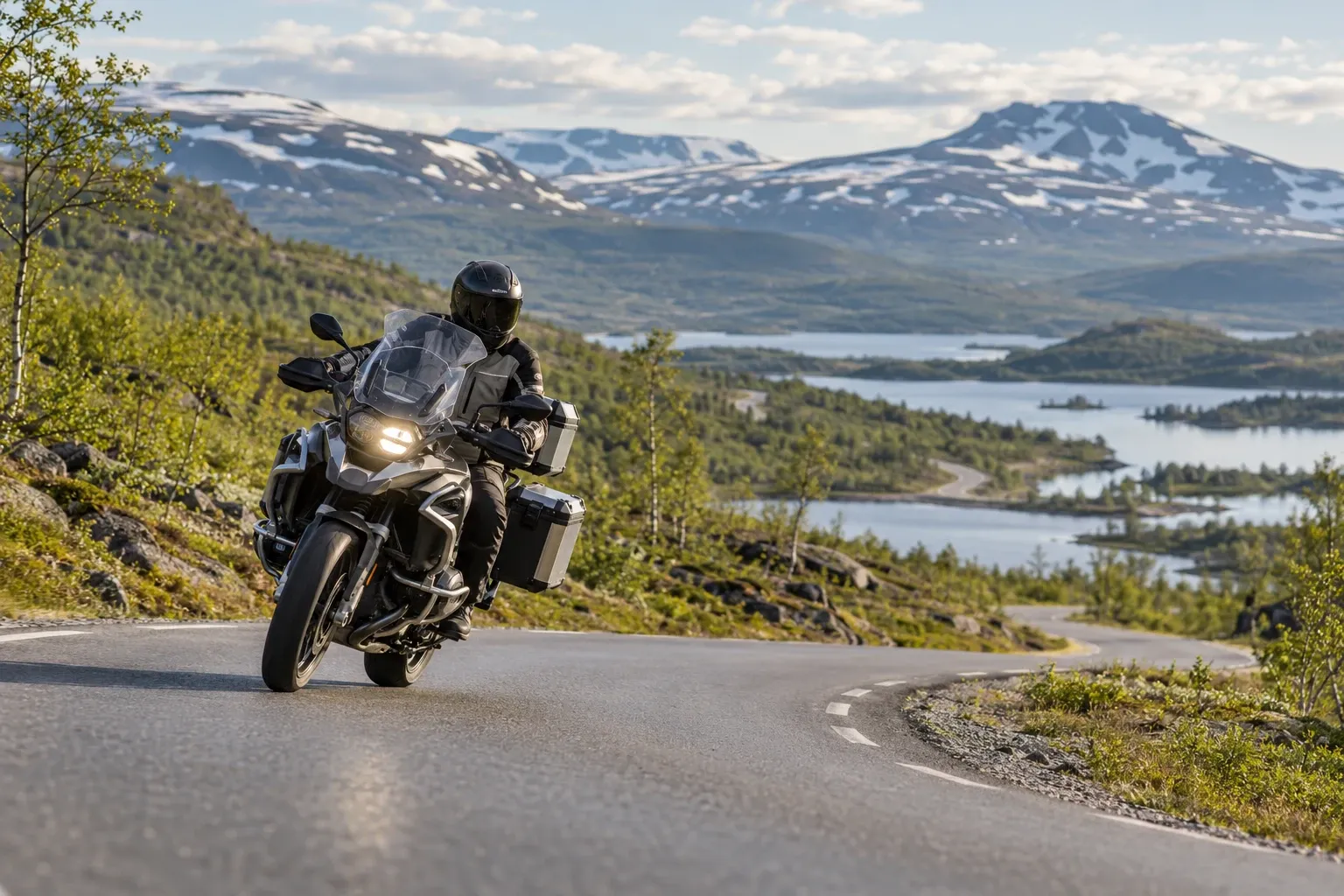
Sweden is long, quiet and cheap to ride. The legal side is a few motorcycle rules on top of the car rules. The real planning is about gravel, wildlife, fuel gaps and a season that the mountains keep short.
When you need this
You’re riding your own bike up from Germany or the Netherlands, or renting one in Sweden. You want to take a passenger, tow a small trailer, or ride the E45 north to the Arctic. Or you’re sitting in a Stockholm queue wondering whether you can filter past. This page covers what is specific to motorcycles. For the general driving rules, start with driving in Sweden.
Licence and insurance
Sweden accepts a foreign licence “according to its content”, so the category printed on it decides what you may ride. A licence from the EU or EEA works as it is, and so does any licence in English, German or French or on the UN model. Others need an IDP or a certified translation; see whether you need an IDP.
| Category | What it covers in Sweden |
|---|---|
| A1 | Light motorcycles |
| A2 | Motorcycles up to 35 kW, at most 0.2 kW/kg |
| A | Any motorcycle |
| B (Swedish) | Three- and four-wheeled motorcycles; a heavy trike needs the holder to be 21 |
A car licence on its own does not cover a two-wheeler. Some countries let car drivers ride light motorcycles at home; in Sweden that only helps if the category is actually on your licence.
Insurance follows the plate. A motorcycle registered in the EU or another listed country, including Norway, Switzerland and the UK, rides on its home insurance. Anything else needs a green card or a Swedish border insurance arranged through Tullverket, the Swedish customs service.
The motorcycle rules
All of these come from the trafikförordningen, the Road Traffic Ordinance.
- Helmets for everyone. Rider and passenger wear one. A child under seven may use other suitable head protection, and the rider must make sure any passenger under 15 is covered.
- Only the helmet is compulsory. We found no rule requiring gloves, boots or a jacket. Trafikverket, the Swedish Transport Administration, still lists protective gear among its safety measures.
- Passengers: at most one on the bike, on a passenger seat, and only if the bike is built for it. The rider must be at least 18, a rule in force since 2023 that many older guides miss.
- Dipped headlights whenever you ride. Daytime running lights alone are allowed only in good daylight. Unlike a car, a motorcycle may use both together in daylight, which is the easiest way to be seen.
- Speed limits are the car limits: 50 km/h in towns and 70 km/h elsewhere unless signs say otherwise. See Swedish speed limits.
- Trailers: at most 125 cm wide, no heavier than half the bike’s kerb weight (excluding fuel and tools), nobody riding in it, and 80 km/h maximum.
- No handheld phone. A mounted phone or helmet intercom is fine if it doesn’t distract you.
- Alcohol: 0.2 per mille. Riding at or above it is a crime, punishable by fines or up to six months in prison. Treat it as zero, the morning after included; see the drink-driving limit.
- No pavement parking. Only bicycles and light mopeds may stop on a footway or cycle path.
- No off-road riding on snow-free ground. The Off-Road Driving Act names motorcycles.
Two car rules don’t apply to you. Motorcycles have no winter tyre requirement: the 1 December–31 March rule, rewritten in 2025, still lists only cars, light trucks and light buses. And Sweden’s miljözoner (low-emission zones) cover cars, trucks and buses, not motorcycles.
Filtering and overtaking
Sweden has no rule that expressly permits or bans lane filtering. What the law does say is that overtaking happens on the left, with a safe sideways gap. On the right it is allowed only when the vehicle ahead is turning left. The right-hand exception for passing other traffic belongs to cyclists and moped riders, not motorcyclists.
So passing a slow queue on the left, with room, can be lawful overtaking. Squeezing between two lanes of stopped cars isn’t addressed either way, and police can treat risky riding as careless driving. Pages claiming filtering is “legal in Sweden” are going further than the law does.
What it costs
The good news: motorcycles are exempt from congestion tax in Stockholm and Gothenburg and from the bridge fees at Sundsvall, Motala and Skurubron. You’ll pay for ferries, the Öresund Bridge and fuel. In Stockholm you also pay to park: the city charges motorcycles the rate for the spot, in motorcycle bays or ordinary spaces.
Roads and hazards
Single-vehicle crashes kill more Swedish motorcyclists than any other kind. Transportstyrelsen, the Swedish Transport Agency, counted 28 motorcyclist deaths in 2025, down from 34 the year before. Trafikverket judged that only three in ten of the riders killed in crashes it studied had kept to the speed limit. These are the conditions that catch riders:
| Hazard | What to know |
|---|---|
| Gravel roads | Just over 20% of the state network, 18,500 km, more than half in the northern and western forest counties. Dust from oncoming cars hides the road. See gravel roads. |
| Fresh chip seal | After tankbeläggning (surface dressing), loose stones stay for one to two weeks. Trafikverket drops the limit to 50 km/h until the road is swept. Take the sign seriously: grip is close to winter levels. |
| Wildlife | Moose, deer and wild boar cross year-round, most at dawn and dusk. Hitting a listed species must be marked and reported to 112. See wildlife collisions. |
| Reindeer | Owned animals, often standing on northern roads; a collision must be reported too. See reindeer herding land. |
| Cable barriers | 10 of 27 motorcyclists killed in median-barrier crashes in 2004–2015 died in connection with a cable barrier. More on 2+1 roads. |
| Fuel gaps | In the three northernmost counties 14,200 residents live 20 km or more from the nearest station. Fill up whenever you pass one. |
Fuel type matters on older bikes. Standard 95 petrol is E10. A motorcycle not approved for E10 should always use E5, usually the 98 pump; see fuel at Swedish pumps. How to pay at the pump is covered in paying at fuel stations.
Check Trafikverket’s traffic information before a riding day. Roadworks and resurfacing show up there; see checking road conditions.
Routes and seasons
The classic long tour is the E45, Inlandsvägen (the Inland Road), Sweden’s longest road, running about 1,690 km from Gothenburg to Karesuando, much of it through the forest counties. The best-known mountain road is Vildmarksvägen (roads 1067 and 824) over the Stekenjokk plateau between Jämtland and Västerbotten. About 50 km of it got new asphalt in 2024–2025.
Vildmarksvägen is open along its whole length only from 6 June to 15 October, and closes over the bare mountain every winter. From 6 June to 15 July, stopping and parking is banned along about 5 km on the Västerbotten side, except at the Stekenjokk and Tjåkkola parking areas. The 2027 opening depends on snow, so check Trafikverket in spring.
| Period | What it means for riding |
|---|---|
| April–May | The south becomes rideable; winter grit still on many roads; gravel roads break up in the spring thaw |
| June–August | The window for the north and the mountains; resurfacing season with 50 km/h stretches |
| September | Quieter roads, more wildlife moving as the hunting season starts |
| October | Vildmarksvägen closes on 15 October; darker, wetter, leaves on bends |
| Winter | No winter tyre law for bikes, but ice ends the season; most Swedish riders lay their bikes up |
For ready-made itineraries by car that work just as well on two wheels, see the northern summer route, the west coast road trip and southern Sweden by car. Arriving by sea? The ferries from Germany carry motorcycles.
Camping: you can wild camp with a tent, but the bike stays where a vehicle may legally stand, never in the terrain. See wild camping in Sweden.
Practical information
| Item | Rule or amount |
|---|---|
| Licence | A1, A2 or A matching the bike; foreign licences valid according to their content |
| Helmet | Rider and passenger; under 7 other head protection allowed |
| Passenger | One, on a passenger seat, rider 18 or older |
| Headlights | Dipped beam always; plus daytime lights allowed in daylight |
| Alcohol limit | 0.2 per mille blood / 0.10 mg/l breath |
| Speed with trailer | 80 km/h; trailer max 125 cm wide |
| Congestion tax and bridge fees | 0 kr for motorcycles (checked 2026-10-15) |
| Stockholm parking | Rate for the spot; never on the pavement |
| Vildmarksvägen | Open 6 June–15 October (2026 season) |
| Chip-seal stretches | 50 km/h until swept, usually 1–2 weeks |
FAQ
Do I need a special licence to ride a motorcycle in Sweden?
You need the right category, not a Swedish licence. Sweden accepts foreign licences according to their content: A1 for light motorcycles, A2 for bikes up to 35 kW, and A for anything. A licence from the EU or EEA works as it is, and so does any licence in English, German or French. A car licence alone does not cover a motorcycle.
Is lane splitting legal in Sweden?
No rule expressly permits or bans it. Swedish law says overtaking happens on the left with a safe sideways gap, and only cyclists and moped riders may pass other traffic on the right. Passing a slow queue on the left can be lawful overtaking; squeezing between cars or along the right is not covered, and police can treat risky riding as careless driving.
Do motorcycles pay tolls or congestion charges in Sweden?
No. Congestion tax in Stockholm and Gothenburg applies to cars, trucks and buses, and Transportstyrelsen lists motorcycles as exempt. The same goes for the three state bridge fees at Sundsvall, Motala and Skurubron. You do pay for ferries, the Öresund Bridge and, in Stockholm, motorcycle parking.
When is the best time for a motorcycle trip in Sweden?
June to August is the safe window for a tour that includes the north. Vildmarksvägen, the best-known mountain road, is open only from 6 June to 15 October, and spring brings gravel left from winter. The south can be ridden from April or May into September. Summer also means road resurfacing, with loose stones and 50 km/h limits.
Can I carry a passenger on a motorcycle in Sweden?
Yes, if the bike is built for a passenger and you are at least 18. Only one passenger may ride on the motorcycle itself, on the passenger seat, and they must wear a helmet. A child under seven may use other suitable head protection, and the rider is responsible for any passenger under 15. Nobody may ride in a trailer.
Is protective clothing mandatory for motorcyclists in Sweden?
Only the helmet. The Road Traffic Ordinance requires a helmet for rider and passenger, and we found no rule requiring gloves, boots or a jacket. Trafikverket still lists protective equipment among its safety measures, and single-vehicle crashes kill more Swedish motorcyclists than anything else, so full gear is strongly advisable on gravel-heavy northern roads.
Can I ride my motorcycle off-road or on forest tracks in Sweden?
Not on snow-free natural ground: the Off-Road Driving Act bans it and names motorcycles. Gravel roads are another matter. Sweden’s state network alone has about 18,500 km of public gravel roads, and they are ordinary roads you may ride. A forest track, beach or meadow is terrain, and riding there is an offence.
Related guides
- Driving in Sweden — the general road rules this page builds on.
- Do you need an IDP for Sweden? — check your licence before you book the ferry.
- Wildlife collisions — exactly what to do after hitting a moose or deer.
- Driving on gravel roads — the road surface you’ll meet most in the north.
- 10 days in northern Sweden in summer — a ready route for the June–August window.
Facts verified 2026-10-15. Sources: Sveriges Riksdag (Trafikförordning 1998:1276, Körkortslag 1998:488, Lag 1951:649, Trafikförsäkringsförordning 1976:359), Transportstyrelsen, Trafikverket, Polisen, Länsstyrelsen Jämtland, Naturvårdsverket, Tillväxtverket, Stockholms stad — full register in this topic’s source file. Found something outdated? Tell us and we’ll fix it.