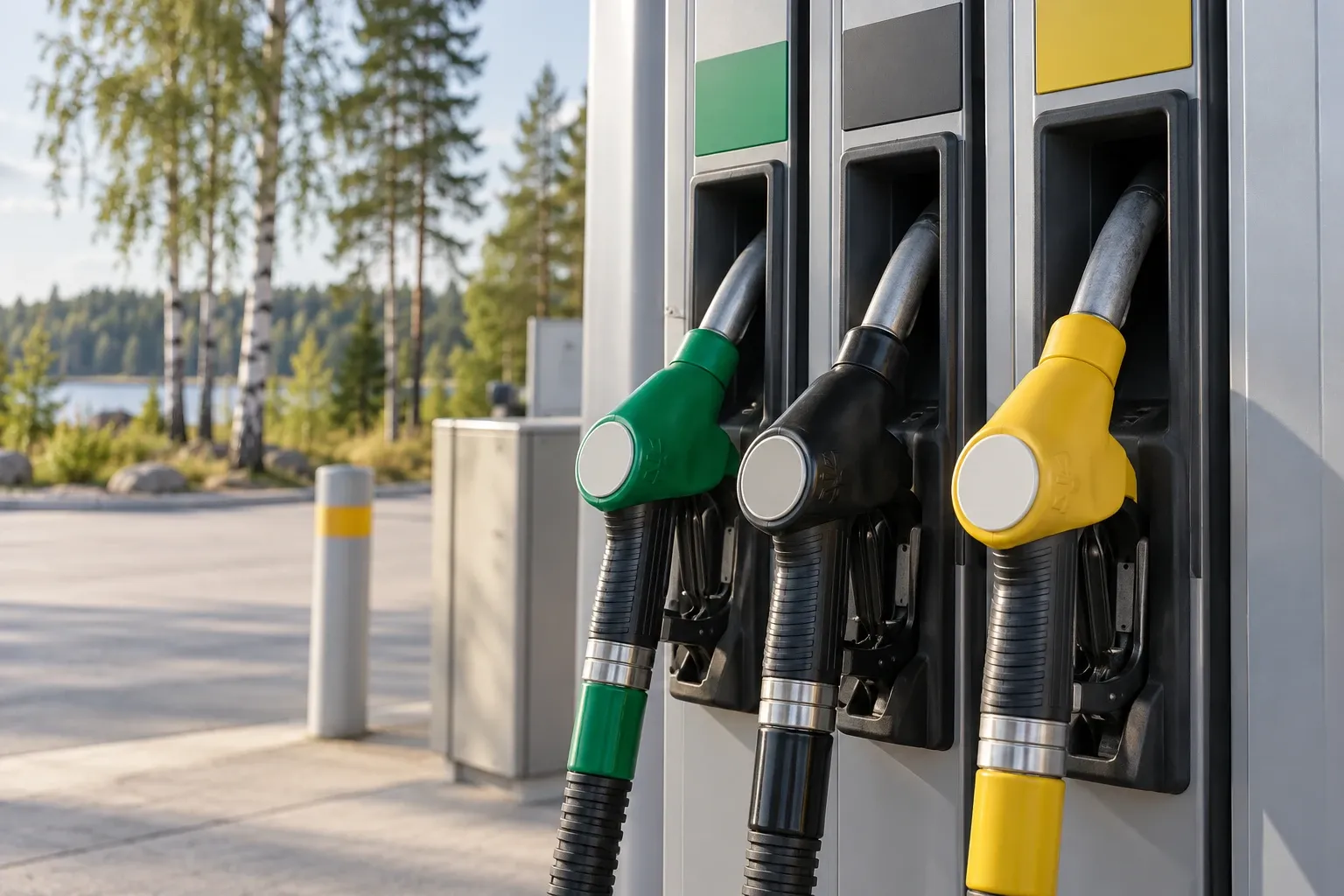
A Swedish pump island can offer five or six nozzles, labelled partly in Swedish. Your car already tells you which one to use. Here is how to read it, what each fuel actually is, and what changed in 2025 and 2026.
When you need this
You’ve picked up a rental car and the key fob says nothing about fuel. Or you’ve driven your own car up from Germany or the Netherlands and want to know whether Swedish diesel is the same. Or you’re at a pump looking at “HVO100” and wondering whether the cheaper-looking renewable option is fine for your car.
It also matters after the fact. If you’ve just filled the wrong fuel, the next two minutes decide whether this is a nuisance or an engine repair.
Start with the label in your fuel flap
Since October 2018, EU fuel labels have appeared on pumps, on nozzle handles and inside the fuel flap of newly produced cars. The shape tells you the fuel family and the code tells you the exact grade:
| Shape | Fuel family | Codes you’ll see in Sweden |
|---|---|---|
| Circle | Petrol | E10, E5, E85 |
| Square | Diesel | B7, B10, XTL |
| Diamond | Gas | CNG, LPG, H2 |
The routine is simple:
- Find the label inside the fuel flap or in the owner’s manual.
- Find the same symbol on the pump or the nozzle handle.
- If you’re unsure, stop and check before you fill.
Go by the code on the handle, not the colour of the pump. Colour conventions differ between countries; the EU code does not. For a rental, photograph the label at pick-up so you have it when you need it.
Older cars built before the labels may have no symbol. For those, the owner’s manual or the maker decides.
Petrol: 95, 98, E10 and E5
Since 1 August 2021, standard 95 petrol in Sweden has been E10, with up to 10% ethanol. Transportstyrelsen, the Swedish Transport Agency, says most petrol cars, including older ones, can use it. If you’re unsure, it advises asking a dealer for your brand. Motorcycles that are not approved for E10 should always use E5.
The numbers 95 and 98 are octane minimums, not ethanol figures. Drivkraft Sverige, the fuel industry body, notes that 98 is often sold as E5. In practice, a car that cannot take E10 uses the 98 pump. Stations do not have to sell E5, though, so read the nozzle label rather than assuming.
| Pump says | What it is | Use it if |
|---|---|---|
| 95 / E10 | Standard petrol, up to 10% ethanol | Your car is approved for E10 (most are) |
| 98 / E5 | Higher-octane petrol, usually up to 5% ethanol | Your car is not approved for E10, or the maker asks for 98 |
Diesel: B7, B10 and winter grades
Swedish diesel is Miljöklass 1 (environmental class 1): sulphur-free and meeting both the Swedish standard and the European EN 590. It can contain up to 7% FAME biodiesel, which is what the B7 label means. Every diesel vehicle can run on diesel that meets EN 590, so B7 is always the safe choice.
B10 is newer. Since 1 July 2025, diesel with up to 10% FAME has been permitted in Sweden. But not every diesel vehicle can take it. The European carmakers’ association ACEA warns of compatibility problems, especially in more modern engines. Unless your maker approves B10, stay on B7.
Cold is the other diesel issue. Diesel can start to freeze at around −7 °C, and the Nordic winter grade differs from what is sold on the continent. Winter diesel (vinterdiesel) goes on sale north of the Dalälven river from about 16 September and in the rest of Sweden about a month later. If you’re driving a diesel north in autumn or winter, fill up in Sweden early. That way you’re not running into a cold snap on a tank of continental summer diesel. Our winter driving guide covers the rest of the cold-weather kit.
HVO100 and the XTL mark
HVO100 is a renewable diesel made from hydrotreated vegetable oils or animal fats. It has its own standard, EN 15940, and does not fully meet the regular diesel standards. That’s why it needs the vehicle maker’s approval.
How to tell if your car is approved:
- Look for XTL. Newer approved cars have a square with “XTL” inside the fuel flap.
- No mark? Check Mobility Sweden’s list of approved cars, or ask a dealer; the list doesn’t include every car.
- Not approved? Use B7. Running HVO100 without the maker’s approval can put your warranty at risk.
If your car is approved, HVO100 mixes freely with ordinary diesel. You can switch back and forth without draining the tank. It’s widely available: more than 650 stations had HVO100 pumps in 2025. In the first seven months of 2026, pure HVO made up about one tenth of the diesel volume delivered in Sweden. Renewable HVO is also blended into ordinary diesel. That blended share stays within the diesel standard and needs no approval.
E85 and fordonsgas
E85 is high-blend ethanol, about 75–85% ethanol depending on the season, with less in winter to help cold starts. It’s for flex-fuel cars only and is not intended for ordinary petrol cars.
It’s a shrinking niche. Stations with E85 fell from about 1,800 in 2019 to about 1,300 in 2025. Official delivery data from SCB, Statistics Sweden, show high-blend ethanol at under half a percent of ordinary petrol volumes in January–July 2026. A flex-fuel car runs fine on 95, so plan on petrol and treat E85 as a bonus.
Fordonsgas (vehicle gas) is methane, from biogas, natural gas or a mix, for gas-powered cars. It carries the diamond CNG label. It is not LPG. LPG is called motorgas in Sweden and is sold at far fewer places. Never fill an LPG tank at a fordonsgas pump. Campers should read our guide to LPG and gas bottles in Sweden.
You may also see ED95 mentioned. It’s a 95% ethanol fuel for specially adapted diesel engines, mainly buses, sold only at certain stations and depots.
Put the wrong fuel in? Don’t turn the key
A feltankning (misfill) is fixable if you don’t start the engine.
- Don’t start the engine, and don’t even switch on the ignition.
- Push the car away from the pump with help rather than driving it.
- Call roadside assistance or a tow so a workshop can drain the tank. In a rental, use the rental company’s assistance number.
- Check your insurance or rental terms for what’s covered.
| Mistake | How bad | Why |
|---|---|---|
| Petrol in a diesel | Serious | Driving on can damage the injection pump and injectors, and with enough petrol the engine itself |
| Diesel in a petrol car | Less serious | The engine runs badly, smokes and stops; usually recovers once drained |
Costs vary with towing distance, the workshop and whether the engine was started, so we don’t publish a figure. For what to do and whom to call on the road, see roadside assistance in Sweden.
Taxes and what changed in 2026
Ordinary pumps already sell part-renewable fuel. Under the reduction obligation (reduktionsplikt), petrol and diesel suppliers must cut greenhouse emissions by 10% each year from 2025 to 2030 by blending in renewables. In petrol that means ethanol and bio-naphtha; in diesel, FAME and HVO.
Pure and high-blend biofuels such as HVO100 and E85 are exempt from fuel tax. Several industry publications still say this exemption ends in December 2026. That is out of date. On 16 April 2026 the government announced that the European Commission had extended Sweden’s approval to the end of 2032.
Petrol and diesel prices also moved in 2026 because of temporary tax cuts; the dates are in the table below. For the payment side, including card holds and unmanned pumps, see our guide to paying at Swedish fuel stations.
Practical information
| Item | Detail |
|---|---|
| Standard petrol | 95, sold as E10 since 1 August 2021 |
| Petrol for cars not approved for E10 | E5, usually the 98 pump; not every station sells it |
| Standard diesel | B7 (Miljöklass 1, EN 590), suits every diesel vehicle |
| B10 diesel | Permitted since 1 July 2025; only with maker approval |
| HVO100 | XTL label; maker approval needed; more than 650 stations (2025) |
| E85 | Flex-fuel cars only; about 1,300 stations (2025) |
| Winter diesel on sale | North of the Dalälven from about 16 September; elsewhere about a month later |
| Tax on HVO100 and E85 | Exempt; EU approval runs to the end of 2032 (checked 2026-10-14) |
| Temporary carbon-tax cut | Petrol 2.40 kr/l, diesel 2,400 kr/m³, 1 July–30 November 2026 (checked 2026-10-14) |
| Pump prices | Vary by station and day; check the price board or the pump |
FAQ
Is 95 petrol in Sweden E10?
Yes. Since 1 August 2021 the standard 95 petrol in Sweden has been E10, meaning up to 10% ethanol. Most petrol cars, including many older ones, can use it. If your car’s maker says it cannot take E10, use E5 instead, which in Swedish stations is usually the 98 pump. Stations are not required to sell E5, so check the nozzle label.
Can I put HVO100 in my diesel car?
Only if the maker approves it. Approved newer cars carry a square XTL mark inside the fuel flap; for others, check Mobility Sweden’s list or ask a dealer. HVO100 mixes freely with ordinary diesel, so an approved car can switch back and forth. Without approval, the warranty can be at risk; use the B7 nozzle, which suits every diesel.
What is the difference between B7 and B10 diesel?
B7 contains up to 7% FAME biodiesel and meets the EN 590 standard, so every diesel vehicle can use it. B10, with up to 10% FAME, has been allowed in Sweden since 1 July 2025, but not all diesel vehicles can take it, especially modern ones. Unless your maker approves B10, choose the B7 nozzle.
Can I use E85 in a normal petrol car?
No. E85 is about 75–85% ethanol and is meant for flex-fuel vehicles approved for it, not ordinary petrol cars. It is also a shrinking niche: about 1,300 stations had it in 2025, and it was under half a percent of Swedish petrol volumes in early 2026. A flex-fuel car runs fine on 95, so treat E85 as a bonus.
What should I do if I put the wrong fuel in my car?
Do not start the engine or even switch on the ignition. Ask for help to push the car away from the pump, then call roadside assistance or a tow so a workshop can drain the tank. Petrol in a diesel is the serious case; diesel in a petrol car usually recovers once drained. In a rental, call the rental company’s assistance number.
Is fordonsgas the same as LPG?
No. Fordonsgas is methane, biogas or natural gas, for gas-powered cars, with a diamond CNG label. LPG, used in some campervans and conversions, is called motorgas in Sweden and is sold at far fewer places. The two are not interchangeable, so never fill an LPG tank at a fordonsgas pump. Campers should read the LPG guide.
Related guides
- Paying at Swedish fuel stations — PINs, card holds and unmanned pumps, the other half of filling up.
- LPG and gas bottles in Sweden — where campers get LPG, and why it’s not fordonsgas.
- Winter driving in Sweden — cold starts, fuel margins and the kit to carry.
- Renting a car in Sweden — fuel policy at pick-up and return.
- Roadside assistance in Sweden — whom to call after a misfill or breakdown.
Facts verified 2026-10-14. Sources: Transportstyrelsen, Sveriges Riksdag, Regeringen, Skatteverket, SCB, Fossilfritt Sverige, Drivkraft Sverige — full register in this topic’s source file. Found something outdated? Tell us and we’ll fix it.