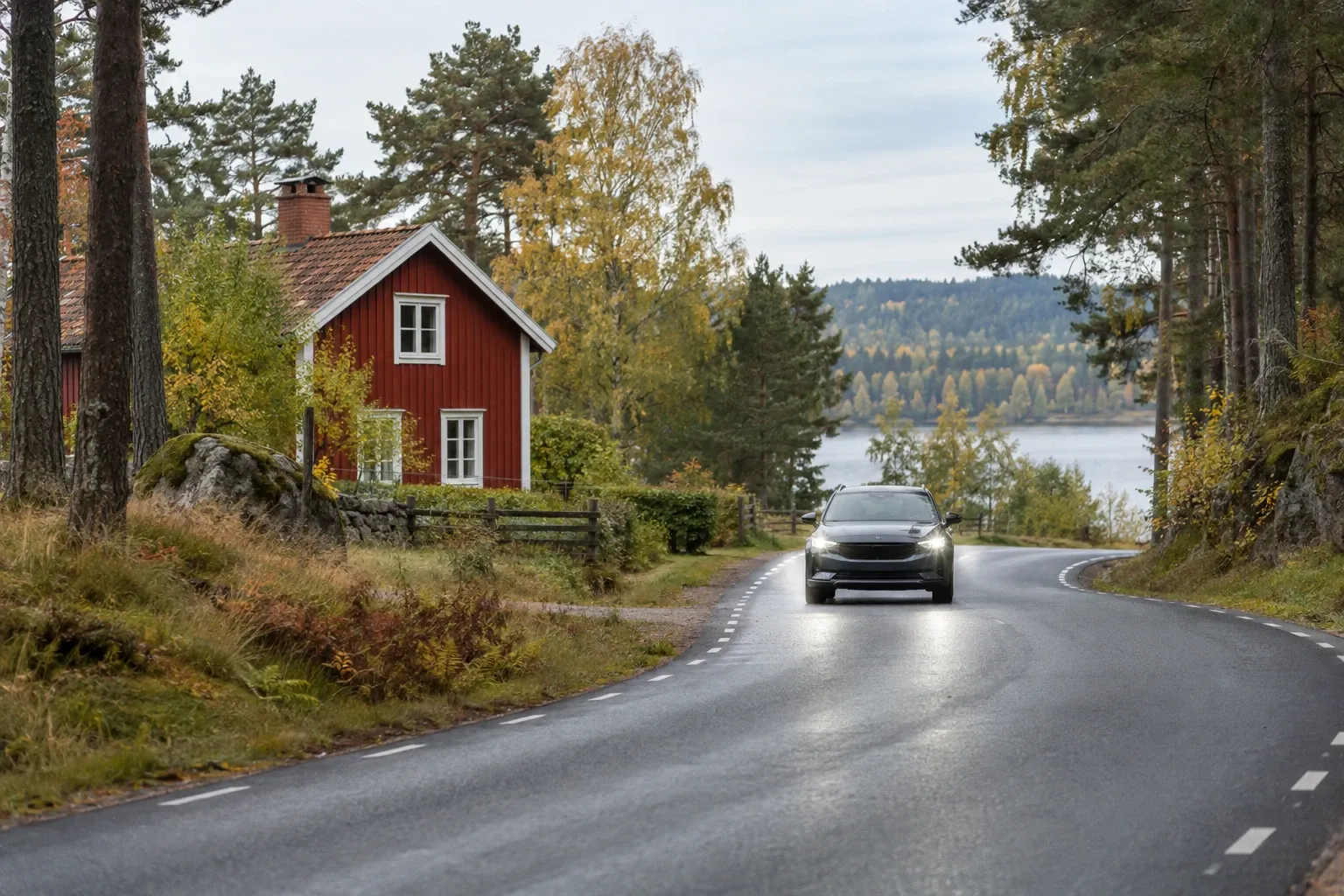
Sweden is one of Europe’s easiest countries to drive in. The roads are quiet and the drivers are patient. The rules are strict, though, and a few of them catch visitors who assume home habits will do. Here is every rule that matters, each checked against the Swedish statute itself.
When you need this
You’re picking up a rental car at Arlanda or Landvetter, or crossing the Öresund Bridge in your own car. Maybe you’re checking whether your home licence works, planning a winter trip north, or holding an invoice that arrived weeks after you got home. Or you’ve just hit a deer on a dark road and need to know what the law expects.
Your licence: most work as they are
Swedish law is generous here, and the rules come straight from the Driving Licence Act (körkortslagen):
| Your licence | Valid in Sweden? |
|---|---|
| Issued in the EU/EEA | Yes, as long as it’s valid at home |
| Non-EEA, in English, German or French | Yes, on its own |
| Non-EEA, follows the 1949 Geneva or 1968 Vienna convention model | Yes, on its own |
| Non-EEA, neither of the above (e.g. only in Arabic or Chinese script) | Only with a certified translation or an international driving permit |
| No photo on the licence | Only together with photo ID |
So a US, UK, Canadian or Australian visitor with an English-language licence needs no international driving permit, whatever older guides say. Two more rules apply to everyone. You must be 18 to drive a car on a foreign licence, even if you drive at 16 at home, and you must carry the licence whenever you drive.
Moving here rather than visiting? A non-EEA licence stops being valid once you’ve been a registered resident for more than a year, though UK and Faroese licences are exempt from that cut-off. Details are in international driving permits and foreign licences.
Headlights: on, all the time
The law requires dipped headlights (halvljus) whenever you’re driving on a road. Daytime running lights (varselljus) may replace them, but not in darkness, at dawn or dusk, or when the weather calls for dipped beam. In fog or heavy rain or snow, fog lights may be used instead.
The trap is the car that switches on its running lights automatically. On many models those leave the rear lamps dark, and in autumn and winter you’ll need dipped beam for most of the day anyway. Turn on dipped beam when you start the car and leave it on.
Who gives way: two rules visitors miss
The right-hand rule (högerregeln). Where two vehicles’ paths cross and nothing else is signed, you give way to the vehicle coming from your right. It applies in quiet residential streets and rural junctions, exactly where visitors least expect it. Signs or road type override it: joining a priority road, motorway or expressway, you give way. When you leave a car park, fuel station or private property, you give way to everyone.
Zebra crossings. At a crossing without traffic lights, you must give way to pedestrians who are on it or about to step onto it. Swedish pedestrians expect cars to stop. Slow down at every one.
Speed limits and cameras, in brief
When no sign says otherwise, the limit is 50 km/h in built-up areas and 70 km/h outside them (the bashastighet, or base speed). Motorways allow at most 110 km/h, or 120 where signed. Signs set other limits from 30 to 120 km/h, in towns and outside them — see speed limits and cameras. With a braked trailer or caravan, 80 km/h is your maximum whatever the sign says.
Fixed speed cameras are signposted: a camera-symbol sign stands before each one, and they photograph only vehicles over the limit. Limits by road type, seasonal changes and what happens to a foreign-plated car caught on camera are covered in speed limits in Sweden.
Phone, seat belts and children
You may not hold a phone while driving. Hands-free calls and a mounted phone used for navigation are allowed only if they don’t impair your driving, so set the route before you move off.
Everyone wears a seat belt. Children shorter than 135 cm need a child seat or booster cushion, either instead of the belt or together with it. More in child car seats in Sweden.
Alcohol: 0.2 per mille means none
The drink-driving (rattfylleri) limit is 0.2 per mille in the blood, or 0.10 mg per liter of breath. That’s lower than in most of Europe, and one drink can reach it. The penalty is a fine or up to six months in prison. Aggravated drink-driving carries up to two years, and courts give particular weight to a level of 1.0 per mille or more. Either way, your right to drive is revoked.
Warning: The limit includes the morning after. A late evening at a crayfish party can still leave you over 0.2 at breakfast. If you’re driving tomorrow morning, stop early tonight or don’t drink.
More in the drink-driving limit.
Winter tyres, in brief
From 1 December to 31 March, winter tyres are compulsory whenever there are winter road conditions, and the police judge conditions on the spot. On a car, studless winter tyres must carry the alpine symbol (3PMSF). All-season tyres marked only M+S don’t count. Studded tyres are legal from 1 October to 15 April, so for this season studs become legal on 1 October 2026 and the winter-tyre duty starts on 1 December 2026. Studs versus friction tyres, rentals and bringing your own car are covered in winter tires in Sweden.
Wildlife collisions: call 112, even if it ran off
If you hit a moose, deer, wild boar or another listed species, the law requires you to call 112 and mark the spot, even if the animal limped away apparently unhurt. A hazard triangle, a plastic bag or a marker strip tied at the roadside will do. Driving on without reporting it is a punishable offence.
This is not a rare event. Sweden logged about 73,300 road accidents with hoofed game in 2025, roughly 200 a day. Be most alert at dawn and dusk, and wherever warning signs or game fences appear. Step by step in wildlife collisions.
Tolls and congestion tax: no booths, just an invoice
Sweden collects road charges by camera rather than at booths, and the invoice goes to the vehicle’s owner. That includes foreign owners.
- Congestion tax (trängselskatt) in Stockholm and Gothenburg on weekdays. Foreign-registered cars are invoiced through Epass24 on Transportstyrelsen’s behalf. See congestion charges.
- State bridge fees (broavgift) on three bridges: Sundsvall (E4), Motala and Skurubron in Nacka, just east of Stockholm, which has charged since 1 October 2023. See bridge tolls and Epass24.
- The Öresund Bridge to Denmark is a separate toll, paid per crossing at the toll station, with a discount agreement if you cross often.
With a rental car, the rental company is the owner, so it pays the charge and re-bills you. Check your agreement for its handling fee.
Warning: Transportstyrelsen never demands payment by email or SMS. A text message about “unpaid congestion tax” with a payment link is a scam.
Mistakes to avoid
- Trusting automatic running lights at dusk. Use dipped beam.
- Not giving way to a car from the right at an unmarked junction.
- Driving through a zebra crossing while someone waits at the kerb.
- “One beer is fine.” At 0.2 per mille it may not be.
- Holding the phone for navigation.
- Driving on after hitting a deer that “seemed fine”.
- Ignoring a congestion invoice because the car was foreign.
Practical information
| Item | Detail |
|---|---|
| Side of the road | Right |
| Headlights | Dipped beam always; running lights only in good daylight |
| Default speed limits | 50 km/h built-up · 70 km/h elsewhere · 110 km/h motorway (120 where signed) |
| Car with braked trailer or caravan | 80 km/h maximum |
| Alcohol limit | 0.2 per mille blood / 0.10 mg/l breath |
| Phone | No handheld use |
| Child restraint | Under 135 cm |
| Winter tyres | 1 Dec–31 Mar in winter conditions; alpine symbol on cars |
| Studded tyres | 1 Oct–15 Apr |
| Wildlife collision | Call 112, mark the spot |
| Congestion tax | Stockholm, Gothenburg; current rates at Transportstyrelsen |
| State bridge fees | Sundsvall, Motala, Skurubron; current amounts at Transportstyrelsen |
| Minimum age with a foreign licence | 18 for a car |
FAQ
Can I drive in Sweden with my foreign driving licence?
Yes, in most cases. An EEA licence is valid as long as it is valid at home, and so is a non-EEA licence. The latter needs a certified translation or an international driving permit only if it follows neither UN convention model and isn’t written in English, German or French. A licence without a photo needs photo ID alongside it. You must be at least 18 to drive a car.
Do I need an international driving permit in Sweden?
Usually not. Swedish law requires one, or a certified translation, only when your licence follows neither the 1949 Geneva nor the 1968 Vienna convention model and is not in English, German or French. US, UK, Canadian and Australian licences in English are valid on their own. If your licence is in another script, bring an IDP or an approved translation.
Do you have to drive with headlights on in Sweden?
Yes, whenever the car is on the road. Dipped beam is the rule, and daytime running lights may replace it only in daylight with good visibility. From dusk until dawn, and in rain, snow or fog, dipped beam is required. Many cars’ running lights leave the rear lamps dark, so the simplest habit is dipped beam at all times.
What is the alcohol limit for drivers in Sweden?
0.2 per mille in the blood, or 0.10 mg per liter of breath. That is lower than in most of Europe, and a single drink can put you over it. Penalties run from fines to six months in prison, and up to two years for aggravated cases, where courts give weight to levels of 1.0 per mille or more. Your right to drive is revoked.
Can I use my phone while driving in Sweden?
Not in your hand. Swedish law forbids holding a mobile phone or other communication device while driving. Hands-free calls and a mounted phone used for navigation are allowed, but only if they do not impair your driving. Set the route and mount the phone before you move off.
What should I do if I hit a moose or deer in Sweden?
Call 112 and mark the spot, with a hazard triangle, a plastic bag or a marker strip, so the animal can be found. The duty applies to moose, deer, wild boar and the other listed species, even if the animal ran off apparently unhurt. Driving on without reporting it is a punishable offence. It’s common: about 200 such accidents happen a day.
Are there toll roads in Sweden?
There are almost no toll roads. The state charges a small fee on three bridges (Sundsvall, Motala and Skurubron near Stockholm), and Stockholm and Gothenburg charge congestion tax. All of these are recorded by camera and invoiced to the vehicle owner, including foreign owners. The Öresund Bridge to Denmark is a separate toll paid per crossing.
Related guides
- Winter tires in Sweden: the full winter-tyre rulebook, with studs, symbols and rentals
- Speed limits in Sweden: limits by road type, cameras, and fines for foreign cars
- Renting a car in Sweden: what to check at the desk before you drive off
- Wildlife collisions: what to do, step by step, after hitting an animal
- Getting around Sweden: when a car beats the train, and when it doesn’t
Facts verified 2026-09-23. Sources: Sveriges Riksdag (Trafikförordningen, the Driving Licence Act, the Traffic Offences Act), Transportstyrelsen, Trafikverket, Nationella viltolycksrådet, Naturvårdsverket, Øresundsbron — full register in this topic’s source file. Charge amounts change and are never published here. Found something outdated? Tell us and we’ll fix it.