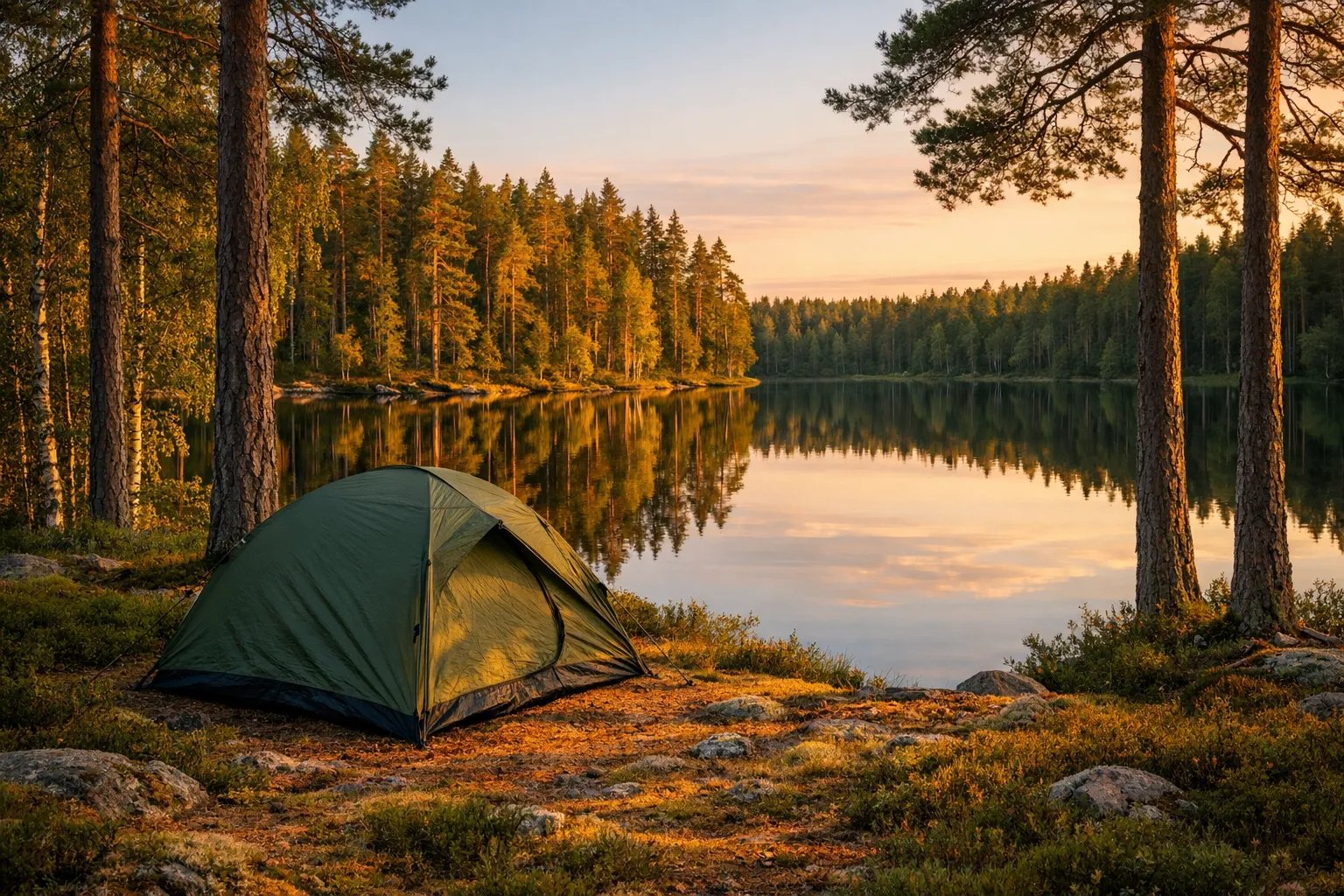
Sweden is one of the very few countries where camping in the wild is a general right rather than an exception. This guide explains what that right actually covers — the law, the official guidance, and the customs — so you can pitch anywhere with confidence and without becoming the reason a beach gets a “no camping” sign.
When you need this
You’re standing at a perfect lakeside at 20:00 wondering if you can legally stay. You’re planning a hike or kayak trip and want to skip campsites entirely. A landowner is walking toward your tent. Or you’re in a campervan and someone told you allemansrätten covers you too (it doesn’t — more below). This page settles all four situations.
The rules — what allemansrätten actually says
Allemansrätten — the right of public access — is anchored in Sweden’s constitution, but it isn’t a detailed law with paragraphs about tents. It’s the freedom left between laws that protect homes, nature and farmland, held together by one statutory duty in the Environmental Code: do not disturb, do not destroy (inte störa – inte förstöra).
What that means for a tent, according to the Swedish Environmental Protection Agency (Naturvårdsverket):
- You may camp for a night or two on land that isn’t farmed, isn’t someone’s plot, and isn’t otherwise protected — without asking anyone. The “night or two” figure is official guidance, not a statutory number; stay longer and you need the landowner’s permission.
- Small groups only. Two or three tents is within the right. A bigger group — or an organized event — needs the landowner’s consent.
- Keep your distance from homes. The law protects a privacy zone (hemfridszon) around every dwelling. No law defines it in meters — the working standard is out of sight and earshot. In open terrain, that’s much farther than in forest.
- Farmland is off-limits, always. Growing crops, planted forest and pasture with animals are categorically outside the camping right, however “natural” they look.
- Leave no trace. Littering in Swedish nature is a criminal offence, and a camp that damages ground or vegetation breaks the do-not-destroy duty.
Warning: The often-quoted rule that you must camp “70 meters from houses” appears in no Swedish law or official guidance. It’s a blog myth. Courts judge by the home’s privacy zone — sight, sound and reasonableness. If you can see into their windows, you’re far too close.
How to choose a legal wild camp, step by step
- Check protected status first. National parks and nature reserves have their own binding regulations — many restrict camping to designated sites or ban it. Check the area in the Naturkartan app or on the county board’s (Länsstyrelsen) pages before you commit.
- Check the fire situation the same day if you plan any flame — see the fire section below.
- Pick legal ground: out of sight and earshot of dwellings; never on plots, crops, planted forest or pasture.
- Pick durable ground: pine heath, rock-slab margins, dry meadow edges — not fragile wetland. Pitch late, keep the camp small.
- Handle fire correctly — existing ring, never on rock, stove by preference.
- Manage waste: everything you carried in leaves with you; bury toilet waste well away from water.
- Move on by the second morning. That’s the whole deal Sweden offers you: one or two nights, invisibly.
Where wild camping is NOT allowed
- National parks and nature reserves — each has its own legally binding rules (föreskrifter). Many mountain parks allow camping only in designated zones; some reserves ban it entirely. This is the first thing to check, every time.
- The privacy zone around any home — trespassing on domestic peace is an offence, not a misunderstanding.
- Farmland — crops, planted forest, grazing pasture.
- Municipal no-camping zones — cities and towns ban camping in parks and on beaches through local ordinances. Look for signs (tältning förbjuden).
- Bird and seal protection areas — marked on sea charts and signs, closed to ALL access (including landing a kayak) during nesting seasons, roughly spring to late summer depending on the area.
Campfires and fire bans
Open fires are part of Swedish camping culture — and the fastest way to lose it is to get them wrong.
When there’s no ban: you may make a small fire with care. Use an existing fire ring on gravel or bare soil, burn only fallen wood, and extinguish with water until everything is cold to the touch. Never light a fire on or beside bare rock — the heat cracks the granite permanently, which counts as damage regardless of any ban.
When there’s a fire ban (eldningsförbud): everything changes. A standard ban forbids open fires and solid-fuel barbecues everywhere outside private gardens — including informal fire rings; only purpose-built fire places with non-combustible edging may stay open under an ordinary ban. A stringent ban (skärpt eldningsförbud) also closes designated barbecue spots. Gas and liquid-fuel camping stoves stay legal under both tiers of the national model, if placed where they cannot ignite the ground — read the local decision (see camping stoves and fire bans).
Bans are issued by county boards and municipalities, appear overnight in dry spells, and violations are fined. Check the Brandrisk Ute app (from the civil-protection agency MSB) or your county’s website the same day you plan a fire. Ban season runs roughly May to September. Full details: what a Swedish fire ban means and campfire rules in Sweden.
Campervans and cars: the rule most visitors get wrong
Allemansrätten covers travel on foot, by bike, on skis, in a kayak — never with a motor. Sweden’s Off-Road Driving Act (terrängkörningslagen) bans driving any motor vehicle on snow-free natural ground: meadows, beaches, forest clearings, heaths. That includes campervans, 4WDs, mopeds and even e-bikes classed as motor vehicles.
So the tent may go where the vehicle cannot. Sleeping in a vehicle is legal only where the vehicle is legally parked — roads, rest areas, and many public car parks, commonly for up to 24 hours. If your bed has wheels, read sleeping in your car in Sweden and wild camping with a motorhome — the rules are entirely different from tent rules, and “but allemansrätten!” has never once worked on a Swedish parking officer.
Mistakes to avoid
- Trusting the 70-meter myth instead of the sight-and-earshot standard.
- Assuming the campervan counts as a tent. It doesn’t, anywhere, ever.
- Skipping the reserve check — “it’s just one night” doesn’t move rangers, who can and do fine visitors.
- Building a new fire ring on virgin ground or rock when an established one exists.
- Overstaying — a week at the perfect spot puts you outside the right and inside the landowner’s patience.
- Camping on pasture or crops because it looks like open nature.
Good to know
- Naturvårdsverket publishes allemansrätten guides in English and German — download them before the trip and keep them offline.
- The friction-free formula locals themselves use: arrive after 19:00, leave by 09:00, keep the camp small and silent.
- If a landowner approaches, greet them, explain you’re staying one night under allemansrätten, and offer to move. Nearly every such conversation ends in a wave — the offer itself is what defuses it.
- The real threats to your night are biological, not legal: ticks — densest in the south, but reported from every Swedish municipality — mosquitoes in July, worst not in Lapland but in the central lake belt, and cold snaps in the fjäll. Late May and September are the sweet spots: empty pitches, few bans, few bugs.
- In reindeer-herding country (roughly the northern half), give herds a wide berth — especially in spring calving season — and keep dogs leashed year-round there. Everywhere in Sweden, dogs must be kept from running loose in nature from March 1 to August 20 by law.
- Water: fill from fast-flowing streams high in the terrain, or ask at a house — details in refilling water outdoors.
- The open three-walled trail shelters (vindskydd) are first-come, shared, one-night stops — free to use, impossible to reserve, and not a place to pitch your tent inside. Hammocks follow the same land rules as tents; use wide straps so you don’t damage bark.
- Camping with kids? Designated camp/fire sites and shelters with a torrdass nearby give you the same nature with fewer logistics — and Swedish campsites are the zero-friction fallback.
- If you get it wrong anyway: in the normal case someone asks you to move — do it, and it ends there. Fines attach to the specific offences (fire bans, littering, protected areas, off-road driving, camping in a home’s privacy zone), not to an honest misjudged pitch.
Practical information
| Item | Cost |
|---|---|
| Wild camping under allemansrätten | 0 kr — free by right |
| Landowner permission for longer stays or groups | Free — it’s a conversation, not a fee |
| Fire-ban violation | Fine, set case by case — plus liability if a fire spreads |
| Littering in nature | Criminal offence; fines |
| Serviced campsite alternative | Varies by region and season — see Swedish campsites |
Season notes: fire-ban season is roughly May–September; the statutory dog leash-control period is March 1 – August 20; bird-protection areas close from spring to late summer; the moose hunt opens 1 September in the north and 8 October elsewhere — wear visible colors near hunting terrain.
FAQ
Can you camp anywhere in Sweden?
Almost — but not literally anywhere. Allemansrätten lets you pitch a tent for a night or two on most natural land without asking anyone. The hard exceptions: the privacy zone around homes, farmland and pasture, national parks and nature reserves with their own regulations, and spots municipalities have signed off-limits. Clear the protected-area check and you’re legal nearly everywhere else.
How long can you wild camp in one spot?
“A night or two” (ett par dygn) — that duration is Naturvårdsverket’s guidance rather than a number written in statute. Staying longer requires the landowner’s permission. In practice one night is always uncontroversial, two is fine, a week is not. Serial one-night hops around the same bay are technically new camps but exactly the behavior that gets areas signed off-limits.
How far from a house do you have to camp?
No Swedish law states a distance — the widely quoted “70 meters” is a blog myth. The legal line is the home’s hemfridszon, the privacy zone where residents may not be disturbed; camping inside it is an offence. The working standard: out of sight and earshot. In open terrain that means considerably farther than in dense forest.
Can I sleep in my car or campervan in the forest?
Not under allemansrätten — it never covers motor vehicles. The Off-Road Driving Act bans driving on snow-free natural ground, so the meadow or forest clearing is off-limits to your van even for one night. Vehicle sleeping is legal where the vehicle is legally parked: roads, rest areas and many public car parks — time limits vary, so check the signs. See our car-sleeping and motorhome guides.
Can I make a campfire while wild camping?
Yes — with care, and only when no fire ban applies. Use an existing ring on gravel or bare soil, keep it small, extinguish with water until cold. Never light a fire on or beside bare rock: the heat cracks it permanently. During an eldningsförbud, open fires and solid-fuel barbecues are forbidden; stringent bans close designated barbecue spots too. Check the Brandrisk Ute app the same day.
Is wild camping in Sweden safe?
By international standards, very. Bears avoid people, the only venomous snake is the huggorm (adder) — call 112 at once after any bite, especially a child’s — and theft at remote pitches is rare. The real risks are mundane: mosquitoes in the northern summer, ticks — densest in the south, but reported from every Swedish municipality, so check yourself wherever you pitch (TBE and Lyme — see our tick guide) — cold snaps in the mountains, and fire-ban mistakes. Prepare for those and Sweden is about as benign as wild camping gets.
What do I do about toilets in the wild?
Bury human waste in a small hole well away from any water, and pack out paper and everything else — visible waste is littering, which is an offence, and the fastest way to turn locals against campers. Popular trails and archipelago islands often have simple outhouses (torrdass); use them where they exist.
Related guides
- Allemansrätten: Sweden’s right of public access — the full right, beyond camping
- Campfire rules in Sweden — the #1 companion read before you strike a match
- Sleeping in your car in Sweden — the wheels version of this question
- Wild camping with a motorhome — what’s actually allowed for vans
- Swedish campsites — when you want a shower and a sauna instead
Facts verified 2026-07-25. Sources: official guidance from Naturvårdsverket (Swedish EPA), Krisinformation.se/MSB, Länsstyrelsen and Swedish statute texts — full register in this topic’s source file. Found something outdated? Tell us and we’ll fix it.