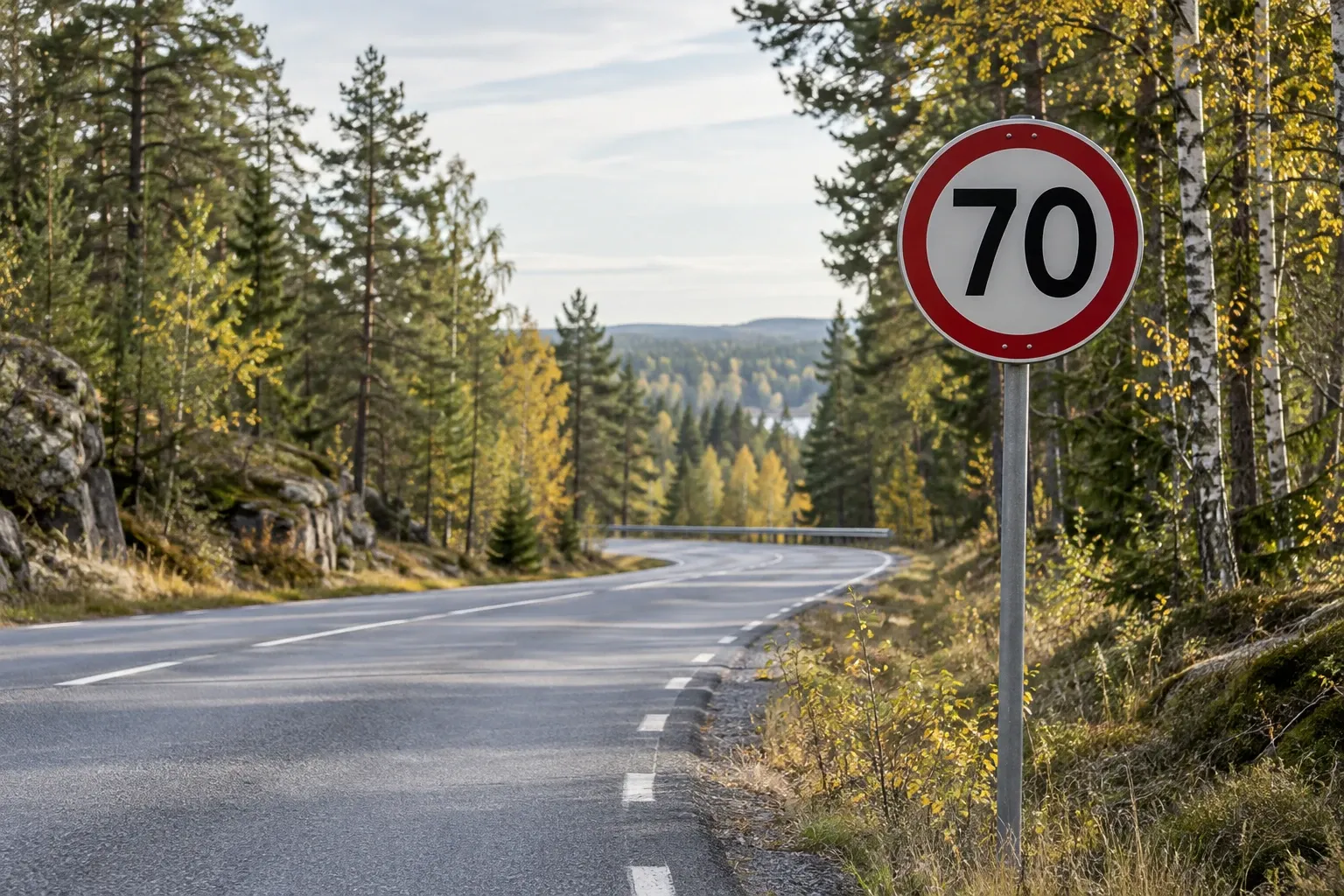
Sweden’s speed rules are a short default plus a lot of signs. The defaults, the towing and motorhome limits, and the fine table below are read from the Swedish ordinances and the prosecutor’s fine catalogue, not copied from other guides.
When you need this
You’ve just picked up a rental car and there’s no sign in sight. Or you’re towing a caravan off the ferry at Trelleborg, or driving a motorhome over 3.5 tonnes and a forum told you it’s limited to 80. Maybe a grey box flashed as you passed, or a letter from the Swedish police has arrived at home. This page covers each of those.
The default limits
With no sign, the trafikförordningen (Road Traffic Ordinance) decides:
| Where | Default limit | Who can change it |
|---|---|---|
| Built-up area (tättbebyggt område) | 50 km/h | The municipality, down to 30 or 40, or other limits by local regulation |
| Outside built-up areas | 70 km/h, the bashastighet (base speed) | Trafikverket, to 80, 90, 100 or 110 |
| Motorway | 110 km/h | Trafikverket, to 120 |
Limits come in ten steps from 30 to 120 km/h, so you will also see 60 on some roads. Trafikverket is still reviewing state roads, raising some to 100 and lowering others to 80, so a road you drove a few years ago may have a new limit. Trafikverket’s speed-limit map shows the posted limit for every state road.
Reading the signs
A speed sign (hastighetsbegränsning, sign C31) applies until the next speed sign. It doesn’t have to be repeated after a junction if the limit stays the same. When a speed sign stands next to the town-entry sign for a tättbebyggt område (sign E5), it covers the whole built-up area unless another sign says otherwise. So the “40” you passed on the way into a small town still applies three streets later.
Electronic signs come in two kinds, and they look alike:
- With a red ring: a binding limit, exactly like a metal sign. Trafikverket lowers these for slippery roads, queues or crossing traffic.
- Without a red ring: a rekommenderad högsta hastighet, meaning an advisory maximum. It’s always below the legal limit.
There is no nationwide winter speed limit in Sweden. The ordinance sets no seasonal speed, and the posted limit applies all year unless a variable sign changes it. Check the ring before you treat a winter number as optional. For driving on ice itself, see winter driving in Sweden.
Towing, motorhomes and other vehicles
Some vehicles have their own ceiling, whatever the road allows. A lower posted limit always wins, and so does your vehicle’s own limit where it is lower than the road’s.
| Vehicle | Maximum |
|---|---|
| Car or motorhome towing a trailer with brakes, a caravan with an overrun brake (up to 3.5 t), or a light trailer (max. half the car’s kerb weight, and no more than 750 kg) | 80 km/h |
| Unbraked trailer heavier than that, no heavier than the towing vehicle | 40 km/h |
| Unbraked trailer heavier than the towing vehicle | 30 km/h |
| Motorhome registered as a car (personbil klass II), any weight | Posted limits, as a car |
| Motorhome registered as a truck over 3.5 t | 80 km/h; 90 on motorways and expressways |
| Heavy bus | 90 km/h; 100 if every passenger over three has a belted seat |
| Moped class I | 45 km/h |
The 80 km/h towing limit applies on motorways too. A car with a caravan at 100 on a 110 motorway is 20 km/h over, and the fine is calculated from 80, not from the road’s limit.
Heavy motorhomes are the common misunderstanding. Swedish law treats a motorhome with fixed seats, beds, cooking equipment and a table as a car, personbil klass II, and sets no weight cut-off. Transportstyrelsen says plainly that there are no special speed limits for these. Only a motorhome registered as a truck gets the 80/90 truck limits. Registration decides, not size, so check your registration document rather than your home country’s rule.
Coming up: a new version of the vehicle-limit table takes effect on 1 December 2026. It changes rules for recovery vehicles and heavy combinations. The 80 km/h limit for a car or motorhome with a trailer does not change.
Speed cameras
Sweden has about 2,735 fixed traffic-safety cameras (trafiksäkerhetskameror) on state roads, plus 25 mobile units run by the police. Most sit on 70–90 km/h roads.
- They are signposted. Sign E24 (automatisk trafikövervakning) marks monitored stretches, and a camera-symbol sign stands before each fixed camera.
- They measure spot speed by radar and photograph only vehicles over the limit, with a flash.
- They photograph the driver, not just the plate, and the images go directly to the police.
- Average-speed cameras: Trafikverket describes only spot-speed cameras. In 2026 it began a pilot with cameras on overhead gantries at three sites, one on road 27/153 at Kärda.
The police then compare the driver’s photo with passport and licence photos. If it matches, a notice with the photo and measurements goes to the driver. If not, the owner is asked who was driving.
Fines and what happens next
Speeding normally ends with an ordningsbot, a fixed fine from the prosecutor’s national catalogue. The amount depends on how far over you were and whether the limit was 50 km/h or lower (see the table under Practical information). It starts at 1,500 kr and tops out at 4,000 kr.
If you sign the ordningsbot, it becomes final, like a court judgment. After that only a court can set it aside. Pay within three months. Polisen publishes an IBAN for payment from abroad. An unpaid fine goes to Kronofogden, the enforcement authority, with a 600 kr fee added.
Serious speeding leaves the catalogue:
- It can be prosecuted as reckless driving (vårdslöshet i trafik), with day-fines set by your income. A gross case carries up to two years in prison.
- Speeding that isn’t minor is grounds to revoke a licence. Police can take it at the roadside when revocation is likely. A foreign licence is tested by the same rules, which can end your right to drive in Sweden.
Foreign cars and rentals
“They can’t chase a foreign car” is out of date. Under the EU cross-border directive, in Swedish law in its current form since 1 January 2016, Sweden can look up the owner of an EU-registered vehicle in its home register and send an information letter. In practice, because the driver is liable, the police camera unit said in 2025 it cannot investigate foreign drivers, so camera photos of foreign-registered cars are rarely pursued. Speeding is one of the covered offences.
The EU tightened this in 2024. Directive 2024/3237 lets the country where the offence happened ask your home country to enforce an unpaid final fine over EUR 70, and member states must write it into national law by 20 July 2027.
With a rental car, the rental company is the owner. The police ask it who was driving, and because the camera photographs the driver, the case follows you.
Mistakes to avoid
- Assuming 50 or 90 on an unsigned rural road. Outside town with no sign, it’s 70.
- Driving a caravan at the road’s limit. 80 is your ceiling, motorways included.
- Applying a home-country rule to a heavy motorhome. Registered as a car, it follows car limits in Sweden.
- Braking only at the camera box. The limit applies along the whole stretch.
- Trusting third-party fine lists. Some misstate the amounts. The catalogue was replaced in February 2025, and its traffic annex was amended again later in 2025.
Practical information
| Item | Detail |
|---|---|
| Built-up area, no sign | 50 km/h |
| Outside built-up areas, no sign | 70 km/h |
| Motorway, no sign | 110 km/h (120 where signed) |
| Towing a braked trailer, caravan or light trailer | 80 km/h maximum |
| Fixed cameras | About 2,735, all signposted; 25 mobile units |
| Payment deadline, signed ordningsbot | 3 months |
Speeding fines (ordningsbot):
| Over the limit | Limit 50 km/h or lower | Limit above 50 km/h |
|---|---|---|
| 1–10 km/h | 2,000 kr | 1,500 kr |
| 11–15 km/h | 2,400 kr | 2,000 kr |
| 16–20 km/h | 2,800 kr | 2,400 kr |
| 21–25 km/h | 3,200 kr | 2,800 kr |
| 26–30 km/h | 3,600 kr | 3,200 kr |
| 31–35 km/h | 4,000 kr | 3,600 kr |
| 36 km/h or more | 4,000 kr | 4,000 kr |
FAQ
What is the speed limit in Sweden if there is no sign?
50 km/h inside a built-up area and 70 km/h outside one. The 70 is called the base speed, or bashastighet. Motorways default to 110 km/h unless signed 120. Everything else, from 30 in towns to 100 on good rural roads, is set by signs. A limit posted with the town-entry sign covers the whole town until another sign says otherwise.
How fast can I drive with a caravan in Sweden?
80 km/h at most, even on a 110 or 120 km/h motorway. The limit applies to any car or motorhome towing a trailer with brakes, or a light trailer of at most 750 kg. A heavier unbraked trailer brings the ceiling down to 40 or 30 km/h. If you are caught speeding, the fine is calculated from 80, not from the road’s limit.
Are speed cameras in Sweden signposted?
Yes. A camera-symbol sign stands before every fixed camera, and there are about 2,735 of them on state roads. They measure spot speed by radar and photograph only speeding vehicles, driver included. The police also run 25 mobile camera units. Trafikverket describes only spot-speed cameras, not average-speed ones, but in 2026 Trafikverket began a gantry-camera pilot at three sites.
How much is a speeding fine in Sweden?
Between 1,500 and 4,000 kr under the prosecutor’s fine catalogue in force since February 2025. 1–10 km/h over costs 2,000 kr where the limit is 50 or lower, and 1,500 kr on faster roads. The fine rises in 5 km/h steps to 4,000 kr. Serious cases go to court instead, with income-based day-fines, and can cost you your licence.
Will a Swedish speeding fine follow me home?
It can. Under EU rules Sweden can look up the owner of an EU-registered car in its home register and send an information letter. In practice, because the driver is liable, the police camera unit said in 2025 it cannot investigate foreign drivers, so camera photos of foreign-registered cars are rarely pursued. Camera cases are addressed to the identified driver, so rental companies are asked who drove. A 2024 EU amendment adds cross-border enforcement of unpaid fines over EUR 70, due in national law by July 2027.
Is a heavy motorhome limited to 80 km/h in Sweden?
Not if it is registered as a car (personbil klass II). Sweden has no special limit for these, whatever the weight, so posted limits apply as for any car. The heavy-truck limits of 80, or 90 on motorways, apply only to a motorhome registered as a truck. Towing a trailer brings the limit to 80 in any case.
Related guides
- Driving in Sweden: headlights, alcohol, licences and the other rules of the road
- Winter driving in Sweden: speed and stopping distance on snow and ice
- Renting a car in Sweden: what the contract says about fines and fees
- Motorhome rules in Sweden: licences, weights and where you can stop
- Bringing a caravan to Sweden: towing rules from the ferry onward
Facts verified 2026-09-23. Sources: Sveriges Riksdag (Trafikförordningen, Vägmärkesförordningen, the Road Traffic Definitions Act, the Driving Licence Act, the Traffic Offences Act), Transportstyrelsen, Trafikverket, Polisen, Åklagarmyndigheten, EUR-Lex — full register in this topic’s source file. Found something outdated? Tell us and we’ll fix it.