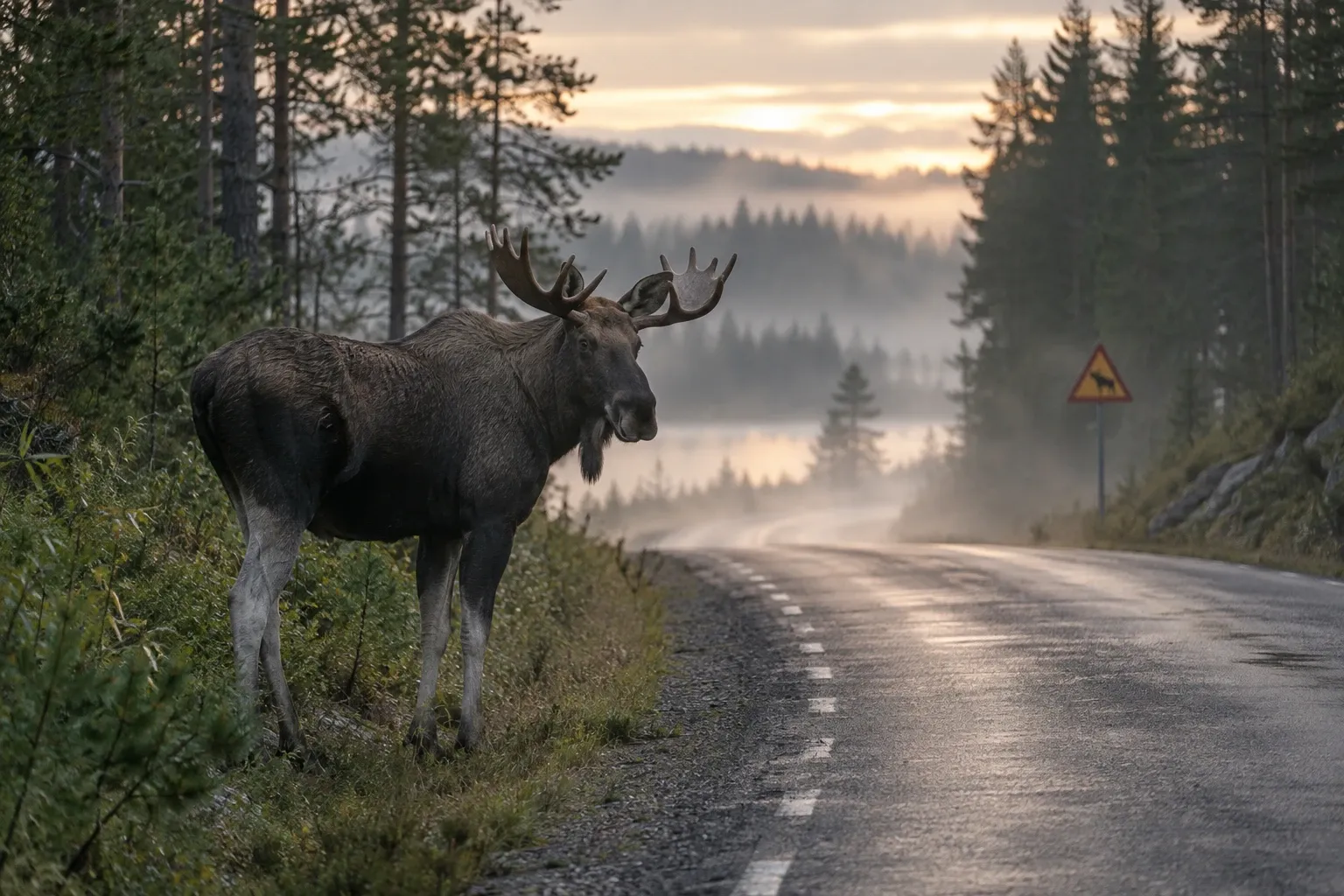
Sweden reported about 73,300 road accidents with hoofed game in 2025, roughly 200 a day. If one of them is yours, the law gives you two jobs: mark the spot and call 112. Here is exactly how, and what happens next.
When you need this
You have just felt the thump, or seen something bolt across the verge, and you are standing beside the car wondering what now. Or you are planning a road trip through forest country and want the drill in your head before dusk. Or someone in the car is saying “it ran off, so we don’t need to call anyone.” They are wrong, and this page explains why.
What to do, step by step
The order matters: your safety and other drivers’ first, then the animal.
- Stop safely and put your hazard lights on. Set out the warning triangle where following traffic needs warning.
- Check the people. If anyone is hurt, say so on the same 112 call.
- Stay away from the animal. Do not approach it, follow it into the forest or try to kill it yourself unless you are trained to. A wounded moose or boar is dangerous.
- Mark the spot on the side of the road where the animal disappeared, even if it is lying dead.
- Call 112 and report the collision to the police. Give your location as precisely as you can (GPS coordinates, or road number and landmarks), the species and the direction it went.
- Move a dead animal off the carriageway only if it is safe to do so.
- Keep your phone on. The police or the tracker may call back for directions.
- Leave the carcass where it is, and tell your insurer or rental company, with the police report details.
Which animals you must report
The duty comes from jaktförordningen, the Hunting Ordinance, section 40. If your motor vehicle collides with any of these species, you must mark the site and notify the police as soon as possible (snarast möjligt):
| Must be reported | Not covered |
|---|---|
| Moose, red deer, fallow deer, roe deer | Hare |
| Wild boar, mouflon | Badger |
| Bear, wolf, lynx, wolverine | Fox |
| Otter, eagle |
Two of those surprise most people. Otter and eagle are on the list, and most English-language guides leave them out. The duty also applies whether the animal died, was injured or ran off looking fine. The ordinance is triggered by the collision, not by the outcome.
Failing to report, deliberately or through gross negligence, is an offence under the Hunting Act (jaktlagen) and is punished with day-fines (dagsböter). A genuine near miss with no contact triggers no duty, because the rule applies when the animal “has been involved in a collision”. If you are not sure whether you touched it, report it anyway.
Marking the spot
The marker tells the tracker where the animal left the road, which is where the search starts. So it goes on the side where the animal disappeared, not wherever you happened to stop.
- Best: a viltolycksremsa (wildlife-accident marker strip), handed out at vehicle inspection stations and police stations.
- Good enough: a plastic bag, or anything visible, tied at the roadside. Keep a couple in the glovebox.
- Boar, bear, wolf or lynx: place the marker about 100 meters from the site. The distance is for your safety, not the animal’s.
Mark the place even when the animal is dead on the road. The police still need to find it.
Reindeer: not wildlife, still reported
Drive north and you may meet reindeer on the road. They are not on the hunting-law list, because they are not wild. Reindeer are domestic animals, owned by individual reindeer owners and herded through the Sami herding communities (samebyar) of Sweden’s northern counties.
That does not mean you can drive on. Swedish traffic rules require anyone involved in a traffic accident that damages someone’s property to notify the owner or the police as soon as possible when the owner is not there. A reindeer is someone’s property. The police and the national wildlife-accident council tell drivers the same thing: call 112 for a reindeer too, and mark the site the same way.
What happens after you call 112
The police register the collision and call out a trained tracker (eftersöksjägare) through the national wildlife-accident network, the Nationella viltolycksrådet. The tracker searches from your marker, and puts the animal down if it is injured.
You do not pay for this. Tracking costs are covered from the state wildlife fund (viltvårdsfonden), not billed to the driver. What you owe is a precise location and a phone that answers.
The carcass and your insurance
The animal is not yours. Game belongs to whoever holds the hunting rights on that land. Bear, wolf, wolverine, lynx, otter and eagles belong to the state. Loading a dead roe deer into the boot counts as theft, so leave it where it lies.
Insurance runs through the police report. Damage from hitting an animal is normally paid under vehicle damage cover (vagnskada), which comes with full cover and some part-cover policies. Terms and any excess vary by insurer; Folksam, for example, states no excess for animal collisions and requires the police report details before paying. The 112 call at the roadside is therefore also the first step of your claim.
Driving a rental car? Tell the rental company as well. Their terms decide who handles the damage; see renting a car in Sweden.
Lowering the risk
Collisions happen in every month, but the risk is not evenly spread.
| When | Why |
|---|---|
| Dawn and dusk | Animals move to feed; the highest-risk hours of the day |
| Spring | Last year’s moose calves are driven off by their mothers and wander |
| Autumn | The hunting season sets game moving, and dusk falls in commuting hours |
Most of the prevention is simple attention. Scan the verges, especially in darkness, because animals’ eyes reflect your headlights. Treat wildlife warning signs as real and slow down where they stand. More than 8,000 km of wildlife fence line Sweden’s state roads, with wildlife bridges (ekodukter) and some crossings fitted with systems that warn drivers when an animal is near. Fences cut the risk but do not remove it.
Where a stretch of road has a known problem, the police or the road authority can set a temporary speed limit aimed at game or reindeer. In the national figures roe deer make up 69% of hoofed-game collisions, wild boar 13%, fallow deer 9% and moose 8%.
Practical information
| Item | Detail |
|---|---|
| Who to call | 112, the police (free) |
| Legal basis | Jaktförordningen 40 § (species and duty); jaktlagen 45 § (fines); trafikförordningen 2 kap. 8 § (reindeer as property) |
| Species | Moose, red and fallow deer, roe deer, wild boar, mouflon, bear, wolf, lynx, wolverine, otter, eagle; plus reindeer |
| Marker | Viltolycksremsa from inspection or police stations, or a plastic bag; 100 m away for boar and predators |
| Tracking cost to you | None; paid from the state wildlife fund |
| Penalty for not reporting | Day-fines, set case by case |
| Insurance | Vehicle damage cover; terms vary by insurer; police report required |
| Statistics | About 73,300 hoofed-game road accidents in 2025 |
| More information | viltolycka.se (Swedish and English), polisen.se |
FAQ
Do I have to report hitting a deer in Sweden?
Yes. If your car collides with a moose, red or fallow deer, roe deer, wild boar, bear, wolf, lynx, wolverine, otter, mouflon or eagle, you must mark the spot and notify the police on 112 as soon as possible. This comes from the Hunting Ordinance, and failing to report can bring a fine. Hares, badgers and foxes are not covered.
What if the animal ran away after I hit it?
Report it anyway. The duty applies to the collision, not to whether the animal died, and an injured animal that ran into the forest is exactly the one a tracker needs to find. Mark the side of the road where it disappeared, call 112 and stay reachable by phone so the tracker can ask for directions.
Do I have to report hitting a reindeer?
Yes. Reindeer are not wildlife but domestic animals owned through Sami herding communities, so they are missing from the hunting-law list. The traffic rules still require you to notify the owner or the police when you damage someone’s property, and the police tell drivers to report reindeer collisions via 112. Mark the site the same way.
Can I keep the moose or deer I hit?
No. The animal belongs to whoever holds the hunting rights on that land, and protected species such as bear, wolf, lynx, otter and eagles belong to the state. Taking it home is treated as theft. Leave it where it lies, or move it off the road only if that is safe, and let the police handle it.
Does car insurance cover hitting a moose in Sweden?
Usually, if your policy includes vehicle damage cover (vagnskada), which comes with full cover and with some part-cover policies. Terms, and any excess, vary by insurer. Insurers ask for the police report, so calling 112 at the scene protects your claim as well as the animal. In a rental car, also tell the rental company straight away.
What happens after I call 112?
The police register the collision and, through the national wildlife-accident network, send a trained tracker (eftersöksjägare) to find the animal and put it down if it is injured. You are not charged for this; it is paid from the state wildlife fund. Stay reachable by phone in case they need directions.
Related guides
- Driving in Sweden: the full set of road rules this duty sits in
- Emergency numbers in Sweden: how 112 works, including from a foreign phone
- Renting a car in Sweden: who handles damage to a rental
- After a car accident in Sweden: when people or other vehicles are involved
- Swedish road signs: reading the wildlife warnings you will pass
Facts verified 2026-09-24. Sources: Sveriges Riksdag (jaktförordningen, jaktlagen, trafikförordningen), Nationella viltolycksrådet, Polismyndigheten, Trafikverket, Naturvårdsverket, Älgskadefondsföreningen, Folksam — full register in this topic’s source file. Found something outdated? Tell us and we’ll fix it.