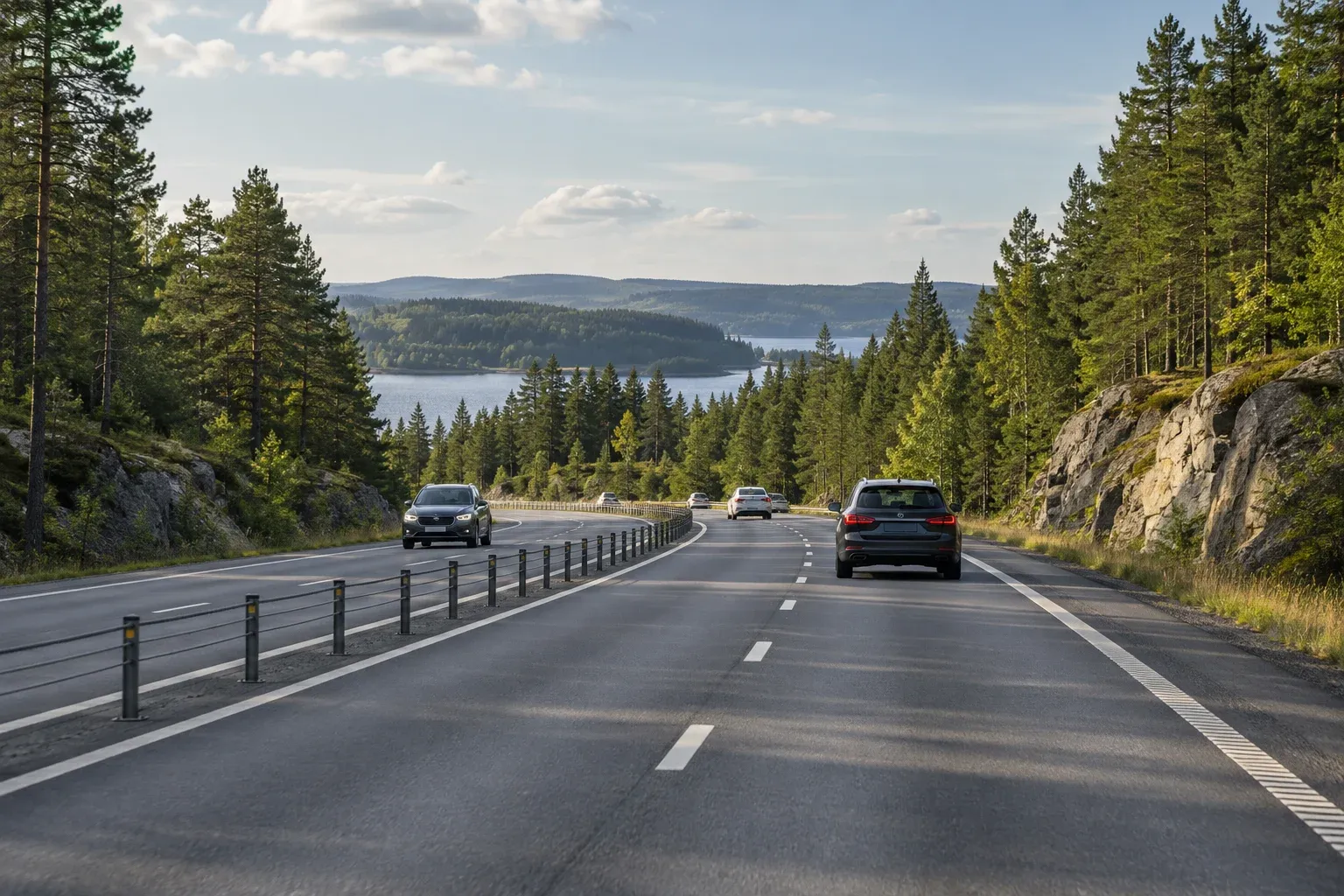
Drive any distance in Sweden outside the cities and you will meet a road with steel cables down the middle and a lane that keeps switching sides. Here is why it exists, how to overtake on it, and what to do when something goes wrong.
When you need this
You have just left the ferry or the airport and joined E4, E20 or a national road, and there is a wire fence running down the centre line. Maybe an arrow sign says your lane is about to end while you are halfway past a lorry. Maybe you hear a siren behind you where there is only one lane, or your tyre goes flat with the barrier a metre to your left. This page covers each of those.
What a 2+1 road is
A 2+1-väg (2+1 road) is an ordinary wide two-lane road rebuilt with three lanes. One direction gets two lanes while the other gets one, and the extra lane alternates between directions along the road. A mitträcke (median barrier), usually steel cables on posts, separates the two directions all the way.
The barrier is the point. It makes head-on crashes physically almost impossible, at a fraction of the cost of building a motorway. Swedish engineers call these mötesfria vägar, “collision-free roads”, a term that also covers expressways with one lane each way and a barrier.
A collision-free road comes in two legal forms, and the difference matters to you:
| Type | Who may use it | What you can’t do |
|---|---|---|
| Motortrafikled (expressway), signed at the start | Only vehicles built for and allowed to do at least 40 km/h; no class I mopeds, cyclists or pedestrians | Stop except at marked parking or rest areas; turn or reverse |
| Ordinary road (mötesfri landsväg) | All traffic, including tractors and bicycles | Normal road rules apply |
There is no special 2+1 law. The road follows the ordinary lane, overtaking and merging rules of the trafikförordningen (Road Traffic Ordinance), which is why knowing those few rules is enough.
Why Sweden built them
Sweden’s first 2+1 road was E4 between Gävle and Söderhamn, converted in 1997, according to Trafikverket’s own 2022 appraisal of that road. Many accounts give 1998 as the start. That is the year the then Swedish Road Administration (Vägverket, now Trafikverket) launched a national programme to rebuild its 13-metre-wide roads and two-lane expressways. In the 1990s that network was about 3,700 km long and saw almost 100 deaths a year. A 1996 study counted about 60 deaths a year in head-on crashes on some 4,000 km of wide two-lane roads, deaths a barrier would likely have prevented.
The results, by Trafikverket’s own figures:
| Measure | Result on converted roads |
|---|---|
| Length converted, 1999–2016 | About 400 km of expressway and about 2,500 km of two-lane road |
| People killed | About 80% fewer, some 50 lives a year |
| Killed or seriously injured | 70–75% fewer |
| Speed limit | Generally raised from 90 to 100 km/h |
A separate VTI evaluation (VTI is Sweden’s national road and transport research institute) found deaths down 71% and injuries down 36%, while warning that the statistical base was still small. Conversion continues road by road under the national transport plan: on E10 between Morjärv and Västra Svartbyn, for example, a 23.5 km 2+1 road with barrier and wildlife fencing is planned, with preparatory work starting in autumn 2026.
How to overtake
The rules are short, and they are all in the ordinary traffic ordinance:
- Keep to the right-hand lane. Use the left lane of a two-lane stretch only to overtake.
- Overtake on the left, and only without danger. Don’t pull out if the driver behind you has already started to overtake.
- Return to the right as soon as it is safe, unless you are about to pass another vehicle straight away.
- If someone is overtaking you, don’t speed up. Keep right and let them by.
- Never cross a solid line between lanes going the same way.
One rule is relaxed, and that’s where visitors get into trouble. Normally you may not start an overtake unless you can safely get back to the right. That requirement does not apply in a lane where oncoming traffic can’t drive, and on a 2+1 road the barrier sees to that. So the law won’t stop you pulling out late. The merge will.
Watch the signs. A white square sign with black arrows, F17, warns that the number of lanes is decreasing. F18 shows the lane directions ahead and may include a symbol for the barrier, placed at least 200 m before it. When the lane-decrease sign appears and you are not clearly past, settle back in. Overtaking lanes alternate along the whole road, so the next chance is rarely far away.
The merge
When the two lanes become one, the ordinance says both drivers must adjust “with mutual consideration”. Neither lane has right of way. In practice traffic merges alternately, like a zipper, but that is a habit, not a rule that gives you priority. Any lane change must happen without danger or unnecessary obstruction, and a driver who sees someone wanting to move in must adapt speed to let them.
Late merges cause queues as well as crashes. On busy holiday days, Trafikverket has closed the overtaking lanes on E4 between Gävle and Tönnebro altogether. It did this over Easter 2023, saying traffic flows much better when everyone stays in the same lane. If you meet closed overtaking lanes, that is why.
Sharing the road
On a 2+1 road that is not signed as a motortrafikled, you can meet tractors, cyclists and mopeds. Cyclists, class II mopeds and vehicles built for no more than 40 km/h must use the shoulder (vägren) where it is wide and suitable enough. On a single-lane stretch you may have to wait behind a slow vehicle until the next overtaking lane. If you cycle in Sweden, our cycling guide covers where bikes are allowed.
Motorcyclists were the group most worried about cable barriers. Trafikverket cites VTI findings that, on the contrary, the risk of death or serious injury for motorcyclists fell by 40–50% on 2+1 roads with cable barriers. Since 2015 its design guideline has also required softer barriers, without sharp edges or posts sticking out above the top beam.
Breakdowns, sirens and barrier damage
Breakdown or puncture. This is where 2+1 roads remain deadly: Trafikverket counts about four deaths a year after breakdowns and punctures on motorways and 2+1 roads. Its advice is warn, leave, call:
- Switch on the hazard lights and place the warning triangle at least 100 m back, farther if you can.
- Leave the car and the road, and wait outside the guardrail if there is one.
- Call a recovery service, or 112 if anyone’s life is in danger.
Emergency vehicles. You must give free passage to an emergency vehicle using its siren, stopping if necessary. On a single-lane stretch, slow down and move as far right as you safely can so it can pass between you and the barrier. Don’t brake hard in the lane.
Hitting the barrier. Stop where it is safe and check for injuries. If the barrier is damaged and nobody is there to take your details, the law says you must notify the owner or the police as soon as possible. Trafikverket’s contact centre for reporting damage is 0771-921 921. Damage to the barrier is property damage, which Swedish law puts on the vehicle’s compulsory motor insurance (trafikförsäkring), so tell your insurer or rental company too.
Mistakes to avoid
| Mistake | What to do instead |
|---|---|
| Pulling out for one more car as the lanes end | When the lane-decrease sign appears, stay behind |
| Sitting in the left lane after passing | Return right as soon as it is safe |
| Speeding up when someone overtakes you | Hold or ease your speed; the law forbids speeding up |
| Tailgating on the single-lane stretch | Drop back; the next overtaking lane is coming |
| Stopping on the shoulder for photos or the map | Wait for a rest area or exit |
| Assuming the zipper merge gives you priority | Mutual consideration applies; no lane has right of way |
Practical information
| Item | Detail |
|---|---|
| Toll or fee | None for driving on a 2+1 road (checked 2026-10-14) |
| Usual speed limit | Often 100 km/h; follow the posted sign, and towing limits still apply |
| Lane-decrease sign | F17, white square with black arrows |
| Breakdown | Hazard lights, triangle at least 100 m back, leave car and road |
| Emergency number | 112 |
| Report barrier damage | Trafikverket contact centre, 0771-921 921 |
| Who pays for barrier damage | The vehicle’s compulsory motor insurance; no published tariff (checked 2026-10-14) |
| Speeding fines | The ordinary national fine table, see our speed-limits guide |
FAQ
What is a 2+1 road in Sweden?
A wide two-lane road rebuilt with a barrier down the middle and three lanes: one direction gets two lanes while the other gets one, and the extra lane alternates between directions. The barrier, usually steel cables on posts, makes head-on crashes almost impossible. Sweden opened its first one on E4 north of Gävle in 1997 and has converted thousands of kilometres since.
How do I overtake on a 2+1 road?
Only on the two-lane stretch in your direction. Move left, pass, and return to the right lane as soon as it is safe. Do not start an overtake you cannot finish before your lane ends: watch for the lane-decrease arrow sign. If someone is overtaking you, keep right and do not speed up. There is never any overtaking on the single-lane stretch.
Who has priority when the two lanes merge?
Neither. Swedish law says that when two lanes merge into one, drivers must adjust to each other with mutual consideration. In practice traffic merges alternately, like a zipper, but no lane has right of way. Finish or abandon your overtake in good time, and if someone signals to move in, adjust your speed to let them.
What should I do if I break down on a 2+1 road?
Switch on the hazard lights and place the warning triangle at least 100 metres back, farther if you can. Then leave the car and the road and wait outside the guardrail if there is one. Call a recovery service, or 112 if anyone is in danger. About four people a year die after stopping on motorways and 2+1 roads.
How do emergency vehicles get past on a single lane?
You must give free passage to an emergency vehicle using its siren, and stop if necessary. On the single-lane stretch, slow down and move as far right as you safely can so it can pass between you and the barrier. Do not brake hard or stop abruptly in the lane, and pull back out only when the road behind is clear.
What happens if I hit the cable barrier?
Stop where it is safe and check for injuries. If the barrier is damaged and nobody is there to take your details, you must tell the road owner or the police as soon as possible. Trafikverket’s contact centre is 0771-921 921. Repairs are paid through the vehicle’s compulsory motor insurance, so tell your insurer or rental company too.
Are 2+1 roads actually safer?
Yes. Trafikverket reports about 70–75 percent fewer people killed or seriously injured on converted roads, and about 80 percent fewer killed, roughly 50 lives a year, even though limits mostly went up from 90 to 100 km/h. A VTI study found that the cable barrier also lowered the risk for motorcyclists, a group that had feared it.
Related guides
- Driving in Sweden: headlights, alcohol, licences and the other rules of the road
- Swedish road signs explained: the lane-arrow signs and the others foreigners misread
- Speed limits and speed cameras in Sweden: the limits, cameras and fine table on these roads
- Winter driving in Sweden: breakdowns and stopping distances in the cold
- Moose and deer on the road: why many 2+1 roads also get wildlife fences
Facts verified 2026-10-14. Sources: Sveriges Riksdag (Trafikförordningen, Vägmärkesförordningen, Trafikskadelagen), Transportstyrelsen, Trafikverket, VTI, Polisen — full register in this topic’s source file. Found something outdated? Tell us and we’ll fix it.