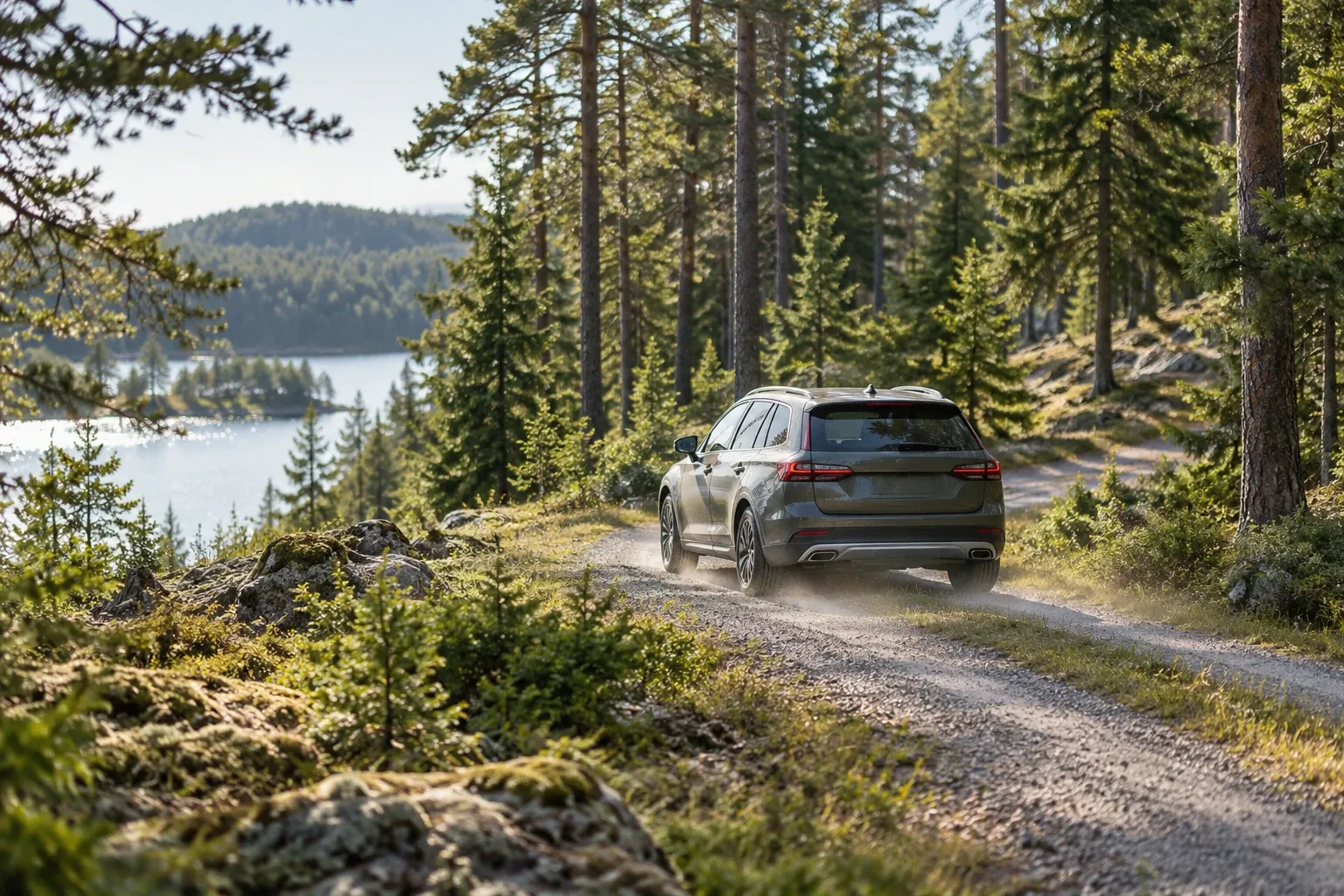
Gravel is a normal road surface in Sweden. Here’s how to drive it safely, what Swedish traffic law actually requires, why spring brings weight limits, and who pays when a stone hits your windscreen. Usually that’s you.
When you need this
Almost any rural trip in Sweden ends on gravel. The road to a rented cabin, a lake, a trailhead or a small ski area often leaves the asphalt for the last few kilometres. Sat-navs also like forest-road shortcuts.
You’ll want this guide if:
- your route leaves the asphalt and you’ve rarely driven on gravel
- you’re in a rental car and wonder what the contract says about bad roads
- dust from an oncoming car or a timber truck has just blinded you
- you’ve got a stone chip in the windscreen
- you’re planning a spring trip with a motorhome or trailer
Who may drive on a private road, and what barriers and “Enskild väg” signs mean, is covered in our guide to private roads and barriers in Sweden. This page is about the driving itself.
How much of Sweden is gravel
Trafikverket, the Swedish Transport Administration, manages 18,500 km of gravel road. That’s a little over 20% of the state road network. More than half of it lies in the seven forest counties: Värmland, Dalarna, Gävleborg, Jämtland, Västernorrland, Västerbotten and Norrbotten.
Traffic on these roads is light, usually under 125 vehicles a day. Trafikverket normally paves a road only once it carries more than 250 a day. If homes line the road, paving can come from about 125 vehicles a day, partly to cut dust for the people living there.
And that’s only the state network. Sweden has about 460,000 km of private road, including some 150,000 km of forest roads, kept by road associations and landowners.
| Network | Length | Who keeps it |
|---|---|---|
| State gravel roads | 18,500 km (just over 20% of state roads) | Trafikverket |
| Private roads, all surfaces | about 460,000 km | Road associations and landowners |
| of which forest roads | about 150,000 km | Forest owners and associations |
Speed: the sign is not the answer
There is no special speed limit for gravel in Swedish law. The base limit outside built-up areas is 70 km/h, and 50 km/h inside them, unless signs say otherwise. Trafikverket can sign higher limits, and municipalities can lower town limits to 30 or 40 km/h. None of these rules depends on the road surface.
What matters more is the general rule in the traffic ordinance (trafikförordningen). Your speed must suit the road, the weather, visibility, your vehicle and its load. It must never be higher than lets you stop within the stretch of road you can see.
The law also names situations that require a low speed, and gravel roads are full of them:
- sharp curves and hill crests
- slippery road surfaces
- meeting other vehicles on narrow roads
- animals on the road
- dirty roads where you risk splashing other road users
So a 70 sign on a winding forest road is a ceiling, not a target. On loose gravel or in dust the legal speed is often well below it.
Driving technique
Gravel gives your tyres less grip than asphalt, so the car is harder to control, especially at speed. No Swedish agency publishes a gravel-driving guide, but police advice from other gravel-road countries and Trafikverket’s own description of road defects point to the same habits:
- Slow down as you leave the asphalt. Grip drops the moment you reach gravel.
- Drive in the wheel tracks other vehicles have made. Loose gravel (löst grus) collects between and beside them, and Trafikverket counts it as a road defect.
- Brake and steer gently. Avoid sudden changes of speed or direction. Brake on the straight before a curve, not in it.
- If the car starts to slide, take your foot off the accelerator and steer where you want to go.
- Keep a long gap to the vehicle ahead, so its dust and stones don’t reach you.
Washboard ripples (korrugering) are another defect Trafikverket grades roads on. They shake the car and loosen its grip; slow down until they ease. A four-wheel drive isn’t needed on maintained gravel roads. Decent tyres and some ground clearance just make the drive less tiring.
Dust, meeting and overtaking
In dry weather gravel roads throw up dust. Trafikverket names the problem directly: dust reduces visibility for vehicles behind and oncoming. Each spring, once the frost has left the ground but before the surface dries out, it binds the dust on state roads with calcium chloride, magnesium chloride or lignosulphonate. By late summer, though, a passing car can still leave a cloud.
Three rules matter most here:
- Meeting: keep right and leave a safe sideways gap. On a narrow road the driver with an obstacle on their side stops if that’s needed for the other to pass.
- Overtaking: only when the lane is free for a long enough stretch. Dust can hide an oncoming car, so a long clear view is the only safe one.
- Being overtaken: if you’re driving slowly or something wide on a narrow, winding road, slow down and pull aside so others can pass.
Then there are lights. Dipped headlights are the default in Swedish law. Daytime running lights may replace them in daylight, but not when the weather or other circumstances call for dipped beam. With daytime running lights alone, many cars show no rear lights. In dust, switch to dipped headlights so the car behind can see you.
Narrow roads have passing places marked with sign E18 (mötesplats). Don’t park in one. Pull into the nearest passing place early for timber trucks: they need the width and can’t stop quickly (see forest roads and logging). Forest gravel roads at dawn and dusk are also prime time for moose and deer; our wildlife collisions guide covers what to do after one.
Spring thaw: soft roads and weight limits
Gravel roads are usually not built up like paved ones, so they cope worse with frost and heavy traffic. During the spring thaw (tjällossning) the ground under the road softens. Heavy vehicles can then damage it permanently, and potholes appear.
Trafikverket can then cap the gross or axle weight on a road at 12, 8 or 4 tonnes. In recent years such temporary limits have applied to 10–30% of the state gravel network, against 2–3% of paved roads. Restrictions on low-traffic roads in Norrbotten and Västerbotten were a question in parliament in April 2026.
An ordinary car is usually below these limits. A heavy motorhome or a car with a loaded trailer may not be. Trafikverket’s traffic-information map has a layer for frost damage and restrictions; see checking road conditions for how to use it, and motorhomes in winter and spring for the weight question.
In winter, low-traffic state roads are normally gritted with sand, not salt, and may keep a couple of centimetres of snow after snowfall. Our winter driving guide covers that season.
Stone chips and damage: who pays
Stone chips (stenskott) come with gravel driving, and at the end of winter they come from every road: small stones left over from winter gritting fly up and hit windscreens.
The road keeper almost never pays. Trafikverket says compensation for a stone chip is very rare. It’s possible only if the agency knew about dangerous loose gravel and neither removed it nor warned of it within reasonable time. The same goes for potholes: Trafikverket pays only if it knew about a dangerous hole and failed to fix it or warn of it. Claims need proof of the damage, and handling takes about six months.
So the cost normally falls on your own cover:
- A Swedish-insured car has glass cover from part-comprehensive insurance (halvförsäkring) upward. The excess depends on the insurer.
- A rental car depends on the contract (see below).
- A foreign-insured car depends on your own policy at home.
Whichever applies, get a chip repaired early. Sweden’s consumer insurance bureau warns that a chip can spread into a crack, and replacing a windscreen usually costs you a larger excess than a repair. Take photos of any damage straight away.
Rental cars on gravel
Gravel is a normal Swedish road surface, and we found no Swedish rental terms that ban it. The risk sits in the cover. Underbody, wheel and glass damage are common exclusions. One major rental company’s Swedish terms go further: driving a road in poor condition without sufficient care, so that the underbody is damaged, counts as gross negligence. That voids the cover, and you pay the full damage.
Read the exclusions before you leave the desk, drive slowly, and keep off rough forest tracks. Our rental car insurance guide explains excess, exclusions and how to dispute a charge.
Practical information
| What | Detail |
|---|---|
| State gravel roads | 18,500 km, just over 20% of state roads (Trafikverket, July 2026) |
| Speed limit on gravel | No separate limit: 70 km/h outside built-up areas, 50 km/h inside, unless signed |
| Spring weight limits | 12, 8 or 4 tonnes where signed; 10–30% of the state gravel network in recent years |
| Dust binding | Spring, after the frost leaves: calcium chloride, magnesium chloride or lignosulphonate |
| Winter gritting on low-traffic state roads | Normally sand, not salt |
| Stone-chip claim against Trafikverket | Very rarely granted; about six months’ handling |
| Where to check restrictions | Trafikverket’s traffic-information map, frost-damage and restrictions layer |
FAQ
Are there many gravel roads in Sweden?
Yes. Trafikverket manages 18,500 km of gravel road, a little over a fifth of the state network, and more than half of it is in the forest counties of central and northern Sweden. Sweden also has some 150,000 km of private forest roads. Routes to cabins, lakes and trailheads often leave the asphalt for the last few kilometres, so expect gravel on almost any rural trip.
What is the speed limit on gravel roads in Sweden?
There is no separate gravel limit. Outside built-up areas the base limit is 70 km/h unless a sign says otherwise, and 50 km/h applies in built-up areas. But the law also requires a speed that suits the road and lets you stop within the distance you can see, which on loose gravel or in dust is often much lower.
Can I drive a rental car on gravel roads in Sweden?
Generally yes, since gravel is a normal Swedish road surface, but read the contract. Cover can exclude underbody, wheels and glass, and one major company’s Swedish terms treat underbody damage from careless driving on a poor road as gross negligence, which voids the cover. Drive slowly, avoid rough forest tracks, and photograph any damage straight away.
Who pays for a stone chip in my windscreen?
Usually not the road keeper. Trafikverket says compensation for stone chips is very rare, possible only if it knew about dangerous loose gravel and failed to remove or warn of it in reasonable time. A Swedish-insured car normally has glass cover from part-comprehensive upward. In a rental, it depends on your contract. Repair a chip early, before it cracks.
Why are some gravel roads closed or weight-limited in spring?
During the spring thaw the ground under the road softens, and heavy vehicles can damage it permanently. Trafikverket can then limit gross or axle weight to 12, 8 or 4 tonnes, and in recent years 10–30% of the state gravel network has had such limits. Its traffic map shows the restricted roads. Ordinary cars are usually below the limits.
How do I drive safely on a gravel road?
Slow down when you leave the asphalt, drive in the tracks other vehicles have made, and avoid sudden braking or steering. If the car slides, ease off the accelerator and steer where you want to go. Keep well back from vehicles ahead because of dust and stones, meet oncoming cars slowly on the right, and use dipped headlights in dust.
Related guides
- Private roads, gates and barriers — whether you may drive that forest road at all
- Checking road conditions in Sweden — the map layer that shows spring weight limits
- Rental car insurance in Sweden — underbody, glass and wildlife exclusions in depth
- Wildlife collisions in Sweden — what to do if a moose steps out on a forest road
- Roadside assistance in Sweden — getting help when you’re far from town
Facts verified 15 October 2026. Sources: Trafikverket, Sveriges riksdag (trafikförordningen), Konsumenternas Försäkringsbyrå — full register in this topic’s source file. Found something outdated? Tell us and we’ll fix it.