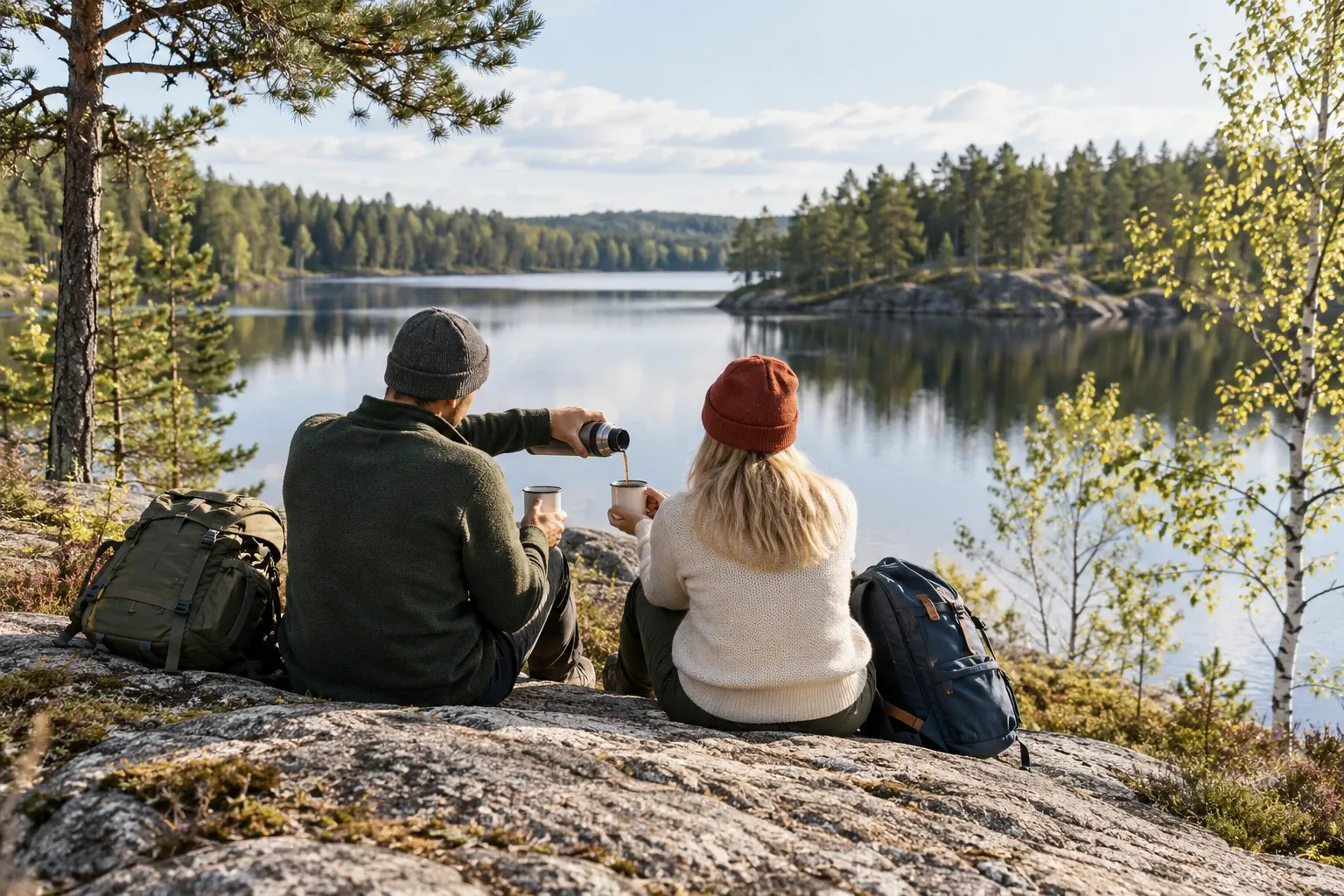
Friluftsliv isn’t a wellness trend or an expedition sport. For most Swedes it means a walk in the forest, a swim in the lake or coffee by a fire. Here is what the word means, why it runs so deep, and how you can join in for free.
When you need this
A Swedish colleague asks if you want to come on a Sunday forest walk, a grillning (barbecue) or a ski outing. Or you notice that offices empty early on sunny Fridays and cities empty in July. You may be moving here and wondering why the children are outside in every kind of weather. Or you read that friluftsliv is a “Nordic lifestyle secret” and want the real version before your trip.
What friluftsliv is
The word literally means “open-air life”. Sweden has written a definition into law: time outdoors in the natural or cultural landscape for wellbeing and nature experiences, with no demand for competition. It appears in the ordinance that decides which outdoor organisations receive state grants (Förordning 2010:2008).
Two details in that definition matter. “Cultural landscape” means farmland edges, parks and the land around villages count, not just wilderness. And “no competition” means a ski race or an orienteering event is sport, not friluftsliv, even though the same people often do both.
The word is shared with Norwegian. Norway’s national encyclopedia says Henrik Ibsen probably used it first, in the 1859 poem På vidderne. That is more cautious than the “Ibsen coined it” line on many websites. Sweden has a long tradition of its own: the Swedish Tourist Association (STF) was founded in 1885 and Friluftsfrämjandet, one of the big outdoor-recreation associations, has been around since 1892.
What Swedes actually do outdoors
The image abroad is of fjäll expeditions and winter camping. The data says something more modest. The latest national survey was run by Statistics Sweden for the Swedish Environmental Protection Agency (Naturvårdsverket). It asked 21,000 people aged 16 and over in autumn 2021, and the report came out in May 2025. Many English-language pages still quote the 2018 survey or no figures at all.
| How often Swedes are in nature (2021) | Share saying “fairly” or “very” often |
|---|---|
| During longer holidays | about 80% |
| At weekends | about 69% |
| On weekdays | about 57% |
The flip side: about 43% are rarely or never in nature on a weekday. The report also warns that the pandemic probably pushed the 2021 numbers up, because walks and forest visits were among the few things still possible.
The ten most common activities were walks, time in the forest for a nature experience, a picnic or barbecue in nature, gardening, swimming in a lake or the sea, sunbathing, cycling, picking berries, picking mushrooms and walking marked lowland trails. In the survey’s own words, outdoor life near home dominates, usually inside built-up areas, in the forest or by water.
Swedes also think it matters. Nine in ten say friluftsliv is good for their health, seven in ten that time outdoors makes everyday life more meaningful, and four in ten that it strongly shaped where they chose to live.
Why it runs so deep
Four things hold friluftsliv up, and each reinforces the others.
| Pillar | What it does | Status |
|---|---|---|
| Allemansrätten (the right of public access) | Opens most land to walkers, free and without asking | Anchored in the constitution |
| National outdoor policy | Ten goals since December 2012, from “nature shall be accessible to all” to “outdoor life shall have a given role in school” | Government policy, not binding on individuals |
| School | Preschoolers regularly spend time in natural environments; Friluftsliv och utevistelse is one of three areas of physical education, with allemansrätten taught at every stage | Binding curriculum |
| Associations | STF (1885) and Friluftsfrämjandet (1892) run outings, courses and children’s groups | Voluntary |
The access right is the base. Over three-quarters of Swedes say allemansrätten matters a lot for what they do outdoors, and 85% say it is worth defending. Our guide to allemansrätten explains what it lets you do and where it stops.
School turns the right into a habit. Skolverket, the national education agency, sums up outdoor competence as knowing how to stay dry, fed, warm and safe in nature. Friluftsfrämjandet created the children’s forest figure Skogsmulle in 1957. If you are moving here with children, see why preschoolers are outside in all weather.
The duty that comes with it
The freedom comes with one written duty. The Environmental Code says that everyone who uses allemansrätten, or otherwise spends time in nature, must show consideration and care. Swedes shorten it to inte störa, inte förstöra — do not disturb, do not destroy.
In practice that means:
- Leave nothing behind. Littering, fires on bare rock and camping next to houses break the duty and can be offences. The campfire rules and wild camping rules have the detail.
- Keep it quiet. Not disturbing covers people and wildlife, and quiet is part of what Swedes go out for. Leave the loud speaker at home.
- Leave the car behind. Allemansrätten is a non-motorised right. Driving onto a beach, meadow or forest track breaks the Off-Road Driving Act, which bans motor vehicles in terrain on snow-free ground except for farming and forestry.
How to join in as a visitor
You don’t need a guide, a membership or new gear. The easiest routes, roughly in order of effort:
| Route | What it is | Cost |
|---|---|---|
| Lit exercise trail (elljusspår) | A floodlit loop at the edge of town; SCB counts nearly 1,700 sites, and 32% of Swedes live within 1 km of one | Free |
| Municipal outdoor pages | Search the town’s website for friluftsliv: trails, swimming spots, barbecue sites, shelters | Free |
| Friluftsfrämjandet outings | Local branches run activities for all ages; many are open to the public, recurring ones often need membership | Varies |
| STF activities | Courses and activities through local chapters | Varies |
| Fritidsbanken | Borrow tents, stoves, skis, skates and life jackets | Free |
Friluftsfrämjandet’s main language is Swedish, but its English page says everyone of all languages is welcome. Look for Hitta äventyr (find adventures) on its site. Fritidsbanken operates in over 40% of municipalities, with no deposit and no late fees, and our lit trails guide explains how the floodlit loops work.
Then copy the Swedish day out: a thermos of coffee, a macka (open sandwich) or sausages for the fire, a sit-pad, and a walk to a lake or a lookout. Simple is the point. If a Swede invites you, say yes. Ask what to bring and whether there is a fire ban.
Clothing matters more than kit. Jeans and cotton in a wet November forest will leave you shivering within the hour; wool or synthetic layers and a waterproof shell solve most weather. See layering clothes for Swedish weather. The proverb det finns inget dåligt väder, bara dåliga kläder — there is no bad weather, only bad clothes — is a saying, not a rule.
Through the year
| Season | What Swedes do |
|---|---|
| Spring | First walks in the sun, birdsong, Easter skiing in the mountains |
| Summer | Swimming, berry picking, holiday-home life |
| Autumn | Mushrooms and berries, ruska colours in the north, hunting season |
| Winter | Lit trails, cross-country skiing, skating |
Summer is holiday-home season: Sweden had 633,861 holiday homes in 2025, and in 2019 about half of Swedes aged 16–84 could use a holiday home or caravan. Our sommarstuga guide covers that half of outdoor life. In autumn, wear visible colours in hunting terrain (see hiking during hunting season).
Winter’s limit is darkness, not law. Daylight is short in the dark half of the year, which is why floodlit trails exist near most towns. Start a long winter walk early or you will finish it in the dark.
Where you are changes the flavour too. In the mountains, friluftsliv means long hikes and hut-to-hut trips (hiking in Sweden). In cities it means a nature reserve at the end of a metro line (day hikes from Stockholm). Lit trails are densest in the north: 60% of Västerbotten’s population lives within 1 km of one, against 18% in Skåne and 10% on Gotland.
Practical information
| Item | Detail |
|---|---|
| Access to nature under allemansrätten | Free by right |
| Ordinary municipal lit trail | Free, no booking |
| Fritidsbanken gear | Free; no deposit, no late fees |
| Friluftsfrämjandet activities | Price varies by branch and activity; recurring ones often need membership |
| Latest national survey | Friluftsliv 2021, Naturvårdsverket report 7189 (May 2025) |
| Legal definition | Förordning 2010:2008, 3 § |
| National outdoor goals | Government communication 2012/13:51 (December 2012) |
FAQ
What does friluftsliv mean?
Friluftsliv literally means “open-air life”. Swedish regulation defines it as time outdoors in the natural or cultural landscape for wellbeing and nature experiences, without any demand for competition. In practice it covers everything from a lunchtime forest walk to a week on a mountain trail. The word is shared with Norwegian; Norway’s encyclopedia says Ibsen probably used it first, in 1859.
How often do Swedes actually go outdoors?
Often, but mostly close to home. In the latest national survey, from 2021, about 80% said they are in nature fairly or very often during longer holidays, 69% at weekends and 57% on weekdays. About 43% are rarely or never in nature on a weekday. Walks, forest visits, picnics, swimming and berry picking top the list.
Why are Swedes so into the outdoors?
Four things reinforce each other. Allemansrätten, guaranteed in the constitution, opens most land to walkers for free. Schools teach outdoor life from preschool onwards. Large associations have organised outings since the 1880s. And the state has had national outdoor-recreation goals since 2012. Nine in ten Swedes also think friluftsliv is good for their health.
Is friluftsliv Swedish or Norwegian?
Both countries use the word and the idea. Norway’s national encyclopedia says Henrik Ibsen probably used it first, in the 1859 poem På vidderne. Sweden has its own long tradition: the Swedish Tourist Association dates from 1885 and Friluftsfrämjandet from 1892. Sweden also defines friluftsliv in regulation, where it decides which outdoor organisations receive state grants.
Can a tourist join a Swedish outdoor group?
Yes. Friluftsfrämjandet’s local branches publish outings for all ages and say everyone of all languages is welcome, though Swedish is the main language. Many activities are open to the public; advanced or recurring ones often require membership. STF also runs courses and activities. Or simply walk a municipal trail, which needs no booking at all.
Do I need special gear for friluftsliv?
No. Most Swedish outdoor life is a walk, a swim or a forest picnic, done in ordinary outdoor clothes. What matters is staying dry and warm: wool or synthetic layers and a waterproof shell. For a camping or skiing trip, Fritidsbanken lends tents, stoves, skis and skates for free in many municipalities.
Related guides
- Allemansrätten: Sweden’s right of public access — what the right lets you do, and the four things that switch it off.
- Lit trails (elljusspår) — the everyday friluftsliv of the dark months, near almost every town.
- Fritidsbanken: borrow outdoor gear for free — skip buying a tent or skis for one trip.
- Sommarstuga culture — why cities empty in July and where everyone goes.
- Outdoor play at Swedish preschools — where the habit starts, rain or shine.
Facts verified 2026-10-14. Sources: Naturvårdsverket, Sveriges riksdag (Förordning 2010:2008, skr. 2012/13:51, Regeringsformen, Miljöbalken, Terrängkörningslagen), Skolverket, SCB, Store norske leksikon, Friluftsfrämjandet, Svenska Turistföreningen, Fritidsbanken — full register in this topic’s source file. Found something outdated? Tell us and we’ll fix it.