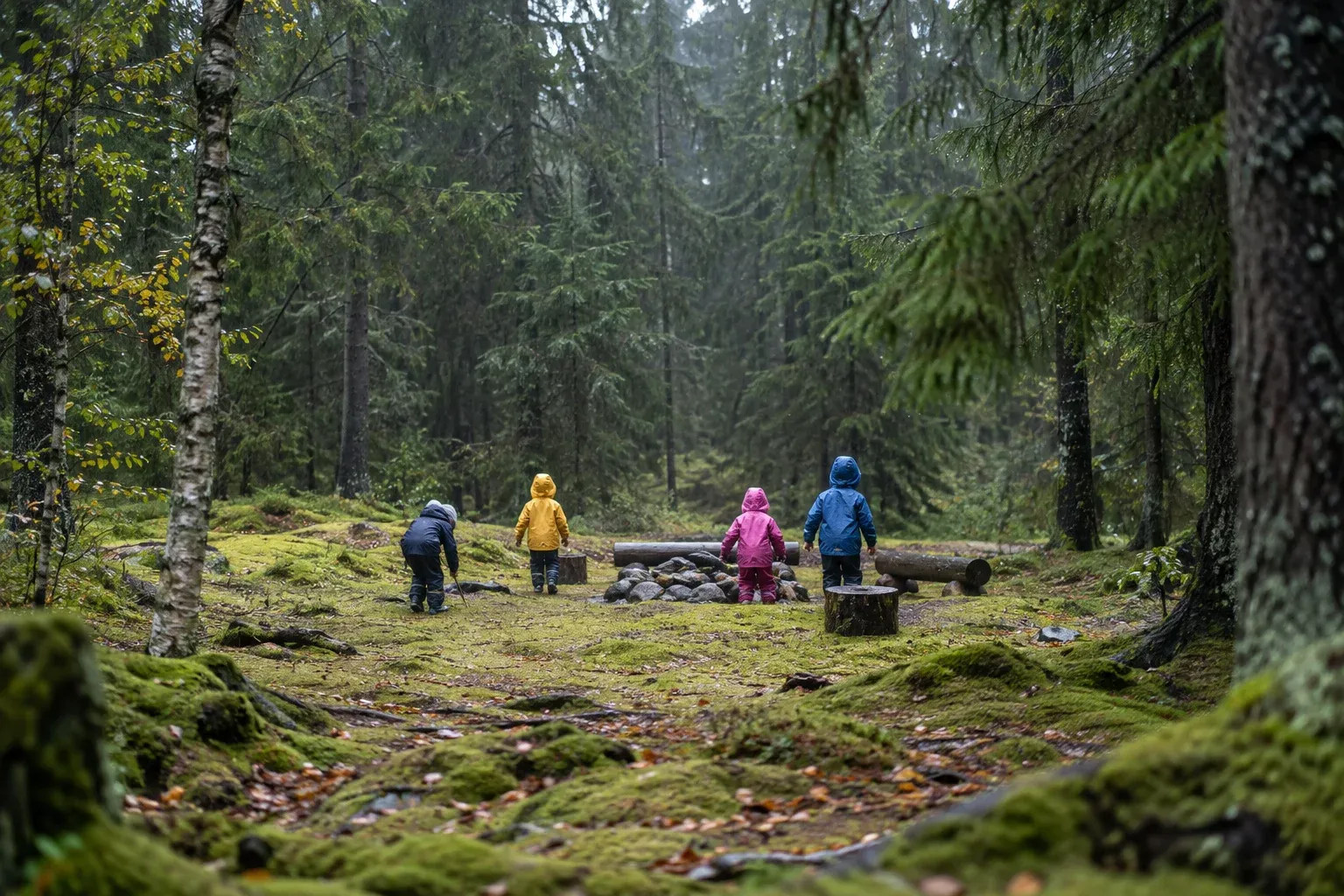
Your child’s first week at a Swedish preschool may end with a muddy rain suit in a plastic bag. That is normal. Here is what the rules actually require, who decides on cold days, and exactly what to pack.
When you need this
You have a preschool place in Sweden and the clothing list arrived in Swedish. Your child came home soaked or cold, and you wonder whether that is how it is supposed to be. You want to know if your child can stay inside on a freezing day, or you are choosing between an ordinary preschool and a “rain or shine” one. Or you are visiting and wonder why Swedish toddlers are out playing in the drizzle.
What the rules actually say
Utevistelse (time spent outdoors) is part of the daily rhythm at a Swedish förskola (preschool, ages 1–5). Its legal footing is the national curriculum, Läroplan för förskolan, known as Lpfö 18. It is a government ordinance, so preschools must follow it.
The curriculum was revised on 1 August 2025. The current text says children should take part in varied physical activities recurring through the day, should regularly spend time in different natural environments, and should be able to switch between activities outdoors and indoors. Care should balance physical activity, other activities and rest.
The old wording no longer applies: the pre-2025 curriculum only said children should be given the opportunity to be physically active and spend time in nature. The August 2025 version is firmer. Many English-language pages still quote the old wording, or claim a law that does not exist.
What the curriculum does not contain matters just as much:
| Common claim | What the texts say |
|---|---|
| “Swedish law says children must be outside every day” | No statute or curriculum sets outdoor minutes or hours |
| “There is a national cold limit” | The curriculum never mentions weather; no national limit exists |
| “Every preschool must have 40 m² of yard per child” | Guidance from Boverket, not a binding figure |
| “Outdoor play is optional extra” | Recurring activity and regular nature time are curriculum requirements |
The planning law does set one hard rule for buildings. A preschool site must have “sufficiently large” outdoor space suitable for play, on or near the plot, and play space comes before parking. Boverket, the national housing and planning agency, calls 40 m² per preschool child and a total above 3,000 m² reasonable, but local building committees judge each case. Inner-city preschools often have small yards and walk to parks and forest instead.
Rain, snow and cold: who decides
Everything beyond the curriculum is local. The huvudman (the municipality or independent operator running the preschool) and the rektor (head) decide how long children are out and what happens in heavy rain or deep cold. Most preschools go out at least once a day in every season.
A February 2026 SVT report from Eskilstuna shows how it works in practice. Preschools there were out almost every day through a cold spell, but principals shortened or skipped outdoor time on some days. No temperature limit was given, and staff noted that rubber boots are unsuitable at around −10 °C. Parents pulled in both directions: some feared their child would fall ill, others complained when the group stayed in.
The attitude is summed up in a proverb you will hear constantly: det finns inget dåligt väder, bara dåliga kläder, “there is no bad weather, only bad clothes”. It is a saying, not a rule, but it explains why the clothing list is long.
If you are worried, ask the preschool what its own routine is. For babies, 1177, the regions’ health service, says newborns should stay inside when it is windy and very cold.
What to pack
Every preschool hands out its own list at inskolning (the settling-in period), so ask for it. The method behind every list comes from 1177: several thin layers instead of one thick one, and no cotton next to the skin, because cotton gets damp and cools the body.
| Layer or item | What works | Swedish name |
|---|---|---|
| Base layer | Wool or synthetic, long sleeves and long johns | underställ |
| Mid layer | Fleece or wool sweater and trousers | — |
| Rain outer layer | Rain jacket and trousers, or a PU rain suit | regnkläder, galonkläder |
| Winter outer layer | Padded one-piece, or jacket and padded trousers | vinteroverall, täckbyxor |
| Feet | Rubber boots in wet weather, lined winter boots in frost | gummistövlar |
| Head | Windproof hat in winter, sou’wester in rain, sun hat in summer | mössa, sydväst |
| Neck | Tube neck gaiter, never a scarf | halskrage, tubhalsduk |
| Hands | Windproof mittens, waterproof for snow play, two pairs | vantar |
| Spares | Socks, mittens, underwear and a full change in the child’s box | extrakläder |
Then get into a routine:
- Label everything, every mitten and boot included.
- Take wet clothes home every day to dry, and bring them back.
- Swap seasonally. Winter gear goes in around the first frost; sun hat and sunscreen come in late spring.
Second-hand children’s outdoor clothing is widely sold in Sweden, and staff are usually happy to say which garments hold up best. For the adult side of the same logic, see packing for a Swedish winter.
Safety: scarves, cords, cold and sun
Some rules surprise newcomers. They come from 1177’s advice for dressing children.
- No scarves. 1177 says a scarf can catch on something. On a slide or climbing frame it can tighten around the neck. Use a tubhalsduk, a tube-shaped neck gaiter pulled over the head.
- No loose cords. Loose strings can catch during play, and 1177 calls the risk life-threatening. Remove or shorten drawstrings on hoods and trousers.
- Check the neck, not the hands. If the neck and forehead feel cold, the child is too cold; a very warm chest or back means too warm.
- Wind makes cold worse. Below zero, wind raises the risk of frostbite. The first sign is white patches on cheeks, nose or ears. Warm slowly, skin to skin, and seek care if blisters form.
- Summer sun. Children burn more easily. 1177 advises shade between about 11:00 and 15:00, covering clothes, a sun hat, and sunscreen of SPF 30 or higher on uncovered skin for children who crawl or walk. Children under one should be kept out of direct sun.
Many preschools also let babies nap outdoors in a pram. 1177 says small children can sleep outside in a pram, protected from wind, with the face free and without overdressing.
I Ur och Skur and forest preschools
I Ur och Skur means “rain or shine”. It is a preschool pedagogy built around outdoor life, licensed by I Ur och Skur Utveckling, a non-profit owned by the outdoor association Friluftsfrämjandet. It marked 40 years in 2025. Preschools and schools join through a license agreement.
Its roots lie in Skogsmulle, a forest figure Friluftsfrämjandet created in 1957 to teach children about nature. Local groups still use its age stages:
| Stage | Approximate age | What it means |
|---|---|---|
| Knopp | 1–2 | The youngest outdoor group |
| Knytte | 3–4 | Short forest trips and play |
| Mulle | 5–6 | Games and songs about plants and animals |
An I Ur och Skur or Mulle preschool means more forest time and an even longer clothing list. When preschool groups visit the same forest regularly, they rely on allemansrätten, the right of public access. Naturvårdsverket says organized groups carry special responsibility and should talk to the landowner when visits recur. See our guide to allemansrätten.
Who can attend
Preschool follows residence. Children bosatta (resident) in Sweden must be offered a place from age 1 as needed for parents’ work or studies, and at least 525 hours a year free from the autumn they turn three. The municipality must offer a place within four months of your application.
| Your situation | Right to preschool |
|---|---|
| Registered as living in Sweden (folkbokförd) | Yes |
| Asylum seeker or temporary-protection holder | Yes |
| EU/EEA or Swiss citizen with free-movement rights | Yes |
| Undocumented child | No, only a right to school |
| Tourist or short visit | No |
Preschool is voluntary. A government inquiry into mandatory preschool for children who do not hear Swedish at home is due to report by 1 September 2027; nothing is law yet. For how to apply and the special offer for newcomer children, see Swedish schools for newcomer families. Fees are covered in preschool fees and maxtaxa.
Visiting families can still join in the culture: public playgrounds, parks and forests are open to everyone, rain or shine.
Practical information
| Item | What to know | Checked |
|---|---|---|
| Outdoor time at preschool | Included in the place; no separate charge | 2026-10-14 |
| Preschool from age 3, 525 hours a year | Free | 2026-10-14 |
| Hours above 525, or under age 3 | Income-based fee under maxtaxa; see the fees guide | 2026-10-14 |
| Outdoor clothing | Supplied by parents; prices vary, not published here | 2026-10-14 |
| Curriculum in force | Lpfö 18 as revised from 1 August 2025 | 2026-10-14 |
| National cold or rain limit | None; set by each preschool | 2026-10-14 |
FAQ
Do Swedish preschools really go outside in all weather?
Mostly, yes. The curriculum asks for physical activity recurring through the day and regular time in nature, so most preschools go out daily in rain, snow and wind. No national rule sets a temperature limit; each principal decides, and some shorten or skip outdoor time on very cold days. Dress the child for the forecast every day.
Is there a law that says children must be outside every day?
No law sets minutes or hours. The revised curriculum from 1 August 2025, a binding government ordinance, says children should take part in varied physical activities recurring through the day and regularly spend time in different natural environments. How that becomes daily outdoor time is the preschool’s decision, which is why routines differ between preschools.
At what temperature do Swedish preschools stay inside?
There is no national limit. Neither the Education Act nor the curriculum mentions weather. Preschools judge cold, wind and the age of the children; on very cold days many go out for shorter spells or stay in. 1177 says newborns should be indoors when it is windy and very cold. Ask your preschool about its own routine.
What clothes does my child need for Swedish preschool?
Several thin layers: wool or synthetic base layer, a warm mid layer, and waterproof or windproof outerwear. Add rain gear and rubber boots, winter overall or padded set, lined boots, windproof hat and mittens for winter, and a sun hat in summer. Pack spare socks, mittens and a full change, and label everything. Ask for the preschool’s own list.
Why are scarves not allowed at Swedish preschools?
1177 advises against scarves because they can catch on something, and warns that loose strings can be life-threatening during play. On a slide or climbing frame a scarf or drawstring can tighten around the neck. Swedish parents use a halskrage or tubhalsduk, a tube-shaped neck gaiter pulled over the head, which keeps the neck warm without loose ends.
What is an I Ur och Skur preschool?
I Ur och Skur, “rain or shine”, is a preschool pedagogy built on outdoor life, licensed by I Ur och Skur Utveckling, a non-profit owned by the outdoor association Friluftsfrämjandet. It marked 40 years in 2025. Groups spend much of the day outside and follow Friluftsfrämjandet’s age stages such as Knytte and Mulle, rooted in the Skogsmulle figure created in 1957.
Can my child attend Swedish preschool as a tourist?
No. Preschool must be offered to children resident in Sweden: registered residents, asylum seekers, temporary-protection holders and EU/EEA/Swiss citizens with free-movement rights. Tourists are not resident, and undocumented children have no preschool right, only a right to school. Visiting families find outdoor play at public playgrounds and in nature, open to everyone under allemansrätten.
Related guides
- Swedish schools for newcomer families — how to get the preschool place in the first place
- Preschool fees and maxtaxa — what the place costs above the free hours
- Packing for a Swedish winter — the same layering logic for adults
- VAB: staying home with a sick child — paid leave when your child is too sick for preschool
- Allemansrätten — the public-access right behind forest outings
Facts verified 2026-10-14. Sources: Skolverket (Lpfö 18, SKOLFS 2025:354), Sveriges riksdag (Skollag 2010:800), Boverket, 1177, Naturvårdsverket, Friluftsfrämjandet, Regeringskansliet and SVT — full register in this topic’s source file. Found something outdated? Tell us and we’ll fix it.