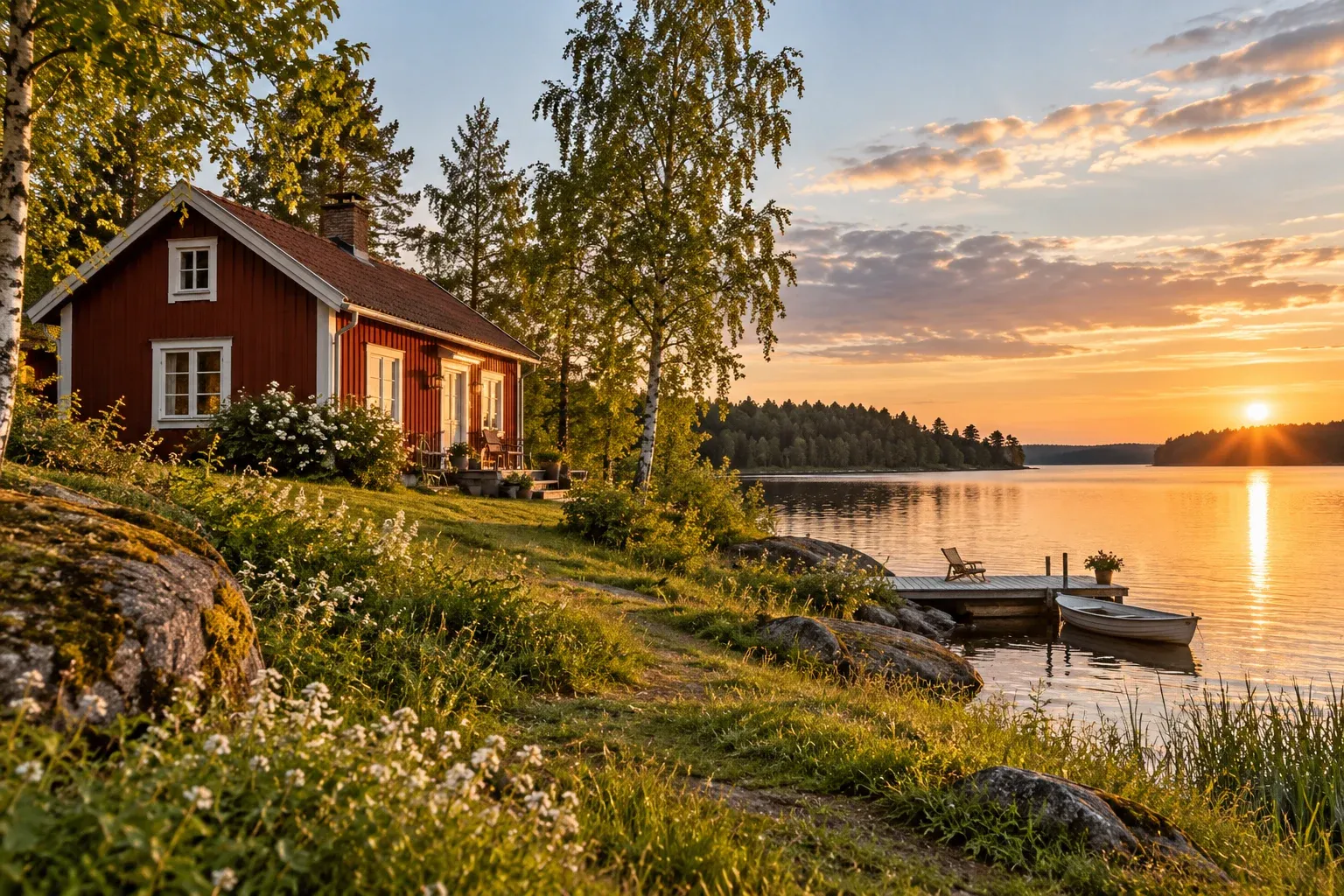
Ask a Swede about July and the answer usually involves a cottage. Here is how many there are, how a noble privilege became a family habit, why the houses are red, who owns them, and what it all means when you visit.
When you need this
Your Swedish colleagues have all gone for four weeks and you’d like to know where. Someone has invited you to their stuga (cottage). You’re scrolling a map of red cottages along a lake and wondering who owns them, or whether you can rent one. Or you’re walking a shoreline lined with small houses and aren’t sure where you’re allowed to go.
Sweden’s cottage numbers
The official word is fritidshus (holiday home); in everyday speech it’s a sommarstuga (summer cottage). Statistics Sweden (SCB) counted 633,861 holiday homes in 2025. If you’ve read “about 600,000” elsewhere, that figure is out of date.
Owning one is not the norm, but using one is common:
| Measure | Figure | Year |
|---|---|---|
| Holiday homes in Sweden | 633,861 | 2025 |
| People aged 16–84 with access to a holiday home or caravan | 49% | 2019 |
| Holiday homes with a foreign owner | 38,133 (6%) | 2025 |
| Holiday homes owned by Swedes living abroad | 16,030 | 2025 |
The access figure comes from SCB’s living-conditions survey and counts cottages you own as well as ones you can borrow from relatives or friends, and it includes caravans. That’s the real shape of the culture: the shared family cottage, used by siblings, cousins and grandchildren.
One caveat on the count: SCB defines a holiday home through the property-tax register, as a small house with no one registered as living there. A cottage someone has moved into full-time drops out of the statistics.
How the summer cottage became ordinary
Second homes began as a privilege of the nobility in the 1500s. During the 1900s they spread to ordinary people as Sweden grew richer and moved to the cities, and cottage building peaked in the 1950s and 1960s.
The legal engine was paid holiday. The semesterlag (Annual Leave Act) and its predecessors gave:
| Year | Statutory paid holiday |
|---|---|
| 1938 | Two weeks |
| 1951 | Three weeks |
| 1963 | Four weeks |
| Today | Five weeks (25 days) |
Today’s law also gives employees the right to one block of at least four weeks in June–August, unless something else has been agreed. Four weeks off at once needs somewhere to go, and for millions of Swedes that place is a cottage.
Why the cottages are red
The national image is the small red cottage with white corners (röd stuga med vita knutar), often with a flagpole. The red is Falu rödfärg (Falu red), a paint made from red earth from the copper mine in Falun.
It wasn’t a peasant paint to begin with. In 1573 King Johan III had the roofs of the royal castle in Stockholm painted with it, and for a long time red was an exclusive color for castles and manors. During the 1800s, as Sweden went from poor to prosperous, the paint reached ordinary houses and barns, and the red cottage became a symbol of the country. It’s still made at the mine today, to essentially the same recipe.
Who owns them and where
Most Swedes keep their cottage close to home. A quarter of holiday homes are owned by someone in the same municipality, and 54% by someone in the same county.
| Where | What the 2025 data shows |
|---|---|
| Norrtälje (Stockholm coast and archipelago) | Most holiday homes in Sweden: 27,352 |
| Värmdö (Stockholm archipelago) | 14,709 |
| Gotland | 13,225 |
| Kronoberg county (Småland) | 36% of holiday homes foreign-owned |
| Värmland | 23% foreign-owned |
| Stockholm, Uppsala, Västmanland counties | 0.5% foreign-owned or less |
| Härjedalen (mountains) | Owners from 264 different municipalities |
| Sotenäs (west coast) | Only 3.3% owned by locals |
People living in Stockholm own 82,918 holiday homes, almost one in eight, and are owners in every municipality in the country.
Foreign owners. SCB counts a holiday home as foreign-owned when the owner has no Swedish address and no Swedish personal identity number. Norway leads with 12,095, then Germany (11,478) and Denmark (9,506), with 1,676 from the Netherlands. Swedes living abroad are counted separately. Foreigners buy on the same legal footing as Swedes; our guide to buying a summer house as a foreigner covers the process.
What the cottage habit means for you
July empties the offices. The four-week right, used by millions at once, is why Sweden slows down in July: in July 2026 about 2.1 million people were away on holiday for a whole week. Nothing closes by law, and shops and attractions stay open. Our guide to why Sweden slows down in July has the details.
You can rent the real thing. Owners let their cottages for the weeks they don’t use them, which is why there’s such a large private cabin market. A holiday let falls under the tenancy rules of the Land Code; the new Private Letting Act from 1 July 2026 doesn’t apply to it. Read renting a stuga before you pay, and what to expect in a Swedish cabin before you arrive. Bed linen, cleaning and a well or outhouse are all normal.
The shore is open, the gardens are not. Strandskydd (shoreline protection) bans new buildings, jetties and fences within 100 m of water without a dispensation, which keeps much of the shoreline open to walkers. A government inquiry is preparing a reform due by the end of 2026, but nothing has changed in law yet; see our strandskydd guide. The cottages themselves are private: allemansrätten doesn’t cover a private plot (tomt) and stops at the privacy zone around a home. No law fixes that zone in meters; stay out of sight and earshot.
Invited to a stuga? Ask what to bring. Linen, towels and a hand with the cleaning before you leave are often expected, just as in a rented cottage.
Mistakes to avoid
- Quoting “600,000” holiday homes. The current SCB figure is 633,861 (2025).
- Saying most Swedes own a cottage. About half had access in 2019, counting borrowed cottages and caravans.
- Cutting across a cottage garden to reach the water. Walk around; the plot is outside allemansrätten.
- Booking a July cabin in May. Swedish families want the same weeks. June and late August are easier and just as beautiful.
- Buying by a lake to build a new house or jetty on the shore. Inside the strandskydd zone you’ll need a dispensation, granted only for listed reasons.
Practical information
| Item | What applies | Checked |
|---|---|---|
| Property fee on a holiday home, 2026 | 0.75% of taxable value, max 10,425 kr per residential building | 2026-10-06 |
| Tax if an owner lets the cottage | 40,000 kr plus 20% of the rent deducted; surplus taxed at 30% | 2026-10-06 |
| Renting a cottage for a week | Varies by owner, area and week; see our renting guide | 2026-10-06 |
| Buying a cottage | Prices vary; stamp duty and title rules in our buying guide | 2026-10-06 |
| Statutory holiday | 25 days; right to four weeks in a row in June–August | 2026-10-06 |
FAQ
How many Swedes have a summer house?
Statistics Sweden counted 633,861 holiday homes in 2025. Ownership is a minority, but access is wide: in SCB’s 2019 living-conditions survey, 49% of people aged 16–84 could stay at least a week a year in a holiday home or caravan, their own or one belonging to relatives or friends. The shared family cottage is the typical Swedish arrangement.
Why do so many Swedes own a second home?
Paid holiday made it possible: two weeks by law from 1938, rising to five today. Growing wealth and the move to the cities did the rest, and cottage building peaked in the 1950s and 1960s. Second homes had been a privilege of the nobility since the 1500s; the twentieth century made them ordinary, and many families still share one passed down.
Why are Swedish cottages painted red?
Falu red paint, made from red earth from the Falun copper mine, was first an exclusive color: in 1573 the king had palace roofs painted with it, and manors followed. During the 1800s it reached ordinary houses and barns, and the red cottage with white corners became a symbol of Sweden. The paint is still made at the mine.
Do foreigners own summer houses in Sweden?
Yes. In 2025, 38,133 holiday homes, 6% of the total, had a foreign owner with no Swedish address or personal identity number: mainly from Norway, Germany and Denmark, plus about 1,700 from the Netherlands. In Kronoberg county in Småland, 36% of holiday homes are foreign-owned. Foreigners buy on the same legal terms as Swedes; our buying guide covers the process.
Can I walk past or near someone’s summer cottage?
Yes, on the shore and paths, but not across the plot. Allemansrätten does not cover a private garden and stops at the privacy zone around a home, which no law measures in meters: keep out of sight and earshot. Strandskydd keeps much of the shoreline itself open to the public.
Why does Sweden slow down in July?
Because the law gives employees a right to four consecutive weeks of holiday in June–August, and much of the country takes it at once — often at a cottage. In July 2026 about 2.1 million people were away on holiday for an entire week. Shops and attractions stay open; offices thin out.
Related guides
- Renting a stuga — book a cottage safely and know your rights
- What to expect in a Swedish cabin — linen, cleaning, water and toilets
- Buying a summer house as a foreigner — the legal steps if you want your own
- Why Sweden slows down in July — the holiday system behind the cottage summer
- Strandskydd — why Swedish shores stay open
Facts verified 2026-10-06. Sources: Statistics Sweden (SCB), Isof, Sveriges riksdag, Naturvårdsverket, Skatteverket, Falu Gruva — full register in this topic’s source file. Found something outdated? Tell us and we’ll fix it.