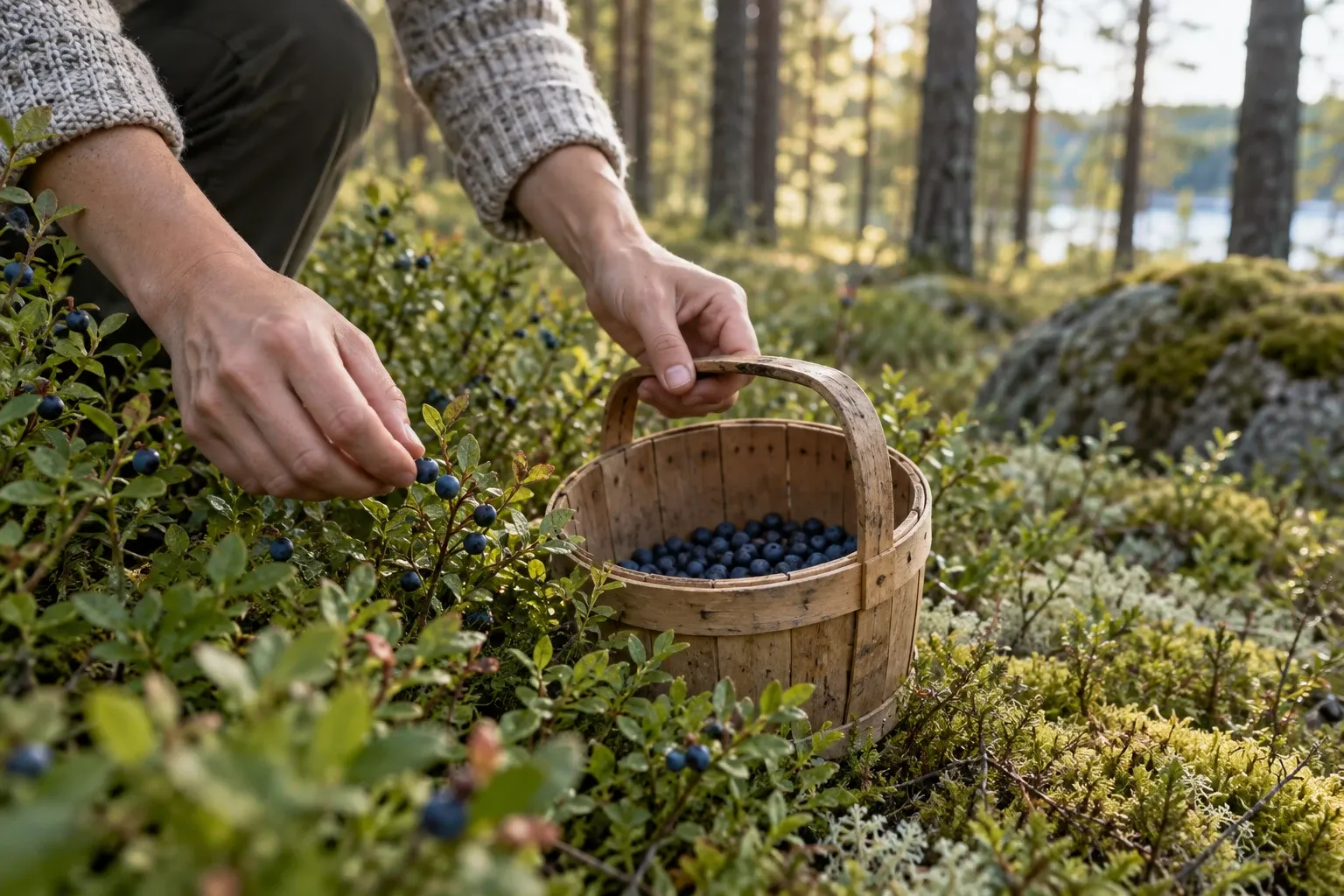
The blueberries in a stranger’s forest are yours to pick. That part is famous. Less well known: you may sell them, the national list of protected flowers changes on 1 November 2026, and freezing berries does nothing against fox tapeworm.
When you need this
You’re on a trail in August and the slope beside it is blue with berries. Or you’re driving north in late July hoping for cloudberries, or you’ve read a warning about fox tapeworm and want to know whether to rinse, cook or skip. Or your child has just eaten a red berry you can’t name.
What you may pick, and where
Picking is part of allemansrätten, the right of public access (see our guide to allemansrätten). No statute lists what the right permits. It is a customary right anchored in the constitution, and picking is allowed because nothing forbids it. The one written duty is to show consideration and care in nature.
In practice that gives you a lot:
| You may | On what terms |
|---|---|
| Pick wild berries | On land you don’t own, without asking |
| Pick ground-growing edible mushrooms | Same terms as berries |
| Pick wild flowers | If not protected, and not in a protected area that forbids it |
| Pick in most nature reserves | Berries and ground-growing mushrooms usually allowed; check the reserve |
| Sell what you picked yourself | Legal; tax-free up to 12,500 kr a year |
There is no quantity limit for ordinary picking. Naturvårdsverket says even large-scale, commercially organised berry picking is not prohibited, though organisers are expected to talk to the landowner and must not cause damage.
Where the right stops
The limits are about place, species and method:
- Gardens and house plots. The plot around a house and the privacy zone around a dwelling are outside the right. The zone has no fixed size; it is judged case by case.
- Cultivated land. Berry farms, crops, planted fruit and garden bushes belong to the grower.
- Living trees. Take nothing from them: no branches, bark or resin.
- Roots and bulbs. Digging up plants is never allowed.
- Tree fungi in reserves. In nature reserves, fungi growing on trees, such as bracket fungi, as a rule may not be picked. Reserve regulations (föreskrifter) are binding, and a few reserves restrict picking further.
- Your car. Driving into terrain on snow-free ground is banned nationwide, and that includes driving to reach a berry slope. Park legally and walk in.
One useful exception: on an abandoned, unkept plot with no building, taking wild-growing apples, cherries, raspberries or gooseberries carries no legal risk, according to guidance quoted by Naturkartan.
Permission from the landowner opens up gardens and fields. It cannot make it legal to pick a protected species. Only a county board dispensation can do that.
Protected plants: the list changes on 1 November 2026
This is the part most English guides get wrong, because it has just changed.
On 14 July 2026 the government amended the Species Protection Ordinance (Artskyddsförordningen, SFS 2026:1504). From 1 November 2026 a new national list applies. According to coverage of the decision, 130 species are added, 102 kept and 182 removed. Common flowers such as blåsippa (hepatica) and gullviva (cowslip) come off the list. All orchids stay protected. Until 31 October 2026 the old list still applies.
The new ordinance sorts protected plants into four tiers:
| Tier | What it means for a picker |
|---|---|
| Strict, enhanced, basic protection | Do not pick, dig up, remove or damage the plant, its seeds or other parts |
| Limited protection (begränsat skydd) | Picking is not banned, but you may not dig or pull the plant up by its roots, or pick it for sale or other commercial purposes |
Protection can be regional. Ramslök (wild garlic), for example, has limited protection only in Kalmar and Stockholm counties. For basic and limited protection, the bans don’t apply where your purpose is obviously not to harm the species, so a hiker who steps on one is not a lawbreaker. Picking one deliberately is a different matter.
The practical rule: if you can’t identify a flower, leave it. Blueberries, lingonberries and cloudberries are not on the national protected list. Orchids always are.
Selling what you pick
The Income Tax Act (Inkomstskattelagen 8 kap. 28 §) makes income from selling wild berries, mushrooms and cones you picked yourself tax-free up to 12,500 kr per tax year. The limit applies per person.
The exemption does not cover:
- cultivated berries, such as strawberries from a field
- picking you are paid to do for someone else
- sales that are part of a business
Above the limit, ordinary income tax rules apply. For most visitors this matters only as a myth-buster. Picking is not restricted to “your own use”.
When berries ripen
Dates shift a week or two with the weather, and the north runs later than the south.
| Berry | Swedish | When | Where |
|---|---|---|---|
| Wild strawberry | smultron | Around Midsummer–July | Sunny edges, the south first |
| Blueberry (bilberry) | blåbär | Midsummer in the south, late July in central Sweden, best from August in Lapland | Spruce and pine forest with mossy floor |
| Raspberry | hallon | July–August | Clearings |
| Cloudberry | hjortron | Mid-July–August | Open bogs in the north |
| Lingonberry | lingon | August–September | Drier pine heath |
Cloudberries follow the same rules as any other wild berry. This research found no Swedish rule that reserves them for landowners or limits who may pick them. In the north, keep clear of reindeer herds, especially at calving, and keep dogs under control.
Late August and September give you ripe berries with far fewer mosquitoes (see mosquitoes in Sweden). Mushroom season runs roughly August to October. Our mushroom-picking guide covers identification.
Staying safe: look-alikes and fox tapeworm
The real risks are identification and hygiene, not the law.
Poisonous berries grow in the same forests as blueberries. Trolldruva (baneberry), ormbär (herb Paris) and try (fly honeysuckle) contain irritants. Poisonings are uncommon but cause stomach upset. Tibast (mezereon) is toxic throughout and burns the mouth even from a couple of berries.
Mushrooms carry the serious risk. Vit flugsvamp (destroying angel), lömsk flugsvamp (death cap) and toppig giftspindling (deadly webcap) are among Sweden’s most poisonous. People confuse them with edible species every year, and serious cases damage the liver or kidneys. Eat only mushrooms you are completely certain of.
If someone eats something they shouldn’t: call 112 in an emergency and ask for poison information. Otherwise call Giftinformationscentralen (the Poisons Information Centre) on 010-456 67 00, around the clock for suspected poisonings. Most tastes of an unknown berry by children cause no or minor symptoms.
Fox tapeworm (rävens dvärgbandmask) occurs in Sweden. The Public Health Agency rates the risk from wild berries, mushrooms and garden vegetables as very low and says they can be eaten as before. The official advice:
- rinse off visible soil and wash your hands before eating
- to remove the risk entirely, cook the berries (jam, sauce): the parasite dies on boiling
- don’t rely on the freezer: the parasite survives freezing
Ticks share the berry habitat, so check yourself after picking in grass and undergrowth (see ticks in Sweden). Berry and mushroom season also overlaps the autumn moose hunt in much of the country, so bright clothing near hunting ground is sensible.
Mistakes to avoid
- Believing picking is only for your own use. Selling is legal.
- Relying on a flower list from before 2026.
- Picking at a berry farm or in a garden because it “looks wild”.
- Freezing berries to kill tapeworm eggs.
- Taking bracket fungi or moss off trees in a reserve.
- Driving down a forest track into the terrain.
- Assuming Norwegian or Finnish rules apply. Each country’s version of the right differs.
Practical information
| Item | Detail |
|---|---|
| Cost of picking | 0 kr, free under allemansrätten |
| Tax-free selling limit | 12,500 kr per person per tax year (own wild picking only) |
| New protected-species list | In force 1 November 2026 (SFS 2026:1504) |
| Emergency / poisoning | 112, ask for poison information |
| Poison advice line | 010-456 67 00, 24/7, free |
| Vehicles | Stay on roads and legal parking |
| Nature reserves | Check the reserve’s föreskrifter on its sign or county board page |
FAQ
Can you pick berries anywhere in Sweden?
Almost anywhere in forest and open country, including private land, without asking. The exceptions: gardens and the area around houses, cultivated berry fields and crops, and nature reserves whose regulations restrict picking. Protected species are off limits everywhere. In most reserves berries and ground-growing mushrooms are still allowed, but check the reserve’s own rules first.
Is it legal to sell berries you picked yourself in Sweden?
Yes. Selling self-picked wild berries, mushrooms and cones is legal, and the income is tax-free up to 12,500 kronor per person per tax year under the Income Tax Act. The exemption does not cover cultivated berries, picking you are paid to do for someone else, or sales that are part of a business. Above the limit, ordinary tax rules apply.
When is blueberry season in Sweden?
Blueberries appear from around Midsummer in the south, from about late July in central Sweden, and are at their best from August in Lapland. Lingonberries follow in August and September, and cloudberries ripen on northern bogs from mid-July into August. Weather shifts every date by a week or two in either direction.
Do I need to wash wild berries because of fox tapeworm?
Rinse off visible soil and wash your hands before eating — that is the official advice. The Public Health Agency rates the tapeworm risk from wild berries as very low and says they can be eaten as before. If you want to eliminate it, cook them: the parasite dies on boiling. Freezing does not kill it.
Which flowers are protected in Sweden?
It depends on the date and the county. From 1 November 2026 a new national list applies: all orchids stay protected, while common species such as hepatica and cowslip are removed. Some plants have limited protection — you may pick them but not dig them up or sell them. If you cannot identify a flower, leave it.
Can I pick cloudberries in northern Sweden?
Yes. Cloudberries are wild berries like any other under allemansrätten; this research found no Swedish rule reserving them for landowners or limiting who may pick them. Stay out of reserves that restrict picking, keep clear of reindeer herds, and remember the bogs they grow on are wet and mosquito-rich. The season runs from about mid-July into August.
Can I pick mushrooms in Sweden?
Yes, ground-growing mushrooms follow the same right as berries, and are allowed in most nature reserves; fungi growing on trees usually are not. The real risk is identification: death cap, destroying angel and deadly webcap all grow in Sweden. Eat only mushrooms you are completely certain of, and call 112 in an emergency.
Related guides
- Allemansrätten explained: the right that makes picking free, and where it stops
- Mushroom picking in Sweden: identification and the species that can kill
- Ticks in Sweden: they live exactly where the berries grow
- Wild camping in Sweden: pitch a tent near the berry slopes, legally
- Vegan and vegetarian Sweden: late summer’s free produce, and what to do with it
Facts verified 2026-09-24. Sources: Sveriges Riksdag, Regeringen, Naturvårdsverket, Länsstyrelsen, Skatteverket (via verksamt.se), Folkhälsomyndigheten, SVA and Giftinformationscentralen. Full register in this topic’s source file. Found something outdated? Tell us and we’ll fix it.