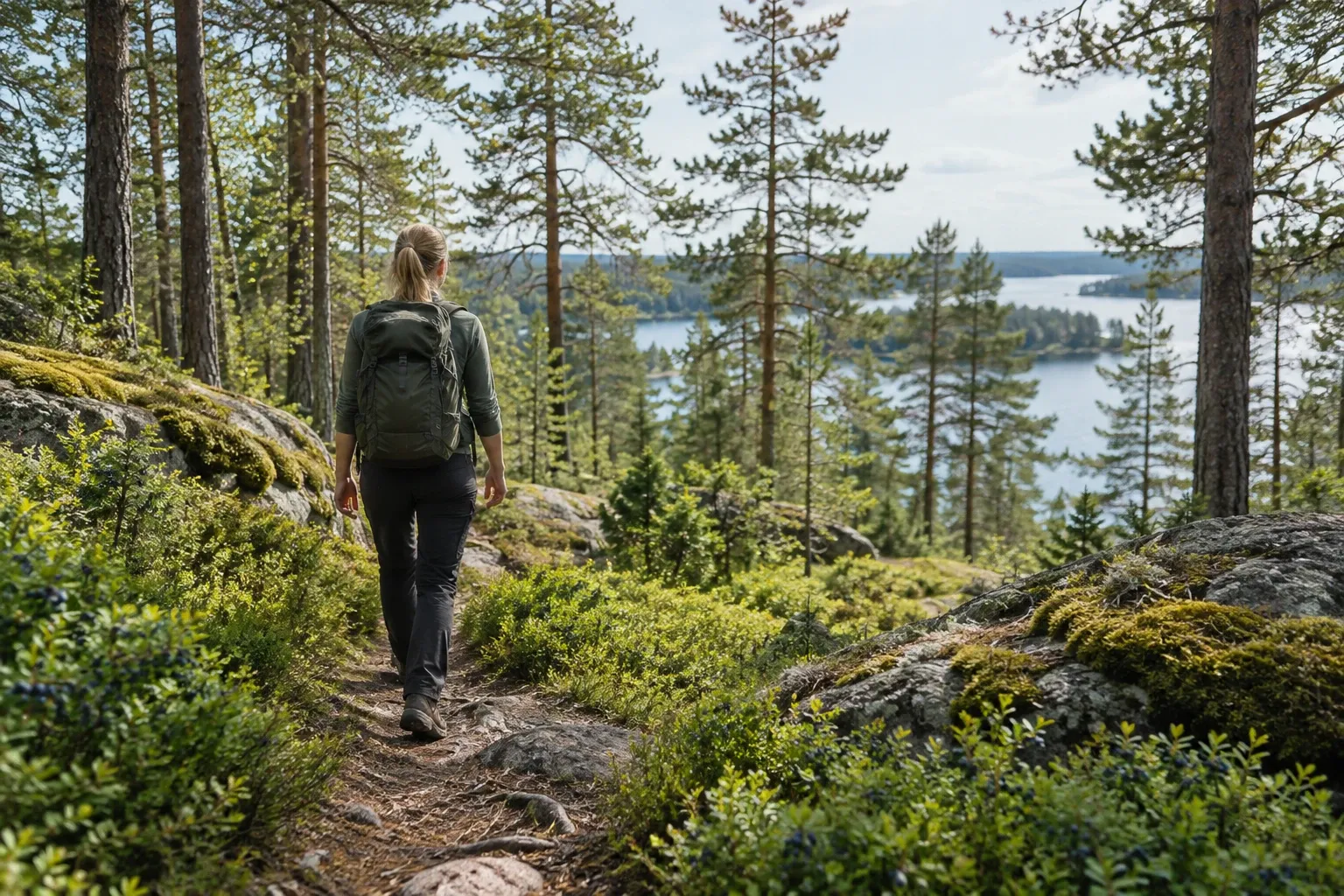
You may cross a stranger’s forest, swim from their shoreline, sleep a night in their woods and eat their blueberries. None of it needs permission. This page explains where that comes from, exactly where it ends, and which widely repeated “rule” about it is not real.
When you need this
You are planning an outdoor trip and want to know what you are entitled to do. Or you are standing on land you do not own, wondering if that is a problem. Or someone told you “in Sweden you can camp anywhere” and you would like the accurate version before you rely on it.
What allemansrätten actually is
Allemansrätten means “everyone’s right”, and it is a genuine legal position rather than Swedish good manners.
It is in the constitution. Regeringsformen chapter 2, section 15 is the provision protecting private property — and it closes with a sentence that overrides its own protections:
Alla ska ha tillgång till naturen enligt allemansrätten oberoende av vad som föreskrivits ovan.
Everyone shall have access to nature under allemansrätten regardless of what is prescribed above.
Read that carefully. Property rights in Sweden are constitutionally guaranteed, and public access to nature is constitutionally guaranteed against them.
But no law says what it permits. This is the part almost every English explanation skips. Allemansrätten is a customary right that the constitution acknowledges rather than creates. There is no statute listing the activities it covers. Its real shape is whatever remains once the laws protecting homes, crops, wildlife and property have taken what they take.
Which is why the honest answer to “is X allowed?” is usually “nothing prohibits it” rather than “a law permits it” — and why it matters enormously whether a rule you have been told is a statute or one agency’s interpretation. This page keeps those apart throughout.
The one duty: inte störa, inte förstöra
The single thing that is written down is the duty. Miljöbalken — the Environmental Code — chapter 7, section 1:
Var och en som utnyttjar allemansrätten eller annars vistas i naturen skall visa hänsyn och varsamhet i sitt umgänge med den.
Everyone who exercises allemansrätten or otherwise spends time in nature shall show consideration and care in their dealings with it.
Swedes compress this into four words every schoolchild learns: inte störa – inte förstöra. Do not disturb, do not destroy.
That is not a friendly slogan attached to the right. In legal terms it is the closest thing the right has to a definition, and it resolves most situations the written rules never anticipated. When you cannot find a rule for your specific case, apply the duty — that is what a Swedish authority would do.
What the right covers
| You may | Notes |
|---|---|
| Walk, hike, run, ski across land you do not own | Including private forest and open ground |
| Cycle in nature and on private roads | Provided no damage results |
| Ride a horse | Same condition; hooves damage soft ground, so more care is expected |
| Swim, paddle, row, sail, land a boat | Along shores and across water |
| Pick wild berries and edible ground-growing mushrooms | For your own use or to sell, on anyone’s land |
| Pick wild flowers | Except legally protected (fridlyst) species |
| Pitch a tent for a night or two | Away from homes, off farmland — see the camping guide |
Two limits inside that list catch people out. Mushrooms growing on trees are not included — the ground-growing edibles are. And you may not dig up plants, seedlings, bulbs or roots; picking is not the same as harvesting.
The most useful framing: this is a right of access and passage, not of use. It lets you be somewhere. It does not hand you the place.
Where the right stops
These are the boundaries that turn a pleasant walk into a legal problem.
Homes and gardens. The right stops at the hemfridszon, the privacy zone around a dwelling, and it does not reach a plot or garden (tomt) at any distance. Unlawfully entering or remaining in someone’s dwelling is hemfridsbrott under the Criminal Code, chapter 4, section 6 — punishable by fines or up to one year’s imprisonment. This is the hard edge, not a courtesy.
Cultivated land. Fields with growing crops, planted forest, seed beds and pasture in use are off limits. “It looks like nature” is not the test; whether someone is growing something on it is.
Living trees. You may never break branches or twigs from a living tree, or take bark, sap or resin. Only loose dry twigs, branches and cones on the ground are yours to gather — not windfall trees, which belong to the landowner (see T0131). This is the most common physical breach visitors commit, usually while collecting firewood.
Motor vehicles — completely. Allemansrätten is a right of non-motorised movement. Separately and independently, the Off-Road Driving Act (terrängkörningslagen, section 1) prohibits driving a motor-driven vehicle in terrain for purposes other than agriculture or forestry throughout the whole country on snow-free ground, plus snow-covered forest land with young growth and snow-covered farmland.
So the freedom that lets your tent go almost anywhere does not let your car leave the road. County guidance treats electric bikes and other motorised vehicles as outside the right too — stricter than most visitors assume.
Hunting and fishing. Neither is part of the right. Hunting belongs to the landowner. Fishing needs a permit, with one large statutory exception: free fishing with hand gear along the entire coast and on Sweden’s five biggest lakes — Vänern, Vättern, Mälaren, Hjälmaren and Storsjön. There are exceptions — no crayfish in the lakes, no salmon on the northern coast, no trolling behind a boat on the east coast or in the lakes; see fishing in Sweden.
Littering. A criminal offence in Sweden, not a tidiness issue.
The 70-metre rule is not real
Search in English for how far from a house you may camp and you will be told 70 metres, confidently, on site after site.
No Swedish statute states any distance for the hemfridszon. We checked the five statutes that govern this topic — the constitution, the Environmental Code, the Criminal Code provision on hemfridsbrott, the Off-Road Driving Act and the dog supervision law — and none contains a figure. Naturvårdsverket, the agency that actually interprets allemansrätten, declines to give one, saying the size cannot be stated because conditions vary case by case.
The number appears to be a loose generalisation of individual court outcomes concerning specific properties. It is not a rule, and treating it as one fails in both directions:
| Situation | Why 70 metres misleads |
|---|---|
| Dense forest, broken terrain | The zone is smaller; you may be fine much closer |
| Open field or meadow | Long sightlines make the zone considerably larger |
| Across water, or a shoreline cabin | Sound and sight both carry; 70 m can be plainly inside |
| Passing through vs. camping overnight | The distance expected grows with how long you stay |
Use the test Swedish authorities actually use: sight and sound. If you can see into their windows, or hold a conversation they can hear, you are too close. It needs no measuring, and unlike a number it self-corrects for terrain.
And the distance expected of you grows with what you intend to do: walking past a house needs almost nothing, sitting down to eat needs more, sleeping there needs considerably more.
Dogs: what the law actually says
You will see this described everywhere as koppeltvång — compulsory leashing — between 1 March and 20 August. The statute says something slightly different, and the difference is worth knowing.
Lag (2007:1150), section 16: between 1 March and 20 August, dogs must be kept under such supervision that they are prevented from running loose in areas where wildlife is present. The word “leash” does not appear.
In practice this is a distinction without much freedom attached: in open nature a leash is the only dependable way to satisfy the requirement, and that is what signage and every county board will tell you. But the legal test is control, not equipment — and outside that period the duty does not vanish, it softens: a dog must still be prevented from chasing wild animals.
Protected areas override everything
Sweden has 31 national parks and more than 5,000 nature reserves, and their density is highest exactly where visitors want to go.
Each one carries binding local regulations — föreskrifter — that can restrict or entirely remove parts of allemansrätten: camping, fires, cycling, riding, landing a boat, or access itself, often seasonally. The signs at the boundary carry legal force. “It was only one night” is not a defence.
This is the one check that can invalidate the whole right in a single step, so make it first. The Naturkartan app maps reserves and their rules in English. Municipalities can also prohibit activities in specific parks and beaches by local ordinance, marked with signs.
Practical information
| Item | Detail |
|---|---|
| Constitutional basis | Regeringsformen 2 kap. 15 § |
| Statutory duty | Miljöbalken 7 kap. 1 § — consideration and care |
| The principle | Inte störa, inte förstöra |
| Cost | Free — it is a constitutional right, and there is no permit |
| Privacy zone size | No statutory distance; judged case by case |
| Working test near homes | Out of sight, out of earshot |
| Home privacy breach | Hemfridsbrott — fines or up to 1 year imprisonment |
| Dog period | 1 March – 20 August, supervision preventing loose running |
| Motor vehicles | Excluded; terrain driving prohibited nationwide on bare ground |
| Hunting / fishing | Outside the right; fishing free with hand gear on the coast and 5 largest lakes |
| Protected areas | Binding föreskrifter override the right |
| Landowner permission | Free, and beats every rule of thumb on this page |
FAQ
What is allemansrätten?
It is Sweden’s right of public access: the right to move freely on foot, by bike, on horseback or by boat across land and water you do not own, to swim, to pick berries and mushrooms, and to camp briefly. It is anchored in the constitution, which guarantees access to nature regardless of property protections. The duty attached is to disturb nothing and destroy nothing.
Is allemansrätten actually a law?
Partly. The constitution guarantees it exists, and Miljöbalken 7 kap. 1 § imposes the duty of consideration on everyone using it — both are statute. But no law lists what it permits. Its content is customary, defined mainly by the statutes that limit it: hemfridsbrott, the terrain-driving ban, hunting and fishing law, and protected-area regulations.
How far from a house can I camp under allemansrätten?
There is no legal distance. The “70 metres” figure repeated across travel sites appears in no Swedish statute, and Naturvårdsverket explicitly says the privacy zone varies case by case with terrain and vegetation. The working test is sight and sound: out of view, out of earshot. Open ground and shorelines require considerably more clearance than dense forest.
What is not allowed under allemansrätten?
Entering a home’s privacy zone or a garden, crossing cultivated land and pasture in use, damaging or taking anything from living trees, driving any motor vehicle off-road, hunting, fishing without a permit outside free-fishing waters, picking protected plants, and littering. Protected areas add their own binding restrictions on top.
Can I pick berries and mushrooms on private land in Sweden?
Yes. Wild berries, edible ground-growing mushrooms and wild flowers may be picked for your own use, even on land owned by someone else. You may not pick protected species, take mushrooms growing on trees, or dig up plants, bulbs or roots. Selling what you pick is allowed too; for large-scale commercial picking, talking to the landowner first is recommended.
Do I have to keep my dog on a leash in Sweden?
Between 1 March and 20 August, dogs must be kept under such supervision that they cannot run loose where wildlife is present. The statute does not literally say “leash”, but in open nature a leash is the only dependable way to satisfy it. Outside that period a dog must still be prevented from chasing wild animals.
Does allemansrätten apply in national parks and nature reserves?
Only as far as the area’s own regulations allow. Every national park and nature reserve has binding föreskrifter that can restrict or prohibit camping, fires, cycling, riding, landing a boat or access altogether, often seasonally. These override the general right, and the signs at the boundary carry legal force. Check before you rely on anything.
Does allemansrätten cover campervans and motorhomes?
No. It is a right of non-motorised access. The Off-Road Driving Act prohibits driving a motor vehicle in terrain on snow-free ground throughout Sweden, so a vehicle cannot legally leave the road to reach a wild spot even for one night. Sleeping in a vehicle is legal where the vehicle is legally parked, which is a separate question.
Related guides
- Wild camping in Sweden — the tenting side of this right, in full detail
- Campfires and fire bans — what you may burn, and what a ban suspends
- Sleeping in your car in Sweden — where this right stops and parking law begins
- Wild camping with a motorhome — why the vehicle changes the whole answer
- Berry picking in Sweden — seasons, species and how much you may take
- Refilling water outdoors — the other thing you need when you are out there
Facts verified 2026-07-26. Sources: Sveriges Riksdag (Regeringsformen, Miljöbalken, Brottsbalken, Terrängkörningslagen and the dog supervision act, all quoted from the statute texts), Naturvårdsverket and Länsstyrelsen — full register in this topic’s source file. No distance figure for the privacy zone is published here, deliberately: none exists in law. Found something outdated? Tell us and we’ll fix it.