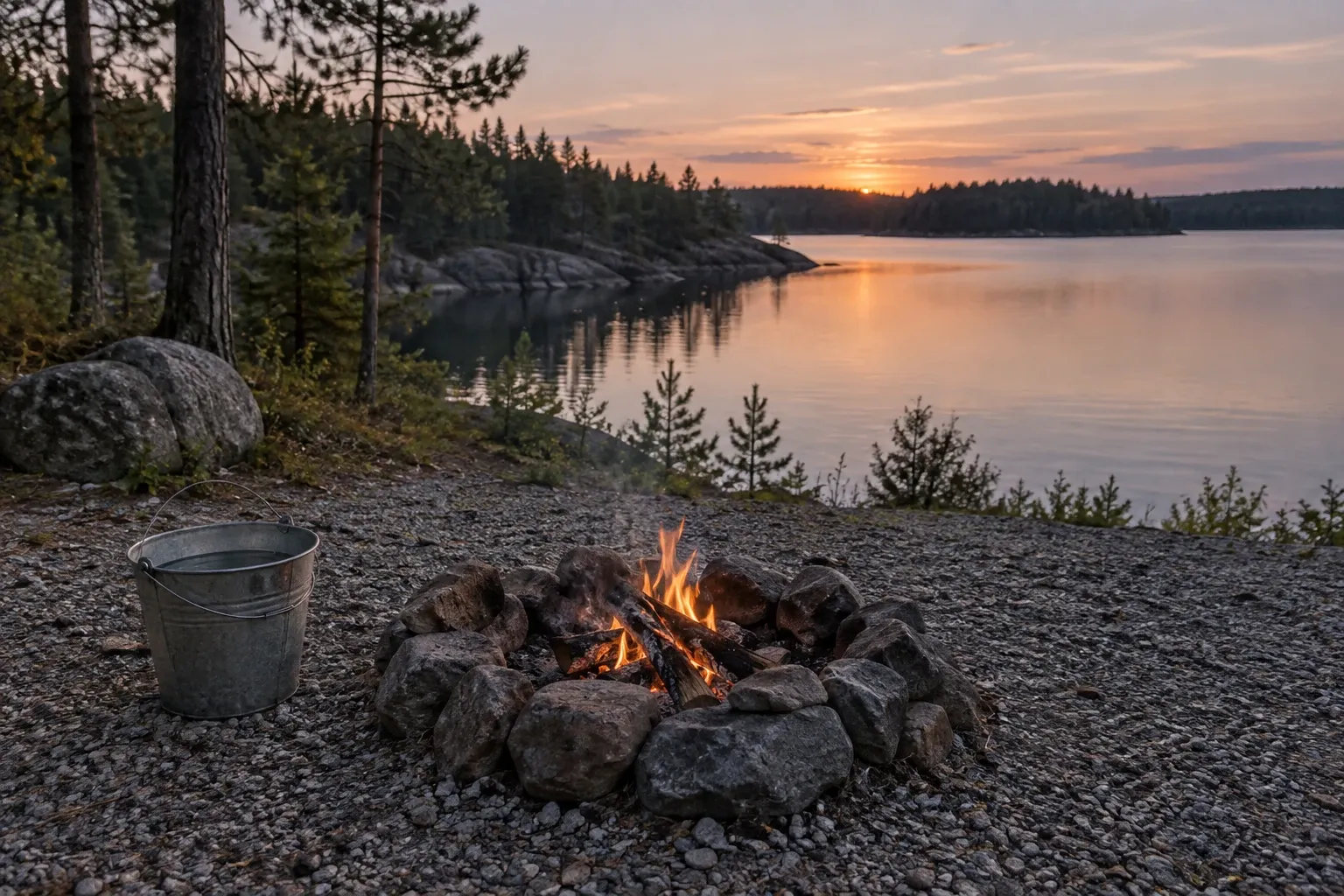
Most guides tell you campfires are allowed in Sweden and leave it there. That’s true for maybe half the summer, in half the country. The useful knowledge is the ban system — and specifically what stays legal when a ban is on, so you can still cook dinner.
When you need this
You’re wild camping and planning to cook over a fire. Or you’re standing at a stone fire ring in July, unsure whether using it is currently legal. Or you’ve seen eldningsförbud on a sign and don’t know what it covers.
A fire is a responsibility, not a right
Allemansrätten permits a campfire. It does not entitle you to one.
The distinction matters legally: you choose the site, you control the fire, and you answer for it if it escapes. That liability doesn’t disappear because the fire was allowed when you lit it. It’s the same logic that runs through all of allemansrätten — broad freedom, paired with responsibility.
Two constants apply whenever fires are permitted at all:
- Never light a fire on or against rock. Heat cracks stone, and the scar is permanent. A smooth granite slab looks like the safest surface available and is one of the worst.
- Firewood means fallen, dead twigs and branches. Taking wood from living trees isn’t covered by allemansrätten.
What an eldningsförbud actually stops
Sweden manages fire risk with bans issued by the county administrative board (Länsstyrelsen), in consultation with the county’s rescue services and based on fire-risk forecasts from SMHI.
Two things follow that visitors routinely get wrong:
Bans are local, not national. One county can be under a total ban while its neighbour is open, and a single day’s drive can cross the line. Municipalities hold the power too, and county bans often name only some municipalities — so check the municipality you are actually in, which is also the granularity of the national fire-risk map. How to do that lookup is covered in fire bans explained.
Bans change with the weather. A dry week can trigger one within days, and it can lift just as quickly.
Under an ordinary eldningsförbud, it is forbidden to light fires, grill, and burn solid fuels in nature. That covers your campfire and your charcoal.
What stays legal during a ban
This is the part worth memorising, because it means a ban doesn’t end your cooking:
| Under an ordinary ban | Allowed? |
|---|---|
| Gas or liquid camping stove (friluftskök) | Yes |
| Grilling on your own plot | Yes |
| Permanent, purpose-built fire places | Yes |
| Open fire in nature | No |
| Charcoal grilling in nature | No |
| Disposable barbecue on the ground | No |
The camping stove is the constant. A stove running on gas or liquid fuel stays legal under both ban tiers, which is exactly why experienced visitors carry one and treat an open fire as a bonus rather than the plan.
The stricter tier: skärpt eldningsförbud
When fire risk goes to extreme, counties can issue a skärpt (stringent) ban. The exemptions shrink:
- Public and fixed fire places are closed too — the pit that was fine last week is not fine now.
- Pyrotechnics are banned.
- Still allowed: cooking on a gas or liquid camping stove in nature, and grilling on your own plot where there’s no risk of spread.
So the practical difference between the tiers is the fixed fire place. Your stove survives both.
Disposable barbecues
The classic visitor mistake. An engångsgrill sets ground alight with startling ease — placed on grass, moss or a wooden picnic table, the heat goes downward as well as up.
During a fire ban, a disposable barbecue is permitted only when placed on top of a permanent fire place built so that ignition and spread cannot occur. Not on the ground. Not on a table. Not on a rock.
Outside a ban they’re legal but still the least safe option available. A camping stove does the same job without the risk.
Building and killing a fire properly
- Use an existing fire place where one exists — it concentrates impact.
- Site it on bare mineral soil or sand, away from rock, tree roots and dry moss. Moss and peat can carry fire underground.
- Carry water to the fire before lighting it, not when you discover you need it.
- Keep it small. A cooking fire needs far less wood than people build.
- Drown it until it is cold to the touch. Not until the flames stop — until you can put your hand in the ashes. Embers in dry ground can smoulder for hours and resurface after you’ve left.
Mistakes to avoid
- Assuming a fire pit that exists is one you may currently use.
- Using a disposable barbecue directly on the ground.
- Building a fire on rock because it looks clean and safe.
- Breaking branches from living trees.
- Assuming the neighbouring county’s ban status applies where you are.
- Leaving a fire that “looks out” without soaking it.
Practical information
| Item | Detail |
|---|---|
| Fire under allemansrätten | Permitted with care; you are liable if it spreads |
| Who issues bans | County administrative board (Länsstyrelsen) or the municipality, with rescue services |
| Basis | SMHI fire-risk forecasts |
| Scope | Regional — varies by county, changes with weather |
| Ordinary ban bans | Fires, grilling, burning solid fuels in nature |
| Ordinary ban allows | Camping stove · own plot · permanent fire places |
| Stringent ban also bans | Fixed and public fire places · pyrotechnics |
| Stringent ban allows | Camping stove · own plot (no spread risk) |
| Disposable barbecue | Only on a fixed fire place during a ban |
| Penalty for breach | Fines (böter) |
| Firewood | Fallen, dead wood only |
FAQ
Can you make a campfire in Sweden?
Yes, allemansrätten permits it, but as a responsibility rather than a right — you choose the spot, control the fire and are liable if it spreads. It is prohibited whenever the county has issued an eldningsförbud, which happens regularly in dry summers. Always check the current status for the county you are in before lighting anything.
What does eldningsförbud mean?
It is a fire ban issued by a county administrative board together with the rescue services, based on SMHI fire-risk forecasts. Under an ordinary ban you may not light fires, grill or burn solid fuels in nature. Grilling on your own plot, using permanent fixed fire places, and cooking on gas or liquid camping stoves remain allowed.
Can I use a camping stove during a Swedish fire ban?
Yes. A camping stove running on gas or liquid fuel remains permitted under both an ordinary ban and the stricter skärpt eldningsförbud, provided it is used carefully and not on flammable ground. This is why experienced visitors carry a stove and treat open fires as an optional extra rather than the cooking plan.
Are disposable barbecues allowed in Sweden?
Only with care, and during a fire ban only when placed on top of a permanent fire place built so ignition and spread cannot occur. Used directly on grass, moss or a wooden table they readily set the ground alight, which is why they are the classic visitor mistake. A camping stove is the safer and more reliable choice.
What is a skärpt eldningsförbud?
A stringent fire ban. In addition to the ordinary prohibition it closes public and fixed fire places and bans pyrotechnics. Cooking on a gas or liquid camping stove in nature is still allowed, as is grilling on your own plot where there is no risk of spread. It is issued when fire risk is extreme.
What happens if you break a fire ban in Sweden?
Breaching a ban, whether deliberately or through carelessness, is punishable by fines. Beyond the penalty, you can be held liable for the cost and consequences of a fire that spreads. Because bans are county-level and change with the weather, “I did not know” is neither a defence nor difficult to avoid — the status is published by each county.
Related guides
- Wild camping in Sweden — the allemansrätten rules this sits inside
- Refilling water outdoors — the other thing you need at a camp
- Swedish campsites — where fire pits are provided and maintained
- Allemansrätten explained — the right of public access in full
- Fire bans in detail — how to check and what changes
Facts verified 2026-07-25. Sources: Naturvårdsverket (the Swedish EPA), MSB, Länsstyrelsen, municipal rescue services — full register in this topic’s source file. Fire-ban status changes daily and is never published here; always check your county. Found something outdated? Tell us and we’ll fix it.