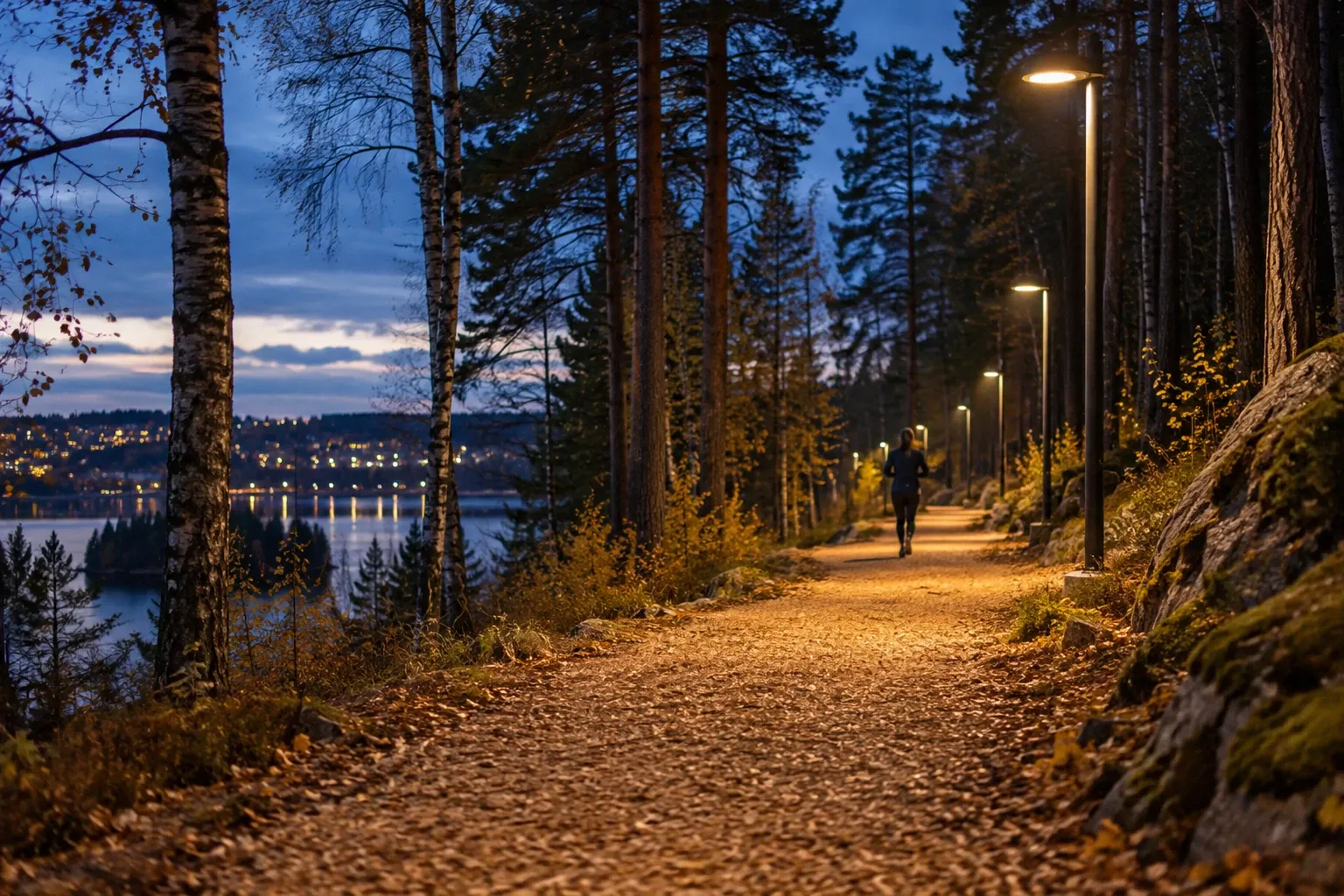
That line of lamp posts disappearing into the forest behind the sports ground is public, free and meant for you. Here is what it is, when the lights go off, who may bring a bike or a dog, and what changes when the snow comes.
When you need this
You are staying in a Swedish town between October and March, the sun sets in the middle of the afternoon, and you want to run or walk somewhere that isn’t a pavement. Or you have spotted a lamp-lined path into the trees and want to know whether you may use it, and whether it will still be lit at 22:30.
It also matters when the season turns. The wood-chip trail you ran on in October may have ski grooves in it the morning after the first real snowfall, and the rules for using it change with them.
What an elljusspår is
Elljusspår means, word for word, “electric-light track”. It is a motionsspår (exercise trail) with floodlights along it. Statistics Sweden (SCB) defines it exactly that way, as an elbelyst motionsspår, using the national mapping agency Lantmäteriet’s definition, and leaves unlit trails out of its count.
On the ground, a typical one looks like this:
- A marked loop, or several. Many towns run a set of colour-coded loops of different lengths from one starting point. Alingsås’ Nolhaga has four lit loops, from 1.5 to 4.6 km, marked with colour on the trees.
- A soft surface. Wood chips (flis) or bark chips (barkflis) are the norm; a few loops are paved.
- On the edge of town. Some run through forest, others start at a sports ground, as Stockholm’s own trail pages put it.
- Owned by the municipality. The town lights it, maintains it and, in many places, grooms it for skiing.
Most were built in a burst from the 1960s to the early 1980s. University research describes state grants that helped municipalities and clubs pay for lit trails and changing rooms in that period; many trails have outlived the changing rooms and saunas built with them.
English-language pages, including skiing guides, usually translate elljusspår as “floodlit ski track”. That is half the story. It is a year-round running and walking trail that becomes a ski track when there is enough snow. Our cross-country skiing guide covers the ski side; this page covers the trail itself.
How many, and where
SCB counts nearly 1,700 sites with a lit trail, and 1,475 of them lie within 1 km of a town or village. Nationally, 32% of the population lives within 1 km of one. The figure is from a page last updated in 2021. Municipalities don’t have to report trails to Lantmäteriet, so the true number may be higher.
The spread is uneven, and it follows the dark:
| Area | Share of residents within 1 km of a lit trail |
|---|---|
| Västerbotten | 60% |
| Norrbotten | 49% |
| Västernorrland | 47% |
| Stockholm urban area | 30% |
| Gothenburg | 35% |
| Malmö | 17% |
| Skåne (county) | 18% |
| Gotland | 10% |
The top municipalities are Upplands Väsby north of Stockholm (91%), Kiruna (82%) and Arvidsjaur (75%). If you are staying anywhere in the north, a lit trail is very likely within walking distance.
When the lights are on
There is no national rule. Each municipality sets its own hours, with a timer, a dusk sensor or an astronomical clock that follows sunrise and sunset. What the sources agree on is the shape: lights come on early in the morning and again at dusk, and go off for the night, most often between 22:00 and 23:00.
| Municipality | Lighting hours |
|---|---|
| Lerum | 06:00–23:00, when it is dark |
| Kiruna | 06:00–23:00 daily |
| Umeå | From 06:00 until daylight, again from dusk; off automatically between 22:00 and 23:00 |
| Mjölby (Vifolkavallen) | Astronomical clock; off between 22:00 and 05:00 |
Two practical points follow. A run that starts at 22:00 can end in a dark forest, so carry a headlamp if you set out late. And in the light summer evenings, lights that run only when it is dark barely come on: the trail is simply a forest running path.
If a stretch of lights is broken, tell the municipality through its fault-report service (felanmälan), usually linked from the trail page.
Free, with one exception
Ordinary municipal lit trails cost nothing and need no booking. Sweden’s right of public access, allemansrätten, is written into the constitution, and a trail on municipal land is open to everyone on foot (see the right of public access).
There is one exception worth knowing. Naturvårdsverket, the Swedish Environmental Protection Agency, says a compulsory fee is possible only where a track is a facility in the legal sense, and it names lighting among the investments that can make it one. In practice that matters at ski stadiums in winter. Östersund’s stadium fee covers its 5.0 km lit exercise trail from the day the ski tracks open until grooming stops. The rest of the year, and on the ordinary trail behind your hotel, you walk in for free.
Bikes, dogs and buggies
The trail is built for people on foot. Other users fit in on these terms:
| You are | The rule | Type |
|---|---|---|
| Cycling | No general ban, but give way to walkers and runners and ride slowly | Official guidance |
| Cycling where signs say Cykelåkning förbjuden | Not allowed | Local regulation |
| Riding or driving a motor vehicle in Mjölby’s trails | Not allowed | Local regulation |
| With a dog, 1 March–20 August | Must not run loose where there is wildlife; in practice, a leash | National law |
| With a dog on Mjölby’s lit trails | Leash all year | Trail owner’s rule |
| Pushing a buggy or using a wheelchair | Look for a paved loop; wood chips are soft | Local practice |
The bike rule comes from Naturvårdsverket: exercise trails are meant for walking and exercise on foot, but nothing nationally bans cycling. A municipality can ban it through local traffic or public-order regulations, and some do. Mjölby, for example, forbids motor vehicles, riding and cycling on its trails at Vifolkavallen.
For dogs, the national rule runs from 1 March to 20 August. In those months, dogs must be kept from running loose wherever there is wildlife, and a forest trail is such a place. Breaking it can lead to a fine. Our leash law guide has the rest of the year and the exceptions.
Paved lit loops are rarer but exist. Lerum’s Trygghetsrundan at Stenkullen is a 1.6 km asphalt loop round the sports ground. A loop like that is the one to look for with a buggy or a wheelchair.
When the snow comes
After a snowfall, many municipalities set ski tracks on their lit trails. Lerum grooms all its lit trails except the paved Stenkullen loop. From then on, the national ski federation’s track rules apply. Walking or running in a prepared ski track during the snow season is not allowed under its rules, and the municipalities that groom them say the same. Kiruna’s page says so outright.
So:
- Check before you go. The municipal page, or the status site it points to, shows whether a trail is groomed. Lerum sends readers to Skidspår.se.
- Walk at the edge, never in the grooves. Footprints ruin them for every skier after you.
- Pick another trail. An ungroomed or paved loop keeps runners and walkers out of the skiers’ way.
- Check the dog rules for ski tracks. Some owners allow dogs only at set times or on the skate side.
Want to ski the lit trail yourself? See cross-country skiing for visitors for borrowing skis, track etiquette and which tracks charge.
Getting there in the dark
The trail is lit; the road to it often is not, at least not well enough for drivers to see you. Trafikverket, the Swedish Transport Administration, puts numbers on it. In dark clothes without a reflector, an oncoming driver on dipped headlights sees you at 20–30 m. In light clothes it is about 60 m, and with a reflector about 125 m.
Its advice:
- Wear reflectors low on your legs and arms, where they move.
- Wear them in town too: street lights help you see, not others see you.
- Replace them every three years or so, and buy ones marked SIS or CE.
Trafikverket’s page sets no legal requirement for pedestrians to wear a reflector; it is advice. If the walk to the trailhead crosses icy pavements, our guide to walking on ice covers grit, cleats and footwear.
Practical information
| Item | Detail |
|---|---|
| Price | Free on ordinary municipal trails, no booking |
| Exception | Ski-stadium trails in ski season; Östersund’s day card was 90 kr per adult on 2026-09-25 (page names no season) |
| Typical length | 1.5–5 km per loop |
| Typical surface | Wood or bark chips; a few paved loops |
| Lights | Set by the municipality; most off between 22:00 and 23:00 |
| Dogs | No loose dogs 1 March–20 August; some trails require a leash all year |
| Bikes | Allowed unless signed otherwise; walkers have priority |
| Winter | Many trails groomed for skiing after snowfall; don’t walk in the grooves |
| Find one | Municipal website (“elljusspår”, “motionsspår”); many municipalities list theirs on Naturkartan under “Lighted trails” |
FAQ
What is an elljusspår?
An elljusspår is a floodlit exercise trail, usually a marked loop of 1.5 to 5 km through a town forest, surfaced with wood chips or gravel. Statistics Sweden counts nearly 1,700 sites with one, and a third of Swedes live within a kilometre of one. They are built for running and walking after dark, and many are groomed for skiing once snow falls.
Are elljusspår free to use?
Yes, ordinary municipal lit trails are free and need no booking, because the right of public access applies. The exception is a trail that is part of a ski facility in winter: Östersund’s stadium ticket covers its lit 5 km exercise loop from the day the ski tracks open until grooming stops. Naturvårdsverket lists lighting among the investments that can make a fee lawful.
What time do the lights go off on an elljusspår?
It depends on the municipality, but most switch off between 22:00 and 23:00. Lerum and Kiruna light their trails from 06:00 to 23:00 when it is dark, Mjölby’s astronomical clock is off from 22:00 to 05:00, and Umeå’s lights go off automatically between 22:00 and 23:00. Check the local page, and carry a headlamp on late runs.
Can I walk or run on an elljusspår in winter?
Yes, until it is groomed for skiing. Once snow falls, many municipalities set ski tracks on their lit trails, and walking or running in a prepared track breaks the ski federation’s and the owners’ rules. Walk at the very edge, or choose a trail that is not groomed: Lerum, for example, leaves its paved Stenkullen loop free of ski tracks.
Can I take my dog on an elljusspår?
Usually yes. From 1 March to 20 August Swedish law says dogs must not run loose where there is wildlife, which on a forest trail means a leash. Some owners require a leash all year: Mjölby welcomes dogs on its lit trails only on a leash. In ski season, check the local dog rules for groomed tracks.
Can I cycle on an elljusspår?
Often, but walkers come first. Naturvårdsverket says exercise trails are for people on foot and there is no general cycling ban, so ride slowly and give way. A municipality can ban cycling through local regulations, and some do: Mjölby forbids cycling, riding and motor vehicles on its exercise trails. A sign reading “Cykelåkning förbjuden” means no bikes.
How do I find an elljusspår near me?
Search the municipality’s website for “elljusspår” or “motionsspår”. Stockholm has its own trail search page, and many municipalities list their trails on Naturkartan, a regional outdoor map, under “Lighted trails”. In winter, the municipality’s page or Skidspår.se shows whether the trail is groomed. The north has the most: 60% of Västerbotten’s residents live within 1 km of one.
Related guides
- Cross-country skiing for visitors — the same lit trails in winter, with track rules and where a pass is needed.
- Polar night: Sweden’s dark season — why the lights matter from October to March.
- Utegym: Sweden’s free outdoor gyms — the strength half of the workout, often beside the trail.
- Sweden’s leash law — the full dog rules beyond the trail.
- What to pack for Sweden in winter — layers for running in the cold and dark.
Facts verified 2026-10-14. Sources: SCB, Naturvårdsverket, Trafikverket, Sveriges Riksdag, Svenska Skidförbundet, and the municipalities of Lerum, Mjölby, Alingsås, Stockholm, Kiruna, Umeå and Östersund — full register in this topic’s source file. Found something outdated? Tell us and we’ll fix it.