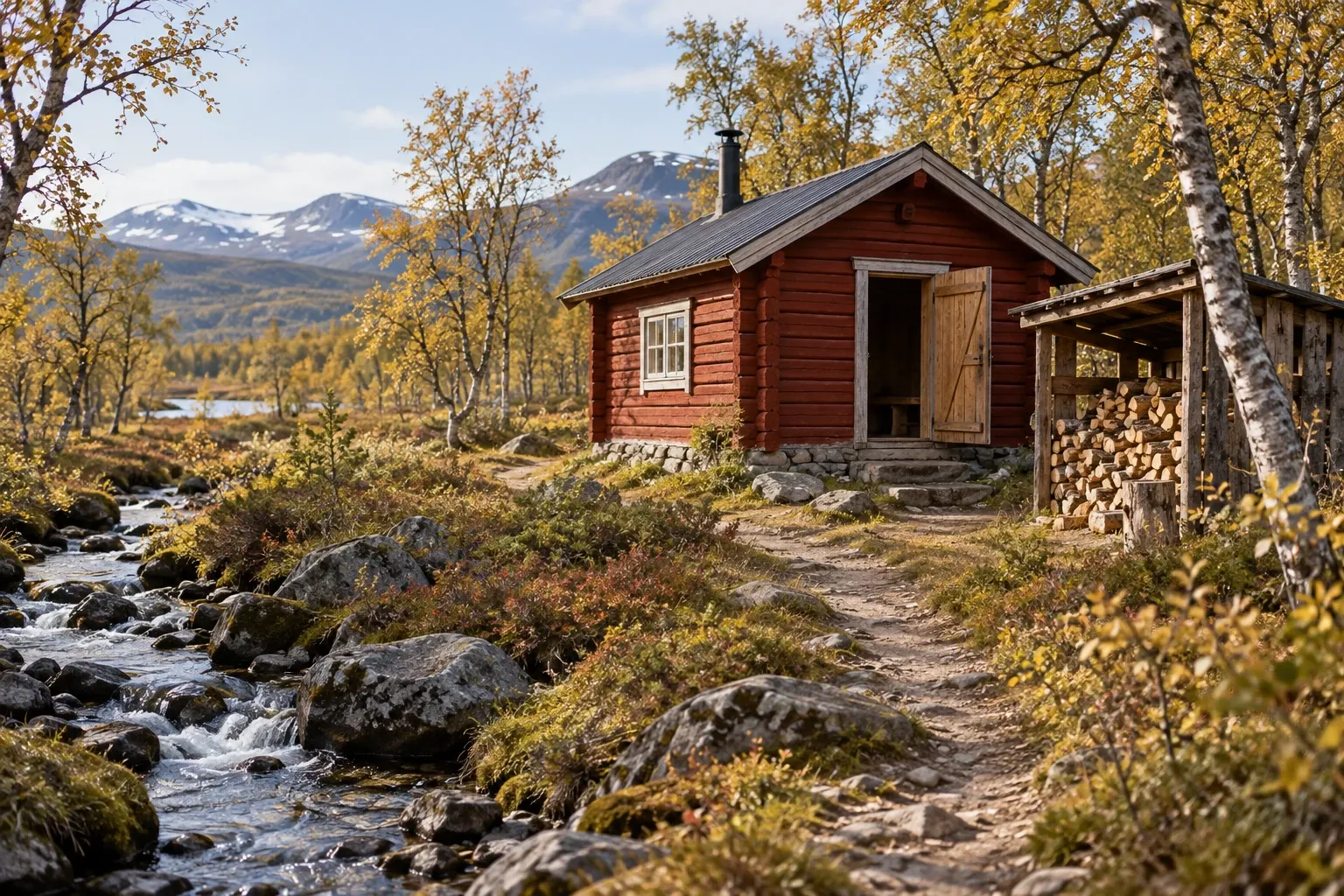
Swedish trail maps are dotted with huts, but only some of them are beds. This guide sorts the huts outside the Swedish Tourist Association’s network into the four kinds you will meet, and tells you which you may sleep in, how to pay and what to pack.
When you need this
You are planning a hike or ski tour and the map shows a hut that is not run by the Swedish Tourist Association (STF). Or you have arrived at an unlocked cabin and found people already inside. Or the weather has turned and you are standing outside a rest shelter, wondering whether you may spend the night. You may also be following an older guide that lists a hut that no longer exists.
Two related kinds of shelter have their own guides. STF’s staffed mountain huts, with wardens, shops and prebooking, are covered in STF mountain huts and stations. The open three-walled lean-tos on lowland trails are in wind shelters (vindskydd). This page covers everything in between: the enclosed huts and cabins run by the county boards (Länsstyrelsen), the national parks and Laponiatjuottjudus, the body that manages the Laponia World Heritage area.
Four kinds of hut
Most overnight huts in Sweden’s roadless mountains are STF’s, but not all. Outside STF, the huts on county-board and national-park pages fall into four kinds, and the kind decides everything:
| Kind | Swedish | Sleep there? | Book? | Pay? |
|---|---|---|---|---|
| Overnight cabin | övernattningsstuga | Yes, a night or two | No: first come, shared | Free or a fee per bed |
| Simple cabin | koja (Västerbotten) | Yes | No | Free |
| Rental cabin | uthyrningsstuga | Yes, the whole cabin | Yes, online, prepaid | Yes, at booking |
| Rest hut or rest shelter | raststuga, rastskydd | Emergencies only | No | Free |
The state trail system in the mountains runs to about 5,500 km of marked trails through Dalarna, Jämtland, Västerbotten and Norrbotten. Naturvårdsverket, the Swedish Environmental Protection Agency, is responsible for it, and the county boards and Laponiatjuottjudus maintain the trails, bridges and rest shelters. The counties differ a lot: Västernorrland keeps about thirty year-round open huts in its coastal reserves and park, while Jämtland’s county board manages 41 rest shelters and leaves overnight huts mainly to STF.
Overnight cabins: unlocked, unbookable, shared
An övernattningsstuga is the closest Sweden comes to a free mountain hut. It has bunks or beds, usually mattresses, a wood stove and firewood, and sometimes a gas cooker and simple kitchenware. The door is unlocked and you cannot book. You share with whoever turns up.
Some are free. Skuleskogen National Park on the High Coast has six simple cabins open all year at no charge, and Västerbotten’s kojor cost nothing either. Others charge a small fee per bed, paid on trust by the slip or notice in the hut. Fulufjället National Park’s always-open huts and Västerbotten’s county-board stugor charge one; Muddus/Muttos National Park in Laponia has five year-round cabins paid the same way. Amounts are in the table under Practical information.
The rules are about sharing:
- Give way after a night. In Skuleskogen you may stay two nights at most, and anyone who has slept one night must make room for new arrivals. Västerbotten asks the same, and gives hikers and skiers priority to the beds.
- Bring your own sleeping bag and pillow. In winter some cabins have their mattresses removed, so carry a sleeping mat.
- Cook on your own stove. Firewood is delivered by snowmobile once a year, in late winter, and in busy cabins it can run out by late autumn. The county boards tell visitors to carry a camping stove in reserve.
- Leave no food. Food and packaging draw mice; everything goes out in your pack.
- Dogs are welcome in the cabins of several county boards and in Skuleskogen, but not on mattresses, blankets or beds.
Rest huts and rest shelters: breaks and emergencies only
This is the rule that catches most visitors. A raststuga (rest hut) has tables and benches, often a stove, but no beds. In the mountains the state rest shelters (rastskydd) sit roughly halfway between overnight huts. They are for breaks and for shelter from bad weather. You may sleep in one only in an emergency.
Fjällsäkerhetsrådet, the state mountain-safety council, sets out the rules:
- Never plan a night there. In a real emergency there is always room for anyone who needs a roof, even if the people inside have to move up.
- Never use a camping stove indoors. Any stove and any fuel can cause carbon-monoxide poisoning or a fire.
- Light the wood stove only in an emergency. Check that the ventilation is open, burn for at most 2–3 hours at a time, then let it rest as long.
- Close the door properly when you leave, or the wind can break it.
- Sign the guest book. If something happens to you, your entry helps mountain rescue.
Many rest shelters have a help phone that connects to an alarm centre and is marked on the mountain map. Some have a sack of emergency wood; Västerbotten’s county board asks you to report it if you used it.
Rental cabins: book the whole cabin
Some county boards also let whole cabins (uthyrningsstugor). In Dalarna you book online and pay in full at booking, and the code to a key box on the wall arrives by email. You bring sheets or a sleeping bag and clean before you leave. Some sites, such as Hävlingestugorna in Långfjället, are let only while the county board’s warden is there.
Rental cabins are the only kind you can reserve. If your plan depends on any other hut, it depends on luck, so pack a tent.
Gåsen has closed: check before you go
STF’s Gåsen hut in the southern Jämtland mountains has been closed since 1 January 2024, and there has been no accommodation or service on the site since. The closure followed a new lease agreement between STF and the county board, reached after an agreement between STF and the area’s Sámi reindeer-herding communities. The county board has built a new rest shelter about 400 m south-west of the old site, on the trail towards Helags. It is for emergencies only, and the board says visitors need mountain experience and a tent.
Guides written before 2024 can still show Gåsen as a hut stop. Jämtland’s county board warns that trails and facilities can be moved, changed or closed, and that an old map can be an unpleasant or even dangerous surprise. Check the county board’s current page for every hut you plan to use. For the trails around it, see Jämtlandstriangeln.
Paying from abroad
County-board huts do not take cash on site. You pay by Swish, Sweden’s mobile payment app, or by bank transfer, using the slip or notice in the hut. Swish needs a Swedish bank account and BankID, so most visitors pay by transfer. Västerbotten’s county board publishes an IBAN and BIC for payments from abroad on its huts page. In Fulufjället you can also pay by card or cash at the park’s visitor centre.
Hut etiquette and safety
- Leave it ready for the next person. Clean up, carry in wood and split some kindling.
- Never fell a dead standing tree (torraka) when the woodshed is empty. Dalarna’s county board points out that they are valuable to many threatened insects and birds.
- Carry out all rubbish. There is no waste collection in the mountains, and littering is illegal.
- Do not dry-sweep a dusty cabin in the north. Sorkfeber (vole fever) spreads through dust from vole droppings, mostly north of the Dalälven river. Spray with detergent and wipe wet instead.
- The indoor stove is legal during a fire ban. Swedish fire bans cover fires outdoors in forest and land. An outdoor campfire is another matter; see campfire rules.
- Private means private. A cabin that is not public belongs to someone. Entering another person’s building without permission is olaga intrång (unlawful intrusion) under the Swedish Criminal Code, punishable by fines or up to a year in prison.
Mobile coverage near huts ranges from fair to none. Leave a travel plan with someone at home, and mark the help phones on your map; mountain safety in Sweden explains both.
Practical information
| Item | Amount or rule (checked 2026-10-15) |
|---|---|
| Rest hut or rest shelter | Free; overnight in emergencies only |
| Skuleskogen National Park overnight cabin | Free; two nights at most |
| Västerbotten koja | Free |
| Västerbotten county-board stuga | 200 kr per person per night; ages 0–15 free |
| Dalarna county-board overnight cabin | 100–200 kr per bed per night, varies by cabin |
| Fulufjället overnight cabin | 200 kr per bed; under 16 half price; day use 40 kr |
| Muddus/Muttos overnight cabin | Fee per night, paid by the slip in the cabin |
| Dalarna rental cabin | Price on the booking page; fully prepaid; full charge if cancelled within 7 days |
| Rental cabin left uncleaned (Dalarna) | 500 kr |
| Payment | Swish or bank transfer; IBAN for payments from abroad on Västerbotten’s page |
FAQ
Are there free huts in Sweden you can just walk into?
Yes, but fewer than many hikers expect. County boards run unlocked overnight cabins in some national parks and nature reserves, such as Skuleskogen’s six free cabins and Västerbotten’s free kojor. Others charge a small fee per bed. None can be booked, so you share with whoever arrives and may have to give way after a night. Carry a tent.
Can I sleep in a rest shelter (rastskydd) in the Swedish mountains?
Only in an emergency. Rest shelters sit about halfway between overnight huts and are meant for breaks and shelter from bad weather, not planned nights. In a real emergency there is always room for anyone who needs a roof. Never use a camping stove inside, and burn the wood stove only in emergencies, for at most 2–3 hours at a time.
What is the difference between a raststuga and an övernattningsstuga?
A raststuga is a rest hut with tables and benches, often a stove, but no beds; it is for breaks and, in the mountains, emergencies. An övernattningsstuga is an overnight cabin with bunks or beds, usually mattresses, a stove and firewood. Overnight cabins are first come, first served and shared, and some charge a small fee per bed.
Can I book a wilderness hut in Sweden?
Only rental cabins. County boards let some whole cabins through an online booking system, fully prepaid, with the key-box code sent by email. Unlocked overnight cabins and rest huts cannot be booked at all. STF’s staffed mountain huts are a separate system with their own prebooking. If your plan depends on an unbookable cabin, pack a tent.
How do I pay for a Swedish wilderness hut without Swedish cash or Swish?
Use the payment notice or slip in the hut. County-board huts take Swish or bank transfer, and Swish needs a Swedish bank account, so a visitor usually pays by bank transfer instead. Västerbotten’s county board publishes an IBAN and BIC for payments from abroad. In Fulufjället you can also pay by card or cash at the visitor centre.
What should I bring to an open hut in Sweden?
Pack as if the hut were full or cold. Bring a sleeping bag, a sleeping mat (some cabins lose their mattresses in winter), a camping stove in case the firewood has run out, a cooking pot and warm clothes. Add a tent as a fallback, a rubbish bag for everything you carry in, and matches.
Is the Gåsen hut in Jämtland still open?
No. STF’s Gåsen hut has been closed since 1 January 2024, and there has been no accommodation or service on the site since. The county board built a new rest shelter about 400 m south-west of the old hut site, towards Helags, but it may be used overnight only in an emergency. Visitors need mountain experience and a tent.
Related guides
- STF mountain huts and stations — the staffed, bookable huts most mountain hikers use.
- Wind shelters (vindskydd) — the open lean-tos on lowland trails, also free and unbookable.
- Wild camping in Sweden — where you may pitch the tent when the hut is full.
- Mountain safety in Sweden — travel plans, help phones and weather before you rely on a hut.
- Skuleskogen National Park — six free cabins on the High Coast, and how the park’s rules work.
Facts verified 2026-10-15. Sources: Fjällsäkerhetsrådet, Länsstyrelsen Norrbotten, Jämtland, Dalarna, Västerbotten and Västernorrland, Sveriges nationalparker (Naturvårdsverket), Folkhälsomyndigheten, MCF, Sveriges riksdag (Brottsbalken 4 kap. 6 §), SVT — full register in this topic’s source file. Found something outdated? Tell us and we’ll fix it.