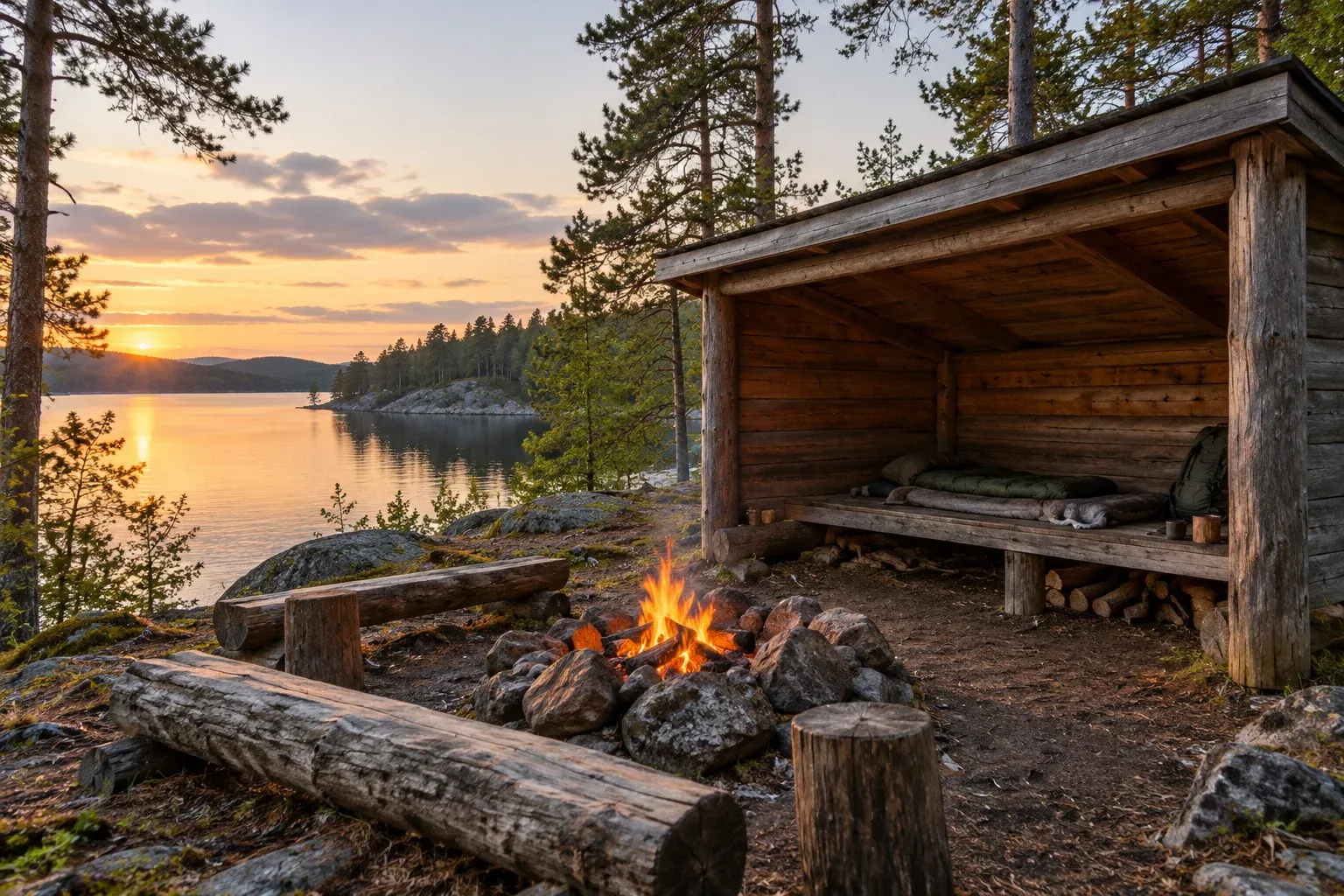
Those little hut symbols on Swedish trail maps are real, free and open to you. But they are shared, small and unbookable, and the firewood is not always there. Here’s how to use them without a cold surprise.
When you need this
You’re planning a multi-day walk on a lowland trail and wondering whether you can leave the tent at home. You’ve reached a shelter at dusk and there are already people in it. You’ve spotted a vindskydd symbol in the Naturkartan app, or you’re standing in front of a fire ring wondering whether you’re allowed to light it. This page covers all of it.
What a vindskydd is, and who builds it
A vindskydd — literally “wind protection” — is a simple timber lean-to: three walls, a roof, an open front, usually a raised wooden floor for sleeping bags and a fire place in front. They stand along hiking trails, by lakes and in nature reserves and national parks. Anyone may stop to rest, eat or sleep.
There is no national owner. Lowland trails, the ones outside the state mountain system, are run by regions, municipalities and trail associations. Naturvårdsverket (the Swedish Environmental Protection Agency) has coordinated that work since 2017 and hosts a voluntary quality framework for lowland trails, but it owns no shelters.
| Trail | Responsible body | What you’ll find |
|---|---|---|
| Bergslagsleden (Örebro County) | Region Örebro län | A rest site with shelter, fire place, woodshed and toilet on all 17 stages |
| Skåneleden | Region Skåne | Camp sites with usually one shelter, dry toilet, fire place, firewood, bin, water |
| Sörmlandsleden | Trail association | Shelters built and renewed by the association itself — a new one at Bötet on stage 36:1 in 2026 |
No booking: first come, first served
This is the single most important fact. Skåneleden’s operator says it plainly: camp sites and shelters cannot be booked in advance — först till kvarn (first come, first served). There is usually only one shelter per camp site, sleeping 6–8 people.
So the operator’s advice is to carry a tent, especially in high season. Nobody has to leave to make room for you, and a full shelter at 21:00 with no tent means a night in the open.
There are exceptions. A few shelters are bookable — on Skåneleden, the three at Hovdala (Birk, Birka and Ronja) must be booked ahead through the operator. Treat these as the rare case, not the rule.
The unwritten rules — and where they become law
Outside protected areas, no statute says how to use a shelter. What exists is a shared-resource etiquette that Swedes take seriously:
- Make room. Keep your gear compact so latecomers can fit.
- One night. Move on the next day. It matches Naturvårdsverket’s “one or two nights” rule of thumb for tents.
- Leave it clean. Pack out everything if the bin is full or missing.
- Tent nearby if it’s full. On Skåneleden, pitching next to a camp site is usually allowed.
In national parks and nature reserves, the etiquette can become binding regulation. In Tyresta National Park, near Stockholm, the park regulations forbid using the existing shelters for an overnight stay more than one night in a row, and fires are allowed only at designated places. Where a reserve or park bans camping, it is signposted, and on Skåneleden a camping ban also covers hammocks.
Fire, firewood and stoves
Most shelters have a fire ring in front, and the fire is half the charm. Three things to know:
A fire ring that exists is not one you may currently use. Under an ordinary eldningsförbud (fire ban) from the county or municipality, permanent fixed fire places may stay open; under a stringent ban they close too. Check the status for the municipality you are in before lighting anything — breaching a ban means fines, and you are liable if a fire spreads. See campfire rules and fire bans for the two tiers.
Firewood is common but never guaranteed. Every Bergslagsleden stage has a woodshed. But Skåneleden’s operator warns that wood is sometimes stolen, or simply burned faster than it is restocked, and advises bringing your own wood, charcoal or a camping stove.
Never cook on a stove inside a shelter. Fjällsäkerhetsrådet, the mountain safety council, says camping stoves are for outdoor use only — every type and every fuel — because of carbon-monoxide poisoning and fire risk. Cook in the open in front of the shelter.
Mice, voles and the dust warning
Shelters are dry, sheltered and full of crumbs, so rodents move in. Keep food sealed or hung in your pack overnight.
In northern Sweden there is a specific reason to care. Folkhälsomyndigheten (the Public Health Agency) says sorkfeber — vole fever, caused by the Puumala hantavirus — is largely confined to areas north of the Dalälven river and spreads mainly by inhaling dust contaminated with bank-vole urine and droppings. If a shelter floor is dusty and full of droppings, don’t dry-sweep it. The agency advises spraying with detergent and wiping with a wet cloth, wearing gloves, and washing your hands afterwards.
Lowland vindskydd vs mountain rastskydd
Don’t confuse the two. In the mountains, the closed huts along the state trails are rastskydd (rest shelters), and they work differently.
| Lowland vindskydd | Mountain rastskydd | |
|---|---|---|
| Building | Open front, three walls | Closed hut with a door |
| Overnight use | Yes, one night, shared | Emergencies only, not planned nights |
| Booking | No (rare exceptions) | No |
| Stove inside | Never | Never |
| Wood stove | Usually a fire ring outside | Indoor stove, emergency use only |
For huts you can actually sleep in up north, see STF mountain huts.
Practical information
| What | Detail |
|---|---|
| Price | Free to use |
| Booking | Not possible on public trails; a few operator exceptions (e.g. Hovdala in Skåne, terms set by the operator) |
| Capacity | Often one shelter per camp site, sleeping 6–8 (Skåneleden) |
| Stay | One night — a binding rule in some parks, such as Tyresta |
| Firewood | Often supplied, never guaranteed |
| Fire | At the fire ring only, and only without a fire ban |
| Finding them | Naturkartan app and map; trail organisations’ stage pages |
| Health | In the north, avoid stirring up vole-dropping dust |
FAQ
Can you book a vindskydd in Sweden?
Almost never. Shelters on public trails are first come, first served, and Skåneleden’s operator states plainly that its camp sites and shelters cannot be booked in advance. A handful of operators run bookable shelters as an exception, such as three at Hovdala in Skåne. Otherwise, carry a tent in case the shelter is already taken when you arrive.
Can you sleep in a wind shelter in Sweden?
Yes. Open lowland shelters along trails and lakes are meant for resting and overnight stays, free of charge. Keep it to one night and share the space with anyone who turns up. In some national parks, such as Tyresta, staying more than one night in a row is prohibited by the park’s regulations. Mountain rest shelters are different: emergencies only.
What if the shelter is already full?
You make do with what you carry. Shelters typically sleep only 6–8 people, and nobody has to leave for you. Pitch a tent nearby where camping is allowed — usually fine next to trail camp sites, but check the signs in parks and reserves. That is why trail operators recommend carrying a tent, especially in high season.
Is there firewood at Swedish wind shelters?
Often, but not always. Many trails stock a woodshed — every Bergslagsleden stage has one, for example — but Skåneleden’s operator warns that wood is sometimes stolen or burned faster than it can be refilled. Bring your own wood, charcoal or a camping stove if you depend on hot food, and check for a fire ban first.
Can I make a fire at a vindskydd?
Usually, at the fire ring provided, unless a fire ban is in force. Under an ordinary eldningsförbud permanent fixed fire places may still be used; under a stringent ban they close too. In national parks and reserves, fires are generally allowed only at designated places. Never move the fire closer to the timber shelter.
How do I find vindskydd?
Use Naturkartan, the national outdoor map and app, which lists trails, nature reserves and shelters, much of it published by municipalities and regions. Trail organisations such as Skåneleden, Sörmlandsleden and Bergslagsleden also mark shelters on their stage maps and websites. Check the stage page before you go, as operators post closures and damage there.
Related guides
- Wild camping rules — what allemansrätten allows when the shelter is full and the tent comes out.
- Hiking in Sweden — lowland versus mountain trails, and how to plan stages.
- Campfire rules and fire bans — the two ban tiers and what stays legal.
- Skåneleden — a trail with a shelter at most camp sites.
- Tyresta National Park — where the one-night shelter rule is law.
Facts verified 2026-10-06. Sources: Region Skåne (Skåneleden), Länsstyrelsen Stockholm, Fjällsäkerhetsrådet, Naturvårdsverket, Folkhälsomyndigheten, Region Örebro län, Föreningen Sörmlandsleden — full register in this topic’s source file. No current fire-ban status is published here; check your municipality. Found something outdated? Tell us and we’ll fix it.