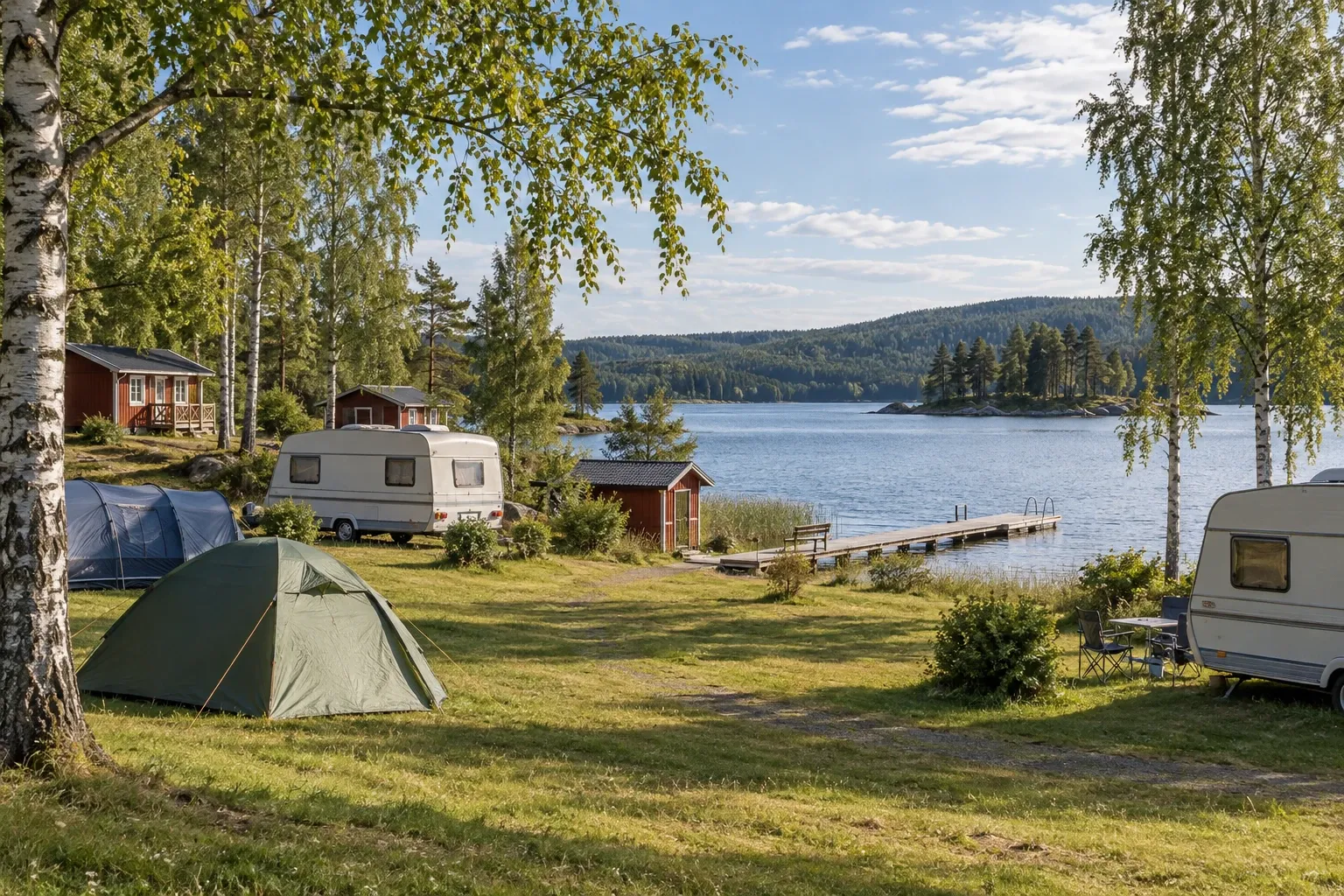
If you have read that Swedish campsites require you to buy a camping card, you have read something that stopped being true in 2019 — and it is still the most common piece of advice on the subject.
When you need this
Planning a camping trip and hitting the camping-card question. Deciding whether Camping Key Europe is worth the fee. Or the forecast has turned and you’re looking for cheap roofed accommodation.
You do not need a camping card
For years, checking in at a Swedish campsite meant buying a camping card. SCR Svensk Camping — the industry association for Swedish campsites — abolished that obligation at the start of 2019.
What remains is a registration requirement, not a purchase one. You still identify yourself at check-in. You just don’t have to pay for the privilege.
The distinction matters because the old advice is everywhere, and acting on it means paying an annual fee for something you would have got free.
Camping ID: the free alternative
At campsites affiliated with SCR, you check in with either:
| Camping ID | Camping Key Europe | |
|---|---|---|
| Cost | Free | Annual fee |
| Covers check-in | Yes | Yes |
| Campsite discounts | No | Yes, Sweden and Europe |
| Accident & liability insurance | No | Yes, family covered |
| Validity | — | 12 months from purchase |
Camping ID is free and obtained either at the campsite itself or by downloading the association’s app. For most visitors, that is the entire answer.
Note that non-SCR campsites — municipal sites, small private ones, farm campsites — set their own arrangements and may not use this system at all.
When Camping Key Europe is worth buying
It is a genuine benefits product, not a scam. It just isn’t compulsory.
The card provides campsite discounts across Sweden and Europe, quicker check-in, and accident and liability insurance covering the family, for 12 months from purchase.
The honest calculation:
- One short trip: rarely pays for itself. Take the free Camping ID.
- Several weeks of touring, or annual return visits: the discounts and the insurance can comfortably justify the fee.
Check the current price before buying — it is an annual commercial figure and card variants differ.
Cabins are the sector’s best-kept secret
Here is the thing most visitors miss entirely: most Swedish campsites rent cabins (stugor).
They range from simple sleeping huts — four walls, bunks, no plumbing — to fully equipped cottages with kitchen and bathroom. And they are frequently the cheapest roofed accommodation available in an expensive country, well below hotel rates.
This makes them the answer to the classic Swedish camping problem: three days of rain. Outside July you can often book at short notice.
Season: roughly May to September
Swedish campsites are more seasonal than most of Europe’s.
The bulk of the sector operates roughly May to September, with a sharply concentrated peak in July, the Swedish holiday month. A minority stay open year-round, mainly near ski areas and cities.
If you are travelling in May or September, verify opening dates with the individual site rather than trusting a listing. Arriving at a closed campsite in a remote area is a genuine problem, not an inconvenience.
In July, book pitches and especially cabins ahead. Coastal and lakeside sites fill.
What a pitch costs
Pricing is structured rather than flat, and it varies enough by site and season that any published figure would mislead:
- Per pitch, commonly plus a per-person charge
- Electricity is usually extra — ask when booking
- Showers carry a charge at some sites
- July is the most expensive period of the year across the sector
- Cabins are booked as accommodation, at higher rates than a pitch but well below a hotel
Check the individual site for current rates. For how campsites compare with the free and cheap alternatives, see wild camping and motorhome stopovers.
Mistakes to avoid
- Buying Camping Key Europe believing it is mandatory.
- Assuming the card system applies at every campsite, including non-SCR ones.
- Turning up in May or September without checking opening dates.
- Overlooking cabins and paying for a hotel when the weather breaks.
- Parking overnight in a campsite car park without checking in — it’s private property.
- Expecting allemansrätten to apply inside a campsite’s grounds. It doesn’t.
Practical information
| Item | Detail |
|---|---|
| Camping card required? | No — abolished at the start of 2019 |
| Check-in | Free Camping ID, or Camping Key Europe if you have one |
| Camping ID | Free, from the campsite or the association’s app |
| Camping Key Europe | Optional · annual fee · 12 months from purchase |
| Card benefits | Discounts in Sweden and Europe · faster check-in · accident and liability insurance |
| Season | Roughly May–September; a minority year-round |
| Peak | July — book ahead |
| Pitch pricing | Per pitch, usually plus per person; electricity extra |
| Cabins | Widely available; cheapest roofed option at many sites |
| Non-SCR sites | Own arrangements; the Camping ID system may not apply |
FAQ
Do I need a camping card for Swedish campsites?
No. The requirement to buy a camping card was abolished at the start of 2019. At campsites affiliated with SCR Svensk Camping you check in with either a free Camping ID, available through the campsite or the association’s app, or a Camping Key Europe card if you own one. A great deal of travel advice still wrongly says the card is compulsory.
What is Camping Key Europe and is it worth buying?
It is an optional benefits card, valid 12 months from purchase, providing campsite discounts in Sweden and Europe, faster check-in, and accident and liability insurance for the family. It is not required for access. For one short trip it rarely pays for itself; for several weeks of touring or annual return visits, the discounts and insurance can justify the fee.
What is a Camping ID?
The free alternative to the paid card. It identifies you at check-in at SCR-affiliated Swedish campsites and can be obtained at the campsite itself or by downloading the association’s app. It exists precisely because purchasing a card is no longer compulsory, and it is what most visitors should use.
Are Swedish campsites open all year?
Most are not. The bulk of the sector operates roughly May to September, with a concentrated peak in July. A minority stay open year-round, mainly near ski areas and cities. If you are travelling in May or September, verify opening dates with the individual site rather than relying on a listing, particularly in remote areas.
Can you rent cabins at Swedish campsites?
Yes, and it is one of the sector’s best-value offers. Most campsites rent stugor ranging from simple sleeping huts to fully equipped cottages, usually well below hotel prices. They are especially worth knowing about when the weather turns during a camping trip. Book ahead for July; short notice is often fine outside the peak.
Is wild camping allowed at a Swedish campsite?
No — that is a contradiction. A campsite is private property, so allemansrätten does not apply inside its grounds, and pitching or parking overnight without checking in is not permitted. The right of public access applies to unfenced land away from homes, which is a different setting entirely.
Related guides
- Wild camping in Sweden — the free alternative and what it permits
- Wild camping with a motorhome — ställplatser versus campsites
- Sleeping in your car in Sweden — where campsites fit in the budget
- Refilling water outdoors — once you leave the serviced site
- Campfires and fire bans — including at provided fire places
Facts verified 2026-07-25. Sources: Camping.se (SCR Svensk Camping), Swedish hospitality trade press, Caravan Club of Sweden — full register in this topic’s source file. Card prices and site opening dates change; check before booking. Found something outdated? Tell us and we’ll fix it.