Sweden is the easiest card country most visitors will ever travel in. Acceptance is not the interesting question — it’s a solved problem. The two things that actually cost travellers money and time are a button on a terminal and a four-digit number they’ve forgotten.
When you need this
Packing, and deciding which cards to bring. Or a terminal is turned toward you asking “EUR or SEK?” and you have three seconds. Or you’re at a fuel pump in the countryside that wants a PIN you’ve never used.
Acceptance: the boring good news
Riksbanken’s Payment Report 2026 gives the picture in three numbers:
| Measure | Share |
|---|---|
| In-store purchases made by card | 92% |
| People using a card or card-in-phone | 98% |
| Paid cash at their most recent purchase | 5% |
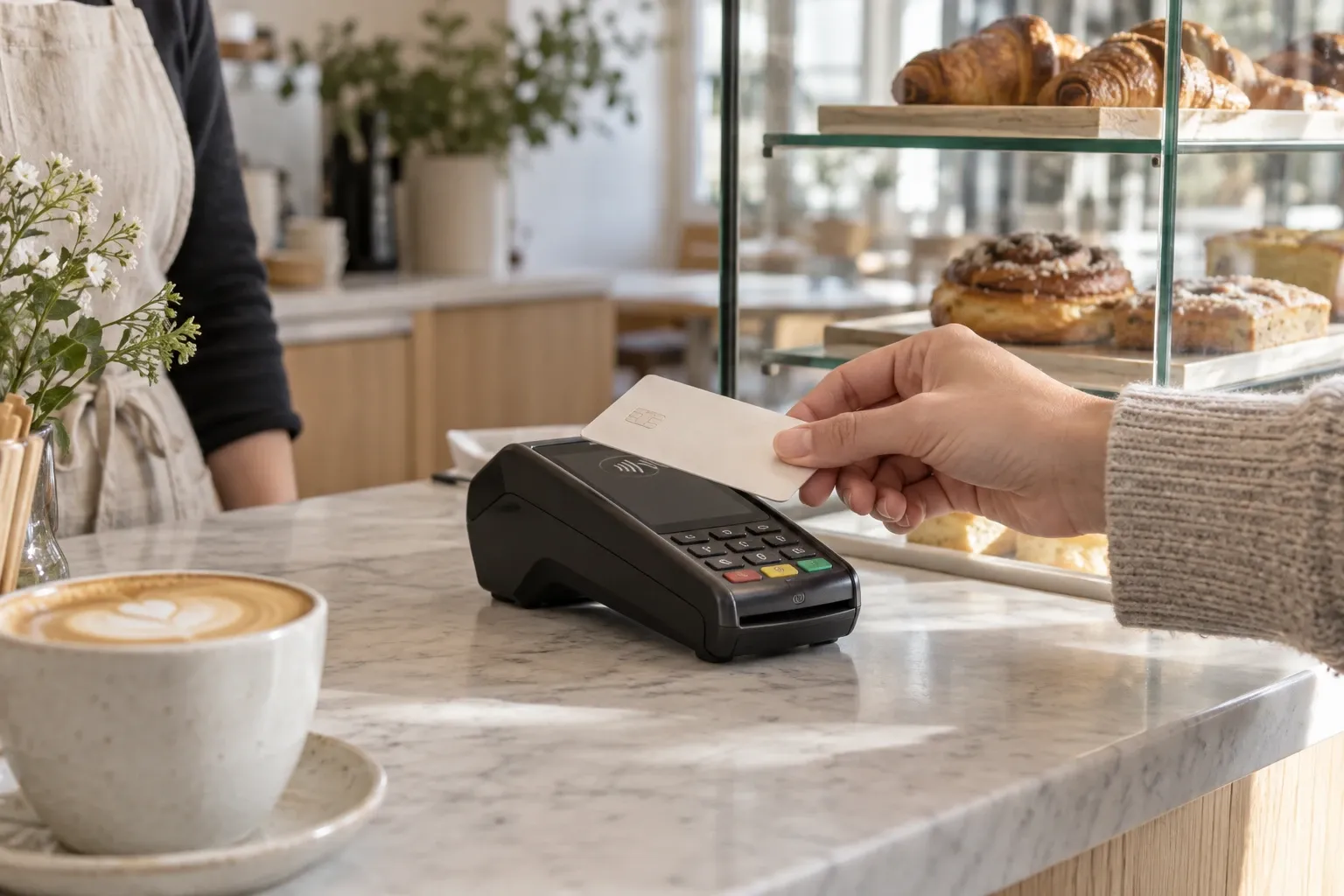
Visa and Mastercard are accepted essentially universally, including for very small amounts — there’s no minimum-spend culture and no card surcharge. Contactless is the default, and Apple Pay and Google Pay work wherever cards do.
One consequence catches people out: most Swedish businesses are entitled to refuse cash, and many do. “I’ll just pay cash” is not a reliable fallback here.
The exception is new. Since 1 July 2026, grocery stores and pharmacies with a staffed checkout must accept cash for small payments. So food and medicine are covered; the café, the museum and the bus are not. Full detail in can you pay with cash in Sweden?.
Rule one — always choose kronor
This is the one that quietly costs money.
When a card terminal or ATM asks whether you’d like to be charged in your home currency instead of kronor, it is offering dynamic currency conversion (DCC). It looks like a courtesy — you see a familiar currency, so you know what you’re spending. What’s actually happening is that the merchant’s payment provider converts the transaction at a rate it chooses, rather than letting your own bank do it at the interbank-based rate.
That rate has the provider’s margin built in and is typically worse than your bank’s, and it sometimes carries an added fee. Sweden’s consumer bureau says paying in the local currency is usually cheapest, and card-scheme rules say the merchant must offer you the choice and must not make it for you. Documented Swedish cases have produced double-digit markups on a single withdrawal.
So: always press the option showing SEK / kronor. Every time, at every terminal, including ATMs. If the machine is facing away from you and staff are pressing the buttons, say “kronor” out loud — they’ll do it.
Your own bank’s foreign-transaction fee still applies either way. That’s a separate, unavoidable cost; DCC is the avoidable one stacked on top.
Rule two — know your PIN
Contactless handles ordinary shopping. But Sweden is full of unmanned terminals, and they frequently want a chip-and-PIN transaction:
- Fuel pumps
- Parking machines
- Ferry gates
- Some self-service kiosks and self-checkouts
If you tap for everything at home, you may genuinely not know your PIN — and it cannot be recovered standing at a pump on a Sunday evening in rural Sweden. Look it up before you travel, for every card you bring.
While we’re at the pump: fuel pumps place a pre-authorisation hold larger than your actual purchase, released some days later. It’s normal, and it startles anyone watching a tight balance.
American Express and the other schemes
This is the acceptance gap that matters. American Express is taken by many hotels and larger retailers, and frequently declined by smaller shops, restaurants and transport operators. It’s fine as a secondary card, and a poor choice as your only one.
Diners Club, Discover, UnionPay and JCB are niche in Sweden — don’t build a trip around them.
Bring two cards from different schemes — one Visa, one Mastercard — and keep them in different places. In a near-cashless country, a single blocked or damaged card is a real problem rather than an inconvenience.
What your bank charges you
The costs that exist are yours, not Sweden’s:
- Foreign transaction fee — set by your bank, typically a small percentage. Check it before travelling; it’s the only card cost you can’t dodge.
- ATM withdrawal fees — your bank’s, plus whatever the operator charges.
- DCC markup — entirely avoidable, per rule one.
Swedish shops themselves add nothing. The price on the label is what you pay, at any amount.
Mistakes to avoid
- Pressing “yes” to home-currency billing because it looks helpful.
- Bringing only American Express.
- Assuming contactless covers everything and never learning the PIN.
- Planning to fall back on cash at a card-only business.
- Not telling your bank you’re travelling, then having the card blocked.
- Being alarmed by a fuel-pump pre-authorisation hold.
Good to know
- Add both cards to your phone wallet. Phone contactless often works smoothly where a physical reader is awkwardly placed.
- Public transport increasingly takes a direct card tap — several regional operators let you tap a contactless card or phone at the reader instead of buying a ticket. It varies by region; see how to pay for buses in Sweden.
- A small cash reserve is still worth carrying for flea markets and informal sellers — the same places where Swish is the only alternative and you can’t use it.
- You’ll use the card most at the supermarket — see Swedish supermarkets explained.
Practical information
| Item | Detail |
|---|---|
| Universally accepted | Visa, Mastercard (incl. Apple Pay / Google Pay) |
| Patchy | American Express |
| Avoid relying on | Diners Club, Discover, UnionPay, JCB |
| Contactless | Standard for everyday amounts |
| PIN needed | Fuel pumps, parking, ferries, some kiosks |
| Currency choice | Always SEK / kronor — decline home-currency billing |
| Card surcharge in shops | None |
| Minimum spend | None |
| Your costs | Bank’s foreign-transaction fee; ATM fees |
| Cash as fallback | Unreliable — most businesses may refuse it (groceries and pharmacies must accept it since 1 Jul 2026) |
FAQ
Are credit cards accepted everywhere in Sweden?
Visa and Mastercard are accepted almost universally, including for very small purchases — 92% of Swedish in-store purchases are made by card. American Express is patchier: fine at many hotels and larger chains, often declined by small shops and restaurants. Bring a Visa or Mastercard as your main card and treat Amex as a secondary.
Should I pay in kronor or in my own currency in Sweden?
Always kronor. When a terminal offers to charge in your home currency it is performing dynamic currency conversion through the merchant’s payment provider, with the provider’s margin built into the rate, and it can carry an extra fee. Sweden’s consumer bureau says paying in the local currency is usually cheapest. Decline it every time.
Do I need a PIN for my card in Sweden?
Yes, bring one you know. Contactless covers ordinary shopping, but Sweden has many unmanned terminals — fuel pumps, parking machines, ferry gates and some self-service kiosks — that require a chip-and-PIN transaction. Travellers who only ever tap at home are the ones who get stuck at a pump.
Can a Swedish business refuse to accept cash?
Mostly, yes — card-only premises are lawful and common, so a card is often the only accepted method. The exception since 1 July 2026 is grocery stores and pharmacies with a staffed checkout, which must take cash for small payments. Elsewhere, plan around the card and keep cash as a small backup for markets and informal sellers.
Will my contactless card work on Swedish public transport?
Increasingly yes — several regional operators now accept a tap of a contactless Visa or Mastercard, or a phone wallet, directly at the reader. It varies by region and by which zones you travel in, so check the operator before boarding rather than assuming national coverage.
Do Swedish shops charge a fee for paying by card?
No. There is no card-surcharge culture in Swedish retail; the displayed price is what you pay, for any amount. The only card-related costs a visitor faces are their own bank’s foreign-transaction fee and, if they accept it, the avoidable markup from dynamic currency conversion.
Related guides
- Can you pay with cash in Sweden? — the other half of the payment picture
- Swish for tourists — why the app everyone mentions is closed to you
- Money in Sweden: the complete guide — currency, costs and payment in one place
- How to pay for buses in Sweden — where your card may tap directly
- Swedish supermarkets explained — where you’ll use the card most
Facts verified 2026-07-25. Sources: Sveriges Riksbank (Payment Report 2026), Visa traveller guidance — full register in this topic’s source file. Found something outdated? Tell us and we’ll fix it.