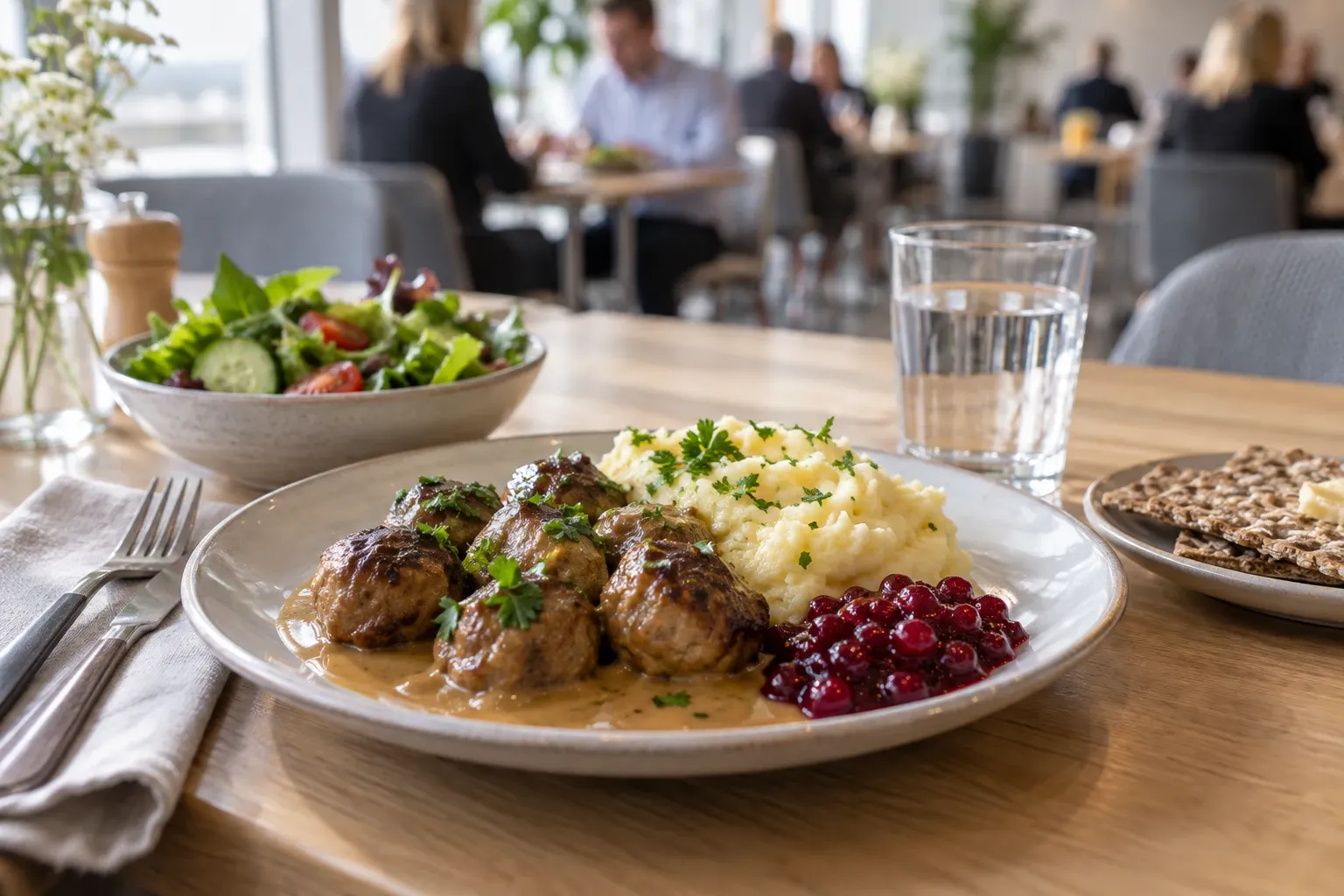
Most visitors walk past it every day. It is written in Swedish, in chalk, on a board on the pavement, and it is the single most useful thing to know about eating in this country.
When you need this
You are standing in front of a chalkboard at 12:15 and cannot read it. Or you are budgeting a trip where restaurant dinners have already wrecked the daily food line. Or you want one properly cooked Swedish meal a day without paying evening prices for it.
What dagens lunch actually is
Dagens lunch means “today’s lunch”. You will also see dagens rätt (“today’s dish”), veckans lunch (“the week’s lunch”), or just Dagens. They all mean the same thing: the fixed-price weekday lunch that ordinary Swedish restaurants have served for generations.
One number covers a hot main course and, at most places, a self-serve salad buffet, bread and butter, a meal drink and coffee afterward. Region Västernorrland lists its public hospital restaurant’s lunch in exactly those terms — huvudrätt, salladsbuffé, måltidsdryck, bröd, kaffe/te och kaka — which is as close to a written specification as this institution has.
The value is structural, not promotional. Many restaurants with an expensive evening menu run dagens at lunchtime from the same kitchen, so the comparison that matters is not one restaurant against another. It is 12:30 against 19:30 at the same address:
| Lunch, on a weekday | Evening, same restaurant | |
|---|---|---|
| Main course | Yes, one of two or three choices | Yes, à la carte |
| Salad buffet | Included | No |
| Bread and butter | Included | No |
| A drink | Included | Ordered and paid for separately |
| Coffee | Included | Ordered and paid for separately |
| Price | One posted number | The menu, plus everything above |
Three things keep it invisible to foreigners. It is advertised in Swedish on a pavement sign. It is weekday-only, and the window closes early. And nothing about it looks like a tourist offer — because it is not one. It is what working Sweden eats, in a room that mixes office workers and trades in the same queue.
What the one price includes
The line to find on the board begins Ingår — “included”. Everything after it is already paid for.
| On the board | What it means |
|---|---|
| salladsbuffé / salladsbord | Salad buffet — self-serve, often a full table of vegetables, beans, pickles and herring rather than a garnish |
| bröd och smör | Bread and butter, also self-serve |
| måltidsdryck | “Meal drink” — water, saft (squash), a soft drink or lättöl (light beer) |
| kaffe / kaffe och kaka | Coffee, often with a small biscuit or cake |
That the light beer can be in there is a quirk of Swedish law worth knowing: a drink of at most 2.25% ABV is a lättdryck, not an alcoholic drink, and serving it needs no licence. Beer above 3.5% is starköl, a proper alcoholic drink requiring a serving permit — which is why it is never part of the deal, and neither is wine.
The window: about 11:00 to 14:00, and it stops sharply
Roughly 11:00 to 14:00, Monday to Friday. But “roughly” is doing real work, because each venue posts its own hours. Real examples read on the same day:
| Venue | Actual lunch window |
|---|---|
| Region Stockholm hospital staff restaurant | 10:30–14:00 |
| Regional hospital restaurant | 11:00–13:30 |
| Museum bistro | 11:30–14:00 |
| Small-town restaurant | 11:15–14:30 |
Swedes eat lunch early — normally between 11:00 and 13:00, though some restaurants serve as late as 14:00 or 15:00. Aim for 11:30–12:45 and never plan to arrive after 13:00. Two things go wrong at the end of service: the popular dish sells out, because two or three dishes are cooked in a batch, and the salad buffet is at its thinnest. After the window, the kitchen switches to the evening menu and you pay evening prices for the same food.
How to read the board
Read it in this order: today’s weekday, the dishes under it, the price, the Ingår line.
| Swedish | Means |
|---|---|
| dagens / dagens rätt / dagens lunch | Today’s dish — the headline |
| veckans lunch / veckans meny | The week’s menu, usually posted on Monday |
| vardagar | Weekdays — the serving-hours line |
| ingår | Included in the price |
| dagens kött / dagens fisk | The day’s meat dish / fish dish |
| dagens vegetariska / dagens gröna | The day’s vegetarian dish |
| ta med / avhämtning | Takeaway — usually a second, lower price |
| öppen för alla | Open to everyone (on canteens) |
Each day offers two or three choices, usually one meat and one fish, changing every weekday. If you would rather choose before you walk, Swedish lunch sites and apps list the same menus city by city, with prices and hours.
Husmanskost, and why Thursday is soup day
The classic dagens content is husmanskost: Swedish everyday home cooking. Meatballs, pyttipanna, fried herring, kalops, brown beans with pork. As SLU’s food-culture research puts it, lunch restaurants are where the older husmanskost repertoire is maintained — this cooking survives on lunch boards more reliably than in restaurants aimed at visitors.
And on Thursdays, much of the country serves yellow pea soup with pancakes. This is not a gimmick: torsdagens ärtsoppa med pannkakor is listed on Sweden’s national inventory of intangible cultural heritage, maintained jointly by Isof, Nordiska museet and Riksantikvarieämbetet. The roots run back to pre-Reformation Friday fasting, pancakes joined the meal in the 18th century, and the tradition has a long military association. It is usually the cheapest thing on the board and the most Swedish meal you will eat all trip.
Where to find one — including canteens open to strangers
Ordinary neighborhood restaurants are the obvious answer. The non-obvious one: institutional canteens are often open to anyone. A Region Stockholm hospital says of its staff restaurant, plainly, öppen för alla — open to everyone — and serves lunch on weekdays from 10:30 to 14:00. Region Västernorrland publishes public lunch hours for its hospital restaurants and lists exactly what the price includes. Museum bistros run the same deal, and are among the few venues that also serve lunch at weekends.
Business districts and industrial estates beat tourist streets at lunchtime, because those venues compete for the same office workers every single day. And a restaurant with a serious evening menu is worth a lunch visit rather than a dinner one — that is where the gap is widest.
Serving yourself: how the buffet works
Take a plate from the stack at the salad buffet and help yourself. Bread, butter and usually the drink are self-serve too. This is expected, not cheeky — the model assumes you get up and collect what you have already paid for. The coffee sits at the end of the buffet or on a hot plate near the till, and nobody will necessarily offer it to you, so go and get it before you leave.
Pay by card, and add nothing on top: there is no service charge and tipping is not expected in Sweden. If you want water, ask for kranvatten — tap water is free on request and excellent.
Vegetarian, soup, buffet and takeaway versions
- Vegetarian is a standard slot, not a request. Boards routinely run dagens kött / dagens fisk / dagens vegetariska, and public-sector restaurants list dagens gröna as a fixed daily option. More in vegan and vegetarian travel in Sweden.
- The soup option is often on the board at a lower price than the main, usually with bread, cheese and the same buffet access.
- Lunch buffets (lunchbuffé) replace the plated main with all-you-can-eat at one price — common at pizzerias and Thai or Indian restaurants.
- Takeaway (ta med) is usually cheaper, but it is a different package: the drink, coffee and dessert normally drop out. It is also taxed differently — 6% on food taken away against 12% on a meal eaten in, a temporary split that runs to 31 December 2027. The full tax picture is in eating out in Sweden.
Why it costs this little
It is a different product from the same kitchen: a set dish cooked in volume for a weekday crowd, with the extras built into a single price.
One number shows how normal all this is. When an employer pays for an employee’s lunch, Skatteverket taxes it as a benefit at a standard value — 124 kr for 2026, up from 122 kr in 2025. That is a tax valuation, not a menu price, but it tells you what the Swedish state considers a normal lunch to cost, and it hints at why the weekday lunch trade is big enough to sustain the institution at all.
One thing worth flagging, because almost nothing in English has caught it: Sweden’s April 2026 food VAT cut did not make this cheaper. The reduction from 12% to 6% covers livsmedel — groceries and takeaway — and Skatteverket is explicit that restaurant services stay at 12%. Your eat-in lunch deal got no tax relief at all. The same dish in a box did.
Mistakes to avoid
- Turning up at 14:15 and concluding Sweden has no affordable restaurants.
- Ordering à la carte in a restaurant that is running dagens three meters away on a board. Ask: “Har ni dagens?”
- Buying a drink, or skipping the salad buffet and coffee, that the price already covered.
- Tipping on top of a price that is already complete.
- Walking past a hospital or museum canteen that says öppen för alla.
- Expecting the deal at the weekend, or on a public holiday.
Practical information
| Item | Detail |
|---|---|
| Days | Monday to Friday; weekend versions are the exception |
| Hours | About 11:00–14:00, set per venue — some stop at 13:30 |
| What one price buys | Hot main, salad buffet, bread and butter, a drink, coffee |
| Choices | Two or three dishes, changing daily; menu posted for the week, usually on Monday |
| Vegetarian | A standard daily slot (dagens vegetariska / dagens gröna) |
| Thursday | Yellow pea soup and pancakes, nationwide |
| Price | See the dated national band in eating out in Sweden — roughly 135–145 kr for 2026, with listed lunches spanning about 45–465 kr. Read the board |
| Skatteverket’s benefit value of one employer-paid lunch | 124 kr for 2026 (a tax valuation, not a menu price) |
| VAT | 12% eaten in; 6% taken away, until 31 December 2027 |
| Tip | None expected; no service charge |
| Payment | Card or phone |
FAQ
What is dagens lunch in Sweden?
It is the fixed-price weekday lunch that most ordinary Swedish restaurants serve, written dagens lunch, dagens rätt or just Dagens on a chalkboard outside. One price buys a hot main course plus, at most places, a self-serve salad buffet, bread and butter, a meal drink and coffee. The dishes change every weekday.
What time is dagens lunch served?
Roughly 11:00 to 14:00, Monday to Friday, with the exact window set by each venue — real examples run 10:30–14:00, 11:00–13:30 and 11:15–14:30. Swedes eat lunch early, mostly between 11:00 and 13:00. Arrive by 13:00 to be safe; after the window the kitchen switches to the evening menu and evening prices.
Does the price really include the salad buffet, bread and coffee?
Yes, at most places, and that is the point of the deal. A regional health authority lists its public restaurant’s lunch as main course, salad buffet, meal drink, bread, coffee or tea and a small cake, for one price. Look for the line beginning Ingår (“included”) on the board, and help yourself.
Is dagens lunch available at weekends?
Usually not. It is a weekday institution built around people at work, so Saturday and Sunday normally mean à la carte, brunch or a buffet at a different price. A minority of restaurants run a weekend variant, and museum and attraction restaurants are the most likely to serve lunch at weekends. Treat public holidays as weekends.
Why is lunch so much cheaper than dinner in Sweden?
Because it is a different product from the same kitchen: a set dish cooked in volume for a weekday crowd, with the extras built into a single price. Many restaurants with expensive evening menus run dagens at lunchtime. The tax explanation for restaurant prices in general belongs to our eating-out guide.
What is husmanskost, and what is the Thursday pea soup about?
Husmanskost is Swedish everyday home cooking — meatballs, pyttipanna, fried herring, kalops, brown beans — and lunch restaurants are where the repertoire survives. On Thursdays much of the country serves yellow pea soup with pancakes, a tradition on Sweden’s national list of intangible cultural heritage, with roots in pre-Reformation Friday fasting.
Is there always a vegetarian option?
In practice, yes. Swedish lunch boards routinely carry a fixed set of slots — dagens kött (meat), dagens fisk (fish) and dagens vegetariska or dagens gröna (the green one) — so the vegetarian dish is a standard part of the rotation rather than a special request you negotiate with the kitchen.
Can I get dagens lunch to take away?
Very often, at a lower price — but it is a different package. The drink, coffee and dessert usually drop out, leaving the main and sometimes salad and bread. Takeaway food also carries 6% VAT rather than the 12% on a meal eaten in, a temporary rate that runs to 31 December 2027.
Related guides
- Eating out in Sweden — the whole picture: price bands, VAT, tipping, ordering customs
- Tipping in Sweden — why the posted price really is the whole price
- Can you drink the tap water in Sweden? — the other free thing on the table
- Grocery prices in Sweden — the other way to eat cheaply here
- Swedish opening hours — what a röd dag does to your lunch plans
Facts verified 2026-07-26. Sources: Skatteverket (Swedish Tax Agency), Sveriges Riksdag (Alkohollagen), Levande kulturarv (Isof / Nordiska museet / Riksantikvarieämbetet), SLU Future Food, Region Västernorrland, Region Stockholm, Visit Stockholm, restaurants’ own menus and Swedish lunch-menu statistics — full register in this topic’s source file. Lunch prices reset annually and the reduced takeaway VAT rate expires 31 December 2027; this page is on a 6-month review cycle. Found something outdated? Tell us and we’ll fix it.