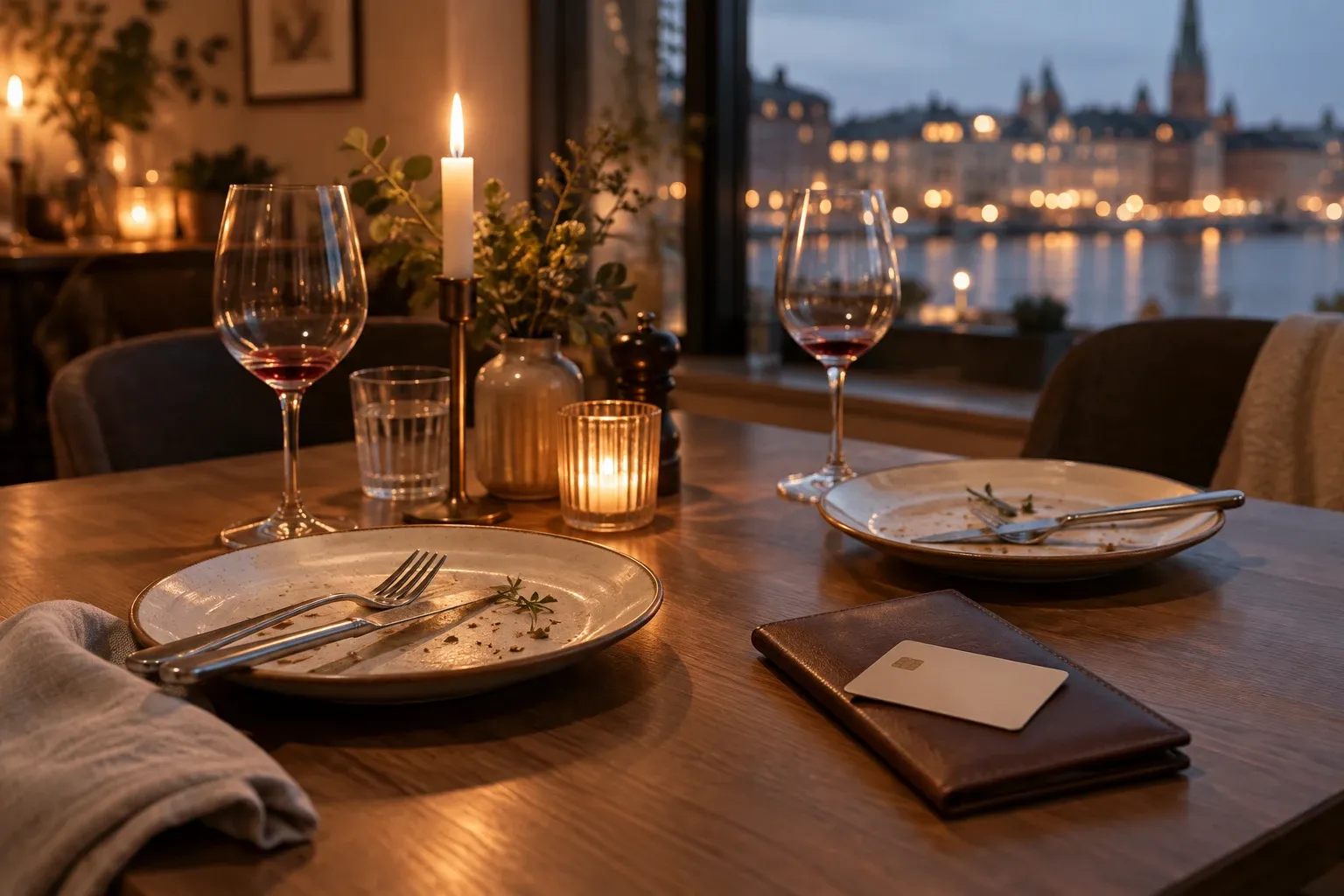
Visitors from tipping cultures worry about tipping too little. In Sweden the mistake runs the other way: people arrive with an 18–20% reflex, apply it to every bill, and spend a great deal of energy on a decision Swedes simply do not make.
When you need this
The bill has arrived and you’re doing arithmetic out of habit. Or a terminal is being held out to you showing “5% / 10% / 15%” and you have three seconds. Or you’re checking out of a hotel wondering about housekeeping, or getting out of a taxi with no idea what to hand over.
The short answer
Nothing is expected, anywhere, in any of those situations.
If you want to tip because something was genuinely good, the Swedish range is round up, or 5–10% at a sit-down restaurant. That 10% is the top of the customary range, not the entry point. Everywhere else — cafés, bars, taxis, hotels, hairdressers — there is no tipping custom to speak of.
Service is included in the advertised price, and no service charge is added to your bill. The number on the menu is the number you pay.
Why tipping isn’t structural here
This is the part other guides leave out, and it’s the part that makes the norm make sense rather than feel like stinginess.
Sweden has no statutory minimum wage at all — and, more to the point, no lower “tipped” wage tier of the kind that makes tipping load-bearing in the United States. Pay in hotels and restaurants is set by collective agreement between the employers’ organisation Visita and the union HRF. That agreement, the Gröna riksavtalet, covers over 100,000 employees and currently runs from April 2025 to March 2027.
The practical consequence for you: your server is paid to serve you before you decide anything. A tip in Sweden is a bonus on top of a wage, not a substitute for one. Nobody’s rent is riding on the number you press.
One footnote before you press a large percentage: a tip is taxable income for whoever receives it. Skatteverket, the tax agency, is explicit — the employer reports tips it distributes; staff who divide tips themselves declare them on their own returns. It is not untaxed cash in a pocket either way.
Situation by situation
| Situation | What’s expected | If you want to |
|---|---|---|
| Sit-down restaurant | Nothing | Round up, or 5–10% for genuinely good service |
| Café, bakery, fika, counter service | Nothing at all | Nothing — there is no custom here |
| Bar | Nothing per drink | Round up a tab |
| Taxi | Fare as metered or as quoted | Round up to the next convenient figure |
| Hotel housekeeping | Nothing — not a Swedish practice | — |
| Hotel porter | Nothing | A small note for heavy bags carried a long way |
| Hairdresser / barber | Nothing | — |
| Guided tour (paid) | Nothing | A small note for an excellent guide |
| Free walking tour | This is the exception | The guide’s income is the tips — budget as you would a ticket |
| Food delivery | Optional, offered in the app | Genuine judgment call — see below |
Two need a sentence more. Free walking tours invert the logic: there’s no ticket price because the tips are the price — decide your amount before the tour starts. And delivery couriers sit outside the wage argument that carries the rest of this page; platform courier pay is structured differently from restaurant employment, so that one is a genuine judgment call.
The card machine now asks
Sweden is a card country — 92% of in-store purchases are made by card — which means the tipping decision has moved from coins on a table to a screen pointed at your face.
A wave of newer terminals now presents preset tip percentages, commonly 5, 10 and 15%, sometimes running up to 20%, where the machine previously just asked for a total. Every one of them has a zero option. Depending on the terminal, the button you want reads:
- Ingen dricks — literally “no tip”, the clear version; or
- Fortsätt — “continue”, which visitors routinely misread as “you must pick a percentage first”
Both mean no tip. Take either and the payment completes exactly as it would otherwise.
Two things worth internalising. First, the presets are a sales interface, not a statement of Swedish custom — 15% is an American number that arrived with the machine. Second, don’t tip twice. If you’ve already added a tip on the terminal, leaving cash on the table as well is a duplication people make when the screen was in Swedish.
What happens if you leave nothing
Nothing happens. That’s the whole answer.
No Swedish server will chase you, comment, sigh, or treat you differently. Swedes leave nothing for ordinary service constantly, including Swedish restaurant staff when they eat out. The awkwardness a visitor feels at this moment is imported — it’s produced by the culture they came from, not by the one they’re standing in.
If it helps to have a sentence ready: “Ingen dricks, tack” — no tip, thanks. Staff hear it all day.
Is the norm changing?
Somewhat, and honestly: yes, at the margin, and the machines are doing it.
The effect is documented and large. The payment company Kassacentralen told Svenska Dagbladet that tips at the average establishment had doubled after preset prompts were introduced, with some venues seeing a six-fold rise. SVT’s reporting from Dalarna found the pattern from the other side: restaurants with the prompting terminals reported more tips, restaurants without them reported no change.
Swedish restaurateurs are not uniformly pleased about it. One in Älvdalen declined the system outright, saying the prompts “become a bit coercive” and that guests press out of stress. A manager in Leksand observed that people “feel stingy if they don’t give anything when it’s possible to choose a certain percentage.” Swedish has even coined a word for the sensation: dricksskam, tip shame.
So hold both facts at once. No obligation exists — and the machine will ask anyway. That combination, rather than a flat “Swedes never tip”, is the accurate picture in 2026.
Mistakes visitors make
- Calculating 15–20% from muscle memory before reading anything about Sweden.
- Reading the terminal’s top preset as the expected amount. It was chosen by a payment company.
- Feeling that leaving nothing would be rude. It is unremarkable.
- Tipping at a café counter because the machine asked.
- Leaving an envelope for hotel housekeeping — not a Swedish practice; it will puzzle more than please.
- Adding a tip to a fixed-price airport taxi fare that was already complete as quoted.
- Tipping twice, once on the terminal and again in cash.
Good to know
- The best default is “round up, or nothing.” Paying 400 kr on a 378 kr bill is the most Swedish tip there is — invisible, unfussy, no arithmetic.
- Decide before the terminal appears. The prompt is built for the three seconds when you’re being watched; having already decided removes the pressure.
- Reward the thing that was actually good. A server who spent ten minutes on your allergies is exactly who the 10% is for. Ordinary competent service is already paid for.
- If you want to be generous, say so. Verbal praise to a manager carries real weight in a Swedish workplace and costs nothing.
- Large-group set menus occasionally carry a pre-agreed service charge in the booking terms — check the confirmation rather than assuming.
- The money you don’t spend on tips isn’t a saving to feel guilty about. It was never part of the price. What a Swedish meal actually costs is covered in eating out in Sweden.
Practical information
| Item | Detail |
|---|---|
| Tip required | None, in any setting |
| Restaurant, if you choose to | Round up, or 5–10% for genuinely good sit-down service |
| Card-terminal presets you’ll see | Commonly 5 / 10 / 15%, sometimes up to 20% |
| Skip button | Ingen dricks, or Fortsätt (“continue”) |
| Service charge on the bill | None — the menu price is the final price |
| Café, bar, hairdresser, housekeeping | Nothing customary |
| Taxi | Fare as shown; rounding up optional |
| Free walking tour | Tip-funded — budget as you would a ticket |
| Consequence of tipping nothing | None |
| Tax on tips | Taxable income for the recipient |
FAQ
Do you tip in Sweden?
Not as a rule. Service is included in the price and staff earn a normal collective-agreement wage, so tipping is genuinely optional. Most Swedes leave nothing for ordinary service and no one notices. Rounding up the bill, or leaving 5–10% after a good sit-down meal, is appreciated but never expected.
Is it rude not to tip in Sweden?
No. Leaving nothing is unremarkable in Sweden and provokes no reaction from staff, because no one’s income depends on it. The awkwardness visitors feel is imported from tipping cultures, not produced by Swedish ones. Servers thank you the same way whether you add a tip or press the no-tip button.
How much should I tip in a Swedish restaurant?
Nothing is fine. If the meal was genuinely good, round the bill up to a convenient figure or add 5–10% — that is the top of the normal Swedish range, not the starting point. Card terminals often suggest 5, 10 or 15%; 15% is an American number that arrived with the machine, not a Swedish expectation.
Do I tip taxi drivers, hotel staff or hairdressers in Sweden?
Generally no. Taxi fares are paid as metered; rounding up is common but optional. Swedish hotels have no housekeeping-tip custom and staff are not expecting an envelope. Hairdressers are not tipped. A porter who carries heavy bags a long way is the one case where a small note is a normal thank-you.
What happens if I skip the tip prompt on a Swedish card machine?
Nothing. Every tip-enabled terminal has a zero or no-tip option, and the payment completes exactly as it would otherwise. Sometimes the button reads Ingen dricks, sometimes only Fortsätt (continue) — both mean no tip. Swedes press it constantly; the prompt is a software default, not a social demand.
Are Swedish restaurant staff paid properly without tips?
Yes, and this is the fact that makes the norm make sense. Sweden has no statutory minimum wage and no lower “tipped” wage tier; hotel and restaurant pay is set by the Visita–HRF collective agreement, which covers over 100,000 employees. Your server’s rent does not depend on your generosity.
Should I tip a tour guide in Sweden?
Not as a rule, though guides are the one visitor-facing job where tipping has become semi-normal, largely because international groups do it. Free walking tours are the clear exception: they run entirely on tips and expect one. On a paid tour nothing is expected; a small note for an excellent guide is a generous gesture.
Related guides
- Money in Sweden: the complete guide — currency, cash, cards and costs in one place
- Using credit and debit cards in Sweden — the same terminal that asks about tips asks about currency, and there the right answer is always kronor
- Eating out in Sweden — what a restaurant meal actually costs, tips excluded
- Can you pay with cash in Sweden? — why you may not have a note to leave anyway
- How expensive is Sweden? — a realistic budget, built without a tipping line
Facts verified 2026-07-26. Sources: Skatteverket (taxation of tips), Hotell- och restaurangfacket and Visita (the Gröna riksavtalet collective agreement), SVT Nyheter and The Local Sweden (card-terminal tip prompts and their effect), Sveriges Riksbank — full register in this topic’s source file. Found something outdated? Tell us and we’ll fix it.