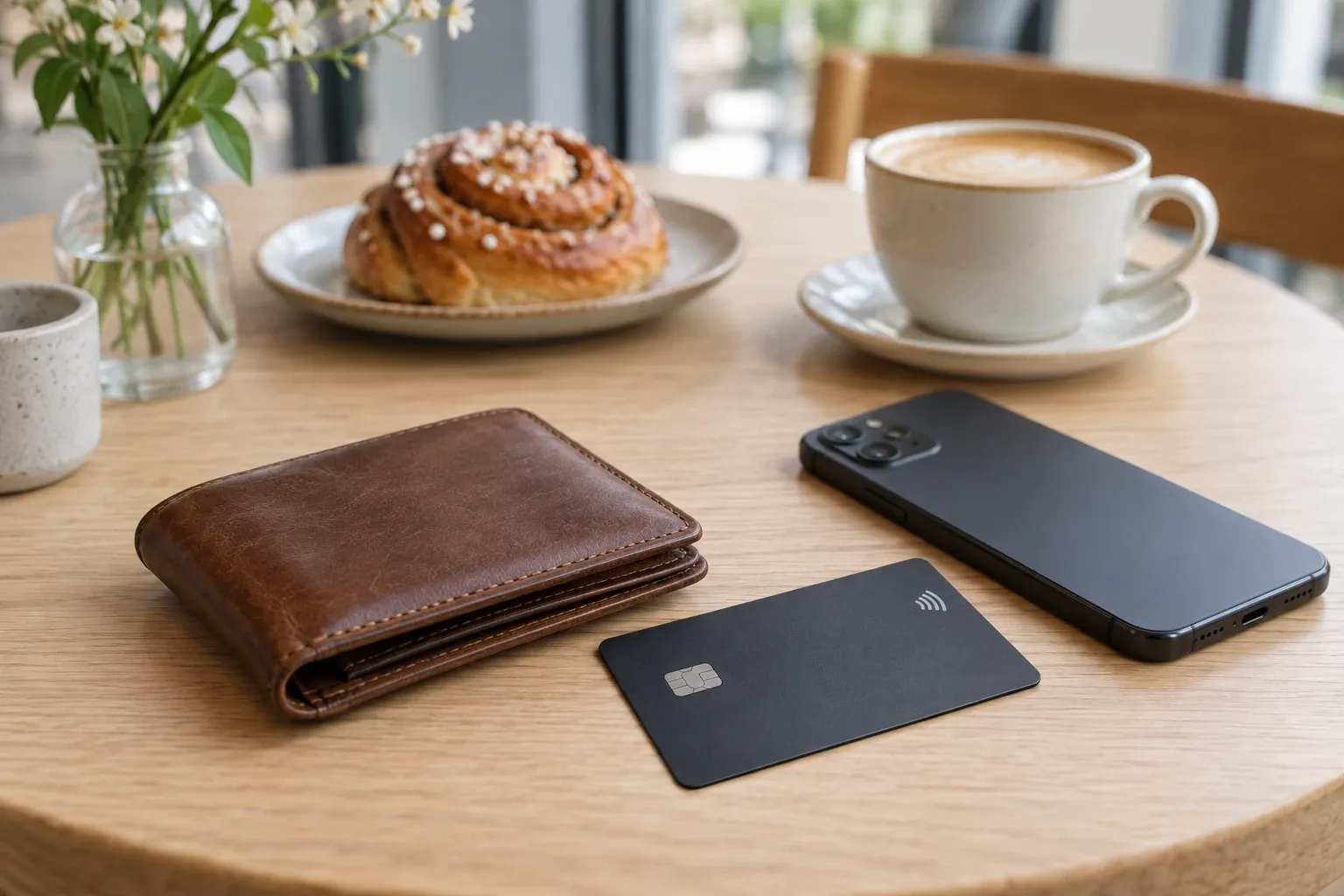
Most money guides for Sweden bury the answer in a list of currency facts. Here it is instead: bring a contactless card, bring almost no cash, and don’t bring euros. Everything below is the reasoning and the exceptions.
When you need this
Packing, and wondering what belongs in your wallet. Deciding whether to visit a bureau de change before flying. Or calibrating a budget against Sweden’s alarming reputation.
The short version: bring a contactless card
Sweden runs on cards to a degree that surprises almost every visitor. Riksbanken’s Payment Report 2026:
| How Swedes pay | Share |
|---|---|
| In-store purchases made by card | 92% |
| People using a card or card-in-phone | 98% |
| Paid cash at their most recent purchase | 5% |
| Used Swish at their most recent in-store purchase | ~2% |
Cash was around 40% of purchases fifteen years ago. It is 5% now.
One contactless Visa or Mastercard — ideally also loaded into your phone wallet — covers essentially the whole country, including very small purchases, with no surcharge. Bring a second card from a different scheme as a backup, and make sure you know the PIN. The full card rules, including the one that saves you money, are in using credit and debit cards in Sweden.
The currency is the krona, not the euro
Sweden is in the European Union but has not adopted the euro. Prices are in Swedish kronor, written kr and abbreviated SEK.
Euros are not generally accepted, and in the rare places that take them the rate is poor. Bringing a wallet of euros to Sweden is one of the most common mis-preparations there is — it results in an unnecessary double conversion, or in the notes coming home unspent.
VAT (moms) is already included in every displayed price, so the shelf price is the price you pay. Non-EU residents can reclaim it on qualifying purchases when leaving the EU.
How much cash should you bring?
200–500 kronor. That’s it.
In a country where 5% of purchases are cash and businesses may lawfully refuse it, a large cash float is dead weight that costs you two currency conversions. The right amount is a small reserve for the genuinely cash-friendly corners: flea markets (loppis), small market and festival stalls, private sales and rural sellers.
If you want cash, withdraw kronor from an ATM after you arrive rather than exchanging at home — the rate is better. Where cash still works and where it definitively doesn’t is covered in can you pay with cash in Sweden?.
Swish: the app you’ll hear about and can’t use
Swedes mention Swish constantly, and you will see its logo on toilet doors, market stalls and parking machines. You almost certainly cannot use it: it requires a Swedish bank account and BankID, which require a Swedish personnummer.
This causes far more anxiety than it deserves. Swish dominates person-to-person transfers — splitting bills, paying a friend — and online checkout. At an actual till, only about 2% of Swedes used it for their most recent in-store purchase. You are missing the app Swedes use to pay each other, not the one they use to pay shops.
Full detail, including what to do at a Swish-only stall, in Swish for tourists.
How expensive is Sweden?
Above the EU average, but not extreme. Eurostat put Sweden’s price level for household final consumption at 121 against an EU average of 100 in 2025 — about a fifth higher.
The important nuance: that reputation is earned mostly by restaurants, alcohol and coffee out, not by supermarkets. Self-catering in Sweden is very manageable, and the gap between cooking and eating out is wider here than in most of Europe. See grocery prices in Sweden for where the money actually goes.
Tipping
Not expected. Service is included in the price, and there is no obligation and no awkwardness in leaving nothing in a restaurant, taxi or bar. Rounding up, or leaving roughly 5–10% for genuinely good restaurant service, is appreciated rather than required.
Visitors from North America routinely over-tip in Sweden out of pure habit. More in tipping in Sweden.
Mistakes to avoid
- Assuming Sweden uses the euro.
- Exchanging a large cash float before departure.
- Bringing only American Express — it’s accepted far less widely than Visa and Mastercard.
- Trying to install Swish.
- Relying on cash as a fallback at a card-only business.
- Tipping at North American rates.
- Budgeting groceries as the expensive part of the trip.
Practical information
| Item | Detail |
|---|---|
| Currency | Swedish krona — kr / SEK (not the euro) |
| Best payment method | Contactless Visa or Mastercard, plus phone wallet |
| Cash to bring | 200–500 kr, withdrawn on arrival |
| Card share of in-store purchases | 92% |
| Cash share of most-recent purchases | 5% |
| Can shops refuse cash? | Mostly yes — but groceries and pharmacies must accept it since 1 Jul 2026 |
| Swish | Unavailable to visitors |
| Price level vs EU average | Index 121 (EU = 100), 2025 |
| VAT | Included in displayed prices; reclaimable by non-EU residents |
| Tipping | Not expected |
FAQ
Does Sweden use the euro?
No. Sweden is a member of the European Union but has not adopted the euro, and prices are in Swedish kronor (kr, SEK). Euros are not generally accepted, and where they are the exchange rate is usually poor. Pay by card in kronor rather than carrying euros, and do not exchange large amounts before travelling.
How much cash should I bring to Sweden?
Very little — 200 to 500 kronor is plenty for most trips. Only 5% of Swedes paid cash at their most recent purchase, and most businesses may lawfully refuse it, though groceries and pharmacies must accept it since July 2026. Cash is otherwise useful mainly at flea markets, small stalls and private sales. Withdraw from an ATM on arrival rather than exchanging at home.
What is the best way to pay in Sweden as a tourist?
A contactless Visa or Mastercard, ideally also loaded into your phone wallet. It is accepted essentially everywhere including for very small amounts, there is no surcharge, and 92% of Swedish in-store purchases are made this way. Bring a second card from a different scheme as backup, and know your PIN for unmanned machines.
Can I use Swish as a visitor to Sweden?
No. Swish requires a Swedish bank account and BankID, which in turn require a Swedish personnummer. There is no tourist version. It matters less than visitors fear: Swish dominates person-to-person transfers and online checkout rather than shop tills, where cards overwhelmingly dominate.
Is Sweden expensive?
Above the EU average, but not extreme. Eurostat put Sweden’s price level for household final consumption at 121 against an EU average of 100 in 2025 — about a fifth higher. The reputation is earned mainly by restaurants, alcohol and coffee out rather than by supermarkets, so self-catering keeps costs reasonable.
Do you tip in Sweden?
Not as a rule. Service is included in the price and tipping is not expected in restaurants, taxis or bars, though rounding up or leaving roughly 5–10% for genuinely good restaurant service is appreciated. Visitors from North America routinely over-tip in Sweden out of habit. There is no obligation and no awkwardness in leaving nothing.
Related guides
- Using credit and debit cards in Sweden — the two rules that save money and trouble
- Can you pay with cash in Sweden? — where the notes still work
- Swish for tourists — the app you’ll hear about constantly
- How to pay for buses in Sweden — transport has its own rules
- Grocery prices in Sweden — calibrating the cost reputation
- Tipping in Sweden — when and how much
Facts verified 2026-07-25. Sources: Sveriges Riksbank (Payment Report 2026), Eurostat — full register in this topic’s source file. Found something outdated? Tell us and we’ll fix it.