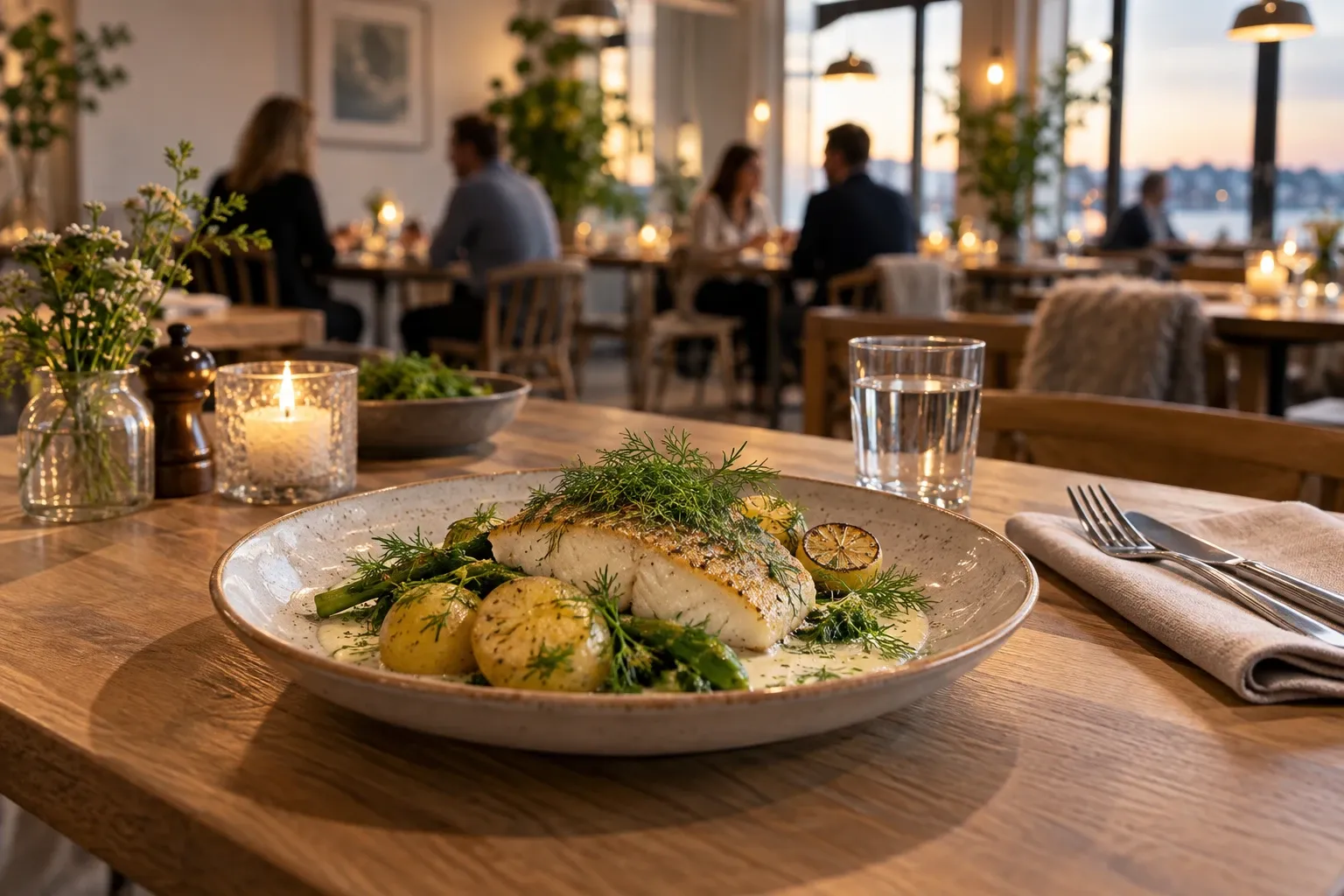
Sweden’s expensive reputation is earned at the restaurant table, not in the supermarket. The good news is that Swedes solved this for themselves decades ago, and the solution is available to you at lunchtime on any weekday.
When you need this
Building a food budget before you book. Standing outside a restaurant at 12:30 wondering what the chalkboard means. Or holding a card terminal that just asked you about a tip in a country you were told doesn’t tip.
Yes, eating out is the expensive part
Our grocery prices guide makes the case that Swedish supermarkets are manageable. This is the other half of that argument: restaurants are not.
The gap between cooking and eating out is wider in Sweden than in most of Europe, and it has been widening for a generation. Between 1999 and 2022, restaurant lunch prices in Sweden rose about 90%, while groceries and non-alcoholic drinks rose 62% and the general price level rose 44% — a divergence SCB attributes largely to labor costs in food service.
That is structural, not a bad year: Swedish restaurant service is expensive because Swedish labor is expensive, and no amount of shopping around changes it. What does change it is when you eat.
Dagens lunch: the single best move in the Swedish food budget
Dagens lunch — “today’s lunch” — is a fixed-price weekday deal offered by a large share of ordinary Swedish restaurants, served roughly 11:00 to 14:00, Monday to Friday. You pick from two to four dishes chalked on a board outside. One price covers the lot.
And “the lot” is the part visitors underestimate. A typical dagens price includes:
| Included in the lunch price | Notes |
|---|---|
| Hot main course | Usually two to four choices, often husmanskost (traditional home cooking), a fish option and a vegetarian one |
| Salad buffet (salladsbuffé) | Self-serve and unlimited — eat it properly, it’s why the deal fills you up |
| Bread and butter | Also self-serve |
| Water or a light drink | Tap water is always there |
| Coffee afterward | Usually from a pot you help yourself to |
Through 2026, national averages tracked in the 135–145 kr range: Gothenburg came in at 133 kr in July 2026, around 10 kr under the national figure, while Stockholm ran highest at roughly 165 kr and smaller towns sat nearer 124 kr.
Treat that as a band, not a quote. We deliberately publish no per-dish price list on this page — restaurant prices move every year, and a dated list is the fastest-rotting content a guide can carry. Every Swedish restaurant posts its menu at the door and online. Read that.
More on finding and using the deal in dagens lunch in depth.
What changes after 14:00
The same kitchen. Often a version of the same food. A completely different bill.
After the lunch window closes, restaurants switch to the evening menu, and a dinner main course on its own typically runs several times the whole lunch deal — with no salad buffet, no bread and no coffee included. Add a starter and a drink and the arithmetic gets steep fast.
Hence the takeaway for a whole trip: eat your main meal at lunch on weekdays. That buys real restaurant food daily rather than as a treat, and leaves the evening for something lighter — or one of the genuinely cheap options below.
The 2026 VAT split, and why your wine costs so much
Here’s the mechanism, and it’s newer than almost every English-language guide realizes.
On 1 April 2026, Sweden cut VAT on food from 12% to 6%. But the reduction covers livsmedel — groceries and food carried out — and explicitly leaves restaurant and catering services at 12%. Sit down at the table and it’s a restaurant service. Take the same food away and it’s food.
Alcohol has always sat in a third bracket: spirits, wine and strong beer (above 3.5% ABV) are taxed at 25%, including the share of a restaurant bill attributable to them. A mixed bill gets split between the rates.
| What you order | VAT rate | Since |
|---|---|---|
| Food carried out, or delivered | 6% | 1 April 2026 (was 12%) |
| The same food eaten at the table | 12% | Unchanged |
| Spirits, wine, strong beer — anywhere | 25% | Unchanged |
Three rates at one counter. Two consequences worth knowing:
- Takeaway is now genuinely cheaper, at least on tax. Hotel room service, incidentally, is still a restaurant service at 12%.
- Drinks are the line that wrecks budgets. A glass of wine carries 25% VAT on top of Sweden’s alcohol excise duty and the restaurant’s own markup. Two or three drinks can outweigh the food they came with. Why Swedish alcohol costs what it does is covered in Systembolaget explained.
One caveat: the 6% food rate is temporary and expires on 31 December 2027 unless it’s extended.
No tip, no service charge, free tap water
Three pieces of good news that surprise American and British visitors in the right direction.
- The menu price is the price. No service charge, no cover charge, no surcharge for sitting at a table rather than standing at the counter.
- Tipping is not expected. Service is included and staff are paid a full wage that doesn’t depend on it. If you want to acknowledge good service, Swedes round the bill up to a convenient figure — 121.60 kr becomes 130 kr. The card terminal will still ask; selecting zero is completely normal, and at counter service nobody expects anything at all. Full detail in tipping in Sweden.
- Tap water is free. Say “kranvatten, tack” and you’ll get a glass or a jug at no charge. Swedish tap water is excellent and drinking it in a restaurant carries no stigma whatsoever — see can you drink the tap water in Sweden?. No law obliges a venue to serve it free and a small minority do charge, but that’s unusual.
Ordering and paying: how it actually works
Watch the person in front of you. At sit-down restaurants there’s table service and you ask for the bill (notan) at the end. At cafés, lunch buffets, bakeries, food halls and korv kiosks you order and pay at the counter first, then find your own table — this is normal, not a downgrade, and no one is ignoring you.
Pay by card or phone. Cash is close to unusable in Swedish restaurants, and Swish is domestic-only. See using cards in Sweden and Swish for tourists.
Order in English. Menus are usually bilingual in anywhere a visitor is likely to eat, and staff switch languages instantly and without fuss.
Fika is not a meal
Coffee and something sweet in the afternoon is its own Swedish institution, with its own etiquette and its own budget line. It isn’t lunch, it isn’t dinner, and it doesn’t follow the dagens economics — treat it as a separate item in the day’s budget. Read Swedish fika before you order.
Booking, allergies and dietary needs
Booking: for lunch, almost never necessary — walk in. For dinner at a popular city restaurant on a Friday or Saturday, book, often a few days ahead. Swedes take reservation times literally, so arrive punctually and call if plans change.
Allergies: EU rules applied in Sweden require any place serving food to tell you whether a dish contains one of the fourteen declarable allergens, orally or in writing, and the business must be able to answer even when the cook who made the dish isn’t there. Venues should signpost that you can ask. State the allergen plainly in English when you order — and if the stakes are medical rather than a preference, ask that the question go to the kitchen rather than accepting a front-of-house guess. The regulator’s own inspections found that distinction changes the error rate from roughly one answer in two to one in seven. Full detail in eating out with food allergies.
Diets: vegetarian and vegan options are default categories on Swedish menus rather than special requests, and lactose-free and gluten-free are everywhere — but note that laktosfri is not the same as dairy-free, which matters if you have a milk allergy. See vegan and vegetarian travel in Sweden.
Where and when it costs more
- Stockholm is the country’s most expensive lunch market; Gothenburg sits under the national average, and smaller towns lower still.
- Roadside restaurants (vägkrogar) and industrial-area lunch places are the best value in Sweden, used by everyone.
- Ski resorts, archipelago islands and mountain stations in season price like the captive markets they are.
- July is awkward: many city restaurants close for the Swedish holiday and business-district lunch trade thins out. Tourist areas run the opposite way.
- December replaces normal menus with the julbord Christmas buffet at many restaurants, priced as an event — see the julbord.
- Public holidays follow Sunday hours or close entirely, and dagens lunch isn’t served.
For cheap dinner, the reliable answers are korv kiosks and street food and Sweden’s peculiar pizza culture. At the other end, fine dining in Sweden is a different market where none of these bands apply.
Mistakes to avoid
- Eating the main meal at dinner every day — the single most expensive habit a visitor brings to Sweden.
- Concluding Sweden is unaffordable and eating supermarket sandwiches all week instead.
- Tipping 15–20% by reflex.
- Ordering wine by the glass without checking the price.
- Buying bottled water at the table.
- Turning up at 14:30 expecting the lunch deal.
- Waiting to be seated at a place where you order at the counter.
Practical information
| Item | Detail |
|---|---|
| Dagens lunch, national average | Roughly 135–145 kr, 2026 |
| Dagens lunch, by city | Stockholm highest, smaller towns lowest — city figures not published here, see below |
| Lunch hours | About 11:00–14:00, Monday to Friday |
| What the price includes | Main, salad buffet, bread and butter, drink, coffee |
| Dinner main course | Deliberately not published — read the posted menu |
| VAT, meal eaten in | 12% |
| VAT, food taken away | 6% from 1 April 2026 to 31 December 2027 (was 12%) |
| VAT, spirits/wine/strong beer | 25% |
| Service or cover charge | None |
| Tip | Not expected; round up if you like |
| Tap water | Free on request (kranvatten) |
| Payment | Card or phone; cash effectively not accepted |
FAQ
Is eating out in Sweden expensive?
Yes — this is where Sweden’s expensive reputation is actually earned. Supermarkets are manageable; restaurants are not. Dinner with drinks in a city adds up fast, because alcohol carries 25% VAT on top of Sweden’s alcohol tax. The fix is timing rather than avoidance: eat your main meal at lunch, when the same kitchen charges a fraction as much.
What is dagens lunch and what does it include?
Dagens lunch is a fixed-price weekday lunch deal served roughly 11:00 to 14:00. The price almost always covers a hot main course plus a self-serve salad buffet, bread and butter, water or a light drink, and coffee afterward. National averages ran around 135 to 145 kronor through 2026, with Stockholm noticeably higher.
Do you tip in Swedish restaurants?
No, and nobody will think worse of you. Service is included in the menu price, there is no cover charge, and staff are paid a full wage. If you want to acknowledge good service, Swedes round the bill up to a convenient figure. Counter-service places expect nothing at all, whatever the card terminal asks.
Is tap water free in Swedish restaurants?
Normally yes. Ask for kranvatten and you will get a jug or a glass at no charge, often without being asked twice — Swedish tap water is excellent and drinking it in a restaurant carries no stigma. No law obliges a venue to serve it free, and a small minority do charge, but that is unusual.
Why is takeaway cheaper than eating in since April 2026?
Sweden cut VAT on food from 12% to 6% on 1 April 2026, but the reduction covers groceries and takeaway only. A meal eaten at the table is a restaurant service and stays at 12%. The same sandwich can therefore carry two different tax rates. The cut is temporary and expires on 31 December 2027.
Do I need to book a table in Sweden?
For lunch, almost never — walk in. For dinner at a popular city restaurant on a Friday or Saturday, yes, and often a few days ahead. Booking is done online or by phone and Swedes take reservation times literally, so arrive punctually and tell the restaurant if your plans change.
How well do Swedish restaurants handle allergies and dietary needs?
Well regulated, imperfectly executed — and the gap matters if the stakes are medical. EU rules applied in Sweden require any place serving food to tell you whether a dish contains one of the fourteen declarable allergens, in speech or in writing. But Livsmedelsverket’s own national control project found 17% of checked dishes carried incorrect allergen information, and front-of-house staff answering without consulting the cook were wrong 48% of the time. The instruction that actually protects you is to ask for the kitchen — “Kan du fråga kocken?” Vegetarian and vegan options are standard rather than an afterthought, and lactose-free and gluten-free are everywhere. One word of caution if the issue is a milk allergy rather than intolerance: laktosfri removes the milk sugar but still contains milk protein — the word you need is mjölkfri, or ask for the allergen information you are legally entitled to.
Related guides
- Dagens lunch in depth — how to find the deal, and what a good one looks like
- Tipping in Sweden — the full answer, including taxis, hotels and the terminal prompt
- Grocery prices in Sweden — the cheaper half of the food budget
- Swedish fika — the institution this page keeps deferring to
- Systembolaget explained — why every drink on the bill costs what it does
Facts verified 2026-07-26. Sources: Skatteverket (Swedish Tax Agency), Livsmedelsverket, SCB (Statistics Sweden), Eurostat, Swedish lunch-menu price statistics — full register in this topic’s source file. Restaurant prices move every year and the reduced food VAT rate expires 31 December 2027; this page is on a 6-month review cycle. Found something outdated? Tell us and we’ll fix it.