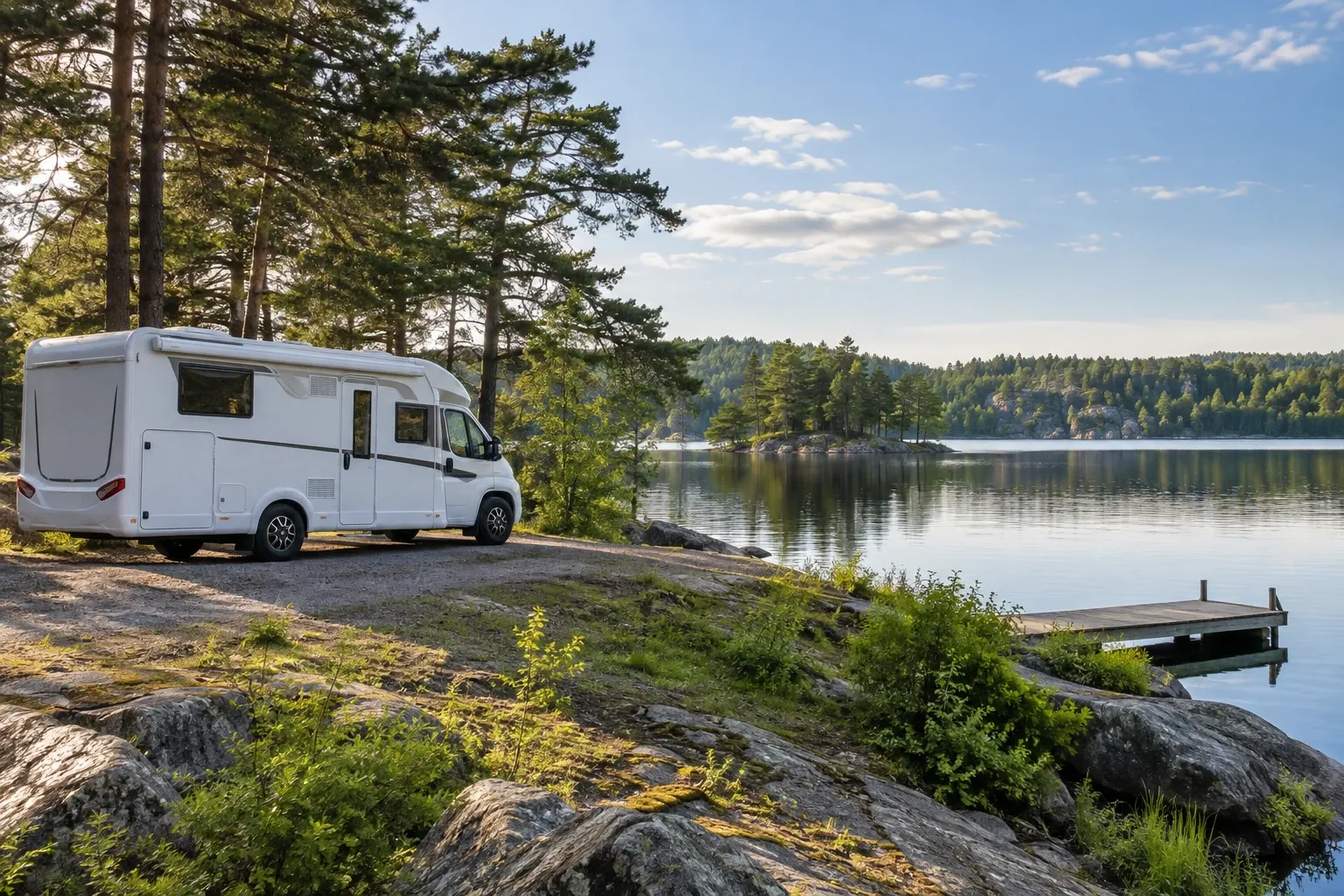
Sweden is one of Europe’s easiest countries to tour by motorhome, with light traffic and stopovers almost everywhere. Four rules decide whether the trip goes smoothly: licence by weight, speed by registration, nights by parking law, and waste only at service points.
When you need this
- You’re planning a first motorhome trip to Sweden from Germany, the Netherlands, Denmark or further away.
- You want to know whether your licence covers the motorhome you own or plan to rent.
- You’re towing a car or trailer, or driving a heavy motorhome, and need the speed limit.
- You’re deciding how to split nights between ställplatser, campsites and rest areas.
- You’re thinking about an autumn or winter trip.
Your licence: set by weight
Swedish law draws the line at 3,500 kg maximum authorised mass (totalvikt). That’s the weight printed on the registration document, not what the vehicle weighs on the day.
| Motorhome’s maximum authorised mass | Licence you need |
|---|---|
| Up to 3,500 kg | B (plus a light trailer: up to 750 kg, or heavier if the combination stays within 3,500 kg) |
| Over 3,500 kg, up to 7,500 kg | C1 |
| Over 7,500 kg | C |
| Towing a heavier trailer | BE (or extended B) on top of B |
A licence from an EEA country is valid in Sweden according to its content, so what counts is the categories printed on your card. Some older licences carry C1 under earlier national rules. If your card shows it, you’re covered. Driving a vehicle your licence doesn’t cover counts as driving without a valid licence.
The 4,250 kg rule is not here yet
You may have read that B licences now cover motorhomes up to 4,250 kg. They don’t, yet. The new EU driving-licence directive (2025/2205) allows it, but only after special training or a test. Sweden hasn’t decided what form that will take. Transportstyrelsen, the Swedish Transport Agency, says most of the directive applies in Sweden from 26 November 2029. Until then, anything over 3,500 kg needs C1.
Speed limits: set by registration
This is where Sweden differs from what many visitors expect. A motorhome registered as a car (personbil klass II) has no special speed limit, whatever its weight. It follows the posted limits like any car. Only a motorhome registered as a truck gets a lower ceiling.
| Your vehicle | Speed limit |
|---|---|
| Motorhome registered as a car, any weight | Posted limits |
| Motorhome registered as a heavy truck | 80 km/h; 90 on motorways and expressways |
| Any motorhome or car towing a trailer | 80 km/h maximum |
Check your registration document before you leave. It tells you both your weight class and your speed category. If you’re towing a car or a trailer, 80 is your ceiling on a 110 or 120 motorway too. A speeding fine is then calculated from 80, not from the road’s limit. Fines and cameras are covered in speed limits in Sweden.
Where to sleep: parking law, not allemansrätten
Allemansrätten, the right of public access, lets people camp in a tent on most land. It doesn’t cover motorhomes, caravans with their towing vehicle or roof-tent vehicles. Driving onto a meadow, beach or forest track is banned under the Off-Road Driving Act. That applies however empty the spot looks.
What governs you instead is parking law, and it’s more permissive than it sounds:
- Sleeping in a legally parked vehicle isn’t prohibited by any general rule.
- On municipal streets in built-up areas and on public roads, you may park at most 24 hours in a row on weekdays. Weekdays before a Sunday or public holiday don’t count.
- Private car parks and private land follow the owner’s signs and permission.
- Local overnight bans (övernattning förbjuden) override all of this and are enforceable. They cluster at exactly the scenic coastal spots motorhomes want.
In practice, the trip runs on three kinds of stop. Ställplatser are motorhome stopovers, often with power, water and waste disposal. They’re free at some sites and cheap at most. Campsites are the full-service stop for showers and laundry. Rest areas and legal parking fill the gaps. Most travelers build the route around ställplatser and book a campsite every few days. See motorhome wild camping in Sweden, ställplatser explained and overnight RV parking rules.
Campsites don’t need a camping card. The compulsory card was abolished in 2019. A free Camping ID covers check-in, and Camping Key Europe is optional. Details in Swedish campsites.
Water and waste
Grey water (gråvatten) and the toilet cassette go only into disposal points. Ställplatser and campsites provide them, often alongside fresh water. Never empty into nature, a lake or a storm drain. It damages the environment, can bring penalties, and gets local overnight bans introduced for everyone.
In the north the distances between service points are long, so plan each service stop into the route. Many water points close in winter. The mechanics are in motorhome service stations.
Gas: bring a plan
This one catches continental visitors. Gas connections differ across Europe, so Swedish bottle-exchange schemes can’t swap your foreign bottle. Swedish motorhomes use their own exchange bottles. Your options:
- Arrive with enough full bottles for the trip.
- Use a refillable tank or tank bottle, filled at dedicated LPG (motorgas) stations — about 50 in Sweden, few in the north. Never at a fordonsgas pump: that is compressed methane, not LPG.
- Buy a Swedish bottle and fit an adapter.
Swedish gasol is propane, which works in cold weather. Butane-rich blends from southern Europe perform poorly below freezing. Details in LPG and gas bottles in Sweden.
Ferries
Ferry operators require gas valves closed for the whole crossing and cap what you can carry. Stena Line, for example, allows at most three cylinders totalling 47 kg. Check your operator’s restricted-items rules before you book. Islands such as Gotland depend on ferries that charge by vehicle length and have limited deck space. The German routes are in ferries from Germany to Sweden.
Cities and charges
Cities are the most restrictive places to park a motorhome. Stopovers sit on the outskirts. Stockholm also has environmental zones. On Hornsgatan a class 2 zone requires diesel cars and light vans to meet Euro 6. A class 1 zone for heavy vehicles covers most of the inner city.
Sweden charges tolls on three state bridges, levies congestion tax in Stockholm and Gothenburg, and the Øresund Bridge prices motorhomes by length. See bridge tolls and the Øresund Bridge.
Winter touring
Winter trips work, but plan for them:
- Winter tyres are compulsory from 1 December to 31 March in winter road conditions.
- Minimum tread is 3 mm, or 5 mm on a motorhome over 3,500 kg.
- Most campsites close outside the summer season, and water points shut to prevent freezing.
- Only propane works reliably in the cold.
Tyre rules in full: winter tyres in Sweden.
Practical information
| Item | What to expect |
|---|---|
| Ställplats overnight | Free at some sites; a modest nightly fee at most. Check the app or sign |
| Campsite check-in | Free Camping ID. Camping Key Europe optional, annual fee, valid 12 months |
| Speeding fine | Calculated from your vehicle’s own limit where lower |
| Tolls and charges | Three charged state bridges, congestion tax in Stockholm and Gothenburg, Øresund toll by vehicle length |
| Gas | Exchange requires a Swedish bottle; refill tanks with LPG |
| Winter tyres | 1 Dec – 31 Mar in winter conditions; 5 mm tread over 3,500 kg |
| Busiest month | July. Arrive early at ställplatser |
We publish no stopover, campsite, ferry or gas prices: they vary by site and season and change every year.
FAQ
What licence do I need to drive a motorhome in Sweden?
A standard B licence covers motorhomes up to 3,500 kg maximum authorised mass, which is the figure on the registration document, not the actual loaded weight. Above 3,500 kg you need at least C1. An EEA licence is valid in Sweden according to the categories printed on it, so check those before you pick a vehicle.
Can I drive a 4,250 kg motorhome on a B licence in Sweden?
Not yet. The new EU driving-licence directive allows B holders to drive motorhomes up to 4,250 kg after special training or a test, but Sweden has not decided the form, and Transportstyrelsen says most of the directive applies from 26 November 2029. Until then, anything over 3,500 kg needs C1. Many websites already present the change as current.
What is the speed limit for a motorhome in Sweden?
It depends on registration. A motorhome registered as a car (personbil klass II) has no special limit at any weight and follows the posted limits, up to 120 on some motorways. One registered as a heavy truck is capped at 80 km/h, or 90 on motorways. Towing a trailer or car caps any motorhome at 80 km/h.
Where can I stay overnight with a motorhome in Sweden?
At ställplatser (motorhome stopovers), campsites, rest areas and legal parking, where sleeping in the vehicle is not prohibited. Allemansrätten does not cover motorhomes, and driving onto open ground is illegal. On municipal streets and public roads the limit is 24 hours in a row on weekdays, and local overnight bans override that.
Where do I empty grey water and the toilet cassette?
Only at disposal points, which ställplatser and campsites provide, often together with fresh water. Never empty into nature, a lake or a storm drain. In the north the distances between service points are long, and many water points close in winter, so plan each service stop into the route rather than improvising it.
Can I get my gas bottles refilled in Sweden?
Usually not a foreign exchange bottle: connections differ across Europe, so Swedish exchange schemes cannot swap them. Options are bringing enough full bottles, fitting a refillable tank or tank bottle filled at dedicated LPG (motorgas) stations, which are rarer in Sweden than on the continent, or buying a Swedish bottle with an adapter.
Can I tour Sweden by motorhome in winter?
Yes, but plan for it. Winter tyres are compulsory from 1 December to 31 March in winter road conditions, with at least 3 mm tread, or 5 mm on motorhomes over 3,500 kg. Most campsites close outside the summer season, water points shut to prevent freezing, and only propane gas works reliably in the cold.
Related guides
- Motorhome wild camping in Sweden: what the vehicle may and may not do overnight.
- Ställplatser explained: the stopover network your route will run on.
- Speed limits in Sweden: fines, cameras and the towing limit in full.
- Renting a motorhome in Sweden: licence weight limits and what a rental includes.
- Winter tyres in Sweden: if your trip crosses 1 December.
Facts verified 2026-09-24. Sources: Sveriges Riksdag (Road Traffic Ordinance, Driving Licence Act), Transportstyrelsen, Naturvårdsverket, City of Stockholm, SCR Svensk Camping, Stena Line — full register in this topic’s source file. Found something outdated? Tell us and we’ll fix it.