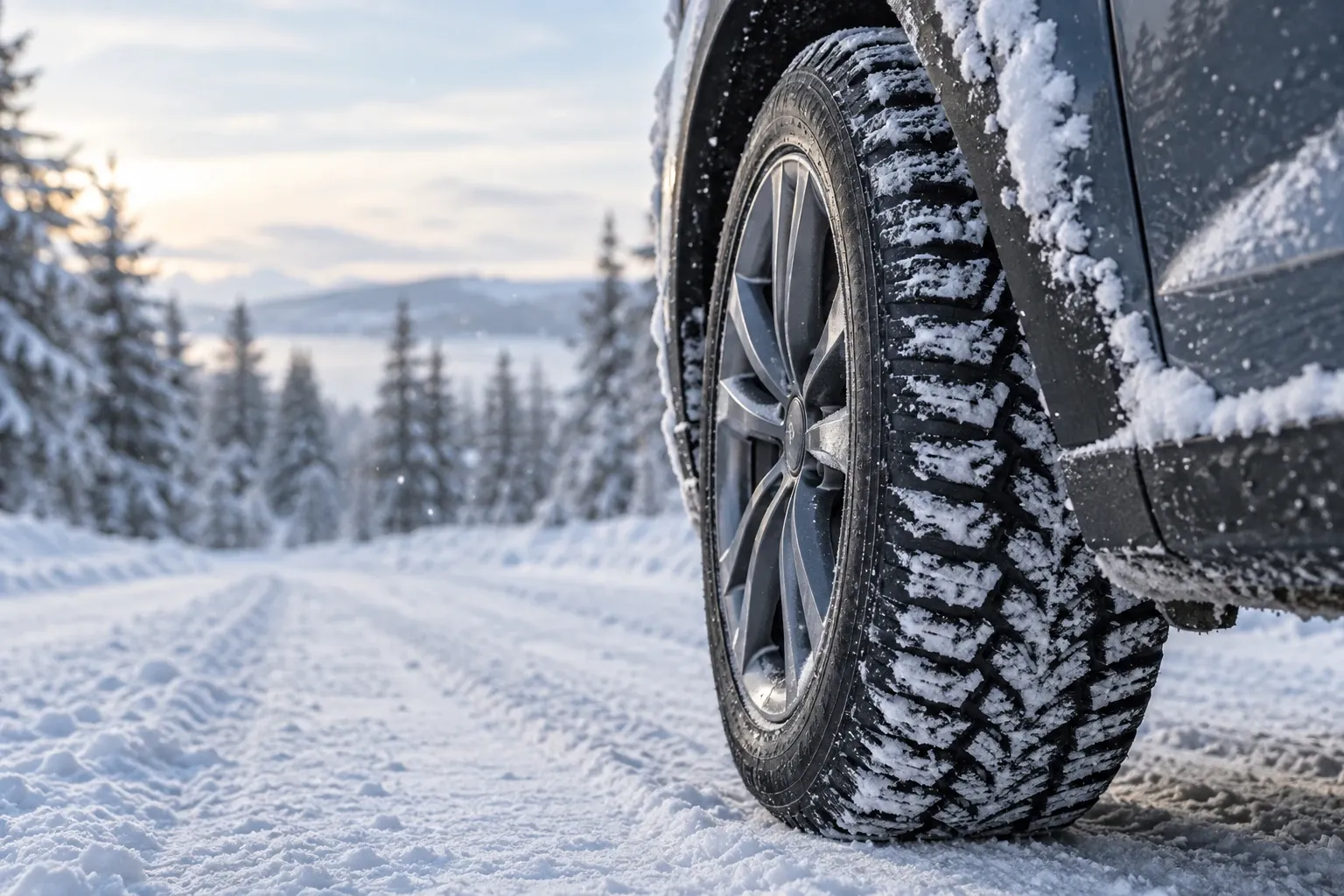
Sweden’s winter-tyre law is a date window plus a weather test, and the tyre marking decides whether you pass it. Here is the rule as the ordinance and Transportstyrelsen’s tyre regulation actually state it, including two changes most guides haven’t caught up with.
When you need this
You’re renting a car between October and April, or driving your own car up from Germany, the Netherlands or Denmark in winter. Maybe you’re wondering whether your all-season tyres are legal here, or you’re towing a caravan to a ski resort, or you’ve been offered a studded rental and plan to drive into central Stockholm.
The rule in one table
For this season, studs become legal on 1 October 2026, and the winter-tyre duty runs from 1 December 2026 to 31 March 2027.
| Period | What the law requires |
|---|---|
| 1 October – 15 April | Studded tyres allowed |
| 1 December – 31 March | Winter tyres (or equivalent equipment) required when there are winter road conditions; tread at least 3 mm |
| 16 April – 30 September | No studs, unless winter conditions exist or are expected |
| All year | Tread at least 1.6 mm |
The duty covers cars, motorhomes, light vans, light buses and any trailer they tow (trafikförordningen, the Road Traffic Ordinance, 4 kap. 18 a §).
What are winter road conditions? Vinterväglag means snow, ice, slush or frost on any part of the road, and the police add the verge. That definition is Transportstyrelsen’s general advice rather than statute text. In practice the police judge on the spot. So in theory you could drive summer tyres on a dry January day. In practice, conditions change by the hour, frost counts, and a cold, clear December morning can be enough. Fit winter tyres before 1 December and leave them on.
“Equivalent equipment” exists as an option: Transportstyrelsen gives snow chains as an example. For a visitor, it is a fallback, not a plan.
Which tyres count: the alpine symbol, not M+S
This is the change that catches visitors. Since 1 December 2024, a studless winter tyre on a car must carry the alpine symbol: a three-peak mountain with a snowflake, also called 3PMSF (alptopp/snöflinga). A tyre also qualifies if it is marked POR or is studded.
The old M+S (“mud and snow”) marking alone no longer counts on a car. Many guides and forums still say it does. They are out of date.
| Tyre marking | Legal winter tyre on a car? |
|---|---|
| Alpine symbol (3PMSF) | Yes |
| Studded | Yes |
| POR | Yes |
| M+S only | No, since 1 December 2024 |
“All-season” is a marketing word, not a legal category. An all-season tyre with the alpine symbol is a legal winter tyre in Sweden. One marked only M+S is not, and in winter road conditions it counts as having no winter tyres at all. Check the sidewall, not the product name.
Tread depth: at least 3 mm in the central 75% of the tread from 1 December to 31 March in winter conditions. Motorhomes over 3,500 kg need 5 mm. The year-round minimum of 1.6 mm isn’t enough in winter, so tyres that were legal in October can fail on 1 December. A temporary spare after a puncture is exempt.
Studded tyres: when, and how
Studs (dubbdäck) are legal from 1 October to 15 April. Legally the rule is written the other way round: studs are banned from 16 April to 30 September unless there are, or may be, winter road conditions that justify them. So keeping studs on in late April is fine in the mountains during a cold spell and an offence on a bare, dry road in spring.
Two combination rules matter:
- No mixing. A car up to 3,500 kg can’t run studded and studless tyres together (a temporary spare excepted).
- The trailer follows the car. If your car is studded, a trailer or caravan behind it must be studded too when there are winter road conditions.
Both studded and studless tyres are legal winter tyres. The real question for a visitor is where you’ll drive.
Stud bans in Stockholm, Gothenburg and Uppsala
Municipalities may ban studs on named streets, and three cities do. Crossing a banned street is allowed at the points each city names.
| City | Streets where studs are banned |
|---|---|
| Stockholm | Hornsgatan (in sections, plus parts of Rosenlundsgatan and Varvsgatan), all of Fleminggatan, Kungsgatan between Sveavägen and Birger Jarlsgatan |
| Stockholm, from 1 October 2027 | Also Sveavägen, Birger Jarlsgatan, Vasagatan and Torsgatan |
| Gothenburg | Friggagatan and Odinsgatan (you may cross Odinsgatan at Barnhusgatan and use the Odinsplatsen roundabout) |
| Uppsala | Kungsgatan between Strandbodgatan and S:t Olofsgatan; Vaksalagatan between Storgatan and Kungsgatan |
If your trip centres on central Stockholm, Gothenburg or Uppsala, studless tyres with the alpine symbol spare you from routing around these streets. Stockholm’s list grows on 1 October 2027, so check the city’s page before a winter trip after that date.
Rentals, foreign cars, trailers and motorhomes
Rental cars. The law puts the duty on the vehicle’s owner, even when someone else is driving, and for a rental car the owner is the rental company. It must make sure the car isn’t driven without proper tyres, and it can be fined if it is. You can be fined too, so glance at the sidewall. If you’ll drive into one of the three city centres, ask at the desk whether the tyres are studded. More in renting a car in Sweden.
Foreign-registered cars. The police state plainly that the winter-tyre rules cover foreign vehicles, including on trips to and from abroad. A German or Dutch car on M+S-only all-season tyres doesn’t meet Swedish rules in winter conditions.
Trailers and caravans. A trailer towed by a car must have winter tyres under the same conditions. Trailers up to 3,500 kg may keep M+S tyres designed for winter until 30 November 2028. After that, the alpine symbol applies to them too.
Motorhomes. A motorhome is legally a car (personbil klass II), so the 1 December – 31 March rule applies, with 5 mm tread above 3,500 kg.
Heavy trucks and buses have their own, stricter window, 10 November to 10 April regardless of weather, which has applied since the 2025–26 season. It doesn’t apply to cars or motorhomes.
Exempt: vehicles 30 years old or older by model year, test drives and towing for repair, the shortest route to an inspection, and vehicles with rims of 10 inches or less.
Fines
The fine for driving without winter tyres when they’re required is set in the Prosecutor-General’s fixed-fine schedule, current since 21 February 2025. Older guides quote a lower figure. The driver and the owner can each be fined. Current amounts for every tyre offence are in the table below.
Warning: A studless trailer behind a studded car, or a mix of studded and studless tyres on one car, is a separate offence. Fix it before you set off, not at the roadside.
Mistakes to avoid
- Trusting M+S on a German or Dutch all-season tyre. Look for the mountain and snowflake.
- Treating 1 December as optional because the road looks dry. Frost counts.
- Taking a studded rental down Hornsgatan or Fleminggatan.
- Keeping studs on after 15 April “in case it snows” when it isn’t winter where you are.
- Forgetting the caravan’s tyres.
Practical information
| Item | Detail |
|---|---|
| Winter-tyre duty | 1 Dec–31 Mar, when there are winter road conditions |
| Studded tyres | 1 Oct–15 Apr, longer if winter conditions exist or are expected |
| Required marking (studless, car) | Alpine symbol (3PMSF) or POR; M+S alone not accepted |
| Tread depth in winter | 3 mm; 5 mm for motorhomes over 3,500 kg |
| Trailers up to 3,500 kg | Winter-designed M+S tyres accepted until 30 Nov 2028 |
| Foreign-registered cars | Covered |
| Fine: no winter tyres | 2,000 kr (driver; owner separately) |
| Fine: tread too shallow | 1,200 kr |
| Fine: studs out of season | 500 kr |
| Fine: mixed tyres, or studless trailer behind studded car | 1,000 kr |
| Fine: studs on a banned street | 1,000 kr |
| Exempt | Vehicles 30+ years old; rims of 10 inches or less |
FAQ
When do you need winter tyres in Sweden?
From 1 December to 31 March, whenever there are winter road conditions: snow, ice, slush or frost on any part of the road. Outside those conditions summer tyres are legal, even in January. Because conditions change fast, most drivers fit winter tyres before December and keep them on. For the 2026–27 season the duty starts on 1 December 2026.
Are all-season tyres legal in Sweden in winter?
Only if they carry the alpine symbol, a three-peak mountain with a snowflake (3PMSF). Since 1 December 2024, a studless tyre on a car must have that symbol to count as a winter tyre. An all-season tyre marked only M+S does not qualify, and in winter road conditions it is treated as having no winter tyres at all.
When can I use studded tyres in Sweden?
From 1 October to 15 April. Outside that window studs are allowed only if there are, or may be, winter road conditions that justify them. For this season, studs become legal on 1 October 2026. Stockholm, Gothenburg and Uppsala ban them on certain central streets, and a trailer towed by a studded car must be studded too.
Do Sweden’s winter tyre rules apply to foreign cars?
Yes. The police state that the winter-tyre rules cover foreign-registered vehicles, including on trips to and from abroad. A German or Dutch car driving in Sweden between 1 December and 31 March must have tyres that meet Swedish rules in winter road conditions, which means the alpine symbol on studless tyres. M+S markings accepted at home may not be enough.
Will a rental car in Sweden have winter tyres?
The law puts the duty on the owner, and for a rental car the owner is the rental company. It must make sure the car is not driven in breach of the winter-tyre rule, and it can be fined if it is. The driver can be fined too. If you’ll drive in central Stockholm, Gothenburg or Uppsala, ask whether the tyres are studded.
What is the fine for not having winter tyres in Sweden?
2,000 kronor under the Prosecutor-General’s fixed-fine schedule in force since 21 February 2025. Older guides quote lower figures. The driver and the vehicle’s owner can each be fined. Tyres worn below 3 mm in winter conditions carry a 1,200 kronor fine, and studs used outside the permitted season carry 500 kronor. Amounts can change, so treat them as a guide.
Where are studded tyres banned in Sweden?
On named streets in three cities. In Stockholm: Hornsgatan, Fleminggatan and part of Kungsgatan, with Sveavägen, Birger Jarlsgatan, Vasagatan and Torsgatan added from 1 October 2027. In Gothenburg: Friggagatan and Odinsgatan. In Uppsala: parts of Kungsgatan and Vaksalagatan. Crossing these streets is allowed at the points each city names.
Related guides
- Driving in Sweden: the full rulebook for lights, alcohol, give-way and wildlife
- Winter driving in Sweden: how to drive once the tyres are right
- Renting a car in Sweden: what to check at the desk before you drive off
- Getting around Sweden: when a winter train beats a winter drive
Facts verified 2026-09-23. Sources: Sveriges Riksdag (Trafikförordningen), Transportstyrelsen (TSFS 2009:19 and its winter-tyre guidance), Polisen, Riksåklagaren and Åklagarmyndigheten, and the cities of Stockholm, Gothenburg and Uppsala — full register in this topic’s source file. Found something outdated? Tell us and we’ll fix it.