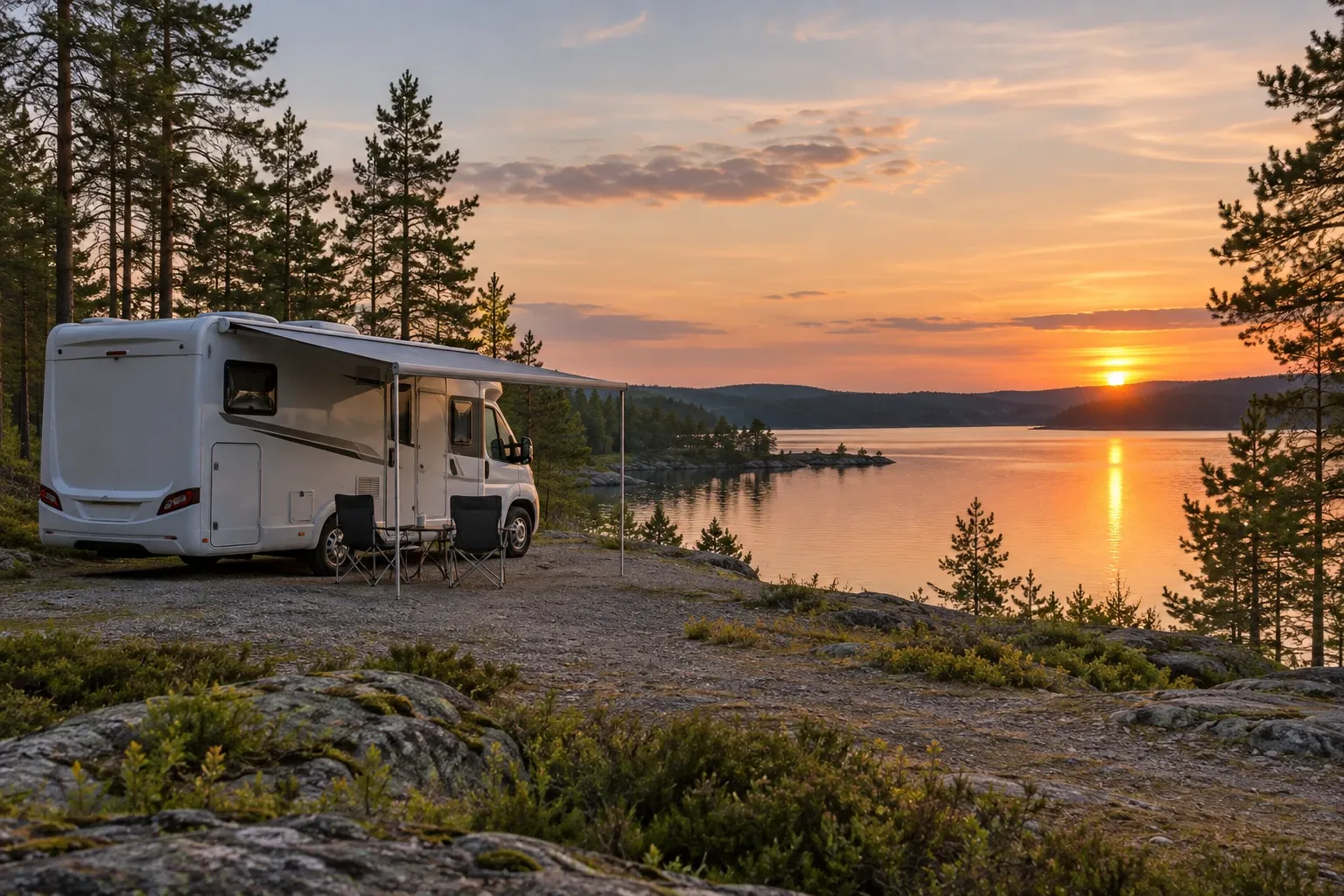
Sweden is genuinely one of Europe’s best motorhome countries. It just isn’t good for the reason most arrivals think. The famous right to roam does not cover your vehicle — and once you know what replaces it, the trip gets easier rather than worse.
When you need this
Planning a Swedish motorhome trip and budgeting overnight stops. Choosing between a ställplats, a campsite and a rest area tonight. Or looking at a beautiful empty lay-by and wondering whether staying is legal.
The right you have read about does not cover your vehicle
Naturvårdsverket, the Swedish environmental agency, is explicit: setting up a motorhome, a caravan with its towing vehicle, or a car with a roof tent is not part of allemansrätten. Pitching a tent for a night or two is.
That distinction is the whole topic. A great deal of “free camping in Sweden” content implies a right that simply does not exist for vehicles, and travellers act on it — parking on private land, on meadows, at beaches — in good faith.
What allemansrätten actually protects is covered in wild camping in Sweden. The short version: it’s about people on foot and tents, not vehicles.
What actually governs you: parking law
The good news is that the replacement framework is permissive.
Sleeping in a legally parked motorhome is not prohibited. There’s no general rule against it, and a vehicle counts as parked whether or not anyone is inside. So the question becomes: may I park here, and for how long?
- On streets and public roads: a maximum of 24 consecutive hours on weekdays. The limit doesn’t apply on the day before a Sunday or public holiday.
- At rest areas and marked parking: the same 24-hour default, unless signage says otherwise.
- Local bans override both. Municipalities and landowners can prohibit overnight stays, and those bans are enforceable. They cluster at exactly the scenic coastal and lakeside spots motorhomes want.
Read the signage every night. Look for övernattning förbjuden. This is the same legal logic that applies to cars — see sleeping in your car in Sweden.
You may not drive onto open ground
The Off-Road Driving Act prohibits driving on bare ground. Pulling into a meadow, a field or a forest track to reach a view or a shoreline is not permitted, regardless of how empty and accessible it looks, and regardless of whether you’d be allowed to park on the road nearby.
Ground vegetation damaged by vehicles recovers slowly, and this is one of the behaviours that prompts municipalities to introduce the local bans that then affect everyone.
Ställplatser: the network that replaces it
Here’s the part that makes Sweden work for motorhomes, and it’s what the “free camping” narrative obscures.
A ställplats is a motorhome stopover: a designated place to park overnight, commonly with electricity, fresh water and waste-disposal facilities. Some are free. Most are inexpensive. They exist across the country, in towns, at harbours, beside attractions and on farms.
The realistic model for a Swedish motorhome trip is therefore not “park anywhere for free” but “a cheap or free stopover almost everywhere, with services” — which is, in practice, a better trip. You get water, power and legal disposal instead of anxiety about whether you’ll be moved on.
Three tiers to mix:
| Option | Cost | Facilities |
|---|---|---|
| Rest area | Free | Toilet; 24h max; transit nights |
| Ställplats | Free to modest | Power, water, waste disposal |
| Campsite | Higher | Showers, laundry, kitchens, family facilities |
Most motorhome travellers use rest areas and ställplatser for transit and a campsite every few days for a full service and shower stop.
Water and waste
This is a legal and environmental obligation, not a courtesy.
Empty toilet cassettes and grey water only at proper disposal points — the ones provided at ställplatser and campsites, which is what they exist for. Emptying into nature, a lake or a storm drain is never acceptable and can carry penalties alongside the direct harm.
Plan service stops into the route rather than improvising them, particularly in the far north where distances between facilities are long, and in winter when many water points are shut off to prevent freezing.
For drinking water on the road, see refilling water outdoors.
Mistakes to avoid
- Believing free wild camping applies to the vehicle.
- Driving off the road onto grass or a forest track.
- Staying a second night in the same street or lay-by.
- Emptying waste anywhere other than a disposal point.
- Using a campsite’s car park without checking in.
- Ignoring an övernattning förbjuden sign because the spot looks unused.
Good to know
- Ask at farms and small businesses. Permission is often given freely, and asking converts a grey area into a clear yes.
- A tent pitched beside the motorhome is covered by allemansrätten, even though the vehicle isn’t — but the vehicle still has to be parked legally.
- Arrive early in July. Popular ställplatser fill up in high summer.
- Nature reserves and national parks usually prohibit overnight vehicle stays outright, independent of the general rules.
- Winter changes the map: many ställplatser and campsites close or cut services, and water points are often turned off. Verify before relying on a stop.
- Cooking outside? Check the fire rules first — see campfires and fire bans.
Practical information
| Item | Detail |
|---|---|
| Allemansrätten covers motorhomes? | No — tents only |
| Sleeping in a parked motorhome | Not prohibited |
| Street / public road limit | 24 consecutive hours on weekdays |
| Exception | Doesn’t apply the day before a Sunday or public holiday |
| Rest areas | ~270 nationally · free · open 24/7 · toilets |
| Ställplats | Free to modest fee · power, water, waste disposal |
| Driving off-road | Prohibited on bare ground |
| Private land | Landowner permission required |
| Local overnight bans | Enforceable; common at coasts and lakes |
| Waste disposal | Only at designated service points |
FAQ
Can you wild camp with a motorhome in Sweden?
Not under allemansrätten. The right of public access covers pitching a tent for a night or two; it explicitly does not cover motorhomes, caravans with towing vehicles or roof-tent vehicles. You may sleep in a motorhome where parking is legal, subject to the 24-hour limit and any local ban, but you cannot claim a right to occupy open land.
What is a ställplats?
A motorhome stopover: a designated place to park overnight, commonly with electricity, fresh water and waste-disposal facilities. Some are free and most are inexpensive. They exist across Sweden and are the intended infrastructure for motorhome touring, which makes them the practical basis for planning a trip rather than an occasional fallback.
How long can a motorhome stay parked in one place in Sweden?
On streets and public roads the general limit is 24 consecutive hours on weekdays, and it does not apply on the day before a Sunday or public holiday. Rest areas and marked parking places usually apply the same 24-hour default unless signage says otherwise, and municipalities can set stricter local rules.
Can I drive my motorhome off-road to find a spot in Sweden?
No. The Off-Road Driving Act prohibits driving on bare ground, so pulling into a meadow, field or forest track is not permitted regardless of how empty or accessible it looks. This applies even where you would otherwise be allowed to park nearby, and ground damage from vehicles is slow to recover.
Where do I empty a toilet cassette in Sweden?
At the disposal points provided by ställplatser and campsites, which is what they exist for. Emptying waste water or a cassette into nature, a lake, or a storm drain is never acceptable and can carry penalties as well as causing direct environmental harm. Plan service stops into the route rather than improvising them.
Is it cheaper to use ställplatser or campsites in Sweden?
Ställplatser are generally cheaper and some are free, offering parking plus basic services. Campsites cost more and provide showers, laundry, kitchens and often family facilities. Most motorhome travellers mix the two — ställplatser or rest areas for transit nights, a campsite every few days for a full service and shower stop.
Related guides
- Sleeping in your car in Sweden — the same legal question, smaller vehicle
- Wild camping in Sweden — what allemansrätten actually protects
- Swedish campsites — the full-service option
- Refilling water outdoors — drinking water on the road
- Public toilets in Sweden — including the rest-area network
Facts verified 2026-07-25. Sources: Naturvårdsverket (the Swedish EPA), Trafikförordningen (1998:1276), Swedish motorhome touring guidance — full register in this topic’s source file. Local overnight bans and site services change; always check the signage and the operator. Found something outdated? Tell us and we’ll fix it.