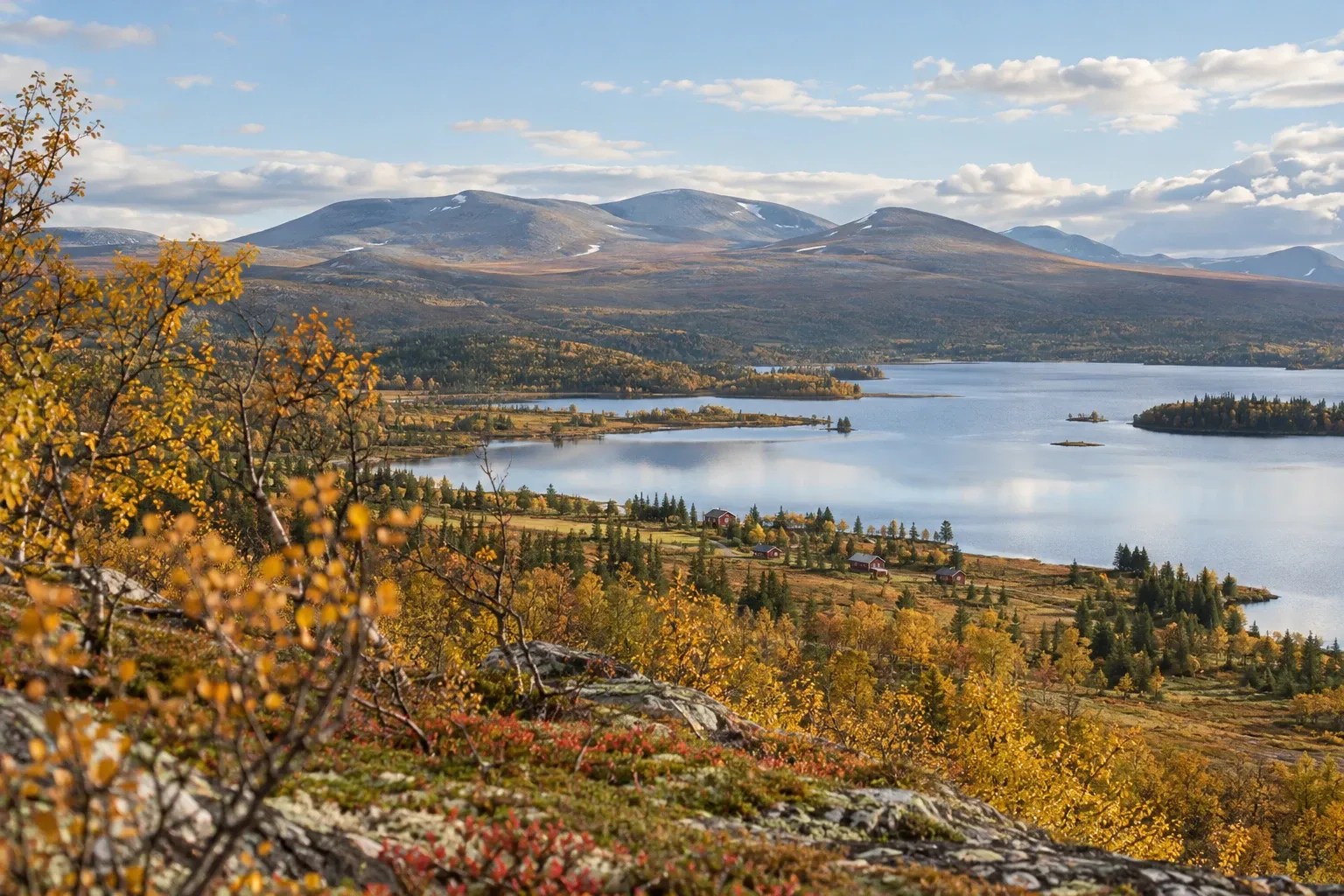
Härjedalen has more mountain than people: about 10,000 residents on 11,344 km² of land. Here is how the province fits together, what Funäsdalen offers in winter and summer, and every realistic way to get there.
When you need this
You’re choosing between Härjedalen, Åre and Sälen for a ski week and want to know what Funäsdalen actually offers. Or you’re planning a summer hike to Helags, Rogen or Sonfjället and need the regional picture first. Maybe you’re travelling without a car, want to drive the Flatruet road, or have just noticed “Härjedalen” next to “Jämtland” and wonder how the two relate.
Where Härjedalen is
Härjedalen is a mountain-and-forest province in west-central Sweden, between Dalarna, Jämtland and Norway. It belonged to Norway until the Peace of Brömsebro in 1645, and it is still the least-populated of Sweden’s provinces. Today almost all of it forms one municipality, Härjedalens kommun, inside Jämtlands län (Jämtland county). The municipal seat is Sveg.
The numbers explain the feel of the place. The municipality covers 11,344 km² of land, about 2.8% of Sweden, and had 10,025 inhabitants in August 2026 — fewer than one person per square kilometer. Sveg (2,448 people in 2023) and Funäsdalen (1,064) are the largest places. You may see slightly different figures in encyclopedias: the old province and the modern municipality don’t share exactly the same borders.
For planning, think of four areas:
| Area | Places | What it is for a visitor |
|---|---|---|
| Funäsfjällen (the west) | Funäsdalen, Tänndalen, Ramundberget, Bruksvallarna, Fjällnäs, Tännäs, Ljusnedal, Messlingen, Mittådalen | Nine linked villages, six ski areas; Rogen and the musk oxen to the south |
| The north-west | Ljungdalen, Helags | Gateway to Helags and its glacier, over the Flatruet plateau road |
| Vemdalen and Hede | Vemdalen, Hede, Lofsdalen, Sonfjället | A separate ski destination on the bus route from Östersund; Sonfjället National Park |
| Sveg | Sveg | The municipal seat, with the airport and the Inlandsbanan station |
The western mountains are also Sámi land. They are reindeer grazing land, and the Sámi herding right applies there whoever owns the ground — it rests on immemorial use, not on a permit from the state.
Funäsdalen and the Funäsfjällen villages
Funäsdalen sits beside the lake Funäsdalssjön at the foot of Funäsdalsberget, and road 84 from Sveg runs right into the village. It is the base for Funäsfjällen, a destination of nine villages linked by cross-country, cycling, hiking and snowmobile trails.
The village is also home to Härjedalens Fjällmuseum, the municipal museum, where you meet the mountain farmers, Sámi and ironworks workers who built the region. It keeps seasonal hours: in 2026 it opens for the autumn school break, 26–31 October, then again from 14 December.
Where you stay matters more than in a single-resort town, because the villages are spread out. By our own routing measurement, Tänndalen is 14 km from Funäsdalen, Tännäs 19 km, Ramundberget 22 km and Ljungdalen 41 km.
| Base | Best for |
|---|---|
| Funäsdalen | Shops, the museum, Funäsdalsberget, bus connections |
| Tänndalen / Ramundberget | Higher-altitude downhill and cross-country |
| Ljungdalen | Helags in summer and winter |
| Tännäs | Rogen and the guided musk ox tours |
Winter: skiing on one pass
Funäsfjällen has six ski areas — Tänndalen, Ramundberget, Funäsdalsberget, Tännäskröket, Kappruet and Tänndalsvallen — with more than 150 runs on one shared lift pass, the Fjällpass Lift. They are separate hills, connected by trails and a ski bus rather than by lifts, so don’t expect to ski from one to the next. Since 2023 a 1–7 day Fjällpass Kombi adds the cross-country tracks to the lift pass; season passes are still bought separately for lifts and tracks.
Cross-country is the other half of the story: about 300 km of connected tracks between the villages and over the open fell. Adults need a track pass (spårkort). Children and young people up to 15 ski the tracks free, under an arrangement announced in November 2024 for three more years.
The season starts early. Pre-season skiing on stored snow begins in Tänndalen (downhill) and at Ramundberget and Bruksvallarna (cross-country) from the autumn school break in late October, and the track season runs to the end of April. Snowmobilers get about 910 km of trails through a joint deal between Funäsfjällen, Vemdalen and Ljungdalen — see our snowmobile guide for licence rules.
Vemdalen lies in Härjedalen too but is a separate destination with its own resort operator and pass; in 2026/27 Vemdalsskalet plans to open on 27 November, subject to snow. For a side-by-side with Åre, Sälen and Idre, read skiing in Sweden.
Off-piste? The mountains around Funäsdalen, Ramundberget, Ljungdalen and Helags are Västra Härjedalsfjällen, one of only six Swedish areas with a public avalanche forecast on lavinprognoser.se. The resort’s own assessment covers lift-served terrain only; beyond the boundary the forecast — planned to start around 11 December for 2026/27 — and your own judgment take over.
Summer: Helags, Rogen and Flatruet
Helags is Härjedalen’s highest mountain, about 1,800 m, carrying Sweden’s southernmost glacier. The mountain station sits in roadless country 12 km on foot from the trailhead at Kläppen, about 6 km from Ljungdalen; in 2027 it opens 5 March – 18 April and 1 July – 26 September. It is also one of the strongest areas in Sweden for the endangered arctic fox.
Rogen, south of Tännäs, is a 500 km² nature reserve on the Norwegian border and the winter range of Sweden’s only wild musk oxen. The main entrance is at Käringsjövallen, about 20 km south of Tännäs. Reserve rules are binding: no deliberate approach within 100 m of a musk ox, and no dogs from 20 April to 31 May. Our musk ox guide covers the herd, the distances and the guided enclosure tours near Tännäs.
Flatruet is the high plateau between Funäsdalen and Ljungdalen, crossed by road 531. You’ll often read that it’s Sweden’s highest public road; it is widely billed that way, but no Trafikverket source we read states it. At the plateau’s eastern tip, the Ruändan rock paintings show reindeer, bears, moose and people and are more than 4,000 years old; park at Baggården and walk up to Ruvallen.
Sonfjället National Park, one of Sweden’s first nine parks (1909), is a forest-and-fell park and one of the country’s densest bear areas, with its main entrance at Nyvallens fäbod. Read our bear guide before a forest walk.
Around Funäsdalen itself there are bike parks on a summer Fjällpass Cykel and a via ferrata on Funäsdalsberget.
Getting there
There is no railway to Funäsdalen, and the drive is long: by our measurement about 570 km and eight hours’ pure driving from Stockholm, 211 km from Östersund and 77 km from Røros in Norway.
| Mode | How it works |
|---|---|
| Coach | Härjedalingen runs Stockholm–Uppsala–Gävle–Funäsdalen six days a week. Buy before travel: no tickets on board, and you can board only at your booked stop. |
| Regional bus | Länstrafiken bus 164 Östersund–Vemdalen–Hede–Funäsdalen; bus 631 Sveg–Hede–Funäsdalen. Card or app only, no cash on board. |
| Night train + transfer (winter) | Snälltåget’s night trains from Malmö via Stockholm connect at Röjan or Östersund with transfers to Funäsfjällen, booked with the ticket. |
| Rail, nearest stations | Røros (Norway), Sveg, Ljusdal, Östersund — then bus or car. Inlandsbanan passes Sveg in summer (daily 15 June – 12 August in 2026). |
| Flights | Sveg–Mora–Arlanda, a state-procured route under contract to 26 October 2027. Røros is the closest airport by road; Åre Östersund, the main regional airport, is 209 km away. |
If you miss the last bus, the fallback is a taxi transfer, and in Vemdalen these must be booked two to twelve hours ahead. For the full picture on reaching mountain resorts by train and bus, see ski resorts without a car.
Rules that catch visitors
| Rule | Status | What it means |
|---|---|---|
| Winter tyres 1 December – 31 March in winter conditions | (law) | Applies to foreign-registered cars too |
| Flatruet road closed 22:00–06:00, 1 December – 15 April | (guidance — Trafikverket) | Cross in daylight; it can also close at short notice in bad weather |
| Scaring, chasing or driving off reindeer | (law — fines, even through negligence) | Slow down and wait when a herd is on the road |
| Rogen reserve: 100 m from musk oxen, no dogs 20 April – 31 May, no off-road vehicles | (law) | Binding reserve regulations |
| Buses cashless; coaches pre-booked | (practice) | Carry a bank card |
More on the roads in mountain roads in winter and on herding rules in reindeer herding land.
Practical information
| Item | Detail (checked 2026-10-15) |
|---|---|
| Population | 10,025 in the municipality (August 2026); Funäsdalen 1,064, Sveg 2,448 (2023) |
| Härjedalens Fjällmuseum | Adult 160 kr, free for under-18s; open 26–31 Oct 2026, then from 14 Dec |
| Lift pass / Fjällpass Kombi | Price by days and season on Funäsfjällen’s booking pages; not published here |
| Cross-country track pass | Paid for adults; free up to age 15 |
| Regional bus | Zone-based fares; card or app, no cash on board |
| Rogen nature reserve | No entry fee listed |
| Avalanche forecast | lavinprognoser.se, area Västra Härjedalsfjällen, in season |
| STF Helags 2027 | 5 Mar – 18 Apr and 1 Jul – 26 Sep |
FAQ
Where is Funäsdalen in Sweden?
Funäsdalen is a mountain village of about 1,000 people in western Härjedalen, close to the Norwegian border. Härjedalen is a province inside Jämtland county. By our routing measurement it is about 570 km and eight hours’ pure driving from Stockholm, 211 km from Östersund and 77 km from Røros in Norway. Road 84 from Sveg runs right into the village.
Is Härjedalen part of Jämtland?
Partly. Härjedalen is its own historic province, Norwegian until 1645, but today almost all of it forms Härjedalens kommun, one of the municipalities of Jämtland county. So you will see “Jämtland Härjedalen” used for the region. In practice Funäsdalen is a separate trip from Åre: more than three hours’ drive from Östersund.
How do you get to Funäsdalen without a car?
There is no railway. Härjedalingen coaches run from Stockholm, Uppsala and Gävle six days a week, bought in advance. Länstrafiken bus 164 comes from Östersund and bus 631 from Sveg, card payment only. In winter, Snälltåget’s night train connects at Röjan or Östersund with pre-booked transfers. Sveg also has flights to Arlanda via Mora.
Is Funäsdalen good for skiing?
Yes, especially for mixed groups. Funäsfjällen has six ski areas — Tänndalen, Ramundberget, Funäsdalsberget, Tännäskröket, Kappruet and Tänndalsvallen — with more than 150 runs on one lift pass, plus about 300 km of cross-country tracks, free for children up to 15. The areas are separate hills linked by bus and trails, not one connected lift system.
What is there to do in Härjedalen in summer?
Hiking is the core: Helags, Härjedalen’s highest mountain with Sweden’s southernmost glacier, reached on foot from Ljungdalen; Rogen’s lakes and musk ox country; and bear country at Sonfjället National Park. Around Funäsdalen there are bike parks, a via ferrata on Funäsdalsberget, the Fjällmuseum, and the Ruändan rock paintings on Flatruet, more than 4,000 years old.
Can you drive over Flatruet in winter?
Yes, but not at night. Road 531 over Flatruet between Mittådalen and Skärkdalen, the route from Funäsdalen to Ljungdalen, is closed every night from 22:00 to 06:00 between 1 December and 15 April, and can close at short notice in bad weather. Plan to cross in daylight, with winter tyres, and check Trafikverket’s traffic information before setting out.
Related guides
- Musk oxen in Härjedalen — Rogen’s rules and the guided enclosure tours near Tännäs.
- Skiing in Sweden — how Funäsdalen compares with Åre, Sälen, Vemdalen and Idre.
- Cross-country skiing in Sweden — track passes, etiquette and what to rent.
- Mountain safety — before Helags or any off-piste day.
- Next door: Jämtland in summer and Idre and northern Dalarna.
Facts verified 2026-10-15. Sources: SCB, Länsstyrelsen Jämtland, Sveriges Nationalparker, Naturvårdsverket (lavinprognoser.se), Trafikverket, Transportstyrelsen, Riksdagen, Sametinget, Länstrafiken Jämtland, Härjedalens Fjällmuseum, Funäsfjällen, Destination Vemdalen, Svenska Turistföreningen, Härjedalingen, Snälltåget, Destination Inlandsbanan, Store norske leksikon, OSRM route measurements — full register in this topic’s source file. Found something outdated? Tell us and we’ll fix it.