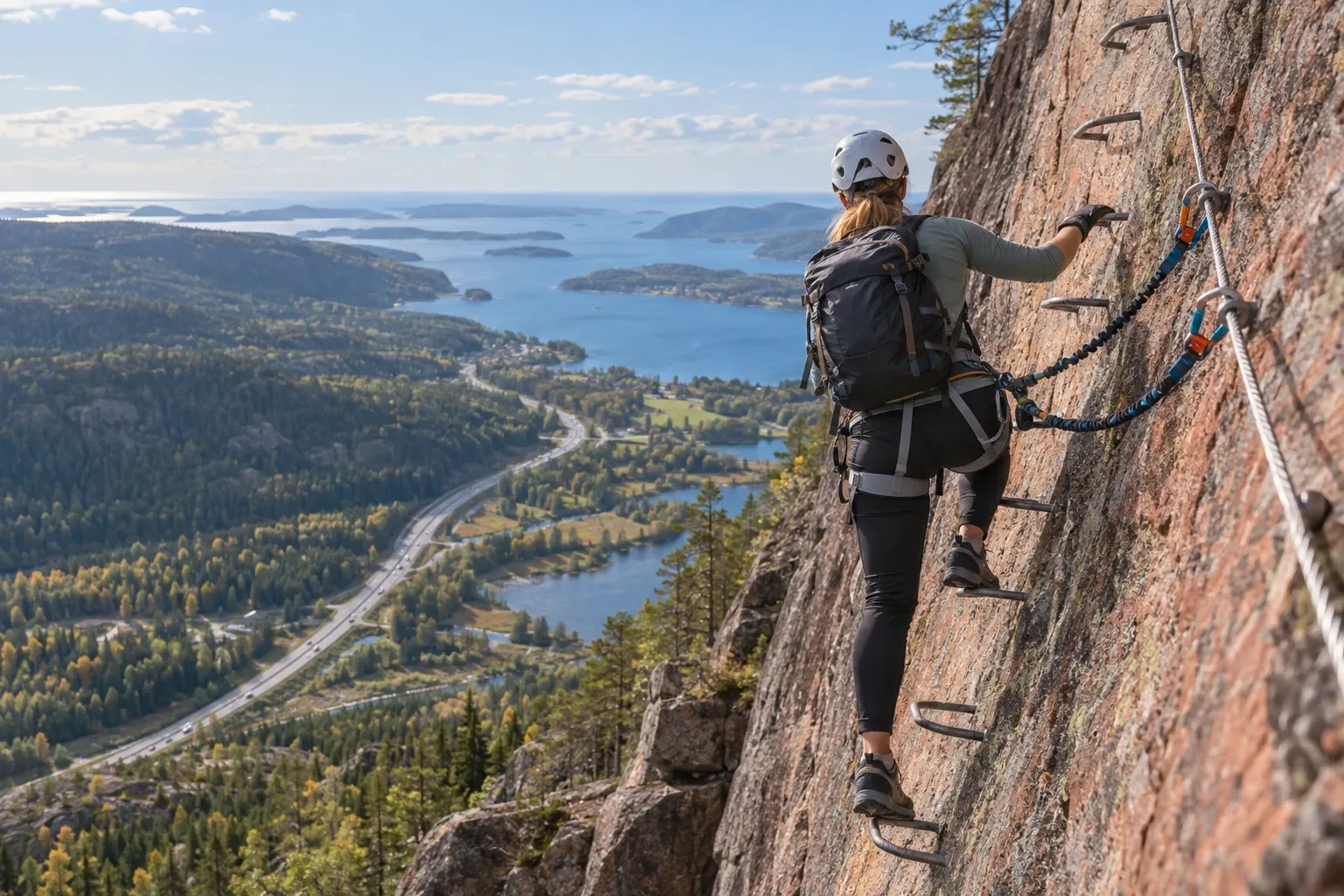
Sweden’s fixed-cable climbing routes are few, short and run in very different ways. This guide lists the routes we could verify, explains the 40 kg rule for children, and covers what to wear, when routes close and what it costs.
When you need this
You’re planning a High Coast or Härjedalen trip and want something more exciting than a summit walk. Or you have a child who is desperate to climb and you need to know if they’re big enough. Maybe you’re standing at the foot of Skuleberget on a damp morning wondering why the routes show a padlock. Or you’ve packed your own via ferrata set from home and want to know it will be accepted.
What a via ferrata is
A via ferrata (Italian for “iron road”) is a steep route fitted with a fixed steel cable, iron rungs and footholds. In Swedish it’s a klätterstig (climbing path) or vajerled (cable route). You wear a harness and helmet, and two lanyards with carabiners keep you clipped to the cable all the way up.
The idea reached Sweden in the 1980s and is far rarer here than in the Alps. The first and still the largest site, Skuleberget on the High Coast, opened in 1987. If you know Alpine Klettersteige, expect far fewer and shorter routes.
Where to climb: Sweden’s verified routes
These are the five routes we could confirm from official or operator sources. Each runs in its own way, and that matters more than the grade.
| Site | Region | How it works | Good for |
|---|---|---|---|
| Skuleberget | High Coast, by the E4 near Docksta | Staffed drop-in: briefing, rental, then you climb on your own | First-timers, families, and experienced climbers on the hard lines |
| Funäsdalsberget | Funäsdalen, Härjedalen | Booked rental slot with a briefing; one route in stages | A mountain summit near 1,000 m with bypass paths |
| Kittelfjäll | Vilhelmina municipality, southern Lapland | Self-service: bring or rent your own kit | Independent adults; 350 m of cable, about 3 hours |
| Järvsö | Hälsingland | Forest via ferrata with rungs and cables | Families with children from about 12 |
| Kebnekaise | Kiruna mountains | Cable section on the eastern summit route | Guided alpine climbers only |
Skuleberget is the one most visitors mean. Its four routes climb a 250-metre east face on about 1,300 metres of cable, inside a state nature reserve. The routes belong to Naturvårdsverket, the Swedish Environmental Protection Agency, and are leased to an operator. The county board says you can only use them through that operator. In 2026 the operator counted 6,055 climbers. More on the four routes below.
Funäsdalsberget rises straight out of Funäsdalen village to a summit near 1,000 metres, about 300 metres above the houses. Volunteers built the route as a recreational trail. The destination company says you use it on your own responsibility, the way you would climb a crag. If a stage feels too exposed, simpler hiking paths let you skip it. You can ride the gondola down, but buy that ticket before you start up.
Kittelfjäll has 350 metres of cable on the mountain Lebnjiesnuenie, opposite the sheer wall of Borkafjället. It starts about 2 km from the village on the road towards Norway, where a sign marks it. A steep path leads to a plateau where the cable begins. The first stage is fairly easy, the second more demanding and airy. There is no desk: bring your own kit or rent it locally. The village site says plainly that you climb at your own risk.
Järvsö offers a via ferrata in a forest setting, with rungs and cables. It recommends climbers from 12 years, at least 40 kg and at least 130 cm tall.
Kebnekaise’s eastern route includes a short cable section, but this is not a family outing. It’s a glacier route on Sweden’s highest mountain, and STF, the Swedish Tourist Association, says that section needs specific equipment and recommends a guide. Fjällsäkerhetsrådet, the national mountain safety council, reported that STF’s guiding on the eastern route was paused for summer 2026. See climbing Kebnekaise before you plan anything there.
We searched for routes in Åre, Vemdalen, Idre and Sälen and found only climbing parks and high ropes courses, which aren’t via ferratas.
Skuleberget’s four routes
| Route | Grade | What it’s like |
|---|---|---|
| White | B, moderate | The one for beginners and children; age, weight or never having climbed are no reason to skip it |
| Yellow | C, difficult | Much steeper, smoother and more physical, with an early “trial section” to test yourself |
| Red | C/D, difficult+ | More exposed, harder the higher you go; it helps to be taller than about 160 cm |
| Black | E, extreme | By far the hardest: climb the red without problems first, and wear climbing shoes |
The operator’s advice is to start with the white route if you’ve never climbed or you’re climbing with children. Fear of heights, not fitness, is the real test. You can turn back at the trial section where the climbing begins, and up to the junction of the white and red routes. Beyond that the red route gets steadily harder, and the operator warns that climbers can get stuck, unable to go on or back.
The process is simple. You read the safety rules, sign an ansvarsförsäkran (liability statement), and are weighed, fitted and briefed. Then you climb on your own. A route takes about two hours including the briefing. Add 30 to 60 minutes to walk down on one of the hiking paths, and extra time in high season when routes queue.
Individuals don’t book: it’s drop-in every day the rock is dry, because routes close in rain. Groups of ten or more should book. A guided climb runs daily at 15:00 until the end of September, and it must be booked.
Children and the 40 kg rule
The question parents ask most is about age, but the rule that matters is weight. A via ferrata lanyard has a falldämpare (shock absorber) that absorbs the shock of a fall. The European standard for these lanyards, EN 958 in its 2017 edition, covers climbers from 40 kg without equipment up to 120 kg including it. Below 40 kg the absorber may not deploy, and the fall stops dead. The Skuleberget operator gives exactly that reason, weighs every climber and says its scale decides.
| Site | Weight | Age and supervision |
|---|---|---|
| Skuleberget | 40–120 kg | 18 to climb alone; under-18s with a parent or guardian confident with heights; at most one child under 15 per adult |
| Funäsdalsberget | 40–120 kg | Children can take part from 40 kg |
| Järvsö | At least 40 kg, 130 cm | Recommended from 12 years |
Some listings, including Naturkartan and one paragraph of the operator’s English page, still say 40–140 kg. The operator’s current Swedish page, the Funäsdalsberget booking page and the standard all say 120 kg, so plan on 120.
The routes aren’t designed for children, so a lot rests on the adult. You supervise every carabiner move, all the way up. If no parent or guardian can come, Skuleberget offers a booked guide instead.
Equipment and what to wear
Staffed sites include a helmet, a harness and a Y-shaped via ferrata lanyard with two self-locking carabiners. At Skuleberget your own kit is accepted at a lower price if it is approved for sport climbing, in good condition and no more than ten years old:
- Harness: EN 12277 type C, or UIAA
- Via ferrata lanyard: EN 958, or UIAA
- Carabiners: self-locking, EN 12275
- Helmet: EN 12492, or UIAA
Missing or unacceptable items are replaced for a fee. Footwear matters more than people expect. Trainers and running shoes are too flexible and grip poorly on smooth rock. Boots are better, and via ferrata shoes, rentable on site, are recommended for the yellow, red and black routes. Thin rubberised gloves give a better grip on the cable and save your palms from blisters.
Weather and season
Skuleberget is open from May into October, as long as the weather allows. The 2026 season ended on 5 October, and the operator plans to reopen in May 2027. Funäsdalsberget has a shorter summer season. STF’s magazine gave July to mid-August in 2023, so check this year’s dates.
Routes close for rain, wet rock, extreme heat and thunder; strong wind alone doesn’t close them. After heavy rain the face can take days to dry, so don’t build a trip around one fixed climbing day. Skuleberget shows a live open-or-closed status for each route and updates it several times a day when the weather turns.
In high summer the east face is in shade after about 15:00, when the rush is also over. Spring and autumn are cooler, quieter and cheaper.
Safety on the cable
- Keep both carabiners clipped. At each anchor, move one carabiner across, then the other. Never have both open at once.
- Don’t free-climb. Hold the cable or the rungs. Falls while not holding on are one of the named risks.
- Pick a grade you could reverse. Overestimating your ability and panicking on a too-hard route are the main risks the operator lists.
- Wear the helmet, and carry water and food. Stonefall and dehydration are real on a sun-warmed face.
- Get off before thunder. You’re clipped to a steel cable on an exposed cliff.
If something goes wrong on a remote route, call 112. In Sweden the rescue itself sends no bill to the person rescued, but healthcare afterwards can cost money. Who pays for a rescue in Sweden explains the difference, and travel insurance for Sweden covers what to check for adventure activities.
At Skuleberget, non-climbers can walk up on marked trails or take the summer cable car and meet the climbers at the top. The reserve’s own rules still apply: no tents, dogs on a lead, and fires only at designated places. Naturum Höga Kusten at the foot of the mountain is open March to November.
Practical information
| Item | Amount or rule (checked 2026-10-15) |
|---|---|
| Skuleberget, one route incl. equipment | 420 kr low season (May–21 June, 17 Aug–4 Oct 2026); 540 kr high season (22 June–16 Aug) |
| Skuleberget, add-on day pass | 210 kr low / 270 kr high season |
| Skuleberget, one route with your own kit | 210 kr low / 270 kr high season |
| Skuleberget, guide | 840 kr per guide low season, 1,080 kr high season; book ahead |
| Funäsdalsberget, climb with rental and briefing | 350 kr per person (year not stated on the booking page) |
| Kittelfjäll | No route fee listed; equipment rental separate |
| Weight limit | 40–120 kg |
| Rescue via 112 | No bill to the person rescued; healthcare can be charged |
FAQ
Is there via ferrata in Sweden?
Yes, but only a handful. The main site is Skuleberget on the High Coast, with four graded routes on a 250-metre face, opened in 1987. Smaller routes climb Funäsdalsberget in Härjedalen, a mountainside in Kittelfjäll and a forest crag in Järvsö. Kebnekaise’s eastern route has a cable section, but that is a guided glacier climb, not a family outing.
How old do kids have to be for via ferrata in Sweden?
Weight matters more than age. The standard via ferrata lanyard needs a climber of at least 40 kilos, or its shock absorber may not work in a fall. At Skuleberget under-18s must climb with a parent or guardian, at most one child under 15 per adult. Järvsö recommends at least 12 years and 130 centimetres.
Do I need climbing experience for Skuleberget?
Not for the white route. The operator says age, weight or never having climbed are no reasons to skip it; fear of heights is the real test. The yellow route is much steeper and more physical, the red more exposed, and the black is extreme: climb the red without problems first, and wear climbing shoes.
Do I need to book the via ferrata at Skuleberget?
No. Individuals simply turn up on a dry day during the season, because routes close in rain and bookings would be cancelled anyway. Groups of ten or more should book. A guided climb, offered daily at 15:00 until the end of September, must be booked in advance. Check the operator’s live route status before driving there.
Can I use my own via ferrata set?
At Skuleberget, yes, at a lower price, if it is approved for sport climbing, in good condition and no more than ten years old. The lanyard must meet EN 958, the harness EN 12277 type C, the carabiners EN 12275 and the helmet EN 12492, or UIAA equivalents. Missing or unacceptable items are replaced for a fee.
What happens if it rains?
Routes close. Skuleberget shuts routes in rain, wet conditions, extreme heat and thunder, and after heavy rain the face can take days to dry. Strong wind alone does not close it. Keep a flexible day in your plan, and follow the operator’s route status, which is updated several times a day when the weather turns.
Related guides
- The High Coast: the trails, naturum and bus stops around Skuleberget.
- Skuleskogen National Park: the next-door day out on the High Coast.
- Climbing Kebnekaise: the alpine route with Sweden’s only glacier-side cable section.
- Härjedalen and Funäsdalen: the rest of a summer around Funäsdalsberget.
- Who pays for a rescue in Sweden: why 112 is free and what can still cost money.
Facts verified 2026-10-15. Sources: Länsstyrelsen Västernorrland, Naturvårdsverket, Svenska Turistföreningen, Fjällsäkerhetsrådet, Funäsfjällen, DIN (EN 958:2017), Sveriges Riksdag, and the route operators at Skuleberget, Kittelfjäll and Järvsö — full register in this topic’s source file. Found something outdated? Tell us and we’ll fix it.