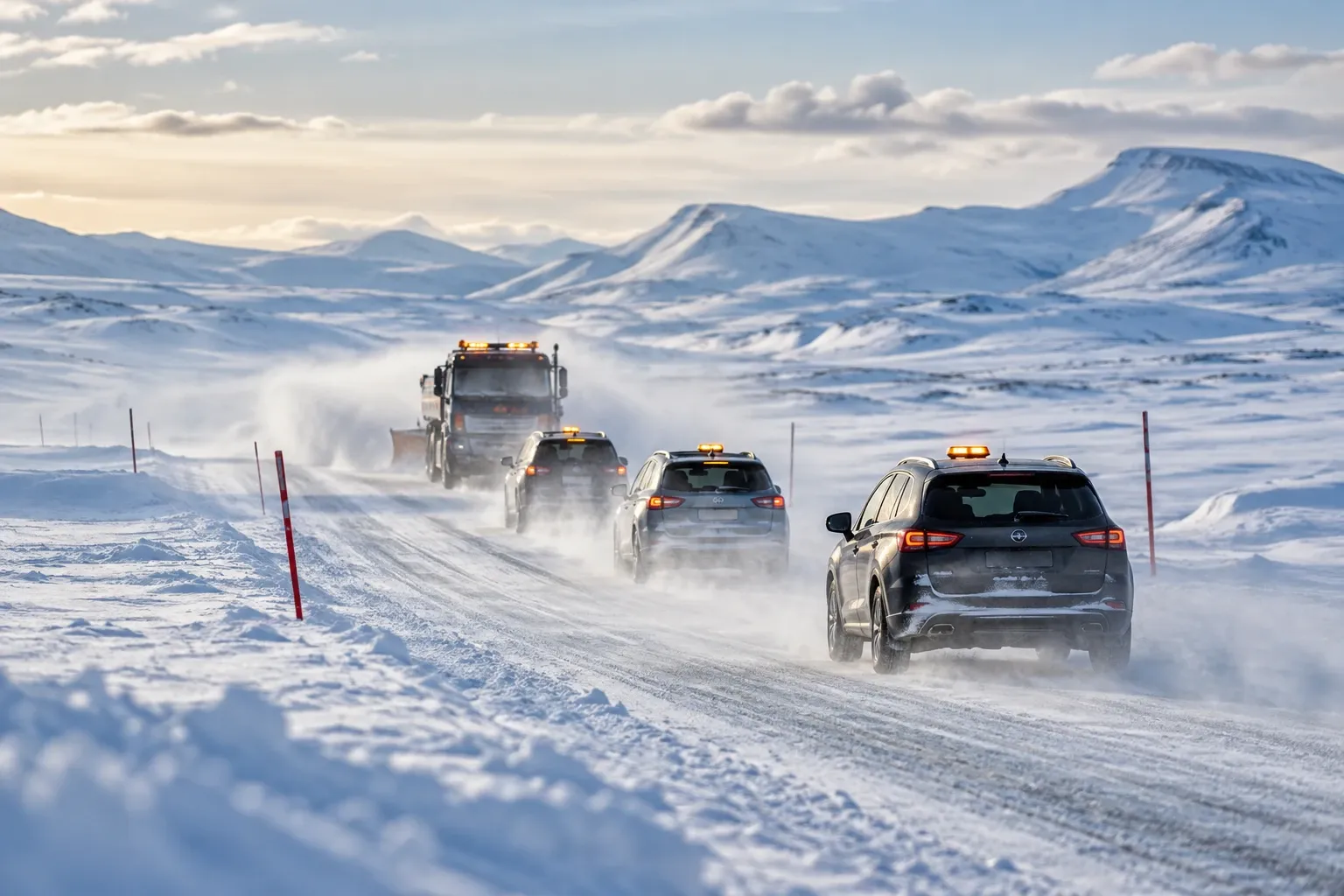
A handful of Sweden’s mountain roads close every winter or every night, and the passes to Norway close or run as convoys whenever a storm blows through. Here’s which roads, what the law says, and how to drive a convoy.
When you need this
You’re planning a winter drive over the fjäll, the Swedish mountains: Kiruna to Narvik on the E10, Arjeplog toward Bodø on road 95, Hemavan into Norway on the E12, or a trip into the Jämtland mountains. You’ve seen kolonnkörning or avstängd on Trafikverket’s map or heard it on the radio. You’re sitting at a lowered barrier with a queue behind you. Or you’re booking a trip in October, May or early June that crosses Vildmarksvägen.
General winter technique, the full kit list and how ploughing works are in our winter driving guide. This page covers only what happens when the mountain road itself shuts.
Closures and convoys: what they are
Most mountain roads stay open all winter. The trouble spots are the stretches over the kalfjäll, the bare mountain above the treeline, where wind and snödrev (drifting snow) can make a road unsafe to drive alone. Trafikverket, the Swedish Transport Administration, then does one of two things:
| Measure | Swedish | What it means for you |
|---|---|---|
| Closure | avstängd väg | A barrier across the road. Nobody drives until it reopens. |
| Convoy | kolonnkörning | You wait at the barrier for the signal, then drive as a group behind a plough that clears the drifting snow. |
The decision is Trafikverket’s, and it shows up on its traffic map as an incident. Every notice comes with the same phrase: sluttiden är preliminär, the end time is preliminary. Take that literally. In March 2025 road 95 was partly closed with convoys on a Sunday and Monday, then fully closed until Wednesday morning. The E10 between Björkliden and Riksgränsen has run as a convoy or been closed in December 2021, March 2022 and December 2024, sometimes for days.
There is a second hazard on the E10. Below the Nuolja range between Abisko and Björkliden, avalanches disrupt both the road and the railway, and Trafikverket runs preventive avalanche control there.
The law behind the barrier
Most pages describe convoys as a custom. The closure itself is law. We read the two ordinances that apply:
- Trafikförordningen 10 kap. 14 § lets the road authority ban traffic on a road or stretch “under kortare tid” (for a short time) when something endangers traffic. The same rule can impose an overtaking ban, a lower speed or a minimum gap between vehicles.
- 14 kap. 3 § makes breaking such a rule a fined offence for any driver of a motor vehicle.
- Vägmärkesförordningen 5 kap. 1 § defines the vägbom, sign X7: a barrier showing the road is wholly or partly closed.
- Trafikförordningen 2 kap. 9 § forbids moving or altering a barrier or any other traffic device, again on pain of a fine.
What the ordinance does not do is mention snowplough convoys. Police instructions, and those of anyone an authority has appointed to direct traffic, override signs and normal rules. Whether a plough driver leading a convoy formally holds that role isn’t stated. In practice, everybody follows the crew, and you should too.
We didn’t verify the fine amount for passing a closure. The law is clear that it’s an offence, and the bigger cost is being stranded on a plateau that nobody is ploughing.
Roads that close by season
Trafikverket publishes a plough map for each county, in 2026 editions. Only the Jämtland map lists seasonal closures. The Norrbotten, Västerbotten and Dalarna maps list none.
| Road | Stretch | Closed |
|---|---|---|
| 824 (Vildmarksvägen) | Leipikvattnet to the county border at Stekenjokk | All winter, 15 October – 6 June |
| 531 (Flatruet) | Mittådalen – Skärkdalen | Every night 22:00–06:00, 1 December – 15 April |
| 1019 | Last 2.2 km to Storulvån mountain station | Every night 22:00–08:00, 1 November – 15 April |
Flatruet and the Storulvån road can also close at other times at short notice because of the weather.
Vildmarksvägen, the Wilderness Road, crosses the Stekenjokk plateau between Västerbotten and Jämtland on roads 1067 and 824. Trafikverket calls it Sweden’s highest paved road, and it shuts over the bare mountain every winter because of the snow. The dates follow the snow: in 2025 it closed on 16 October, and the June reopening is always “if the snow allows”. When it does reopen, stopping and parking are banned from 6 June to 15 July on about 5 km on the Västerbotten side, so that migrating and calving reindeer are left in peace.
Before you drive a mountain road
- Check the season. Stekenjokk is shut from mid-October to early June. If you’re heading to Storulvån or over Flatruet, plan your arrival before the night closure.
- Check the map and the forecast twice, the evening before and the morning of. On Trafikverket’s traffic map, turn on incidents with restrictions and road conditions for the whole route, and read SMHI’s warnings for wind and snow.
- Check the Norwegian side if you’re crossing: vegvesen.no/trafikk, the Vegvesen trafikk app or phone 175.
- Fill up or charge fully before the climb. There are no fuel or charging stations on convoy stretches, and an electric car’s range drops sharply in the cold. See EV charging in Sweden.
- Pack for a long wait: warm clothes and winter shoes, food and a hot drink, a torch, a tow rope and a snow shovel within reach.
- Build in a spare day between November and April.
Winter tyres are compulsory from 1 December to 31 March in winter road conditions, foreign cars included; the details are in our winter tyres guide.
How to drive in a convoy
Trafikverket doesn’t publish a guide to convoy driving; we looked. Statens vegvesen, Norway’s road authority, does, and it describes the same system on the passes you cross into. It’s the best official standard on either side of the border.
Before it leaves. Crews can turn away anyone they think will struggle: people without warm enough clothes, cars with technical faults, or cars without adequate tyres. On busy days the wait can be long, because each Norwegian convoy is capped at the number of people the rescue crews can evacuate, and only one convoy runs on a stretch at a time.
On the move:
- Hazard lights on, and fog lights if you have them.
- Keep eye contact with the car in front and hold a steady speed.
- Below freezing, set the ventilation to blow cold air on the windscreen; it stops the glass icing.
- Never overtake, drop out or try to turn round.
In Norway there is always a plough or lead vehicle at both the front and the back of the column, the two drivers stay in contact, and the front plough stops the convoy now and then to check that everyone is still there.
If the convoy stops, stay with your car. Statens vegvesen warns that moving away from it can be fatal. This is the opposite of Trafikverket’s advice for a breakdown on a motorway or 2+1 road, where you leave the car and get behind the crash barrier. In a mountain whiteout the car is your shelter.
At a closed barrier, stop and wait or turn back. Don’t drive round it because the weather looks fine where you are: Statens vegvesen’s own warning is that it can be worse up on the mountain. While a pass is closed the crews keep ploughing when it’s safe, so the road can reopen as soon as the weather allows. Listen to the local P4 radio channel and recheck the map.
The passes to Norway
Three of the northern routes cross into Norway over passes that Statens vegvesen lists for convoys and closures:
| Swedish side | Norwegian pass | Notes |
|---|---|---|
| E10 via Björkliden and Riksgränsen | E10 Bjørnfjell | The stretch most often in convoy; avalanche control near Abisko |
| E12 via Hemavan | E12 Umbukta | |
| Road 95, Silvervägen, via Merkenes | Rv. 77 Graddis toward Junkerdal | Closed from Merkenes to the border in storms |
Each country decides separately, so a road open in Sweden can be shut a few kilometres past the border. If the E10 is closed, the Kiruna–Narvik train is the fallback for people, though avalanches can stop the railway too. The border itself, with documents, tolls and dogs, is covered in crossing between Sweden and Norway.
Practical information
| What | Details |
|---|---|
| Swedish closures and convoys | Trafikverket’s traffic map, trafikverket.se/trafikinformation/vag (Swedish only, free) |
| Norwegian passes | vegvesen.no/trafikk, Vegvesen trafikk app, phone 175 |
| Radio | Local P4 channel (Sveriges Radio traffic news) |
| Urgent road fault in Sweden (not an emergency) | Trafikverket 0771-921 921, around the clock |
| Emergency | 112 |
| Seasonal closure dates | Trafikverket county plough maps, 2026 editions (Jämtland: Stekenjokk 15 Oct – 6 Jun; Flatruet nightly 22–06, 1 Dec – 15 Apr; Storulvån road nightly 22–08, 1 Nov – 15 Apr) |
| Cost of a convoy or closure | Free |
| Passing a closure or moving a barrier | Fined offence; amount not verified (October 2026) |
FAQ
What is kolonnkörning in Sweden?
Convoy driving. When wind and drifting snow make a mountain road unsafe, Trafikverket lets traffic through only in groups. You wait at the barrier for the signal, then drive in a column behind a plough that clears the road. In Norway there is a plough or lead vehicle at the back too. It happens several times a winter on the E10 near Riksgränsen.
Can I drive past a closed road barrier in Sweden?
No. The road authority may ban traffic on a road for a short time when there is danger, and the closure is marked with a barrier. Breaking that ban is a fined offence, and so is moving the barrier. It is also dangerous: conditions on the plateau can be far worse than at the barrier, and nobody is coming to help.
When is Vildmarksvägen closed?
The high stretch over Stekenjokk, road 824 from Leipikvattnet to the county border, is closed from 15 October to 6 June on Trafikverket’s 2026 map. The dates follow the snow: in 2025 it closed on 16 October, and the June reopening is given as weather-permitting. The rest of the loop stays open, but you can’t cross the mountain.
How long do mountain road closures last in Sweden?
From a few hours to several days. Trafikverket gives end times as preliminary and changes them at short notice. Road 95 was partly closed or in convoy on a Sunday and Monday in March 2025, then fully closed until Wednesday morning. Plan a spare day and a place to sleep on your side of the mountain.
What should I do if the convoy stops?
Stay in or right next to your car. Statens vegvesen warns that moving away from it in a convoy stop can be fatal. Keep your hazard lights on and wait for the crew, who stay in constant contact along the column and stop it now and then to check everyone is there. Warm clothes, food and a hot drink make a long stop bearable.
Which roads to Norway close in winter?
The northern crossings most affected are the E10 at Riksgränsen and Bjørnfjell, the E12 over Umbukta, and road 95 Silvervägen, which becomes Rv. 77 over Graddis in Norway. Each side decides separately, so check Trafikverket’s map for Sweden and vegvesen.no or phone 175 for Norway before you set off.
Related guides
- Winter driving in Sweden — the technique, kit and ploughing rules behind every winter drive
- Checking road conditions in Sweden — how to read Trafikverket’s map, layer by layer, in Swedish
- Crossing between Sweden and Norway — documents, tolls and dogs at the border
- Kiruna to Narvik by train — the fallback when the E10 is shut
- Motorhomes in a Swedish winter — the extra planning a big vehicle needs in winter
Facts verified 2026-10-15. Sources: Trafikverket, Sveriges Riksdag (trafikförordningen, vägmärkesförordningen), Statens vegvesen, Transportstyrelsen, Krisinformation.se, Sveriges Radio, SVT, Norrländska Socialdemokraten, Piteå-Tidningen — full register in this topic’s source file. Found something outdated? Tell us and we’ll fix it.