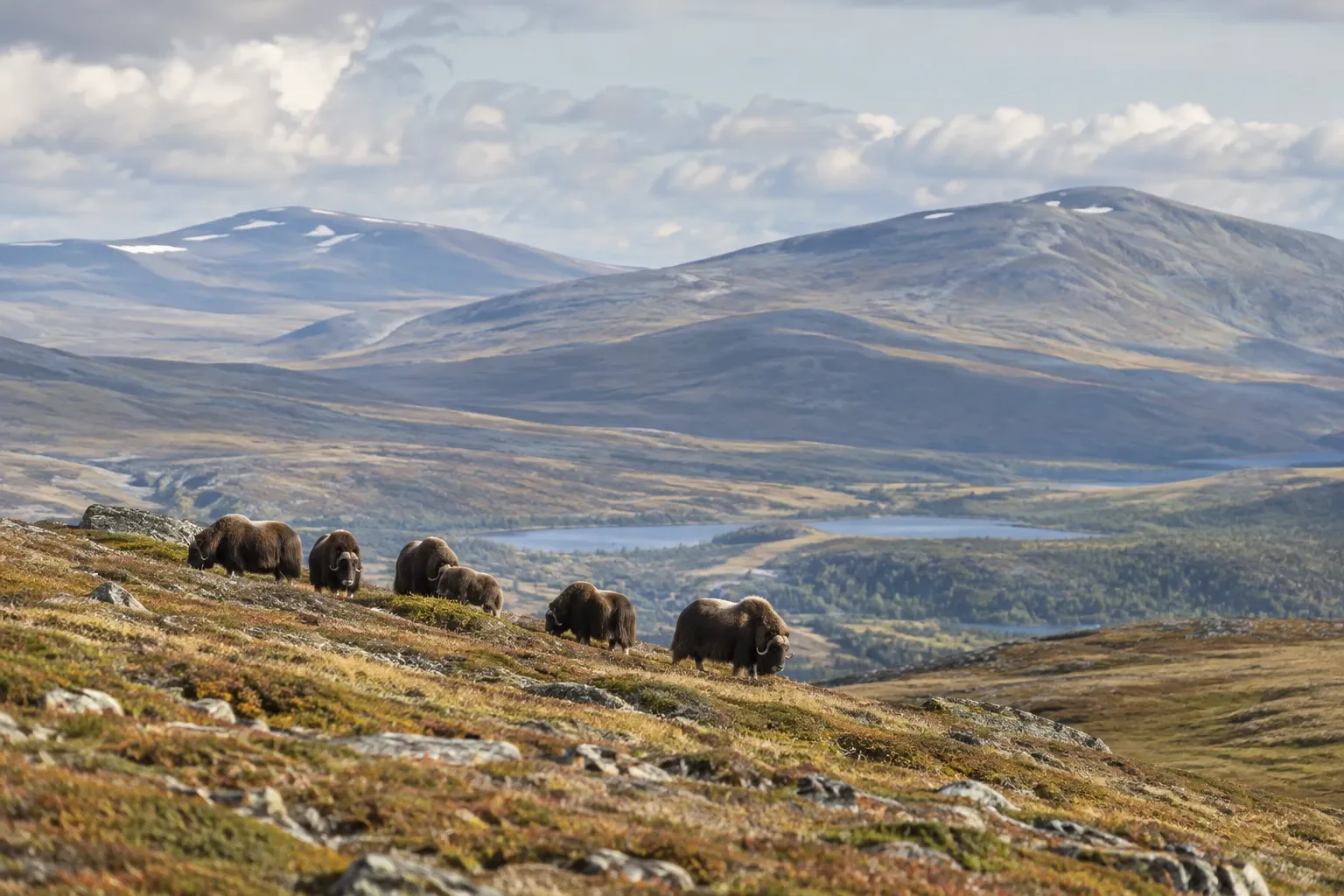
Sweden has exactly one wild herd of musk oxen, and it is small, protected and hard to find. Here is where it lives, what the 100-meter rule actually says, how far away is really safe, and where to go if you want a sighting you can count on.
When you need this
You are planning a hike, ski tour or paddle around Rogen or elsewhere in the Härjedalen mountains. Or you have just seen a dark, shaggy animal on a fell and want to know how close you may go. Maybe you are deciding whether to chase the wild herd or book an enclosure tour. You might also have a dog or a drone with you, or be adding Dovrefjell in Norway to the trip.
Sweden’s only wild herd
The musk ox (myskoxe) is an Ice Age animal that Sweden has only by accident. Its ancestors were shipped from Greenland to Norway. In 1971 five of them walked across the border from Dovrefjell into western Härjedalen. The herd peaked at roughly 30–40 animals in the 1970s and 1980s, then shrank to around ten.
It is small, but it is not dying out right now. The July 2026 count by Projekt Myskoxe 2030, a conservation network, found a core group of eight, three of them calves. That was the third year running with a new calf. Two bulls seen in earlier counts were missing on the day, and the project puts the herd at about ten or eleven.
The herd spends every winter in the Rogen area, a 500 km² nature reserve of boulder ridges and lakes on the Norwegian border. In summer it ranges over the mountains of western Härjedalen. Nobody publishes where it is on a given day, and with about ten animals in that much terrain, most visitors never see it.
Two things changed in 2026. In March, Naturvårdsverket, the Swedish Environmental Protection Agency, gave researchers a five-year permit, running from July 2026, to dart up to ten musk oxen and fit GPS collars. So a collared animal, or a helicopter or drone during capture work, is now normal. And because the herd came from an introduced Norwegian stock, Sweden does not count the musk ox as a native species. That keeps it off the red list, but it does not weaken its legal protection.
The 100 m rule: what the law actually says
Almost every Swedish source says you may not be within 100 meters of a musk ox. That is true, but the rule is more specific than it sounds.
| Where | Rule | Status | Penalty |
|---|---|---|---|
| Rogen nature reserve | No one may medvetet (deliberately) stay closer than 100 m to musk oxen | Law: the reserve’s regulations | Fine |
| Rogen nature reserve | No disturbing wildlife, “for example by photography” | Law: the reserve’s regulations | Fine |
| Anywhere in Sweden | No deliberate disturbance, especially in the mating, rearing and wintering periods | Law: species-protection ordinance, 4 a § | Fines or up to 2 years in prison |
| Outside Rogen | No written distance found | Practice: treat 100 m as the floor | — |
The 100 m figure is written into Rogen’s reserve regulations. Breaking a reserve regulation, deliberately or through negligence, is punishable by a fine. The national rule is the species-protection ordinance (artskyddsförordningen), which bans deliberately disturbing musk oxen anywhere. That ban still applies after the ordinance’s revision on 1 November 2026. Disturbing a protected animal against that ban is an artskyddsbrott, a species-protection offence.
We found no national statute giving the 100 m figure. The county board and the conservation project say it applies generally, and so did a 2025 parliamentary question. The government’s answer, however, cited only the species-protection ordinance. Outside Rogen, then, the binding rule is “don’t disturb”, and 100 m is a sensible minimum, not a written one.
Both rules are about deliberate conduct. If a musk ox appears close to you, you have done nothing wrong yet. Moving away calmly is the legal response and the safe one.
How far is actually safe: 200 m
Norway has more than 220 musk oxen on Dovrefjell. Its national park authority recommends at least 200 meters, twice Rogen’s legal minimum. The reason: reindeer run away, but a musk ox’s instinct is that attack is the best defence. Norway’s environment agency says musk oxen pay people little attention until they feel threatened, and then they may attack.
- Keep 200 m. Treat 100 m as the legal floor, not a viewing distance.
- Detour wide. A musk ox on or beside the trail has right of way; walk around it rather than waiting nearby.
- Never follow a musk ox that is moving away. That is the one mistake the Dovrefjell rules name outright.
- Back away calmly if one reacts to you, and keep going.
Seeing them for sure: the enclosure and Dovrefjell
If seeing a musk ox is the point of your trip, don’t rely on the wild herd.
The musk ox centre near Tännäs (Myskoxcentrum) is an enclosure about 20 km east of Funäsdalen, run by a non-profit that also works to conserve the wild herd. Tours start in Tännäs. You then drive about 7 km to the enclosure in your own car or the guide’s bus, and the tour takes 1–1.5 hours. Booking ahead is required, and no pets are allowed. The centre has kept musk oxen since 2009, and one of its animals was released into the wild herd and has had calves there.
Dovrefjell in Norway has a large population, at least 220 animals in the 2026 count, so sightings there are far more likely. The park authority’s 200 m advice applies there.
Dogs, drones and cameras
Rogen has its own dog rule: no dogs from 20 April to 31 May, except on the winter trail and permitted fishing waters. That is also when reindeer calve, and the whole Rogen area is reindeer grazing land. When reindeer are around, Swedish law requires dogs to be on a lead or shut in. Nationally, dogs must be kept from running loose where there is game from 1 March to 20 August. See our leash law guide for the full picture.
Drones are a bad idea near musk oxen. Rogen bans landing any aircraft on land, water or ice, and flying at the herd breaches the disturbance ban. Our drone rules guide covers take-off and landing bans in reserves.
For photos, bring binoculars and a long lens. At 200 m a phone camera gets a dark dot. Rogen’s regulations name photography as a way of disturbing wildlife, so the picture is never worth getting closer.
Seasons
| Season | Where the herd is | What to know |
|---|---|---|
| Winter | Around Rogen, every year | Food is scarce; the county board says they must graze undisturbed |
| Spring | Calving, the 2026 calf probably in May | Rogen dog ban 20 April–31 May; reindeer calve in May |
| Summer | Western Härjedalen’s mountains | Position not published; the 2026 count was in July |
| 1 March–20 August | — | National rule: no loose dogs where there is game |
If you see one, or find one
Stop, keep your distance or increase it, and watch through binoculars. Afterwards, report the sighting to Projekt Myskoxe 2030 on its report form, with a photo (ideally showing both horns) and the coordinates. Public reports changed the herd count in 2025. A collared animal is normal now; report it like any other.
If you find a dead musk ox, leave it where it is. It belongs to the state, and the find must be reported to the police as soon as possible.
Practical information
| What | Detail |
|---|---|
| Wild herd size | Core group of 8 incl. 3 calves (July 2026 count); project estimate 10–11 |
| Winter range | Rogen nature reserve, Härjedalen (about 500 km²) |
| Rogen access | Käringsjövallen, about 20 km south of Tännäs: parking and information |
| Rogen entry | No fee listed by the county board (checked 2026-10-15) |
| Legal minimum in Rogen | 100 m (reserve regulations) |
| Recommended distance | 200 m (Norwegian park authority) |
| Rogen dog ban | 20 April–31 May |
| Enclosure tour near Tännäs | 1–1.5 hours, advance booking required, no pets; price on the centre’s booking page (checked 2026-10-15) |
| Penalties | Reserve breach: fine. Species-protection offence: fines or up to 2 years |
| Dovrefjell, Norway | At least 220 musk oxen (2026 count) |
FAQ
Are there wild musk oxen in Sweden?
Yes, but only one small herd. It descends from five animals that walked in from Dovrefjell in Norway in 1971, and lives in the mountains of western Härjedalen, wintering around Rogen nature reserve. The July 2026 count found a core group of eight, including three calves, and the conservation project estimates the total at about ten or eleven.
How close can you get to a musk ox in Sweden?
Inside Rogen nature reserve, deliberately staying closer than 100 meters is an offence under the reserve regulations. Elsewhere in Sweden, deliberately disturbing a musk ox is banned by the species-protection ordinance. For safety, follow Norway’s advice and keep at least 200 meters. If one is on your path, take a wide detour.
Are musk oxen dangerous?
They can be. Unlike reindeer, which flee, musk oxen defend themselves by attacking, and Norway’s environment agency says they can be dangerous if people come too close. Kept at a distance they are rarely a problem, and Norway’s park rules recommend at least 200 meters. If one reacts to you, back away calmly, and never follow an animal that moves off.
Where can I see musk oxen in Härjedalen?
For a near-certain sighting, take a guided tour of the musk ox enclosure near Tännäs, about 20 km east of Funäsdalen; booking ahead is required. The wild herd roams the western Härjedalen mountains and winters around Rogen, but no one publishes its position, so seeing it is luck. Dovrefjell in Norway has over 220 animals.
Can I bring my dog to Rogen?
Not from 20 April to 31 May, when dogs are banned from Rogen nature reserve apart from the winter trail and permitted fishing waters. The rest of the year, keep it leashed: Rogen is reindeer grazing land, where dogs must be on a lead when reindeer are around, and Swedish law forbids loose dogs where there is game from 1 March to 20 August.
What should I do if I see a musk ox in Sweden?
Stop, keep or increase your distance, and enjoy it through binoculars. Do not approach, follow or fly a drone at it. Then report the sighting to Projekt Myskoxe 2030 with a photo, ideally showing both horns, and the location. If you find a dead musk ox, leave it and tell the police: it belongs to the state.
Related guides
- Wildlife in Sweden — what else lives in the mountains and the protection rules that cover it.
- Nature reserves in Sweden — how to read a reserve’s regulations before you go.
- Reindeer herding land — the other animals you will meet around Rogen, and why they go first.
- Mountain safety in Sweden — weather, navigation and shelters for the trip around the sighting.
- Härjedalen and Funäsdalen — the region as a destination.
Facts verified 2026-10-15. Sources: Länsstyrelsen Jämtland, Naturvårdsverket, Sveriges Riksdag (artskyddsförordningen, miljöbalken, jaktförordningen), Miljødirektoratet and the Dovrefjell national park board, SVT — full register in this topic’s source file. Found something outdated? Tell us and we’ll fix it.