The Torne Valley is where Sweden stops and Finland starts, with a free-flowing river as the line between them. This guide covers the twin town at the river mouth, how the border works on the ground, and what is worth the drive up road 99.
When you need this
You are heading for Finnish Lapland or Oulu and want to cross by land or by rail. You have landed in Luleå and are weighing a day or two on the Finnish border. You are driving road 99 between Pajala and Haparanda, or you want to see the dip-net fishing at Kukkolaforsen, a Struve Arc point or the Haparanda archipelago. Or you are simply puzzled by a sign that reads both Haparanda and Haaparanta, and by two clocks an hour apart.
None of this is covered by our Swedish Lapland guide, which looks west to the mountains. This page looks east, to the river.
The valley at a glance
Tornedalen, the Torne Valley, follows the Torne River (Torneälven), which forms the border between Sweden and Finland for most of its lower course. The border was drawn along the river in 1809, when Sweden lost Finland to Russia. The old town of Tornio, founded in 1621, ended up on the Russian side, so Haparanda grew on the Swedish bank as its replacement and became a town in 1842.
Three small Swedish municipalities make up the valley’s core:
| Municipality | Population (30 June 2026) | Latitude | Midnight sun? |
|---|---|---|---|
| Haparanda (Haaparanta in Meänkieli) | 8,967 | 65.84° N | No, light nights only |
| Övertorneå | 3,973 | 66.39° N | No, the Arctic Circle is about 26 km further north |
| Pajala | 5,688 | 67.21° N | Yes, around midsummer |
The Torne is one of Sweden’s four nationalälvar, national rivers on which the Environmental Code bans hydropower and regulation. So it runs free to the sea, salmon still swim up it, and a centuries-old fishery survives at its rapids.
The valley is also home to the Tornedalians, one of Sweden’s five national minorities, and to their language, Meänkieli (“our language”). Haparanda, Övertorneå and Pajala are core municipalities for both Meänkieli and Finnish. That is why signs carry two names for one place: Haparanda is Haaparanta. Book and navigate by the Swedish name. Our guide to minority languages and place-name signs explains the law behind them.
Haparanda and Tornio: one town, two countries
Haparanda and Tornio work as a twin town, with the border running between them. You can cross on a pedestrian bridge, and the market square on the border, named after Crown Princess Victoria, lets you step between countries and time zones. In winter, ski trails run on the ice of the bay between the towns. There is even a golf course with 11 holes in Sweden and 7 in Finland; see golf in Sweden.
Three differences matter the moment you cross:
| Haparanda (Sweden) | Tornio (Finland) | |
|---|---|---|
| Clock | Swedish time | One hour ahead, all year |
| Currency | Swedish krona | Euro |
| Main language | Swedish | Finnish |
Only some Haparanda shops take euros, and local banks do not necessarily change money. The twin town’s own advice is to pay by card on both sides. That matters most on the bus: Swedish county buses take cards only, no cash. For the clock, our time zone guide explains the hour; for paying, see cards in Sweden.
The best building in town is Haparanda station, a National Romantic design by SJ’s chief architect Folke Zetterwall, built in 1917 and a protected building (byggnadsminne) since 1986. During the First World War refugees, Red Cross staff and prisoners of war crossed the border here, and Lenin crossed on 15 April 1917. The Swedish tracks and the slightly wider Russian-Finnish ones ran on opposite sides of the building.
The joint tourist information runs “InfoPoints” at Haparanda library and Haparanda town hall, and at the Museum of Torne Valley in Tornio.
Crossing the border: what the law actually asks
Sweden and Finland are both in Schengen, so usually nobody stops you. But “open border” is not the whole answer:
- Sweden runs temporary internal border controls. The current government decision covers 12 May – 11 November 2026. Decisions have come in six-month blocks, and none for the period after 11 November had been published when we checked on 15 October 2026.
- The Aliens Act asks every foreign visitor to hand over a passport or other document showing the right to stay when a police officer asks. That duty does not depend on the border-control decision.
- The crossing is a “border-near area”. A 2023 law lets police make that document check without any suspicion at road bridges and border crossings on public roads, and at railway stations with direct foreign passenger traffic. Haparanda station has had such trains since August 2026.
So carry a passport or national ID card. Our guide to when you must show ID in Sweden has the detail.
Goods are simple here. Both countries are in the EU tax area, so the EU own-use rules apply, not the tighter allowances of the Åland ferries; the age for alcohol is 20.
Kukkolaforsen: the rapids and the dip nets
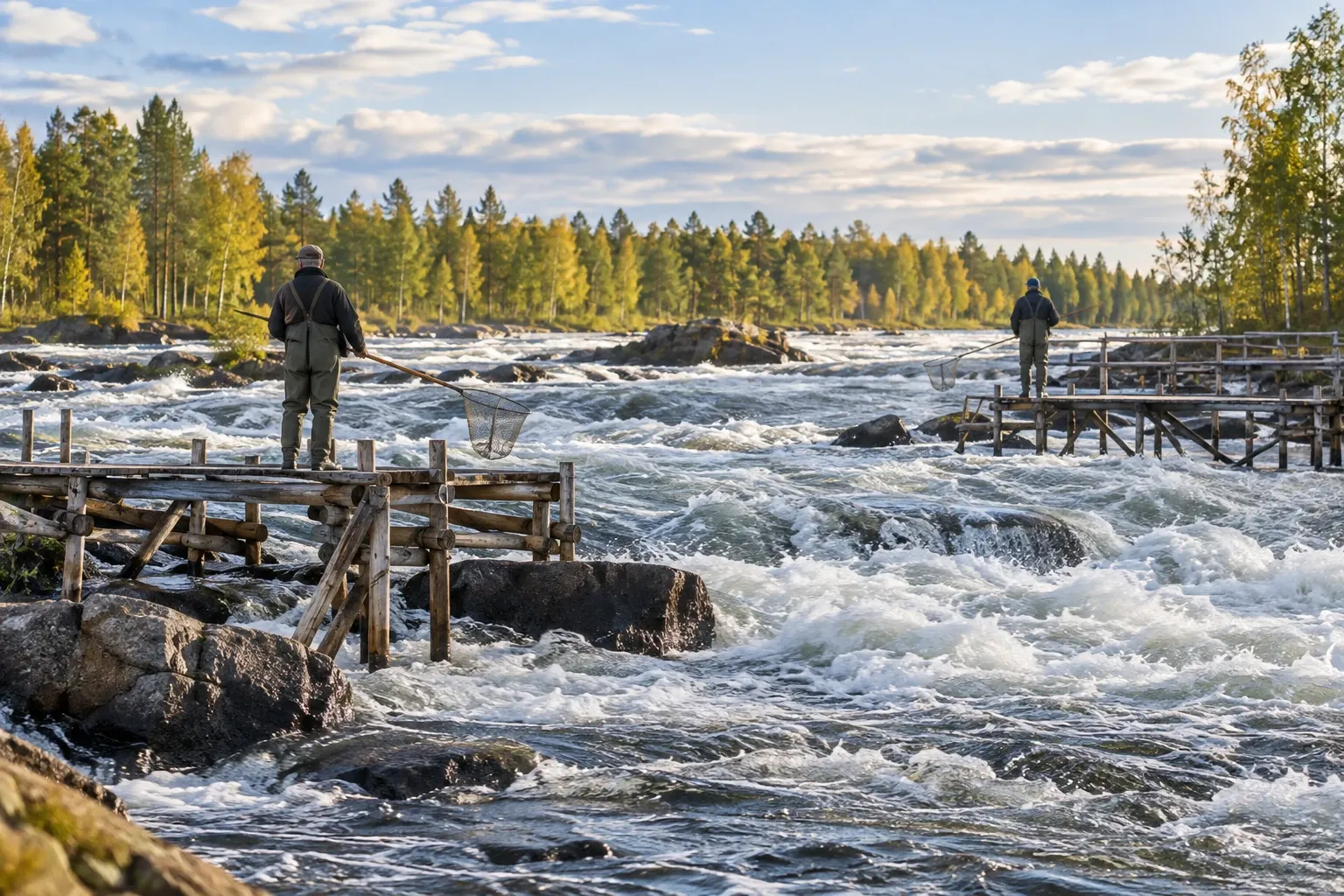
Fifteen kilometres north of Haparanda on road 99, the Torne drops about 14 m over a 3.5 km free-flowing rapid. Wooden platforms called pator reach out into the current, and from them fishers lift whitefish and salmon with long-handled dip nets, a practice centuries old. There is a Kukkola village on each bank.
The fishery is not open to visitors: the dip-net right belongs to about 75 farms and families on both sides. You come to watch, ideally in July, and to eat the catch at the whitefish festival on the first weekend after St James’s Day (25 July).
The UNESCO decision is pending. Sweden and Finland nominated Torne River dip-net fishing for UNESCO’s Representative List of the Intangible Cultural Heritage of Humanity in March 2025. A decision is expected in December 2026, and we will update this page when it comes. A page that already calls it “UNESCO-listed” is ahead of the facts.
Want to fish yourself? The Torne has its own fishing regulation, agreed between Sweden and Finland and amended every season, and you need a permit. Under the general rules, salmon and sea trout may be fished with rod or net from 1 June to 31 August, with one fish kept per angler per day, and all fishing in the river area is closed from 15 September to 15 December. An exception applies for 1 June 2026 – 31 May 2027 and can tighten this, so read the current text from the Finnish-Swedish Border River Commission first. The commission’s fishing page links to the online permit seller for the area. Our fishing in Sweden guide covers licences elsewhere.
Up the valley: Övertorneå and Pajala
Road 99 follows the river north. Övertorneå is 72 km from Haparanda, and Pajala another 110 km beyond.
- Perävaara, about 25 km northwest of Haparanda near Karungi, is one of Sweden’s four World Heritage points of the Struve Geodetic Arc, a survey chain that measured the shape of the Earth. A 400 m walk leads to the only mark the survey left, a cross carved into a fixed stone.
- Övertorneå church was built in 1615–1617 at the foot of Särkivaara and rebuilt as a cross-shaped church in the 1730s. Its organ was built in 1609 for the German Church in Stockholm. The parish publishes no visiting hours, so ask ahead.
- Pullinki, the Övertorneå Struve point, has a ski area beside it.
- The Arctic Circle crosses road 99 about 84 km south of Pajala, just south of Juoksengi.
- The Laestadius museum in Pajala is the parsonage, the pörte (cabin) and the herb garden where the priest Lars Levi Laestadius and his wife Brita-Kajsa lived. Guides are on site in summer; at other times, book a guided visit through the parish.
- Jupukka, about 10 km northwest of Pajala, is reached by a steep marked path of about 600 m.
The Struve points are unstaffed and free, and best visited in summer. Our UNESCO sites guide puts them in context. Fill the tank before the valley: Pajala to Haparanda is about 180 km, and services are thin.
Haparanda Skärgård National Park
Out in the Bothnian Bay, Haparanda Skärgård National Park is a cluster of islands whose largest, Sandskär, has long sandy beaches, a 5 km nature trail, a chapel and a bird ringing station. More than 250 bird species have been recorded there.
Most visitors arrive by private boat. In summer a limited tour boat runs to Sandskär from Nikkala harbour: turn off the E4 eleven kilometres west of Haparanda and follow the signs six kilometres to the end of the road. Boats are booked through the tourist information. Like every Swedish national park it has its own regulations, and in winter snowmobiles are not allowed onto the islands.
Seasons and light
| When | What happens |
|---|---|
| June–August | Main season; Sandskär boats; Struve points most accessible; salmon season under the general rules |
| Midsummer | Midnight sun in Pajala; light nights in Haparanda |
| 15 July | Tornedalingarnas dag, the Tornedalians’ day, when the Meänflaku flag is raised |
| Late July | Kukkolaforsen whitefish festival |
| 15 September – 15 December | All fishing closed in the Torne river area |
| December | UNESCO decision expected; timetable change on 13 December |
| Winter | Ski trails on the bay ice; Pullinki ski area; winter tyres from 1 December in winter conditions |
Haparanda is a light-nights town, not a midnight-sun town: it lies south of the Arctic Circle, so the sun dips below the horizon even at midsummer. From about the Dalälven northwards it never gets fully dark in summer, though, and in the dark half of the year the aurora can appear on clear nights; see our northern lights guide. River and sea ice outside the marked trails is not maintained, so carry ice claws and never go out alone.
Two coastal foods are worth knowing. Kalix löjrom, vendace roe from the coast between Haparanda and Piteå, is a protected designation of origin fished only five weeks a year. Kaffeost, kahvijuusto in Meänkieli, is cheese dropped into hot coffee; see coffee in Sweden.
Getting here and around
By train: Norrtåg runs from Luleå and Boden to Haparanda in a little under two hours. Since 10 August 2026, VR trains continue twice a day to Tornio, Kemi and Oulu. You need two tickets, one from each operator, and each shows its own country’s time. Norrtåg has also applied to connect Haparanda with Finnish night trains from 13 December 2026. Some travel pages, including the twin town’s own “getting here” page, still describe the old bus link via Kemi. Our northern Sweden trains guide and our Finland crossings guide have the details.
By bus: county buses leave from the joint travel centre on the border, where Finnish buses stop too. Swedish buses take cards only and run on Swedish time.
By car: Haparanda is 130 km from Luleå on the E4, under two hours. Winter tyres are required from 1 December to 31 March whenever there are winter road conditions, foreign cars included. A ten-day loop that drives down the whole valley is in our northern Sweden summer route.
Practical information
| Item | Detail |
|---|---|
| Border crossing | Free on foot, by bike, car or bus; carry a passport or ID card |
| Internal border control | Current decision 12 May – 11 November 2026 |
| Time | Finland one hour ahead of Sweden |
| Money | Kronor in Haparanda, euros in Tornio; card best on both sides |
| Swedish buses | Card only, Swedish time |
| Rail | Norrtåg Luleå–Haparanda about 1 h 52 min; VR Haparanda–Oulu twice daily each way; two tickets, fares on the operators’ sites |
| Luleå–Haparanda by car | 130 km, about 1 h 45 min |
| Kukkolaforsen | 15 km north on road 99; free to watch from the bank |
| Struve Arc points | Free, unstaffed; best in summer |
| Sandskär boat | Limited summer tour boats from Nikkala; price on booking via the tourist information |
| Torne fishing | Permit required; general salmon season 1 June – 31 August; closed 15 September – 15 December |
| Emergency | 112 on both sides of the border |
FAQ
Do I need a passport to cross from Haparanda to Tornio?
Carry a passport or national ID card. Sweden and Finland are both in Schengen, so there is usually no stop, but Sweden runs temporary internal border controls under a decision lasting until 11 November 2026, and police may check documents near the bridges and the station without suspicion. Every foreign visitor must be able to show a document proving the right to stay.
Can I pay with euros in Haparanda?
Sometimes. Haparanda’s currency is the Swedish krona, and only some shops accept euros; local banks do not necessarily change money. The twin town’s own advice is to pay by card on both sides of the border. Swedish buses leaving Haparanda take cards only, so a traveller holding only cash of either currency cannot board.
Can you see the midnight sun in Haparanda?
No. Haparanda lies at about 65.8° N, south of the Arctic Circle, so the sun dips below the horizon even at midsummer, though the nights stay light. Övertorneå is just south of the circle too. Drive north on road 99 past Juoksengi, where the circle crosses the road; Pajala, further up the valley, has the real midnight sun around midsummer.
How do I get to Haparanda without a car?
By train. Norrtåg runs from Luleå and Boden to Haparanda in a little under two hours, and since 10 August 2026 VR trains continue twice a day to Tornio, Kemi and Oulu. You need two tickets, one from each operator, and each shows its own country’s time. County buses also stop at the joint travel centre on the border.
What is Kukkolaforsen famous for?
Dip-net fishing. Kukkolaforsen is a 3.5 km free-flowing rapid on the Torne, 15 km north of Haparanda, where fishers stand on wooden platforms and lift whitefish and salmon with long-handled nets, a practice centuries old. Sweden and Finland have nominated it for UNESCO’s intangible heritage list, with a decision expected in December 2026. The whitefish festival is in late July.
What language do people speak in the Torne Valley?
Swedish and Finnish, and also Meänkieli, the Tornedalians’ own language and one of Sweden’s five protected national minority languages. Haparanda, Övertorneå and Pajala are core municipalities for both Finnish and Meänkieli, so signs often carry two names for one place: Haparanda is Haaparanta. Across the river in Tornio, Finnish is the main language.
Can I fish in the Torne River?
Yes, with a fishing permit and under the Torne fishing regulation agreed between Sweden and Finland each year. Its general rules allow salmon and sea trout fishing with rod or net from 1 June to 31 August, one fish kept per angler per day, and close all fishing from 15 September to 15 December. Check the current season’s exception first.
Related guides
- Ferries and the rail link between Sweden and Finland — every crossing, the Haparanda trains among them.
- Trains in northern Sweden — Norrtåg’s network and the two-ticket Finland connection.
- Sweden’s minority languages — why Haparanda is also Haaparanta.
- Sweden’s UNESCO World Heritage Sites — the four Struve Arc points in context.
- 10 days in northern Sweden in summer — a driving loop that comes down the valley.
Facts verified 2026-10-15. Sources: Regeringen, Sveriges Riksdag (Miljöbalken, Utlänningslagen, Lag 2023:474), Länsstyrelsen Norrbotten, Naturvårdsverket, the Finnish-Swedish Border River Commission, SCB, Isof, Svenska kyrkan, Norrtåg, VR, HaparandaTornio — full register in this topic’s source file. Found something outdated? Tell us and we’ll fix it.