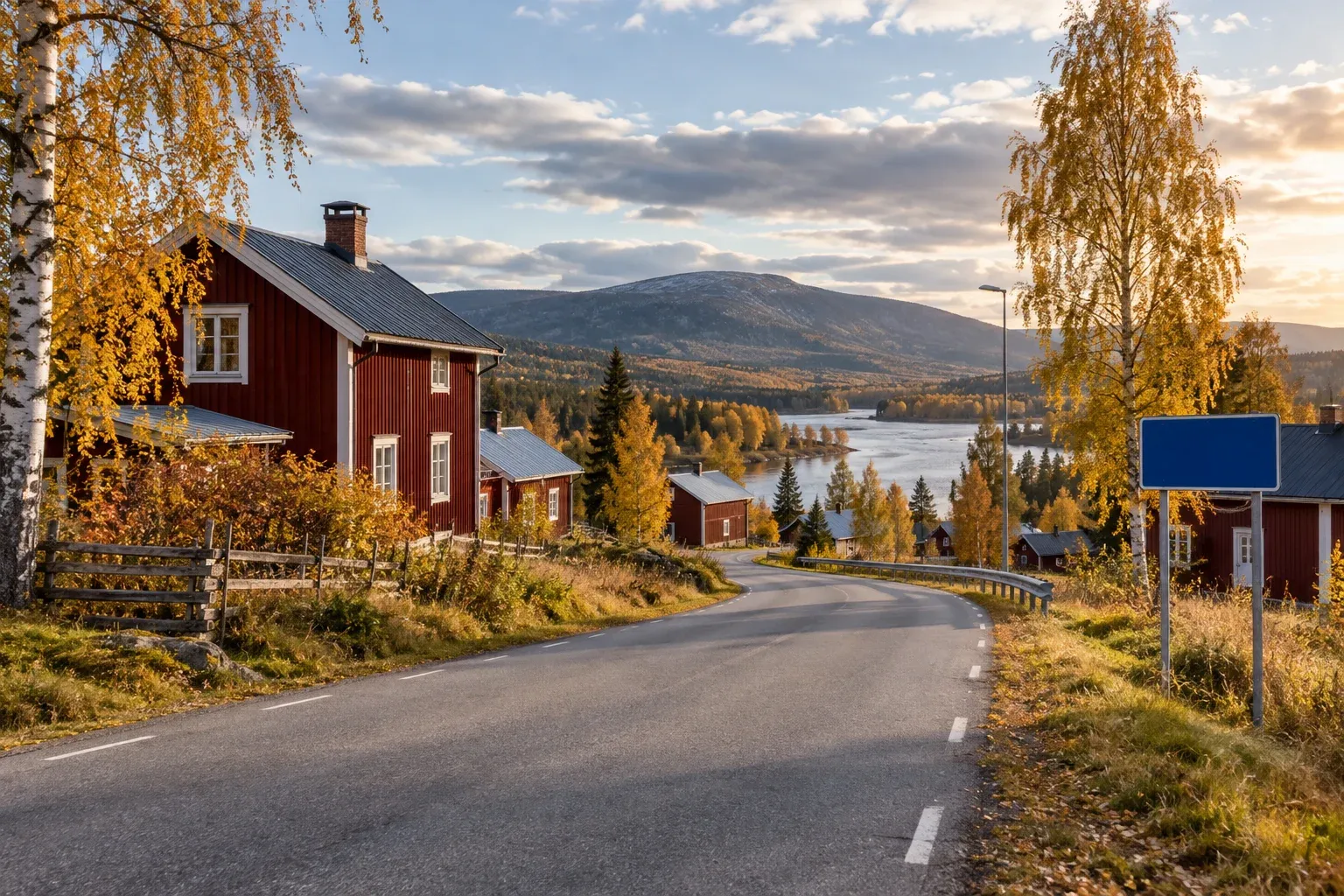
Drive through Tornedalen or Lapland and the road signs start to stack names: Haparanda and Haaparanta, Kiruna and Giron. Here’s which languages they are, why the law puts them there, and how to read them without getting lost.
When you need this
You’re driving through Norrbotten, Västerbotten or Jämtland and a sign gives one village two or three names. A map or hiking app shows a name that isn’t on your booking. Or you hear Finnish in Stockholm, see it on a municipal website, and wonder why a country with no official second language prints things in several.
If you speak Finnish or a Sámi language yourself, there’s a second reason: in parts of Sweden you have the right to use it with the authorities.
The five minority languages
Sweden is officially a one-language country. The Language Act of 2009 makes Swedish the principal language (huvudspråk) and the language of courts and agencies. It also names five national minority languages, which belong to Sweden’s five national minorities.
| Language | Minority | Where you’ll meet it |
|---|---|---|
| Sámi (at least five languages) | Sámi, the Indigenous people | Sápmi, from Kiruna to northern Dalarna; signs and maps |
| Finnish | Sweden Finns (sverigefinnar) | All over Sweden, strongly in the Mälardalen and the cities |
| Meänkieli | Tornedalians (tornedalingar) | Tornedalen and the Malmfälten in Norrbotten; signs |
| Romani Chib | Roma | Across the country, no regional signage |
| Yiddish | Jews | Across the country, mainly a heritage language |
The state has a legal duty to protect and promote all five. English isn’t among them and has no legal status, although most Swedes speak it (see our guide to where English works in Sweden).
Swedish Sign Language has its own protected status in the same Act. Deaf and hard-of-hearing people, and others who need it, have the right to learn and use it. It isn’t counted among the five minority languages.
A few facts behind the table:
- Sámi is a family, not one language. Sweden has at least five: North, Lule, Pite, Ume and South Sámi, each with its own spelling for place names.
- Meänkieli was long called Tornedalen Finnish. It grew apart from Finnish after the 1809 border split the Torne valley, and Sweden recognised it as a language of its own in 2000. Finland classifies it as a Finnish dialect.
- Romani Chib is an umbrella name for some 10–20 varieties spoken in Sweden, from Swedish Romani to Kale, Kalderash, Lovari and Arli.
- Yiddish is above all a heritage language: the Jewish Community of Stockholm estimates 15,000–25,000 Jews in Sweden, and only a few speak and write Yiddish fluently.
Why signs have two or three names
The sign rule isn’t in the Language Act. It’s in the Historic Environment Act (kulturmiljölagen), under “good place-name practice” (god ortnamnssed). It says that in multilingual areas, state and municipal bodies shall as far as possible use names in Swedish, Sámi, Finnish and Meänkieli together on maps, signs and other markings.
In the far north many places have long had names in several languages. Lantmäteriet, the national land survey, puts it plainly: one place can have a Meänkieli, a Sámi and a Swedish name. Its map services show Swedish, Meänkieli, Finnish and North, Lule, Ume and South Sámi names.
Two things follow:
- The names are equal and point to one place. Haparanda and Haaparanta are the same town.
- The rule follows the languages, not the administrative map. It applies where the names are actually in use, which in practice means the traditional language areas of the north. A southern city in the Finnish area doesn’t get Finnish road signs just for being on the list.
Navigate by the Swedish name. Timetables, booking sites and car-hire systems are built on it. Search a train app for the second name on the sign and it may come back empty.
Names you’ll meet in the north
Many Swedish place names in the north are adapted Sámi or Meänkieli names. Arvidsjaur is a Swedish rendering of Árviesjávrrie, and Haparanda of Haaparanta, “aspen shore”. These are names you’ll see:
| Swedish name | Minority name | Language |
|---|---|---|
| Kiruna | Giron | North Sámi |
| Jokkmokk | Jåhkåmåhkke (the municipality writes Jåhkåmåhke) | Lule Sámi |
| Gällivare | Jiellevárre | Lule Sámi |
| Arjeplog | Árjepluovve | Pite Sámi |
| Arvidsjaur | Árviesjávrrie | Ume Sámi |
| Nikkaluokta | Nihkkáluokta | North Sámi |
| Umeå | Ubmeje | Sámi |
| Haparanda | Haaparanta | Meänkieli |
| Pajala | Pajala | Swedish and Meänkieli alike |
| Övre Soppero | Yli Soppero / Badje-Sohppar | Meänkieli / North Sámi |
Spelling follows the local Sámi language, so two correct spellings can look very different. The word for lake is jávri in North Sámi, jávrre in Lule and jaevrie in South Sámi.
Eight words decode a lot of the northern map:
| Word | Language | Means |
|---|---|---|
| johka / jåhkå | North / Lule Sámi | large stream |
| várri / várre | North / Lule Sámi | mountain |
| luokta | Sámi | bay |
| jávri / jávrre | North / Lule Sámi | lake |
| järvi | Meänkieli | lake |
| lompolo | Meänkieli | pond |
| suanto | Meänkieli | slow stretch of river |
| väylä | Meänkieli | big river |
Further south, Värmland’s forests hold about 7,000 Finnish place names, mostly adapted to Swedish spelling, left by Finnish settlers who arrived from the 16th century.
Where the languages are: the administrative areas
Finnish, Meänkieli and Sámi each have an administrative area (förvaltningsområde). It’s a list of municipalities where people may use the language with local authorities, and where the municipality must be able to offer preschool and elderly care in it.
The Act names the core municipalities. Others join by applying to the government by 1 March each year, and so far every municipality that applied has been admitted. Leaving is possible only for exceptional reasons.
| Area | Municipalities in 2026 | Examples |
|---|---|---|
| Finnish | 66 | Stockholm, Göteborg, Malmö, Uppsala, Haparanda, Kiruna |
| Sámi | 27 | Kiruna to Älvdalen in Dalarna, plus Umeå, Östersund, Luleå, Stockholm |
| Meänkieli | 9 | Gällivare, Haparanda, Kiruna, Pajala, Övertorneå, Kalix, Luleå, Stockholm, Umeå |
| Any of the three | 85 of 290, plus 15 regions |
Which Sámi language you’ll see depends on where you are: North Sámi in the far north, then Lule, Pite, Ume and South Sámi as you go south. Kiruna is in all three areas. Its municipality even publishes a four-language phrasebook in Meänkieli, North Sámi, Finnish and Swedish.
Romani Chib and Yiddish have no area and no place names on signs. They’re covered by the general duty to protect and promote.
Finnish in Stockholm
Finnish isn’t only a northern language. It’s Sweden’s largest modern-day immigration language and is spoken all over the country. Minoritet.se estimates that 200,000–250,000 Sweden Finns know Finnish.
In the capital region, Stockholm, Solna, Sundbyberg, Sigtuna (where Arlanda is), Södertälje and nine more Stockholm-county municipalities are in the Finnish area. Stockholm city is also in the Sámi and Meänkieli areas. That’s why you’ll find Finnish pages on municipal websites in the Stockholm region.
Using the languages with authorities
This part matters if you speak Finnish, Meänkieli or Sámi.
- Inside an area, anyone who is a party to a case connected to the area may use the language orally and in writing with an agency whose district overlaps it. The agency must answer orally in the same language. If you have no legal counsel, you can ask for a written translation of the decision.
- Anywhere in Sweden, you may write in these languages to Skatteverket, Försäkringskassan, Arbetsförmedlingen and the Chancellor of Justice about your own case, and to the Parliamentary Ombudsmen and the Equality Ombudsman.
- Outside the areas, you may use them with an agency only if staff who know the language can handle the case.
- Some courts must allow the languages, with interpreting: courts covering Gällivare, Haparanda, Kiruna, Pajala and Övertorneå for Finnish and Meänkieli, and courts covering Arjeplog, Gällivare, Jokkmokk or Kiruna for Sámi.
The rights bind authorities, not businesses. A shop, hotel or tour operator in an administrative area has no duty to speak the language. Don’t expect service in Finnish or Sámi just because the municipality is on the list.
Rights for other Nordic languages are set in separate legislation, which the Language Act points to without detailing.
Mistakes to avoid
- Thinking Sweden has an official second language. It has one principal language plus five protected minority languages.
- Calling Meänkieli a Finnish dialect. In Sweden it has been a language of its own since 2000. Say Meänkieli, or Tornedalen Finnish if you need a gloss.
- Treating “Sámi” as one language. When a host teaches you a word, ask which Sámi language it is. Our Sámi culture guide has a first greeting.
- Assuming minority languages are only in Lapland. Stockholm, Göteborg and Malmö are all in the Finnish area.
- Expecting English on road signs as a fourth language. It has no legal status, and the sign rule names only Swedish, Sámi, Finnish and Meänkieli.
Practical information
| Item | What applies |
|---|---|
| National minority languages | 5: Sámi, Finnish, Meänkieli, Romani Chib, Yiddish |
| Principal language | Swedish |
| Administrative areas (2026) | Finnish 66, Sámi 27, Meänkieli 9 municipalities; 85 municipalities and 15 regions in total |
| New municipalities | Apply by 1 March; the list can grow once a year |
| Using the language with an agency in an area | No fee in the Act |
| Written translation of a decision (no counsel, area case) | A right under the Act; no fee stated |
| Reading multilingual signs and maps | Free |
| Where to check the current list | minoritet.se |
FAQ
What are the official minority languages of Sweden?
Five: Sámi, Finnish, Meänkieli, Romani Chib and Yiddish, set out in the Language Act of 2009. Swedish is the principal language and the language of courts and agencies. Swedish Sign Language has its own protected status in the same Act but is not counted among the five. English has no legal status, even though most Swedes speak it.
Why are road signs in northern Sweden in two or three languages?
Because the Historic Environment Act says that in multilingual areas, names in Swedish, Sámi, Finnish and Meänkieli shall as far as possible be used together on maps and signs. In Tornedalen and Sápmi many villages have names in two or three languages, so a sign may show all of them. They are the same place; navigate by the Swedish name.
What is Meänkieli?
The language of the Tornedalians in northeast Sweden, formerly called Tornedalen Finnish. It grew apart from Finnish after the 1809 border split the Torne valley, and has many Swedish loanwords. Sweden recognised it as a language of its own in 2000, while Finland classifies it as a Finnish dialect. It is spoken around Haparanda, Övertorneå, Pajala, Gällivare and Kiruna.
Is Finnish an official language in Sweden?
Not official like Swedish, but it is a protected national minority language. In 66 municipalities, including Stockholm, Göteborg and Malmö, people may use Finnish with local authorities and the municipality must be able to offer preschool and elderly care in Finnish. Minoritet.se estimates that 200,000–250,000 Sweden Finns know Finnish. In Tornedalen many people speak both Finnish and Meänkieli.
How many Sámi languages are there in Sweden?
At least five: North, Lule, Pite, Ume and South Sámi, each with its own spelling norm for place names. They differ so much that “Sámi” is best seen as a family of related languages. That is why the same word for lake can be jávri, jávrre or jaevrie depending on where the sign stands.
Can I speak Finnish or Sámi with Swedish authorities?
Yes, within limits. In the administrative areas, anyone who is a party to a case connected to the area may use Finnish, Meänkieli or Sámi orally and in writing, and the agency must answer orally in that language. Anywhere in Sweden you may write in these languages to Skatteverket, Försäkringskassan, Arbetsförmedlingen and a few other bodies about your own case.
Is Swedish Sign Language a minority language?
It has a special status of its own. The Language Act gives the state a particular responsibility to protect and promote Swedish Sign Language and gives deaf and hard-of-hearing people, and others who need it, the right to learn and use it. It is not one of the five national minority languages, which are tied to the national minorities.
Related guides
- Sámi culture: a respectful visitor’s guide: who the Sámi are and how to visit on their terms
- Swedish Lapland: the region where the trilingual signs are
- Kiruna: the town that is also Giron
- Swedish road signs: what the rest of the signs on the road mean
- Do Swedes speak English?: where English works and where Swedish takes over
Facts verified 2026-10-05. Sources: Regeringskansliet’s statute database (Language Act, Act and Ordinance on National Minorities and Minority Languages, Historic Environment Act), Lantmäteriet, the Institute for Language and Folklore (Isof), Sametinget’s minoritet.se, and Kiruna and Umeå municipalities. The full register is in this topic’s source file. Found something outdated? Tell us and we’ll fix it.