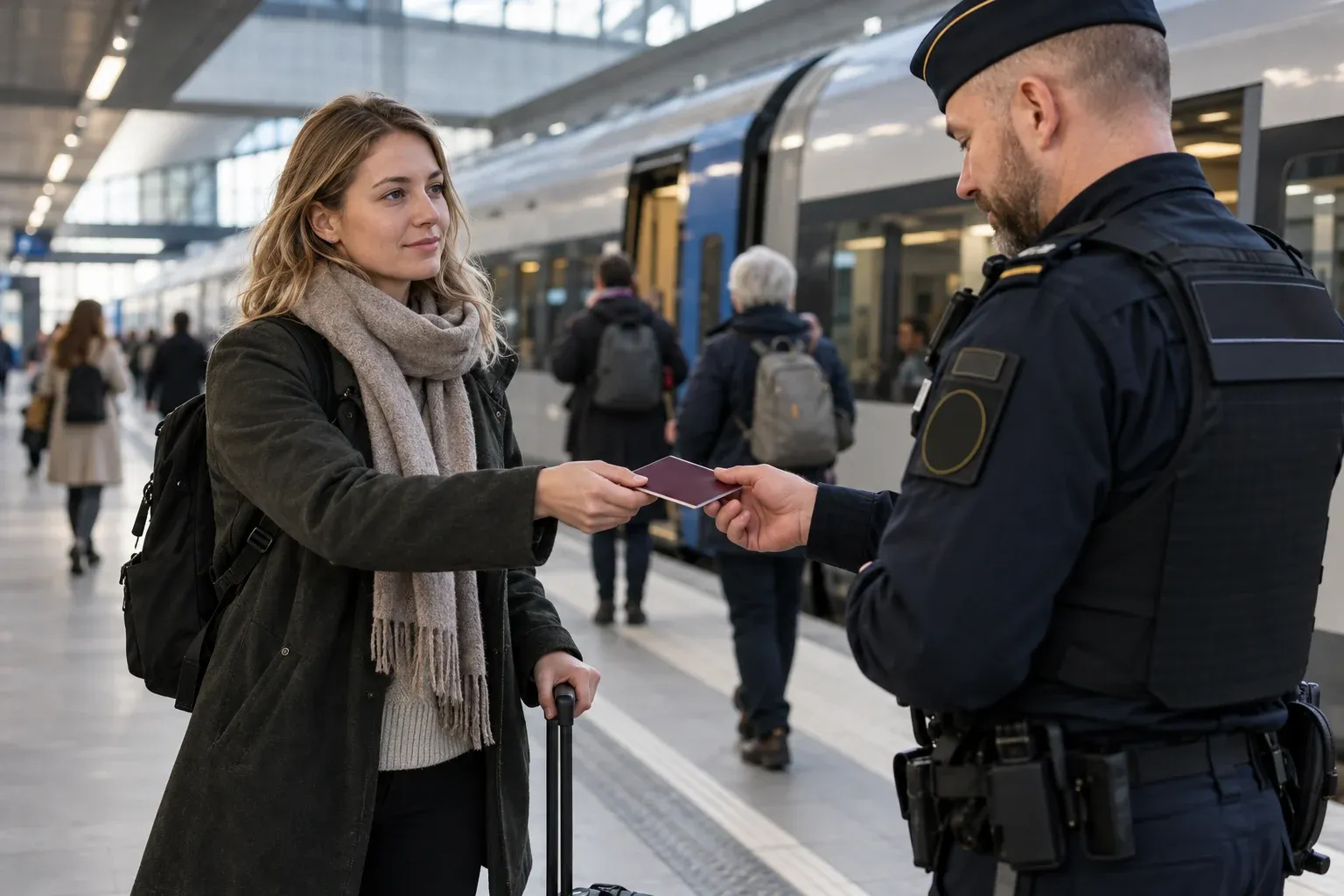
The famous answer — “Sweden has no ID law” — is true for Swedes and misleading for you. Here is what the law requires of visitors, when the police may actually ask, and which document works at each counter.
When you need this
- Deciding whether to leave your passport in the hotel safe for the day
- Planning a day trip between Malmö and Copenhagen
- Checking in at a hotel, campsite or hostel and being asked to sign a card
- Buying alcohol, tobacco or nicotine pouches when you look under 25
- Collecting a prescription or renting a car
- A police officer has just asked you for identification
Residents: no duty to carry ID
Sweden has no national duty to carry identification. A Swede who walks around without ID commits no offence, and the police cannot demand identification from anyone at random.
The powers the police do have are specific. They can take someone in for identification only when there is particular reason to think that person is wanted, under the Police Act (polislagen). A person suspected of a crime who refuses to give name and address can be detained, however minor the offence, under the Code of Judicial Procedure (rättegångsbalken). And drivers must carry their licence. Outside those situations, a Swede need not show anything.
That is the answer Swedish legal Q&A sites and expat forums give, and it is correct. It just isn’t about you.
Visitors: the Aliens Act duty
The Aliens Act (utlänningslagen) puts a separate duty on every utlänning — anyone who is not a Swedish citizen, including EU and Nordic citizens. In its current wording, in force since 13 July 2026, a foreigner staying in Sweden must, on request of a police officer, hand over a passport or other documents showing the right to stay in Sweden.
The statute says “hand over”, not “carry”. In practice there is no difference. A passport in the hotel safe cannot be handed over, and an officer who cannot establish your right to stay may take you along for investigation and hold you for up to six hours. If you refuse to produce documents the officer believes you have, you and your bags may be searched for them.
| Who you are | What satisfies the duty |
|---|---|
| Non-EU visitor | Your passport |
| EU/EEA or Swiss citizen | Passport, or a national ID card that shows citizenship |
| Nordic citizen | No passport requirement, but you still need documents proving the right to stay — carry photo ID showing citizenship |
| Swedish citizen | Nothing — the duty does not apply |
When the police may check
Away from the border, an aliens check (inre utlänningskontroll) needs a reason. The Aliens Act allows one only when there is cause to assume the person lacks the right to be in Sweden, judged on what officers observe and the information they hold. Polisen states plainly that a check is not carried out just because someone looks foreign.
Near the border, that safeguard falls away. A 2023 law on police powers in border-near areas lets officers make selective checks with no suspicion at all in these places and their surroundings:
- Airports and ports with direct foreign commercial traffic
- Railway stations with direct passenger trains abroad
- Road bridges to other countries, including the Öresund Bridge
- Border crossings on public roads
The checks must be selective, not systematic. If documents are not handed over, officers there may search you or your vehicle for them.
Borders and the Öresund crossing
Sweden has run temporary controls at its internal borders for a decade. The current decision covers all internal borders and runs until 11 November 2026; it has been renewed every six months, so assume it continues.
For most visitors the moment of certainty is coming back from Copenhagen. Sweden-bound train passengers are checked at Hyllie, cars and buses at the Lernacken toll station, and ferry passengers at the Swedish harbour. Denmark’s own temporary controls face Germany, not Sweden, so the check happens on the Swedish side. Leave the passport in a Copenhagen hotel and you cannot pass it. Crossing to Norway works the same way — see our guide to the Sweden–Norway border.
Everyday checkpoints: hotels, alcohol, pharmacies, cars
Most ID requests a visitor meets come from counters, not police. Each rests on a different footing, and only some are law.
Hotels, hostels and campsites. Anyone running commercial overnight lets — including tent, caravan and boat pitches — must have foreign guests sign a registration card and prove identity with valid ID. The card records your name, date of birth, home address, dates, and the type and number of the document shown, and is kept for three months. EU and Nordic guests are included. One spouse signs for a couple and their children under 18; on an organised group trip only the leader signs. Foreigners living and registered in Sweden are exempt. Some guides attribute this to a 1966 hotel act; that law dealt with hotel permits and was repealed on 1 January 2025. The rule lives in the Aliens Ordinance and a Polisen regulation. More in our guide to checking in at a Swedish hotel.
Alcohol, tobacco and nicotine. Sellers must satisfy themselves that the buyer is old enough — 20 at Systembolaget, 18 in bars and for tobacco and nicotine pouches. The law names no document, so each seller decides. Systembolaget’s list accepts passports and EU/EEA national ID cards that show citizenship, but not non-Nordic driving licences, photos of ID or digital ID. Detail in Sweden’s alcohol ages and club door policies.
Pharmacies. For narcotic-class prescription medicines, the pharmacy must verify the identity of whoever collects them and may not hand them over if it can’t. For other prescriptions it must make sure the medicine reaches the right person, and 1177 advises bringing ID. See using a prescription in Sweden.
Driving and car rental. Drivers must carry their licence and hand it over to the police on request; a foreign licence without a photo is valid only with photo ID. Rental desks add their own rules: Avis’s Sweden conditions ask for photo ID as well as the licence, and a payment card in the renter’s name. See driving in Sweden.
Flights and SIM cards. SAS requires passengers inside Schengen, children included, to show a passport or national ID card. A Swedish prepaid SIM must by law be registered to an identified person; see registering a prepaid SIM.
Which documents work
| Document | Police / border | Hotels | Systembolaget |
|---|---|---|---|
| Passport | Yes | Yes | Yes |
| EU/EEA national ID card showing citizenship | Yes — counts as a passport | Yes | Yes |
| ID card with no machine-readable zone | No — invalid as a travel document since 3 August 2026 | Operator’s call | Operator’s call |
| Nordic driving licence | Usually, for Nordic citizens within the Nordics | Operator’s call | Yes |
| Non-Nordic driving licence | Not a travel document | Operator’s call | Not on the list |
| Photo or photocopy of a passport | No | No | No |
The machine-readable zone point catches EU travellers most. Since 3 August 2026, national ID cards without a functional MRZ are no longer valid travel documents, whatever the expiry printed on the front. Check the back of yours, and see which passport or ID card gets you into Sweden.
Practical information
| Item | Detail |
|---|---|
| Cost of any ID check or hotel registration | 0 kr |
| Without ID in an aliens check | No fine in the statute; up to six hours held for investigation |
| Internal border controls | All Swedish internal borders, until at least 11 November 2026 |
| Öresund check points | Hyllie (train), Lernacken (road), Swedish harbour (ferry) |
| Hotel registration card kept | Three months |
| ID card MRZ cut-off | 3 August 2026; remaining non-compliant cards 3 August 2031 |
| Lost or stolen document | Report it to the police — see what to do if your passport is lost |
FAQ
Do you have to carry ID in Sweden?
If you live in Sweden, no — there is no general duty to carry identification. If you are visiting, effectively yes. The Aliens Act requires every non-Swedish citizen to hand a police officer a passport or other proof of the right to stay when asked, and you can only hand over what you have on you. EU and EEA citizens can use a national ID card.
Can the police in Sweden ask for ID for no reason?
Away from the border, not for no reason. A check of a foreigner’s right to stay needs grounds to assume the person lacks it, and Polisen says looking foreign is not enough. But at airports, ferry ports, international stations and the bridges to Denmark and Norway, officers may make selective checks without any suspicion. A Swede who is not suspected of anything need not show ID.
Is a photo of my passport enough in Sweden?
No. A photo or photocopy proves nothing in a police check, and Systembolaget refuses photos of documents and digital ID cards outright. Carry the physical passport or national ID card. A copy is still useful as a recovery aid: it speeds up a police report and an emergency passport if the original is stolen. Keep it separate from the original.
Do EU citizens need a passport in Sweden?
No. A national identity card issued by an EU or EEA country, or Switzerland, that shows your citizenship counts as a passport in Sweden for your whole stay. Check the back first: since 3 August 2026, cards with no machine-readable zone are no longer valid travel documents. Nordic citizens are exempt from the passport requirement, but should still carry photo ID showing citizenship.
Do Swedish hotels need my passport?
Yes, if you are not a Swedish citizen. Hotels, hostels, guesthouses and campsites must have foreign guests sign a registration card and prove identity with valid ID; the card records which document you showed and its number. Nordic and EU guests are included. One spouse can sign for a couple and their children under 18, and only the leader signs on organised group trips.
Is a foreign driving licence accepted as ID in Sweden?
For driving, yes; as general ID, not reliably. Swedish law lets you drive on most foreign licences and requires you to carry the licence. But Systembolaget’s accepted list includes only Swedish and other Nordic licences, and Polisen does not treat any licence as a travel document except for Nordic citizens within the Nordics. Carry your passport or ID card alongside it.
Do I need ID at a Swedish pharmacy?
For prescriptions, yes. Pharmacy rules require staff to verify the identity of whoever collects a controlled, narcotic-class prescription medicine, and forbid handing it out if they cannot. For ordinary prescriptions, the pharmacy must make sure the medicine reaches the right person, and 1177 advises bringing ID. Bring the passport or ID card to any prescription pickup, even for a routine refill.
Related guides
- Passport rules for visiting Sweden — which document gets you in, and the ID-card cut-off dates
- Lost or stolen passport in Sweden — the police report and embassy route if the document goes missing
- Sweden’s alcohol ages — the full list of ID Systembolaget accepts
- Crossing between Sweden and Norway — documents and checks on the northern border
- Laws tourists break without knowing — the other rules that catch visitors out
Facts verified 2026-10-01. Sources: Sveriges Riksdag (statute texts), Regeringskansliet, Polismyndigheten, Läkemedelsverket, the European Commission, Öresunddirekt, Systembolaget — full register in this topic’s source file. Found something outdated? Tell us and we’ll fix it.