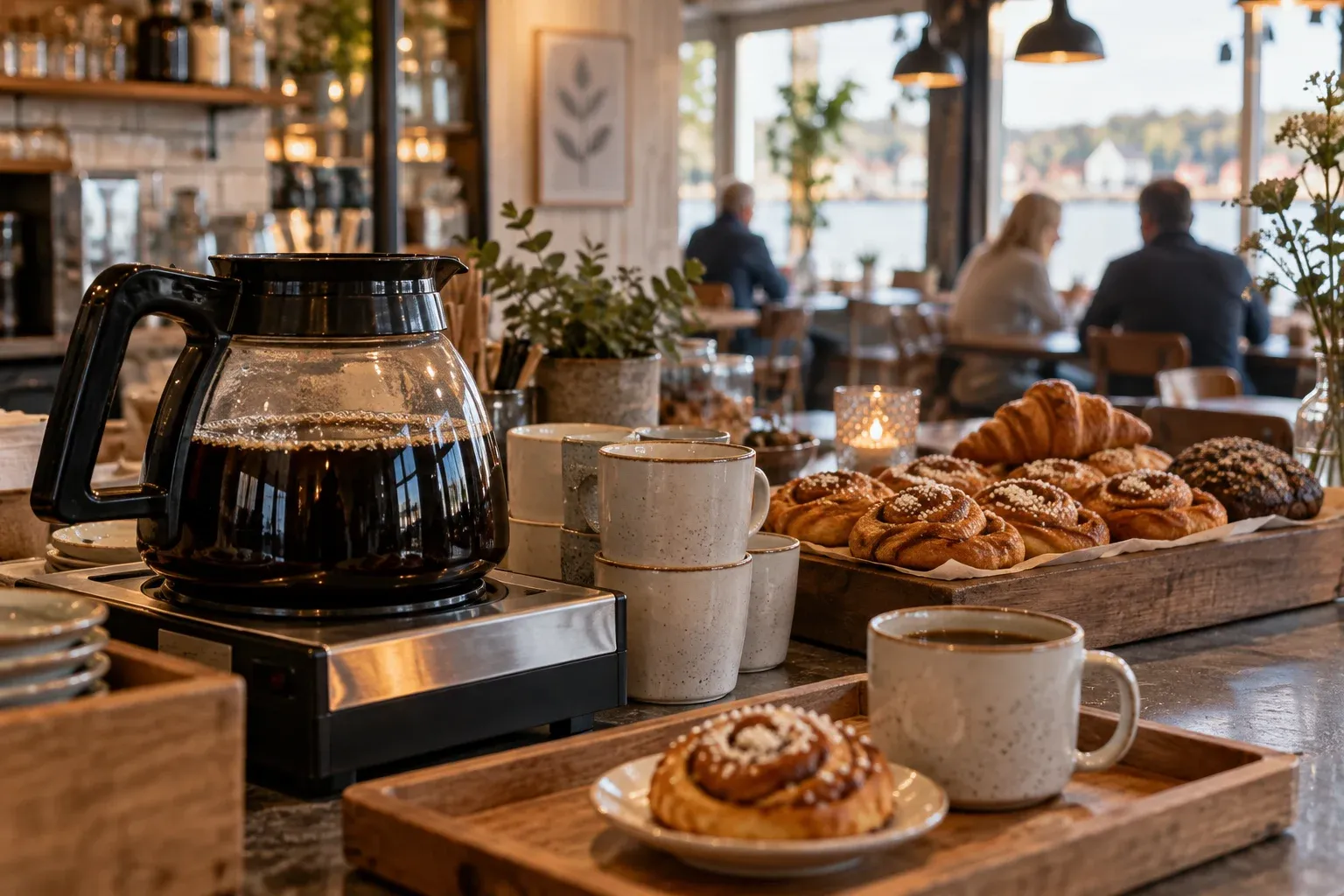
Swedish coffee is less about craft than about habit: a pot of filter coffee on a hot plate, a refill if you ask, and a cup with every lunch. Here is what to order, what to ask, and the northern traditions most visitors never see.
When you need this
- You are at a café counter wondering whether the second cup is free
- A menu lists bryggkaffe, påtår or kokkaffe
- You are buying coffee in a supermarket and the packs say bryggmalet, kokmalet and mellanrost
- Someone in northern Sweden hands you coffee with a bowl of cheese cubes
- You are pregnant, or traveling with teenagers who want coffee, and watching caffeine
- You wonder why every Swedish home, office and lunch restaurant has a pot on
What Swedes actually drink
Coffee in Sweden is first of all a plain drink. Eight in ten Swedes drink it regularly, and in Löfbergs’ 2026 coffee report, based on a Kantar Media survey of 3,970 adults, 70% of coffee drinkers said filter coffee is the type they drink most often.
| Coffee type | Share of coffee drinkers who had it in the past month (2026) |
|---|---|
| Bryggkaffe (filter coffee) | 85% |
| Instant coffee | 25% |
| Espresso | 19% |
| Capsules | 3% |
That default shapes what you meet: a glass pot in cafés, hotel breakfast rooms and lunch restaurants, and a refill custom built around it. Mornings are the main event, with 68% naming the morning as their most important coffee moment. The coffee break, with buns and etiquette, is a separate institution covered in our guide to Swedish fika.
Påtår: the refill custom
Påtår means a refill, and it is used almost only of brewed coffee; a third cup is a tretår. Seven in ten Swedes expect a free refill of coffee at cafés and restaurants, against only 8% for soft drinks. That makes it a strong expectation, not a rule.
| Situation | What usually happens |
|---|---|
| Brewed coffee with a self-serve pot | Refill included; help yourself |
| Brewed coffee, menu lists påtår with a price | Small charge for the refill |
| Latte, cappuccino or other espresso drink | Made per cup; rarely refilled |
| Soft drinks | Not refilled |
| Weekday dagens lunch | Coffee already in the price |
The one sentence to learn is “Ingår påtår?” — “Is a refill included?” — asked when you pay. A self-serve pot on the counter usually answers it for you. At lunch, don’t buy a coffee at all: the weekday deal normally includes it, so help yourself at the end of the buffet (see dagens lunch).
Ordering and buying coffee
In a café, order and pay at the counter, by card, and carry your cup to a table. There is no tipping custom at the counter (see tipping in Sweden). Ask for svart (black) or med mjölk (with milk). Oat drink, havremjölk or havredryck, is widely offered as the dairy-free option.
Two traps sit in self-serve fridges and supermarkets. Filmjölk and fil are sour fermented milk, sold in cartons that look like milk, and they curdle coffee; our guide to Swedish milk confusion explains the shelf. And supermarket coffee is sold by grind:
| Pack label | Means | Use it for |
|---|---|---|
| bryggmalet | filter grind | drip machine |
| kokmalet | coarse grind | boiling in a pot |
| pressmalet | press grind | French press |
| espressomalet | fine grind | espresso |
| ljusrost / mellanrost / mörkrost | light / medium / dark roast | taste |
Medium roast is a mainstream choice: Testfakta’s December 2025 test covered twelve of Sweden’s most common medium-roast brewed coffees. On the road and late at night, petrol stations and station kiosks sell coffee to go; it costs more than a café refill but is always there (see convenience stores in Sweden and fuel stations in Sweden). City specialty coffee bars serve lighter-roasted filter and espresso, where refills are less common, so ask.
Takeaway or eat in matters for tax. Since 1 April 2026 a coffee to take away (att ta med) is taxed as food at 6% VAT, while the same coffee drunk at the table (äta här) is a restaurant service at 12%. Some cafés price the two differently. The 6% rate runs until 31 December 2027.
Kokkaffe and kaffeost in the north
Kokkaffe, boiled coffee, is Scandinavia’s older method: coarse coffee boiled in a pot and left to settle before pouring. Today it is mostly a cabin, campfire and older-generation habit rather than the café default. If you boil coffee over a fire, check fire bans first; see campfire rules in Sweden.
Northern Sweden also drinks the most. In Löfbergs’ 2025 survey, Mellersta Norrland had the highest share of coffee drinkers (84%), and in Västernorrland 6% of coffee drinkers have seven or more cups a day.
The north’s signature is kaffeost, coffee cheese: a fresh, slightly squeaky cheese made from unhomogenised whole milk from cow, goat or reindeer. Along the Finnish border it is kahvijuusto in Meänkieli. Since 2025 the name is an EU protected designation of origin, reserved for cheese from Lapland, Norrbotten, Västerbotten, Jämtland, Härjedalen and Ångermanland. Don’t treat the bowl as a snack plate. The traditional way:
- Fill about a third of the cup with small cubes of cheese.
- Pour hot coffee over them and drink.
- Top up the coffee once more.
- Eat the softened cheese with a spoon.
If you are heading north, Swedish Lapland is kaffeost country.
Caffeine and health
Livsmedelsverket, the Swedish Food Agency, puts an ordinary 1.5 dl cup of brewed coffee at about 70 mg of caffeine. Its advice:
| Who | Advice | Status |
|---|---|---|
| Pregnant women | Max 200 mg a day — about two to three cups of brewed coffee | Guidance |
| Young people under 16 | Max 70 mg a day — about one small cup | Guidance, new in 2026 |
| Children under 6 | Avoid caffeine entirely | Guidance, new in 2026 |
Espresso is about three times as strong per decilitre as brewed coffee (about 134 mg against 44.5 mg), so a few double shots add up fast. Above 300 mg a day, caffeine appears to raise the risk of very early miscarriage. Decaffeinated coffee, koffeinfritt, has about 2 mg per decilitre.
Boiled coffee has one more catch. Unfiltered coffee carries oily compounds, cafestol and kahweol, that raise LDL cholesterol; a paper filter removes them. In a controlled trial, boiled coffee raised LDL cholesterol by about 0.4 mmol/l against the same coffee filtered. It is fine as a cabin treat and worth knowing as a daily habit. French-press and Turkish coffee work the same way.
How much coffee Sweden really drinks
The web still says Swedes get through about 10 kg of coffee each a year. That figure is decades old. The Swedish Board of Agriculture’s official statistics measure roasted coffee used per person:
| Year | Roasted coffee per person |
|---|---|
| 1976 (peak) | 11.29 kg |
| 2020 | 7.70 kg |
| 2023 | 6.08 kg |
| 2024 (preliminary) | 6.42 kg |
That is still a lot of coffee. Prices have risen in recent years, but 79% of coffee drinkers say they drink as much or more.
Practical information
| Item | Detail | Checked |
|---|---|---|
| A cup of brewed coffee at a café | Varies by town and café; check the board | 2026-10-05 |
| Refill (påtår) of brewed coffee | Often included; some cafés charge — ask | 2026-10-05 |
| VAT on coffee taken away | 6% (1 April 2026 – 31 December 2027) | 2026-10-05 |
| VAT on coffee drunk at the table | 12% | 2026-10-05 |
| Coffee with a weekday lunch deal | Included in the dagens lunch price | 2026-10-05 |
| Caffeine in a 1.5 dl cup of brewed coffee | About 70 mg | 2026-10-05 |
| Roasted coffee used per person | 6.42 kg (2024, preliminary) | 2026-10-05 |
FAQ
Are coffee refills free in Sweden?
Often, but not always. Seven in ten Swedes expect a free refill, called påtår, of brewed coffee at cafés and restaurants, and many cafés leave a self-serve pot out. Some list a small charge, and the custom covers brewed coffee, not espresso drinks or soft drinks. Ask “Ingår påtår?” (“Is a refill included?”) when you pay.
What is bryggkaffe?
Bryggkaffe is ordinary drip-filter coffee, brewed in a machine or by hand through a paper filter, and it is what most Swedes drink: 70% of coffee drinkers call it their most frequent type. Order it by name at a café counter. It is the coffee that usually comes with a refill, and a 1.5 dl cup has about 70 mg of caffeine.
How much coffee do Swedes drink?
Official supply statistics from the Swedish Board of Agriculture put use of roasted coffee at 6.42 kg per person in 2024 (preliminary), down from 11.29 kg at the 1976 peak. Eight in ten Swedes drink coffee regularly. The “10 kg a year” still quoted online is decades out of date.
What is kaffeost?
Kaffeost, coffee cheese, is a fresh, slightly squeaky cheese from northern Sweden, made from unhomogenised whole milk from cow, goat or reindeer. You put small cubes in your cup, pour hot coffee over, drink, top up and eat the softened cheese with a spoon. Since 2025 the name is an EU protected designation of origin.
Is boiled coffee (kokkaffe) bad for you?
Not as a treat, but daily it matters. Unfiltered boiled coffee contains oily compounds, cafestol and kahweol, that raise LDL cholesterol; a paper filter removes them. In one controlled trial, boiled coffee raised LDL cholesterol by about 0.4 mmol/l against the same coffee filtered. French-press and Turkish coffee have the same effect.
How much coffee can I drink while pregnant in Sweden?
Livsmedelsverket, the Swedish Food Agency, advises pregnant women to keep caffeine below 200 mg a day, about two to three cups of brewed coffee of 1.5 dl each. Espresso is roughly three times as strong per decilitre, and tea, cola and energy drinks count too. Decaffeinated coffee, koffeinfritt, contains only about 2 mg per decilitre.
Related guides
- Swedish fika — the coffee break itself: buns, workplace and home etiquette
- Dagens lunch — the weekday deal that already includes your coffee
- Swedish milk confusion — why the carton that says filmjölk ruins coffee
- Fika in Stockholm — where to sit down with a cup in the capital
- Swedish breakfast — the meal where coffee is the default drink
Facts verified 2026-10-05. Sources: Jordbruksverket, Livsmedelsverket, Skatteverket, Löfbergs/Kantar coffee reports and published research on boiled coffee — full register in this topic’s source file. Found something outdated? Tell us and we’ll fix it.