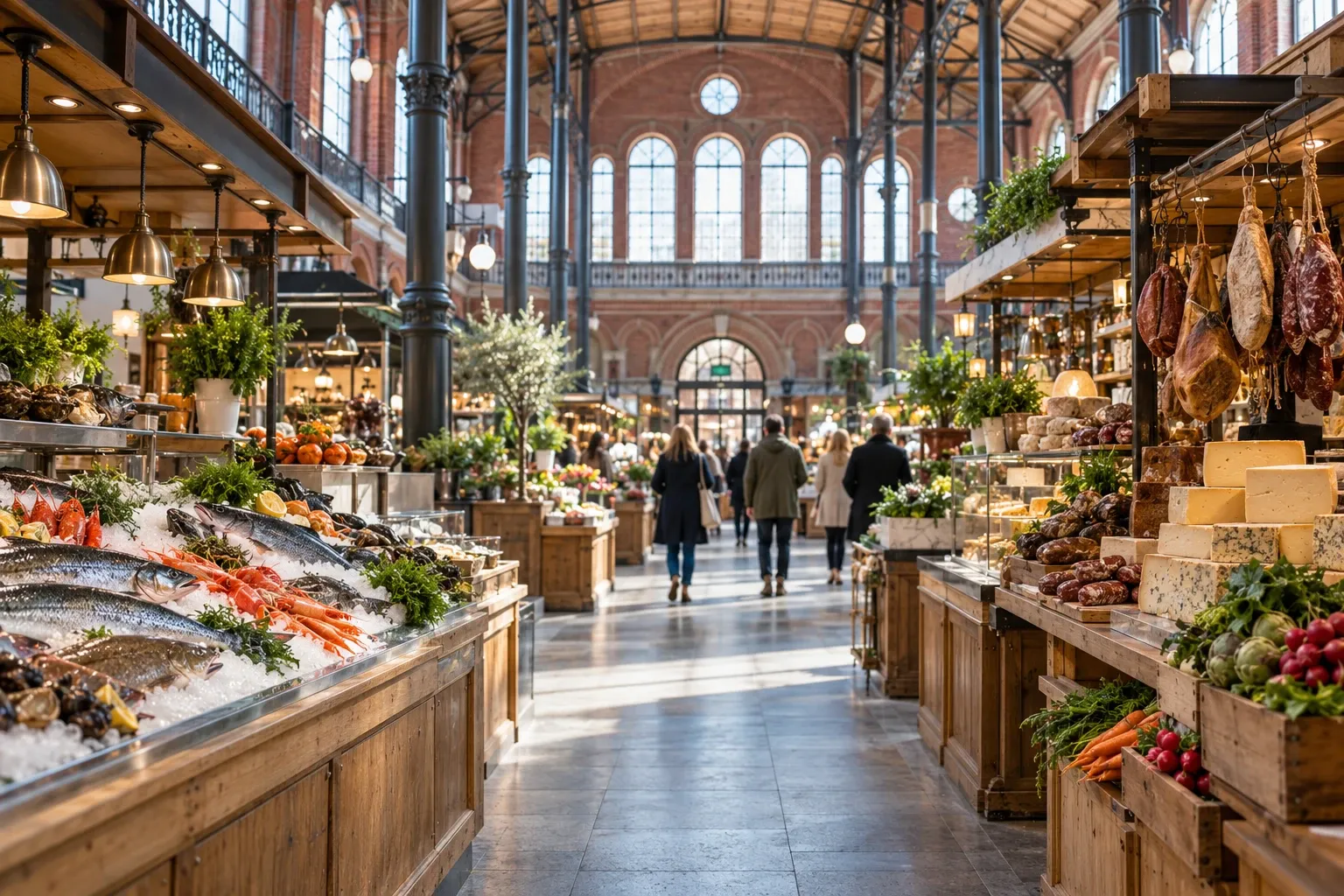
Sweden’s food halls are part sightseeing, part lunch and part deli shopping, and all of them are free to walk into. The catch is practical: which day they open, where your glass of wine may go, and what you can take home.
When you need this
You are planning a day in Stockholm, Gothenburg, Malmö or Uppsala and want lunch under a roof with a choice of counters. Or it is Sunday and you are wondering which hall is open. Maybe you want smoked fish, cheese or caviar to take home, or a wine with lunch and a stroll with it afterwards. You might also be travelling with a dog or a wheelchair and want to know what to expect at the door.
What a saluhall is
A saluhall (market hall) is a covered building where independent traders sell fish, meat, cheese, bread and deli food over the counter. Between the counters are lunch stands and restaurants. Sweden’s best-known halls are 19th-century public buildings, and all three classics are owned by their cities.
For a visitor that makes them three things at once. They are a sight in their own right, the easiest place to try Swedish fish, shellfish and cheese in small amounts, and a lunch spot where everyone in a group can eat something different. Entry is always free; you pay each trader for what you buy.
The halls, city by city
| Hall | City | Age and story | Sunday |
|---|---|---|---|
| Östermalms saluhall | Stockholm | 1888, renovated 2016–2020 | Closed |
| Hötorgshallen | Stockholm | Food hall since the 1950s | Closed |
| Stora Saluhallen | Gothenburg | 1888–89, listed building | Closed |
| Feskekôrka | Gothenburg | 1874 fish hall, reopened 2024 | Counters closed, restaurant open |
| Malmö Saluhall | Malmö | Opened 2016 in a goods shed | Open |
| Uppsala Saluhall | Uppsala | On S:t Eriks torg | Closed |
Östermalms saluhall, Stockholm
The red-brick hall on Östermalmstorg was designed by Isak Gustaf Clason and Kasper Salin and opened on 30 November 1888 with King Oscar II present. Look up at the cast-iron roof: the building is in Stockholm’s highest heritage class and may not be altered. Trade was slow at first. It took off after the City of Stockholm bought the hall in 1914 and banned trading on the square outside.
From 2016 the traders worked from a temporary hall on the square while the old one was renovated. The plan said two years; it took four, and the hall reopened in 2020. Its restaurants stay open into the evening after the food counters close. Take the red metro line to Östermalmstorg. For the district around it, see our Östermalm guide.
Hötorgshallen, Stockholm
Hötorgshallen sits at Hötorget, by the green-line metro station of the same name. It has been a food hall since the 1950s. It is on two floors, joined by a lift and a ramp, and the lower floor has a Systembolaget store, the state alcohol shop. Several traders have seating so you can eat on the spot. On a wet day, both Stockholm halls slot into our rainy-day Stockholm plan.
Stora Saluhallen, Gothenburg
Gothenburg’s main market hall on Kungstorget was finished in 1888–89 and was described at the time as one of the first large buildings in Sweden made entirely of stone, iron and glass. It opened with 92 stalls, became a listed building in 1985 and now draws over two million visitors a year. It is owned by Higab, the City of Gothenburg’s property company, and publishes its traders’ daily lunches online.
Inside it can be tight for space, but there are no thresholds and everything is on one level. The accessible customer toilet costs a fee. In the warmer half of the year, locals carry food out and sit along the canal edge outside. The Kungsportsplatsen tram stop is under a minute’s walk away.
Feskekôrka, Gothenburg
Feskekôrka (Gothenburg dialect for “the fish church”; the hall’s own site spells it Feskekörka) opened in 1874. Architect Victor von Gegerfelt borrowed from stave churches and Gothic architecture, hence the steep roof, the pointed windows and the name. Also owned by Higab, it reopened on 16 May 2024 after a renovation that closed it from 2020.
Inside is a 28-metre fish and shellfish counter that also sells ready-cooked dishes to take away, plus a restaurant and a bar. The thing to know is that the fish counters close on both Sundays and Mondays, while the restaurant opens every day. For what the counters sell and when, read our west-coast seafood guide.
Malmö Saluhall and Uppsala Saluhall
Malmö Saluhall opened on 11 November 2016 in the old Godsmagasinet, a 19th-century railway goods shed that had stood empty since the last train left in 1955. It has around 20 traders and shared seating indoors and outdoors. It is privately owned and, unusually, open on Sundays, though individual traders keep their own hours. Uppsala Saluhall on S:t Eriks torg works the same way, with traders and restaurants keeping their own hours, and is closed on Sundays.
The Sunday problem
This is the mistake that wastes the most trips. Östermalms saluhall, Hötorgshallen, Stora Saluhallen and Uppsala Saluhall are all closed on Sundays. Feskekôrka’s fish counters close on Sundays and Mondays. A Sunday lunch plan built on any of them fails.
On a Sunday you have two options: Malmö Saluhall, or Feskekôrka’s restaurant. One exception is in the calendar: Östermalms saluhall opens on the fourth Sunday of Advent (20 December 2026).
Holidays shift things again. The classic halls close from 24 to 26 December, and Östermalms saluhall and Stora Saluhallen close on New Year’s Day. Hötorgshallen also closes on Good Friday, Ascension Day and Midsummer Eve. Every hall publishes a list of avvikande öppettider (exceptional hours), so check it before a holiday visit. Our guide to Swedish public holidays shows when these fall. And from 2027, Stora Saluhallen closes an hour earlier on Thursdays.
Paying, tipping and VAT
Bring a contactless card. About nine in ten in-store payments in Sweden are made by card, and food-hall stalls work the same way. Sweden’s cash-acceptance duty, in force since 1 July 2026, covers grocery stores with a broad range of food and a staffed checkout. It does not cover shops with a limited food range, so a cheese or fish stall may legally refuse cash. Our guide to using cards in Sweden covers the rest.
Don’t tip at a counter: you pay before you eat and nobody expects more. At a table-service restaurant inside a hall, rounding up is the local gesture. One quirk: until the end of 2027, takeaway food carries 6% VAT and the same food eaten in carries 12%, so a stall may price the two differently. Eating out in Sweden explains the VAT split.
Wine, beer and the serving area
You can have a glass of wine with lunch, but only at a restaurant or bar inside the hall that holds a serving licence. Under the Alcohol Act, a licence covers a defined area, and the licence holder answers for order inside it. The Act also lets several licence holders share one serving area. That is how some halls, Malmö Saluhall among them, let you combine food from different counters with a drink at shared tables.
Three rules follow from the statute:
- You may not carry a served drink out of the licensed area. Walking off to browse the counters with your glass breaks the law, and staff will stop you.
- No bring-your-own: only drinks served under the venue’s licence may be drunk there.
- Bottles to take away come only from Systembolaget, the state retail monopoly. A deli stall cannot sell you a bottle of wine; Hötorgshallen’s Systembolaget is one floor down. See our Systembolaget guide.
In Malmö, some restaurants keep their seats for their own guests, and food bought elsewhere goes to the shared tables.
Dogs
Many visitors have heard that Swedish law bans dogs from food shops. That is not quite right. EU food law requires pets to be kept away from places where food is prepared, handled or stored. The Swedish Food Agency, Livsmedelsverket, judges a dog under control in a shop or serving area to be a low risk, so the business decides.
The big halls decide no. Hötorgshallen and Malmö Saluhall do not allow dogs indoors, though Malmö welcomes them on its outdoor terraces. Guide and assistance dogs are different: they should be admitted, and Sweden’s Equality Ombudsman holds that refusing them could be discrimination. For the wider picture, see dog-friendly stays in Sweden.
Taking food home
Smoked fish, cheese, roe and pickled herring are the obvious souvenirs. Whether they survive the trip depends on where you fly.
| Going to | Meat and dairy | Fish | Jars in liquid |
|---|---|---|---|
| Another EU or EEA country | Free for your own use | Free | Over 100 ml in checked baggage |
| Great Britain | Banned from the EU, even packaged | Allowed | Over 100 ml in checked baggage |
| Anywhere else | Your home country decides | Your home country decides | Over 100 ml in checked baggage |
The Great Britain rule has applied since 12 April 2025. It covers meat and dairy from cattle, sheep, goats, pigs, deer and other ruminants. It stays until the UK revokes it, so check GOV.UK before you fly. Bread, biscuits, chocolate and sweets with low dairy and egg content may go in, up to 2 kg in total. Jars of sill count as liquids at airport security; our pickled herring guide and Swedish groceries worth trying have more on packing them.
Practical information
| Item | Detail (checked 2026-10-15) |
|---|---|
| Entry to every hall | Free |
| Östermalms saluhall | Mon–Fri 09:30–19:00, Sat 09:30–17:00, Sun closed; restaurants open later |
| Hötorgshallen | Upper floor Mon–Thu 10–19, Fri 10–20, Sat 10–17; lower floor closes an hour earlier Mon–Fri; Sun closed |
| Stora Saluhallen | Mon–Wed 10–18, Thu–Fri 10–19 (Thu 10–18 from 2027), Sat 10–17, Sun closed |
| Feskekôrka fish counters | Tue–Thu 10–18, Fri 10–18:30, Sat 10–16; Sun–Mon closed |
| Feskekôrka restaurant and bar | Open daily |
| Malmö Saluhall | Mon–Thu 11–20, Fri–Sat 11–21, Sun 11–17 |
| Uppsala Saluhall | Mon–Thu 10–18, Fri 10–19, Sat 10–16, Sun closed |
| VAT on food | Takeaway 6%, eaten in 12% (to 31 Dec 2027) |
| Stora Saluhallen accessible toilet | Paid |
FAQ
Are Swedish food halls open on Sundays?
Mostly not. Östermalms saluhall, Hötorgshallen, Gothenburg’s Stora Saluhallen and Uppsala Saluhall are closed on Sundays, and Feskekôrka’s fish counters close on both Sundays and Mondays, though its restaurant opens daily. Malmö Saluhall is the exception and opens on Sunday afternoons. Holiday hours differ again, so check the hall’s own page before you go.
Is it free to visit Östermalms saluhall?
Yes. Entry to Östermalms saluhall is free, as it is to Hötorgshallen, Stora Saluhallen, Feskekôrka and Malmö Saluhall; you pay only for what you buy at each counter or restaurant. Go on a weekday or Saturday, because the hall is closed on Sundays. Its restaurants stay open into the evening after the food counters close.
What is Feskekôrka?
Feskekôrka, “the fish church”, is Gothenburg’s fish hall, built in 1874 with a steep roof and pointed windows inspired by stave churches and Gothic architecture. It reopened in May 2024 after renovation and has a long fish and shellfish counter, ready-made dishes, a restaurant and a bar. The fish counters open Tuesday to Saturday only.
Can I drink wine in a Swedish food hall?
Yes, at a restaurant or bar inside the hall that holds a serving licence, and only within its serving area. Some halls have a shared licensed seating area where you can combine food from several counters with a drink. You may not carry a served glass out of the licensed area, and bottles to take away come only from Systembolaget.
Can I take cheese or smoked fish home from a Swedish food hall?
Within the EU and EEA, yes: food for your own use moves freely. To Great Britain, meat and dairy from cattle, sheep, goats, pigs and deer cannot enter from the EU, even packaged; fish is allowed. Elsewhere your home country decides. Jars of herring or roe over 100 ml must go in checked baggage.
Can I bring my dog into a Swedish food hall?
Usually not. Food law keeps pets away from where food is prepared and handled, and leaves customer areas to the business, and the big halls decide against dogs: Hötorgshallen and Malmö Saluhall do not allow them indoors, though Malmö welcomes them on its terraces. Guide and assistance dogs should be admitted.
Do food hall stalls take cash?
Most stalls take cards, and many Swedes never use cash. The legal duty to accept cash, in force since July 2026, covers grocery stores with a broad range and a staffed checkout, not specialist shops with a limited range, so a cheese or fish stall may refuse cash. Bring a card that works for contactless payment.
Related guides
- West-coast seafood — what Feskekôrka’s counters sell, and which seasons and quotas decide it.
- Farm shops and honesty stands — the countryside way of buying straight from the producer.
- Rainy-day Stockholm — how the food halls fit an indoor day on one transit ticket.
- Dagens lunch — the weekday set lunch that many hall counters serve.
- Systembolaget — where the bottle you liked at lunch can actually be bought.
Facts verified 2026-10-15. Sources: the halls’ own websites (Östermalms Saluhall, Hötorgshallen, Stora Saluhallen, Feskekörka, Malmö Saluhall, Uppsala Saluhall), Higab, Sveriges Riksdag (Alkohollag 2010:1622, Lag 2026:769), Livsmedelsverket, Sveriges Riksbank, Skatteverket, Transportstyrelsen, DEFRA/APHA, European Commission — full register in this topic’s source file. Found something outdated? Tell us and we’ll fix it.