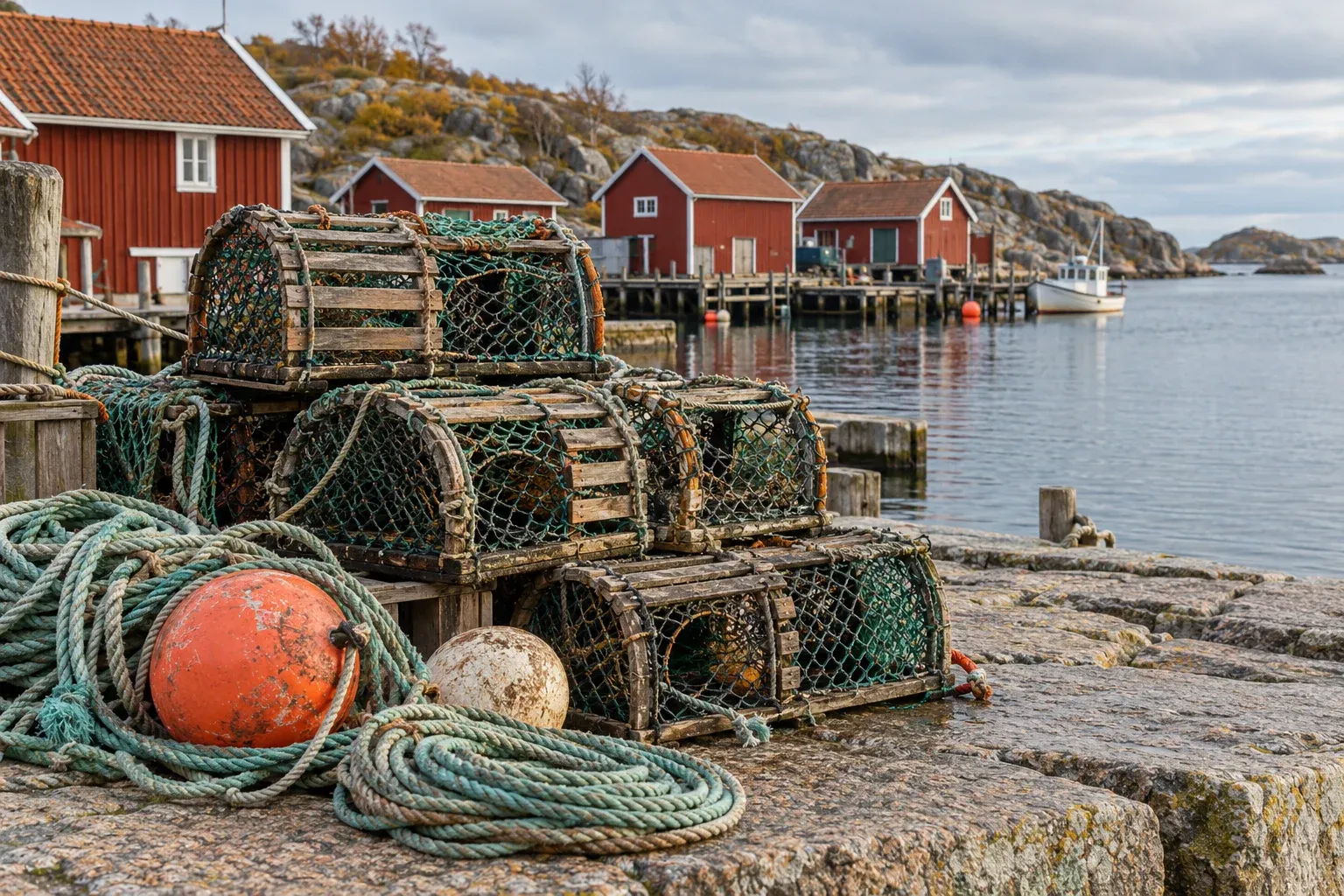
Sweden’s west coast is a shellfish larder, and almost all of it is regulated. Here is what you may eat, what you may take yourself, and where the rules and the brochures part ways.
When you need this
- You are planning a Bohuslän or Gothenburg trip around the autumn lobster season
- You are standing on a rock looking at a bed of oysters
- You want to fish or pot lobster yourself on holiday
- You are buying shellfish to cook in a rented cottage
- You are wondering whether Gothenburg’s fish hall, Feskekôrka, is open
Lobster season and the premiere
The hummerpremiär (lobster premiere) is set by a fixed rule from Havs- och vattenmyndigheten (HaV), the Swedish marine agency: 07:00 on the first Monday after 20 September. In 2026 that was 21 September. Recreational fishers may fish until 30 November; licensed commercial fishers continue to 31 December.
For the people allowed to fish, the limits are tight. A recreational fisher may use at most six pots, a licensed fisher up to 40. The minimum size is 9 cm, measured from the back of the eye socket to the back of the shell, and a lobster carrying roe on the outside must go straight back. New in 2026: under EU control rules in force from 10 January 2026, the pots themselves must now carry the owner’s contact details, not just the buoys. Some waters are closed to lobster fishing altogether, including areas off Gothenburg, the “8 fjordar” area around Orust and Tjörn, and the waters around Koster.
| Rule | 2026 |
|---|---|
| Premiere | 21 September, 07:00 (first Monday after 20 September) |
| Recreational season ends | 30 November |
| Commercial season ends | 31 December |
| Pots per recreational fisher | 6 |
| Minimum size | 9 cm (eye socket to back of carapace) |
| Lobster with external roe | Must be released |
Who may fish lobster, and lobster safaris
Here is the line most travel pages leave out: only Swedish citizens and people permanently resident in Sweden may fish lobster. Foreign citizens may fish only with hand tackle (handredskap: a rod, jig or line), and a lobster pot is not hand tackle. A cottage owner cannot hand that right to a foreign guest, so “lobster fishing included” in a rental listing does not make it legal for you.
The legal way in is a lobster safari (hummersafari). You ride along on a licensed fisher’s boat and watch the pots being hauled; the fisher owns the gear and holds the right. Trips run from late September into November from harbors such as Fjällbacka, Smögen and Grebbestad, and premiere week books out early. Ask before you book what happens to the catch: some trips end with a lobster meal, others sell the catch separately. In early October, Tanum’s restaurants run lobster-season menus under the “Smaka på Bohuslän” banner (2–11 October in 2026).
Oysters: Grebbestad, flat and Pacific
Two oysters grow on this coast. The native flat oyster is the one behind Grebbestadostron, an EU protected designation of origin (SUB), which means production, processing and preparation all happen in the defined area. The other is the invasive Pacific oyster (stillahavsostron), which now crusts rocks at many bathing spots.
Neither is free to pick near land. The Fishing Act reserves oyster fishing within 200 m of the mainland, or of an island at least 100 m long, for whoever holds the private fishing right, usually the landowner, on the coasts of Halland, Bohuslän and Skåne’s west side. HaV says this covers Pacific oysters too, because the law says “oysters”, not one species. The rule is enforced: in May 2026 police reported eight people at Mjölkeviken on Tjörn for picking oysters and mussels. In Kosterhavet National Park oyster picking is banned outright.
“They’re invasive, so they’re free” is a myth with a reason behind it. Freeing Pacific oysters for public picking has been discussed for years, and a 2024 government bill sent the question back for further investigation. The statute read on 1 October 2026 still reserves them, so until the law changes, picking near shore without permission is unauthorised fishing: fines or up to a year in prison, with catch and gear forfeited.
| Oyster rule | Detail |
|---|---|
| Within 200 m of mainland or an island ≥100 m long | Rights-holder only |
| Pacific oysters | Same rule |
| Flat oyster minimum size | 6 cm; Pacific none |
| Kosterhavet National Park | No picking |
| Selling your catch | Needs a licence |
Mind your feet as well as the law: HaV warns that the sharp shells cut easily.
Mussels, and why toxins matter
Blue mussels (blåmusslor) are not covered by the oyster reservation, and picking a few for your own pot is generally treated as allowed. Two things have changed the picture, though. First, the blue mussel is now red-listed: the Swedish Red List 2025, published in March 2026, lists it as near threatened for the first time. Second, wild shellfish can be toxic.
Mussels and oysters filter seawater and concentrate whatever is in it. Livsmedelsverket, the Swedish Food Agency, is blunt: marine algal toxins cannot be boiled away. They survive heating, and paralytic shellfish toxin affects the nervous system. The agency’s baseline advice is not to eat mussels or oysters picked straight from the sea, only controlled ones. In summer 2026 the county board advised against all self-picking at Fjällbacka, Stigfjorden, northern Havstensfjorden, Ljungskile and Halsefjorden, and the list changes weekly.
The easy answer is to buy. Farmed Swedish mussels and oysters are controlled, and Bohusläns blåmusslor is itself an EU protected designation. Mussels are forgiving in a cottage kitchen: steam them in a lidded pan until they open, and discard any that stay shut.
Shrimp and the räksmörgås
Northern shrimp (räkor) are usually sold cooked and chilled, because the boats cook the catch on board. Buy a bag at a harbor fish shop and peel them on the quay, or order the west-coast café classic, the räksmörgås: an open shrimp sandwich with egg, mayonnaise and lemon.
Swedish shrimp has become scarce. The Skagerrak and Kattegat stock is at what scientists advising HaV call worryingly low levels, and the shrimp is red-listed as near threatened. Quotas were cut 12% for 2025/26 after deeper cuts in earlier years; the quota year runs from 1 July. Much of the shrimp sold in Sweden is imported, so ask for svenska räkor (Swedish shrimp) by name if local matters to you.
Feskekôrka and where to buy
Feskekôrka, “the fish church”, is Gothenburg’s fish hall, built in 1874. It closed in 2020 for renovation and reopened on 16 May 2024, which many travel pages have not caught up with. Inside are fish counters, an oyster kiosk, a snaps bar and restaurants. The fish counters are closed on Sundays and Mondays; the restaurants open every day. Along the coast, harbor fish shops sell shrimp, mussels and, in season, lobster.
Practical information
| Item | Detail (checked 1 October 2026) |
|---|---|
| Lobster season 2026 | 21 September 07:00 – 30 November (recreational) |
| Who may fish lobster | Swedish citizens and permanent residents |
| Lobster safari | Late September–November; price and length set per operator |
| Oysters near shore | Rights-holder only, Pacific oysters included |
| Self-picking advisories | Weekly; check Livsmedelsverket’s open/closed areas map |
| Feskekôrka | Free entry; fish counters Tuesday–Saturday, restaurants daily |
| Lobster, oysters, shrimp | Priced per kilo or piece; varies with catch and season |
| Unauthorised fishing | Fines or up to one year in prison; catch and gear forfeited |
FAQ
When does lobster season start in Sweden?
At 07:00 on the first Monday after 20 September, a rule set by Havs- och vattenmyndigheten. In 2026 the premiere was 21 September. The recreational season runs to 30 November and commercial fishing to 31 December. The 2027 date follows the same rule; check HaV’s lobster page in late summer.
Can tourists fish for lobster in Sweden?
No. Only Swedish citizens and people permanently resident in Sweden may fish lobster; foreign citizens may fish only with hand tackle, and pots do not count. A recreational resident may use six pots. Visitors join a lobster safari instead, where a licensed fisher hauls the pots and you watch, help on deck and often eat the catch.
Can I pick oysters on the Swedish west coast?
Not near land without the fishing right. Within 200 meters of the mainland, or of an island at least 100 meters long, oysters belong to the rights-holder, and HaV says that covers invasive Pacific oysters too. Police reported eight pickers on Tjörn in May 2026. Kosterhavet National Park bans picking outright.
Is it safe to eat mussels or oysters I pick myself?
Livsmedelsverket advises against it: wild mussels and oysters can carry algal toxins and harmful microbes, and the toxins survive cooking. In 2026 the county board advised against all self-picking in several Bohuslän areas. Farmed Swedish mussels and oysters are controlled; buy those, or check the weekly advisory map first.
Where can I buy fresh shrimp on the west coast?
At harbor fish shops and fish counters along the coast, and at Feskekôrka in Gothenburg. Shrimp are usually sold cooked, since the boats cook them on board. Ask for Swedish shrimp by name: the Skagerrak stock is at low levels and local quotas have been cut, so much shrimp on sale is imported.
Is Feskekôrka open?
Yes. Gothenburg’s 1874 fish hall reopened on 16 May 2024 after a four-year renovation. Its fish counters are closed on Sundays and Mondays and open Tuesday to Saturday; the restaurants inside open every day. Check the hall’s own website for the hours on the day you go.
What is a lobster safari?
A trip on a licensed fisher’s boat to haul lobster pots during the autumn season, usually late September to November. It is the legal way for visitors to take part in lobster fishing, because the fisher owns the gear and the right. Some packages end with a lobster meal; prices and trip lengths vary by operator.
Related guides
- Bohuslän and the west coast — the region these harbors sit in
- Smögen and Fjällbacka — two of the lobster-safari harbors
- Swedish fishing rules — sizes, seasons and protected species for everything else
- Free fishing in Sweden — what you may catch with a rod on the coast
- Swedish food guide — the wider kitchen and Sweden’s protected food names
Facts verified 1 October 2026. Sources: Havs- och vattenmyndigheten, Länsstyrelsen Västra Götaland, Livsmedelsverket, Sveriges Riksdag (Fiskelag 1993:787), Jordbruksverket, SLU Artdatabanken, Higab and Feskekôrka — full register in this topic’s source file. Self-picking status changes weekly and is never published here. Found something outdated? Tell us and we’ll fix it.