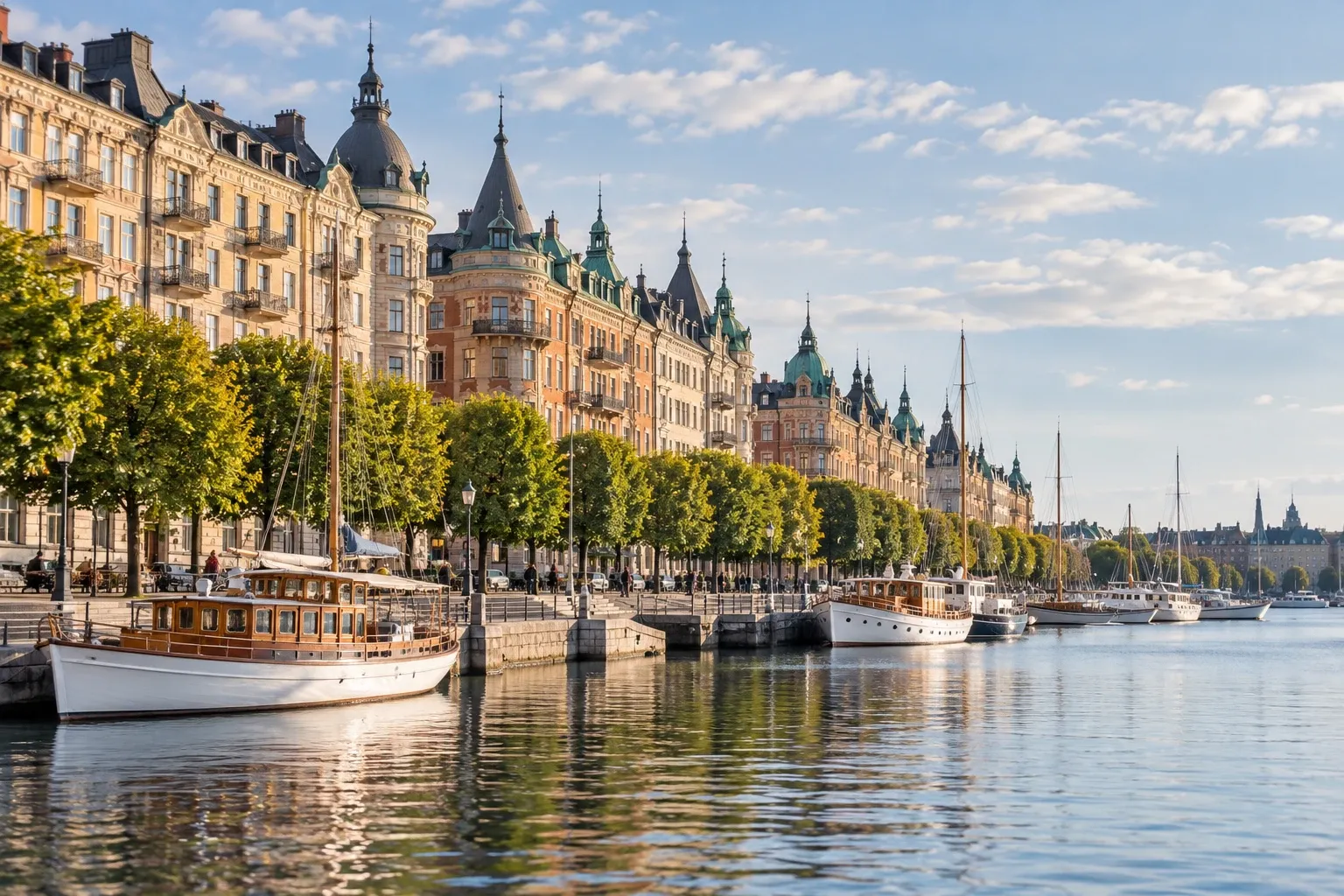
Östermalm’s reputation is boutiques and fine dining. What makes it worth a walk is free: a 19th-century boulevard on the water, one of the city’s oldest parks and a market hall from 1888. Here is what to see, what the museums cost, and what has changed.
When you need this
You have a few hours in central Stockholm and want a grand walk rather than a shopping list. Or you’re staying on Östermalm and want to know what’s nearby. Or you read that the Royal Stables give tours, or that Pride Park is at Östermalms IP, and want to check before you go. This page covers the public places and the state museums. It names no shops, restaurants or bars, because those change faster than any guide can check.
What Östermalm is
Östermalm is the eastern part of Stockholm’s inner city, north of Nybroviken and west of Djurgården. Visit Stockholm, the city’s official visitor site, calls it “upscale Östermalm” and says the name “has become short-hand for luxury, glamour, and affluence.” The elegance label is the tourist office’s. The same site calls the district an important cultural hub, home to the national library and the national stage.
The name is younger than the streets. The area was called Ladugårdslandet, “the barn land.” In 1885 residents petitioned to change it, arguing the old name did not suit the newest and best-built part of the capital, and it became Östermalm that summer.
On paper, the City of Stockholm no longer has an Östermalm district. The area now belongs to Norra innerstaden (the northern inner city), together with Djurgården, Gärdet, Norrmalm, Vasastaden and others. This page stays on the old grid between Nybroplan, Humlegården and Karlaplan.
| Place | What it is | Cost |
|---|---|---|
| Strandvägen | Tree-lined waterfront boulevard, built 1862–1897 | Free |
| Humlegården | 17th-century park with the National Library | Free |
| Östermalms saluhall | Covered market hall on Östermalmstorg, from 1888 | Free to enter |
| Historiska museet | Swedish History Museum | Paid; 0–18 free |
| Armémuseum | Army Museum | Paid; under 19 free |
| Scenkonstmuseet | Swedish Museum of Performing Arts | Paid; 0–18 free |
| Royal Stables (Hovstallet) | Working royal stables | Public tours paused |
| Stadion | The 1912 Olympic stadium | Free to look at |
Strandvägen
Strandvägen is the street to walk. It runs from Nybroplan along the water past Djurgårdsbron to Oxenstiernsgatan, with an avenue of trees between two carriageways and tall stone houses facing the bay. The City of Stockholm’s history site gives the timeline. Building began in 1862, the street got its name in 1885, and the first house, today Strandvägen 23–27, went up in 1881–1883.
The eastern end near Djurgårdsbron was finished in 1896, in time for the 1897 Stockholm Exhibition on Djurgården. The last plot was not built on until 1923, delayed by the First World War.
At its western end, Nybroplan is the theatre corner. The Royal Dramatic Theatre, founded in 1788, has stood in its Art Nouveau building on Nybrokajen since 1908. Visit Stockholm notes that its terrace becomes a bar in summer.
Strandvägen is also the natural way to Djurgården. Royal Djurgården, the island’s administrator, puts the walk from Nybroplan at about 20 minutes. If your feet give out, tram 7 stops at Nybroplan, Styrmansgatan and Djurgårdsbron.
Humlegården and Östermalmstorg
Humlegården is, in the City of Stockholm’s words, the city’s second-oldest park. In 1619 Gustav II Adolf decided to grow vegetables and fruit for the court here. Its name means “the hop garden.” In the 1650s Queen Kristina remade it in baroque style and added the lime avenues, and it opened gradually to the public during the 1700s.
The National Library (Kungliga biblioteket) was built in the south of the park in 1877. Fritjof Kjellberg’s Linnaeus statue of 1885 stands at the center, where three lime avenues meet. The park is classed as a site of national interest for cultural heritage.
For families, Humlegården has a staffed play park (parklek) and a playground in the north, a skating rink in winter, and a summer café in the east that started life as a water kiosk. It is a stone’s throw from Stureplan.
Östermalms saluhall, the market hall on Östermalmstorg, is the district’s landmark. A local parish history article says it was built in only nine months to designs by Isak Gustaf Clason and Kasper Salin. King Oscar II inaugurated it in December 1888, and the city bought it in 1914. It is free to walk in. The hall’s own site lists Monday to Saturday hours and no Sunday hours.
The museums
Three state-run museums sit within a few blocks. All three charge adults, all three let children in free, and all three close on ordinary Mondays.
| Museum | What it covers | Open | Good to know |
|---|---|---|---|
| Historiska museet, Narvavägen 17 | Swedish history; the Gold Room; Visit Stockholm says the world’s largest Viking collection | Tue–Sun; Wed to 20:00 | Ticket includes the Economy Museum; half price daily 16–17 |
| Armémuseum, Riddargatan 13 | Sweden’s history of war and peace | Tue to 19:00, Wed–Sun to 17:00 | Cashless; under-13s need an adult |
| Scenkonstmuseet, Sibyllegatan 2 | Music, theatre and dance | Tue–Sun 11–17 | Cashless; entrance from Väpnarplan |
Historiska museet is the big one. Its ticket also covers the Economy Museum in the same building. There is a half-price hour every day from 16:00 to 17:00, and on Wednesday evenings from 17:00 to 20:00. It also opens on some holiday Mondays: 26 October 2026 for the autumn school break, and 21 and 28 December. Historiska museet and Scenkonstmuseet both have a packed-lunch room with a microwave.
Armémuseum follows men, women and children through Sweden’s history of war and peace. On Tuesday evenings, 17:00 to 19:00, adults get half off. It takes no cash, and children under 13 must come with an adult because some exhibits deal with difficult subjects.
Scenkonstmuseet, the former Music Museum, has interactive exhibitions on music, theatre and dance. From 2027 it also becomes the fixed stage of Unga Operan, the Royal Opera’s young-audience company, for the roughly five years the Opera House is renovated.
One accessibility note per museum. Historiska’s front entrance is stone steps with no ramp, so use the lift to the right of the stairs. Armémuseum’s forecourt is cobbled, with a smoother strip of sawn stone up to the door. Scenkonstmuseet has a street-level entrance with a door opener.
The Royal Stables in 2026
The Royal Stables (Hovstallet) at Väpnargatan 1, next to the Royal Dramatic Theatre, are a working stable. Their horses and carriages are used for state visits, new ambassadors and the State Opening of Parliament.
Many guides, including Visit Stockholm’s Östermalm page from November 2025, say the King’s coachmen show visitors round. Right now they don’t. The Royal Palaces’ own hours page says the stables are “temporarily closed for guided tours,” with no reopening date.
What still works:
- Groups of 10 to 30 can book a 60-minute tour of the stable, harness room and carriage house year-round, by phone or e-mail. The fee is paid in cash on arrival.
- The Christmas market, a craft fair held at the stables on the second weekend of Advent.
Getting there and around
| Way in | Stops | Best for |
|---|---|---|
| Red metro, lines 13 and 14 | Östermalmstorg | Market hall, Humlegården, Nybroplan, museums |
| Red metro, line 13 | Karlaplan | Historiska museet |
| Red metro, line 14 | Stadion, Tekniska högskolan | The Olympic stadium |
| Tram 7 | Nybroplan, Styrmansgatan, Djurgårdsbron | Strandvägen, on to Djurgården |
| Boat line 80 | Nybroplan | Harbour trip to Ropsten via Djurgården and Nacka |
One SL ticket covers the metro, the tram and the line 80 boat, and a contactless card tapped at the gate buys a 75-minute single. Visit Stockholm warns that far from all metro stations have elevators, so step-free travelers should check the SL app before relying on one.
A good loop starts at Östermalmstorg. See the market hall and Humlegården, then go back past Scenkonstmuseet and the Royal Stables to Nybroplan. Walk east along Strandvägen and up Narvavägen to Historiska museet and Karlaplan. No source publishes walking times between these points, so plan it on a map.
Also note what has moved away. Since 2026, Stockholm Pride’s festival area is Pride District in Slakthusområdet, not Pride Park at Östermalms IP, although Visit Stockholm’s Östermalm page still says otherwise.
Practical information
| Item | Detail (checked 15 October 2026) |
|---|---|
| Strandvägen, Humlegården, Östermalmstorg | Free, public streets and park |
| Östermalms saluhall | Mon–Fri 09:30–19:00, Sat 09:30–17:00; no Sunday hours listed |
| Historiska museet | Mon closed; Tue 11–17, Wed 11–20, Thu–Sun 11–17; adult 180 SEK, 90 SEK daily 16–17 and Wed 17–20; 0–18 free |
| Armémuseum | Mon closed; Tue 11–19, Wed–Sun 11–17; adult 140 SEK, seniors and students 95 SEK; under 19 free; cashless |
| Scenkonstmuseet | Tue–Sun 11–17; adult 160 SEK, seniors and students 120 SEK; 0–18 free; cashless |
| Royal Stables | Public guided tours temporarily closed; groups of 10–30 by booking, price on request |
| Getting there | Red metro to Östermalmstorg or Karlaplan; tram 7 to Nybroplan; one SL ticket, fare on sl.se |
FAQ
What is Östermalm known for?
Östermalm is the eastern part of Stockholm’s inner city. Visit Stockholm calls it upscale and says the name has become short-hand for luxury and affluence. For visitors, its best sights are free: the waterfront boulevard Strandvägen, the old park Humlegården with the National Library, and the 1888 market hall on Östermalmstorg. It also has three state museums and the 1912 Olympic stadium.
How do I get to Östermalm?
Take the red metro. Östermalmstorg is the central stop and Karlaplan the eastern one on line 13, while line 14 also stops at Stadion and Tekniska högskolan. Tram 7 runs from T-Centralen via Nybroplan and Styrmansgatan to Djurgårdsbron, and the line 80 boat leaves from Nybroplan. One SL ticket or a tapped contactless card covers all of them.
Can you visit the Royal Stables in Stockholm?
Not on a public tour at the moment. The Royal Palaces say the Royal Stables at Väpnargatan 1 are temporarily closed for guided tours. Pre-booked groups of 10 to 30 people can still be shown the stable, harness room and carriage house year-round, booked by phone. The stables also host a craft Christmas market on the second weekend of Advent.
Which museums are on Östermalm, and are they free?
Three central museums are state-run and paid for adults: Historiska museet (180 SEK, with the Economy Museum included), Armémuseum (140 SEK) and Scenkonstmuseet (160 SEK). Children and teenagers enter free at all three. All three close on ordinary Mondays. Historiska museet has a half-price hour every day from 16:00 to 17:00.
What is Strandvägen?
Strandvägen is Östermalm’s waterfront boulevard, running from Nybroplan past Djurgårdsbron to Oxenstiernsgatan, with an avenue of trees between two carriageways and tall stone houses facing the water. The City of Stockholm’s history site says building began in 1862, the street was named in 1885 and it was finished in 1897, for that year’s Stockholm Exhibition on Djurgården.
What can I do for free on Östermalm?
Walk Strandvägen from Nybroplan towards Djurgården, explore Humlegården with its Linnaeus statue and the National Library, and look round Östermalms saluhall, the market hall from 1888, which costs nothing to enter. You can also see the 1912 Olympic stadium. The museums charge adults, but children and teenagers go free.
Related guides
- Djurgården — where Strandvägen leads: the Vasa Museum, Skansen and the island’s parks.
- Free museums in Stockholm — which museums are still free, and which now charge.
- Stockholm public transport — SL tickets for the metro, tram 7 and the line 80 boat.
- Where to stay in Stockholm — how Östermalm compares with other areas as a base.
- Food halls in Sweden — Östermalms saluhall and the country’s other market halls.
Facts verified 15 October 2026. Sources: City of Stockholm, Stockholmskällan, Visit Stockholm, Historiska museet, Armémuseum, Scenkonstmuseet, the Royal Palaces, Östermalms saluhall, SL — full register in this topic’s source file. Found something outdated? Tell us and we’ll fix it.