Buying straight from Swedish farms is easy once you know three things: how to pay without a Swedish bank app, where the right of public access stops, and which farm products come with their own rules.
When you need this
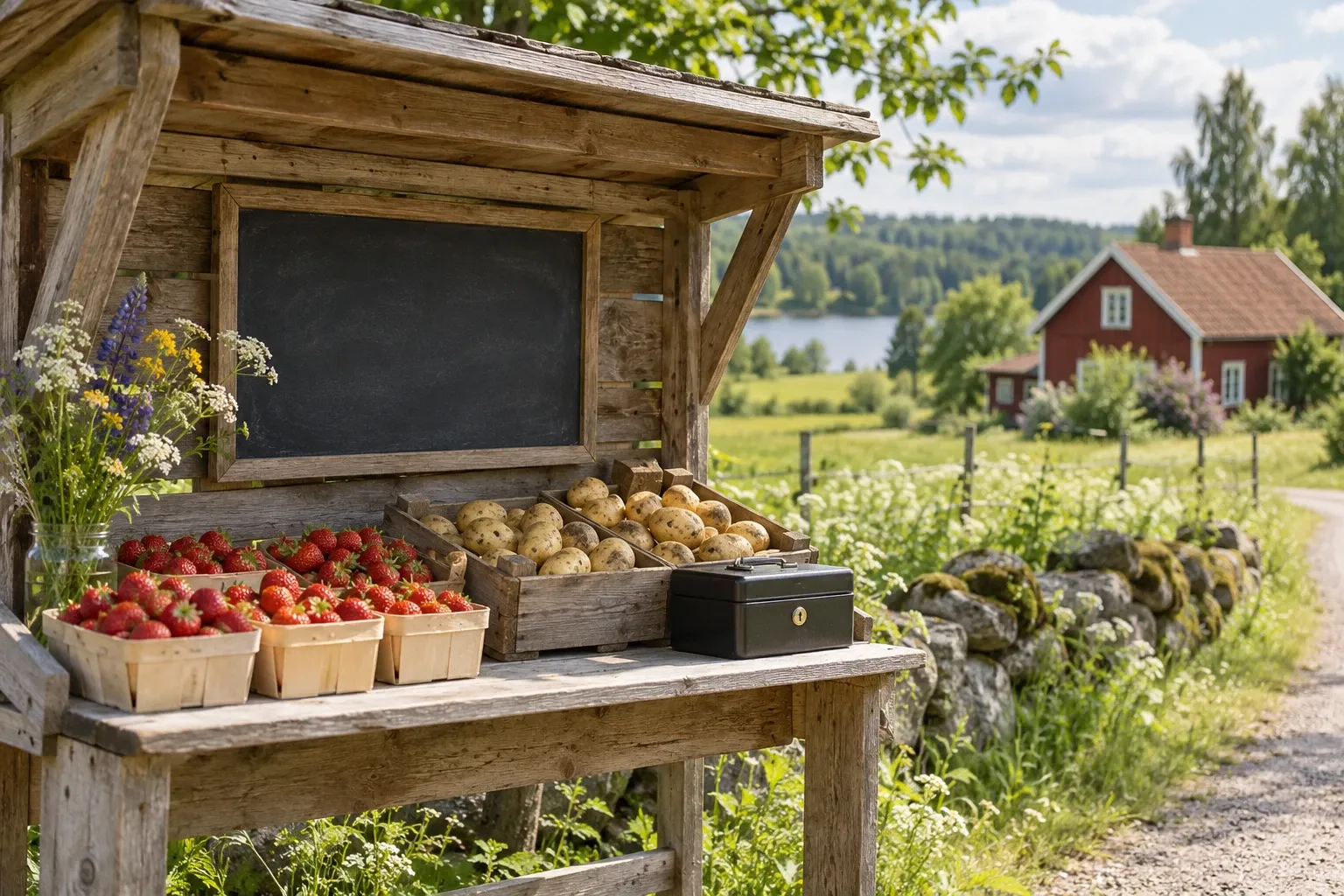
You are driving a country road in July and a hand-painted board says Jordgubbar (strawberries) or Ägg (eggs). You pull in and find a table, a price list, a locked box and a Swish number, and nobody around. Or a farm invites you to pick your own apples. Or you want to bring a farm cheese home and are not sure the airport will let you.
Three kinds of farm shop
Swedish roadside signs lead to three quite different set-ups. Knowing which one you have found tells you how to pay.
| Type | What it is | How you pay |
|---|---|---|
| Gårdsbutik (staffed farm shop) | A small shop on the farm, often with a café, selling its own and neighbours’ produce | Usually card; sometimes cash |
| Självbetjäning (honesty stand) | An unstaffed table, shed or fridge by the road with a price board | Cash box and/or Swish; occasionally a card reader |
| Obemannad butik (unmanned shop) | A locked room that opens when you scan a QR code with Swedish BankID | BankID to enter, then Swish or card |
The honesty stand is the classic. Prices are on a board; you take what you want and pay into the box. There is nobody to haggle with, so the marked price is the price. Not paying is theft under the Swedish Penal Code, and a small value makes it ringa stöld, petty theft, punishable by fines. Some stands have cameras, but the system runs on trust, and rural Sweden’s goodwill towards visitors depends on it.
The unmanned shop is newer. Tourism listings describe farm shops that are “always open” because the door unlocks only after you identify yourself with BankID, Sweden’s electronic ID. If you don’t have Swedish BankID, you cannot get in. Look for a staffed shop or a stand nearby instead.
Paying without Swish
This is where visitors get stuck. Swish needs a Swedish bank account and BankID, and visitors cannot get either. A foreign card or a Swedish SIM card does not help.
Cash is the answer, but don’t assume a new law guarantees it. Since 1 July 2026 Sweden’s grocery stores must accept cash for small payments. The duty covers sales points with a staffed checkout, though, and an unstaffed stand has none. The bill behind the law also excludes shops with a limited range of food. A small farm shop selling its own produce is unlikely to count, though that is our reading rather than a ruling. Any other seller may still refuse cash by posting its terms.
In practice:
- Keep 100–200 kr in coins and small notes in the car all summer.
- Check the board for payment options before you pick anything up.
- Pay the exact sum if you can; stands rarely hold change, and Swedish cash totals are rounded to the krona.
- A Swish-only stand is closed to you. Drive on.
For the bigger picture, see why visitors can’t use Swish and where cash still works in Sweden.
Pick-your-own and allemansrätten
Sweden’s allemansrätten, the right of public access, lets you pick wild berries and mushrooms in a stranger’s forest without asking. It does not cover a strawberry field, an orchard or a garden. Cultivated crops belong to the grower. Naturvårdsverket, the Swedish Environmental Protection Agency, tells walkers to take a detour around fields. Crossing a planting that can be damaged is an offence of its own.
The legal way to pick crops is självplock, pick-your-own. Farms invite you in, usually hand you boxes, show you which rows to pick, and charge by weight or by the box. Strawberries are the summer classic, and pumpkins follow in autumn. It is a good family outing; just pay for everything you carry out.
Christmas trees work the same way. Cut one in someone’s forest without permission and you have committed åverkan, an offence punishable by fines. Buy one from a farm instead. For what you may pick for free, see berry picking in Sweden.
Eggs, raw milk and farm alcohol
Three farm-shop products follow rules that supermarkets never show you.
Eggs without a stamp are legal. Eggs sold direct to consumers at the farm need not meet the EU marketing standards, including the printed producer code. A small producer with 50 hens or fewer, selling elsewhere in its own or a neighbouring county, must post its name and address where the eggs are sold. Unstamped farm eggs are normal, not a warning sign.
Unpasteurised milk is sold, under tight rules. A farmer registered with the county board may sell up to 70 litres a week of opastöriserad mjölk direct to consumers. It may only be sold on the farm, tapped into your container at the time of sale, with written information about the risks. Livsmedelsverket, the Swedish Food Agency, says it can carry EHEC and campylobacter, which can cause kidney damage. Its advice to buyers:
- Bring a clean container and a cool bag, and keep the milk cold.
- Boil or heat it to at least 70 °C before drinking or cooking with it.
- Never serve it unheated to children, pregnant women, older or sick people.
Råmjölk, colostrum from the first milking after calving, is sold too, labelled for heat treatment before eating.
Farm alcohol needs a booking. Since 1 June 2025 a licensed small producer may sell its own wine, cider, beer or spirits on site, between 10:00 and 20:00 on any day. There’s a catch: you must first join a paid visit, such as a tour or tasting, and be 20 or over. Per-person caps apply. A vineyard’s shop sign is not a walk-in bottle shop; any other takeaway alcohol above 3.5% comes only from Systembolaget. Swedish wine, cider and craft beer explains how to book.
Taking it home
Inside the EU, personal food moves freely between member states, so the farm cheese can ride home to Berlin or Amsterdam.
Great Britain is different. Since 12 April 2025 travellers may not bring personal imports of meat or dairy from the EU from cattle, sheep, goats, pigs, deer or other ruminants into Great Britain. The ban applies whether the product is unpackaged or commercially packed. The UK government’s note was updated on 9 October 2026 and the ban still applies; it lasts until revoked.
| Farm-shop item | To another EU country | To Great Britain |
|---|---|---|
| Cheese, butter, milk | Yes | No |
| Sausage, smoked meat, reindeer or moose | Yes | No |
| Eggs | Yes | Yes (poultry is not covered) |
| Biscuits, chocolate, confectionery | Yes | Yes, up to 2 kg in total, within dairy and egg limits |
| Honey, jam | Yes | Not covered by the ban |
Check GOV.UK before you fly, because the list changes with animal-disease outbreaks. For any other country outside the EU, your own customs authority decides. Game meat has its own guide to moose and reindeer on Swedish menus.
Seasons and regions
Farm shops are densest in the farming south and centre: Skåne, Halland, Västergötland, Östergötland, Öland and Gotland. In the north a farm shop more often sells meat, fish or reindeer from a single producer.
| When | What the stands sell |
|---|---|
| June–July | Strawberries and new potatoes; peak honesty-stand season |
| August–September | Vegetables, plums, early apples |
| September–October | Apples, pumpkins, root vegetables; pumpkin pick-your-own |
| November–December | Farm Christmas markets and Christmas trees |
| All year | Eggs, honey and meat; many stands close in winter |
For a full day of farm shops, time your trip for a harvest event. Öland’s Skördefest (harvest festival) fills the whole island with farm shops and food markets on the last weekend of September; in 2026 it ran on 25–27 September. Check its page for next year’s dates.
Practical information
| Item | Amount or rule |
|---|---|
| Produce prices | Set by each farm and posted on the board |
| Swish | Not available to visitors |
| Cash duty (since 1 July 2026) | Staffed grocery checkouts only; stands are outside it |
| Unpasteurised milk | Farm only, tapped on the spot; max 70 litres a week per producer; heat to 70 °C |
| Farm alcohol | Booked paid visit, 10:00–20:00, age 20; per person 0.7 l spirits, 3 l wine, 3 l strong beer, 3 l other fermented drinks |
| Great Britain | No EU meat or dairy from cattle, sheep, goats, pigs or deer; composite foods up to 2 kg |
| Petty theft (ringa stöld) | Fines or up to six months’ imprisonment |
FAQ
How do honesty stands work in Sweden?
An honesty stand is an unstaffed table, shed or fridge, usually by a country road, selling the farm’s own eggs, potatoes, berries or honey. Prices are written on a board. You take what you want and pay into a locked cash box or by Swish, the Swedish payment app. Nobody checks, but taking goods without paying is theft under Swedish law, and some stands have cameras.
Can I pay at a Swedish farm stand without Swish?
Often, yes, if you have cash. Most stands take coins and notes in a box alongside Swish, and some have card readers. Swish itself needs a Swedish bank account and BankID, so visitors cannot use it. The 2026 cash law does not cover unstaffed stands. Keep 100 to 200 kronor in small notes and coins in the car through summer.
Is it legal to pick strawberries or apples from a field in Sweden?
No, not without the farmer’s permission. Allemansrätten lets you pick wild berries and mushrooms on most land, but cultivated crops, orchards and gardens belong to the grower, and taking from them is theft. Pick-your-own farms (självplock) are the legal way: you pick where you are shown and pay by weight or by the box.
Is raw milk from a Swedish farm safe to drink?
Not without heating it. Unpasteurised milk can carry EHEC and campylobacter, which cause severe stomach illness and occasionally kidney damage. Livsmedelsverket, the Swedish Food Agency, advises boiling or heating it to at least 70 °C before drinking, keeping it cold, and never serving it unheated to children, pregnant women, older or sick people. Farms may sell it only on the farm.
Can I buy wine or cider at a Swedish farm shop?
Only on a booked, paid visit. Since 1 June 2025 licensed small producers may sell their own wine, cider, beer and spirits to visitors who have joined a paid tour or tasting, between 10:00 and 20:00 on any day, with per-person caps. You must be 20. Walking in to buy a bottle is not allowed; otherwise strong alcohol comes only from Systembolaget.
Can I take farm cheese or sausage home from Sweden?
Within the EU, yes: personal food moves freely between member states. To Great Britain, no. Since April 2025 travellers may not bring meat or dairy from cattle, sheep, goats, pigs or deer from the EU, even packaged, and the rule still applies in October 2026. Eggs, honey, jam and small amounts of biscuits or chocolate are fine. Other countries set their own rules.
Related guides
- Swish for tourists — why the stand’s payment app is closed to you, and what works instead.
- Can you pay with cash in Sweden? — where notes still work and what the 2026 cash law covers.
- Berry picking in Sweden — what allemansrätten does let you pick for free.
- Swedish wine, cider and craft beer — how to book the farm visit that unlocks a bottle.
- Swedish summer food — what to do with the strawberries and new potatoes.
Facts verified 2026-10-14. Sources: Livsmedelsverket, Sveriges Riksdag (Brottsbalken, Lag 2026:769, Alkohollagen), Naturvårdsverket, Folkhälsomyndigheten, Sveriges Riksbank, DEFRA/APHA (GOV.UK), European Commission — full register in this topic’s source file. Found something outdated? Tell us and we’ll fix it.