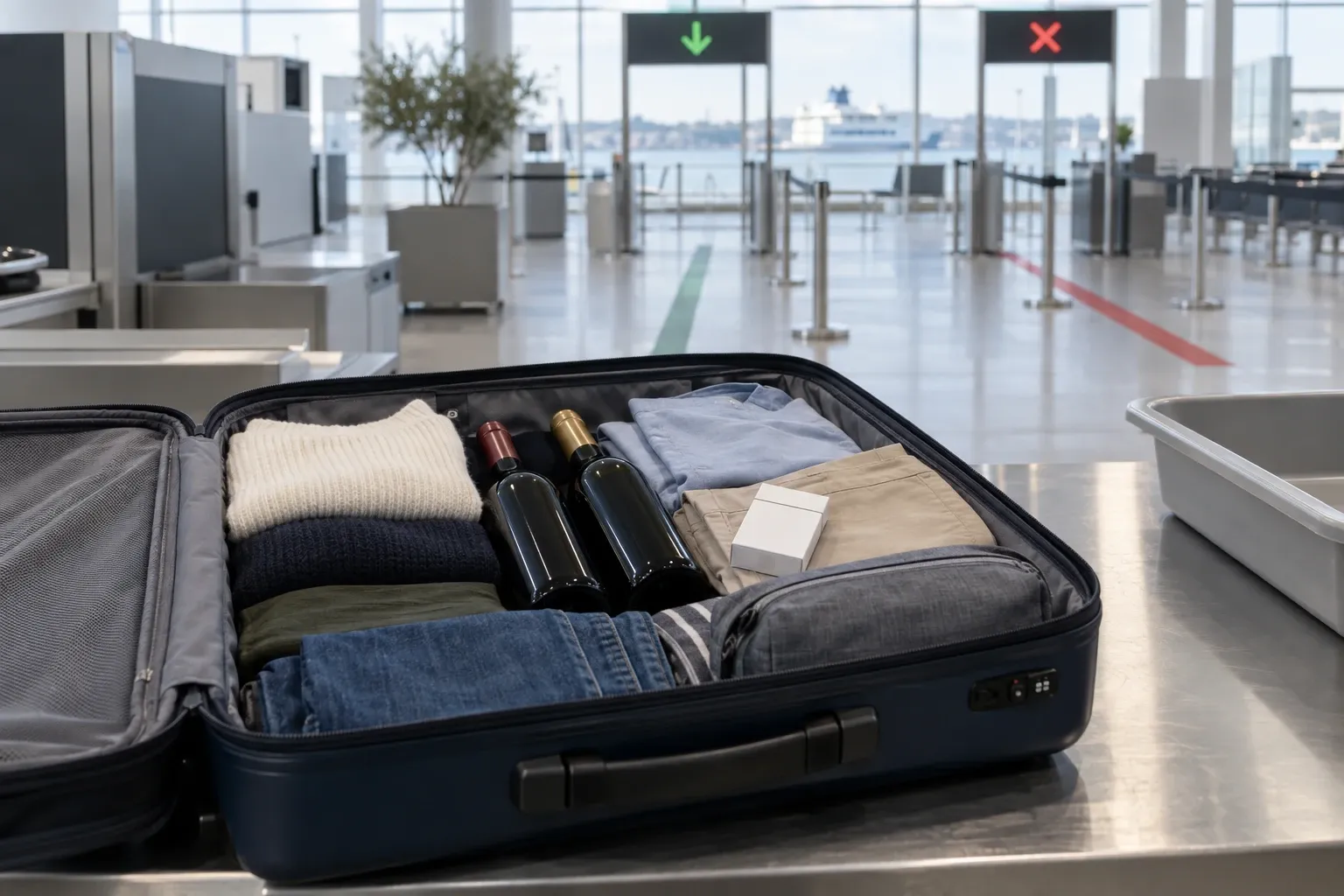
Almost every page about Swedish customs publishes one allowance table. There are two, they differ by a factor of ten, and the only thing that decides which one applies to you is the country you left. Get that fork right and the rest is straightforward.
When you need this
You’re loading the car with wine at a German supermarket before the Trelleborg ferry. You’re driving back from Oslo with a full trunk. You’re on the Stockholm–Turku boat looking at the tax-free shop. Or you’re flying in with prescription medication, a dog, or a large amount of cash.
First, which regime applies to you?
One question decides everything: did you travel from another EU country, or from outside the EU?
| You left from | Regime | Alcohol and tobacco |
|---|---|---|
| Denmark, Germany, Finland, Estonia, Poland, any EU state | EU | No fixed limit — must be for your own use |
| Norway, the UK, Switzerland, Iceland, the US, anywhere else | Non-EU | Hard duty-free limits, in liters and pieces |
| Åland (Baltic ferries calling there) | Non-EU for tax purposes | Hard limits — see below |
Three cases catch people out, every time. Norway is not in the EU, however Scandinavian the border feels. The UK left with Brexit and is now treated exactly like any other non-EU country. And Åland sits inside the EU customs union but outside its tax territory — the entire reason Baltic ferries have a tax-free shop.
Arriving from another EU country
There is no fixed quantity limit. The legal test is different: the alcohol and tobacco must be for your own or your family’s personal use — family meaning close relatives you share a household with — and you must have bought them yourself and be carrying them yourself. No customs duty, no Swedish tax.
To judge “own use,” Swedish Customs works from published guide levels. These are not hard limits. They are the point at which the conversation starts.
| Product | Guide level |
|---|---|
| Spirits | 10 liters |
| Fortified wine | 20 liters |
| Wine | 90 liters (of which at most 60 sparkling) |
| Beer | 110 liters |
| Cigarettes | 800 |
| Cigarillos | 400 |
| Cigars | 200 |
| Smoking tobacco | 1 kg |
Above those figures the burden flips: it is for you to show the quantity is reasonable for your household. That is a real assessment, not a formality — quantity is only one factor, and someone making the same run every week with a shopping list from friends can be stopped while carrying less than the guide levels.
Food travels freely for private use between EU countries, with no duty and no tax.
Arriving from outside the EU: Norway, the UK and everywhere else
Here the guide levels disappear and hard allowances take over. These are per person.
| Category | Duty-free allowance |
|---|---|
| Spirits over 22% ABV | 1 liter — or 2 liters of fortified or sparkling wine |
| Still wine | 4 liters (in addition) |
| Beer | 16 liters (in addition) |
| Tobacco | 200 cigarettes or 100 cigarillos or 50 cigars or 250 g smoking tobacco or 250 g snus — or a proportional mix |
| All other goods, by air or commercial ferry | SEK 5,000 |
| All other goods, by car, private boat or other transport | SEK 3,500 |
Two details that trip people up. The spirits and fortified-wine lines are alternatives to each other; the wine and beer lines are additional, so 2 L fortified wine + 4 L wine + 16 L beer is a legal combination. And the SEK 5,000 / 3,500 value limit covers everything except alcohol and tobacco, which have their own allowances — and it drops the moment you drive your own car instead of flying.
If you see SEK 4,700 and SEK 3,300 quoted elsewhere, those figures are out of date. Tullverket’s current limits are 5,000 and 3,500.
There is also a rule for people who live in Sweden: arriving by ferry from Åland or Norway, you must have been abroad at least 20 hours for the alcohol and tobacco to come in free of duty and tax. Arriving on a commercial flight satisfies the requirement instead. Visitors arriving for a holiday are not affected by it; Sweden-based readers doing a day run to Norway very much are.
E-liquid and other nicotine products get no separate quantity allowance — they count against the SEK 5,000 / 3,500 value limit, and the age limit is 18.
The Åland exception every Baltic ferry passenger meets
The Åland Islands belong to Finland and to the EU customs union, but they sit outside the EU’s VAT and excise territory. That is why the Stockholm–Mariehamn–Turku and Stockholm–Mariehamn–Helsinki ferries run a genuine tax-free shop while sailing between two EU countries.
The consequence is the part nobody mentions at the till: what you buy there is measured against the small non-EU limits, not the EU guide levels. One liter of spirits, not ten. Finland-direct routes that skip Åland are ordinary EU journeys. The Canary Islands have the same status for the same reason.
Food: the rule that catches the most people
From another EU country, bring what you like for private use.
From outside the EU, meat, milk and egg products may not be brought in at all without authorization from the Swedish Board of Agriculture. This is animal-disease control, not revenue, so it applies to the ham in your sandwich regardless of value. Most fresh fruit and vegetables need a plant-health certificate.
The exceptions are narrow but real:
- Norway and Iceland are exempt for animal products only — fresh fruit, vegetables and plants from them still need a phytosanitary certificate; Switzerland and Liechtenstein are exempt for both; San Marino and Andorra for animal products; the Faroe Islands and Greenland up to 10 kg.
- Up to 2 kg of honey, insects, eggs, snails or frog legs.
- Up to 2 kg of powdered infant milk and special medical foods, unopened, branded and shelf-stable.
- Up to 20 kg of fishery products, or one whole fish of any weight.
- No certificate needed for coffee, tea, spices, dried and processed goods such as jam and juice, or fresh pineapple, banana, dates, durian and coconut.
Cash: the rule that changed in April 2026
Carrying the equivalent of EUR 10,000 or more obliges you to declare it to Swedish Customs. “Cash” is broader than banknotes: traveller’s cheques, cheques, promissory notes, investment gold of at least 99.5% purity and gold coins of at least 90% purity all count.
What changed: the declaration duty used to apply only when crossing the EU’s external border. Since 1 April 2026 it applies to journeys to and from other EU countries as well, in both directions. Most travel advice — including a good deal of English-language material — has not caught up. Failing to declare is a criminal offence, and Customs may temporarily seize the money. You can register online before you travel or complete a form at the border. The detail lives in declaring more than 10,000 euros in cash.
Medicines, pets, knives and weapons
Medicines. For your own medical use you may bring up to one year’s supply from an EEA country and three months’ supply from outside the EEA — but read the next paragraph before you rely on that, because it applies only to medicines that are not narcotic- or doping-classed. Carry the prescription, the pharmacy label or a doctor’s certificate; keeping medication in its original packaging is the easiest way to pass the test.
If any of it is narcotic- or doping-classed, those limits are replaced by much shorter ones. From a Schengen state you may bring 30 days’ supply, and for the 22 substances listed in the ordinance a Schengen certificate is required — not merely advisable — naming the prescriber, the patient and the dosage. Arriving from outside Schengen, schedule II–III substances are capped at five days’ supply, and no certificate exists that lifts that cap. This is not an exotic category: methylphenidate, amphetamine, morphine and oxycodone are schedule II, and codeine and tramadol are schedule III. A visitor flying in from the US, UK, Canada or Australia for a fortnight on ADHD or strong pain medication is over the limit on arrival. Arrange the certificate weeks ahead — it is issued by a competent authority in your country of residence, and not always by a pharmacy: in Germany your doctor completes the BfArM form and the state health authority authenticates it, in the Netherlands the CAK issues it. Full detail in bringing medicines into Sweden.
Dogs and cats. They must be registered with Swedish Customs on every entry. You can register online only if you live in and are travelling from another EU country with a European pet passport; everyone else takes the red channel. The animal needs a microchip (or a legible tattoo applied before 3 July 2011) and a valid rabies vaccination first given at least 21 days before departure (dogs coming directly from Norway are exempt; see bringing your dog to Sweden) — a deadline that cannot be fixed at the border. An unregistered animal can be refused entry. See bringing your dog to Sweden.
Knives and weapons. Switchblades, stilettos, butterfly knives, knuckledusters, throwing stars and batons require a permit from the Swedish Police and must be notified to Customs. Pepper spray and tear gas fall under the Weapons Act — an import permit is granted very restrictively, so leave them at home. An ordinary sheath knife is not banned property; Sweden’s knife law restricts carrying knives in public places, school areas and vehicles without a justified purpose. In a rucksack on a hiking trip, fine; in a city center at night, not.
What actually happens if you go over
The ordinary outcome is undramatic: you take the red channel marked varor att deklarera (“goods to declare”), the officer assesses duty and Swedish tax on the excess, you pay and walk on. Declaring costs nothing but time.
There are three channels at a Swedish border, not two. Alongside red and the green nothing to declare channel there is a blue channel, marked with an EU symbol and reserved for travellers arriving directly from another EU country with nothing to declare. It is not a shortcut past the allowances: Tullverket’s own wording is that choosing the green or blue channel with excess goods constitutes smuggling.
Taking the green or blue channel with more than the allowance is a different thing entirely. That is smuggling — a fine or up to two years’ imprisonment, with the goods seized. Alcohol over the limit can also be taken for a tax investigation, and there the burden of proof is yours: you must show it was for personal use. Only in a criminal smuggling case does Customs have to prove the offence.
If no officer is at the red channel, use the red-channel telephone or call Swedish Customs’ command centre on +46 (0)8 405 05 70, staffed around the clock.
Mistakes to avoid
- Assuming the UK is still EU. The difference is 1 liter of spirits versus 10.
- Pooling allowances onto one traveller. They are personal, and under-20s have none for alcohol.
- Forgetting the value limit drops from SEK 5,000 to SEK 3,500 when you drive rather than fly.
- Confusing parcels with luggage. Ordering online from outside the EU is a separate regime — and one that changed on 1 July 2026, when a EUR 3 per-item charge arrived and the old EUR 150 duty relief was withdrawn.
Practical information
| Item | Detail |
|---|---|
| The deciding question | EU country of departure, or non-EU? |
| Non-EU countries people misjudge | Norway, the UK, Switzerland, Iceland — and Åland for tax |
| Age limits | 20 for alcohol · 18 for tobacco and nicotine products |
| Channel to take | Green if within allowances and nothing restricted; red for anything else or any doubt |
| Always declare | Dogs and cats · weapons · EUR 10,000+ in cash |
| Never bring from outside the EU | Meat, milk and egg products (narrow exceptions above) |
| Pre-register online | Pets on an EU passport, weapons, cash — at tullverket.se |
| If no officer is present | Red-channel phone, or +46 (0)8 405 05 70, 24/7 |
| Where to check live figures | tullverket.se, including the duty calculator |
FAQ
How much alcohol can I bring into Sweden?
It depends entirely on where you travel from. From another EU country there is no fixed limit — the alcohol must be for your own or your family’s use, and Tullverket’s guide levels are 10 liters of spirits, 20 of fortified wine, 90 of wine and 110 of beer. From outside the EU: 1 liter of spirits, 4 of wine, 16 of beer.
Is the UK inside or outside the EU for Swedish customs?
Outside. Since Brexit the United Kingdom is treated exactly like any other non-EU country, so the hard duty-free allowances apply: 1 liter of spirits or 2 of fortified wine, 4 liters of wine, 16 liters of beer, 200 cigarettes, plus SEK 5,000 of other goods by air or ferry. Northern Ireland has separate arrangements for goods.
How old do you have to be to bring alcohol into Sweden?
Twenty. The Swedish Alcohol Act sets 20 as the age for importing spirits, wine, strong beer and other fermented drinks, you must have bought them yourself, and you may not hand them to anyone under 20. That is stricter than the 18-year limit for drinking in a Swedish bar, and it applies to EU arrivals too.
Can I bring food into Sweden?
From another EU country, freely for private use. From outside the EU, meat, milk and egg products are banned without authorization, and most fresh produce needs a plant-health certificate. Narrow exceptions exist: 2 kg of honey or infant formula, 20 kg of fish. Norway, Iceland and Switzerland are exempted from the animal-product ban.
Do I have to declare cash when entering Sweden?
Yes, at EUR 10,000 or more — and since 1 April 2026 that applies when travelling to or from another EU country too, not only from outside the EU. Cash includes traveller’s cheques, promissory notes and investment gold. Declare online before you travel or on a form at the border; failing to is a criminal offence.
What happens if I bring in more than the allowance?
Declare it in the red channel and you pay duty and Swedish tax on the excess — routine and unremarkable. Take the green or blue channel instead and it is smuggling: the goods are seized and the penalty is a fine or up to two years’ imprisonment. Alcohol can also be held for a tax investigation, where you must prove personal use.
Can I bring my prescription medicine to Sweden?
Yes, for your own medical use — but check first whether it is narcotic- or doping-classed, because that changes the answer completely. Ordinary medicines: up to a year’s supply from an EEA country, three months from outside. Narcotic- or doping-classed medicines are not covered by those limits; they get 30 days from a Schengen state, with a Schengen certificate that is required rather than optional, and only five days for schedule II–III arriving from outside Schengen. Methylphenidate, morphine, oxycodone, codeine and tramadol are all in that group, so a fortnight’s trip from outside Europe can put an ordinary prescription over the limit.
Do I need to declare my dog at the Swedish border?
Always. Dogs and cats must be registered with Swedish Customs on every entry. You can register online only if you live in and travel from another EU country with a European pet passport; otherwise use the red channel. The animal needs a microchip (or a legible tattoo applied before 3 July 2011) and a rabies vaccination given at least 21 days before travel.
Related guides
- Systembolaget and Sweden’s alcohol monopoly — why bringing your own is worth the planning
- Taking alcohol home from Sweden — the same rules, running the other way
- Crossing the Sweden–Norway border — an EU external border with a Scandinavian face
- Declaring more than 10,000 euros in cash — including the April 2026 change
- Do you need a visa for Sweden? — the other half of arriving legally
Facts verified 2026-07-26. Sources: Tullverket (Swedish Customs), Jordbruksverket, Polisen, Läkemedelsverket, the Swedish Riksdag and the European Commission — full register in this topic’s source file. Found something outdated? Tell us and we’ll fix it.