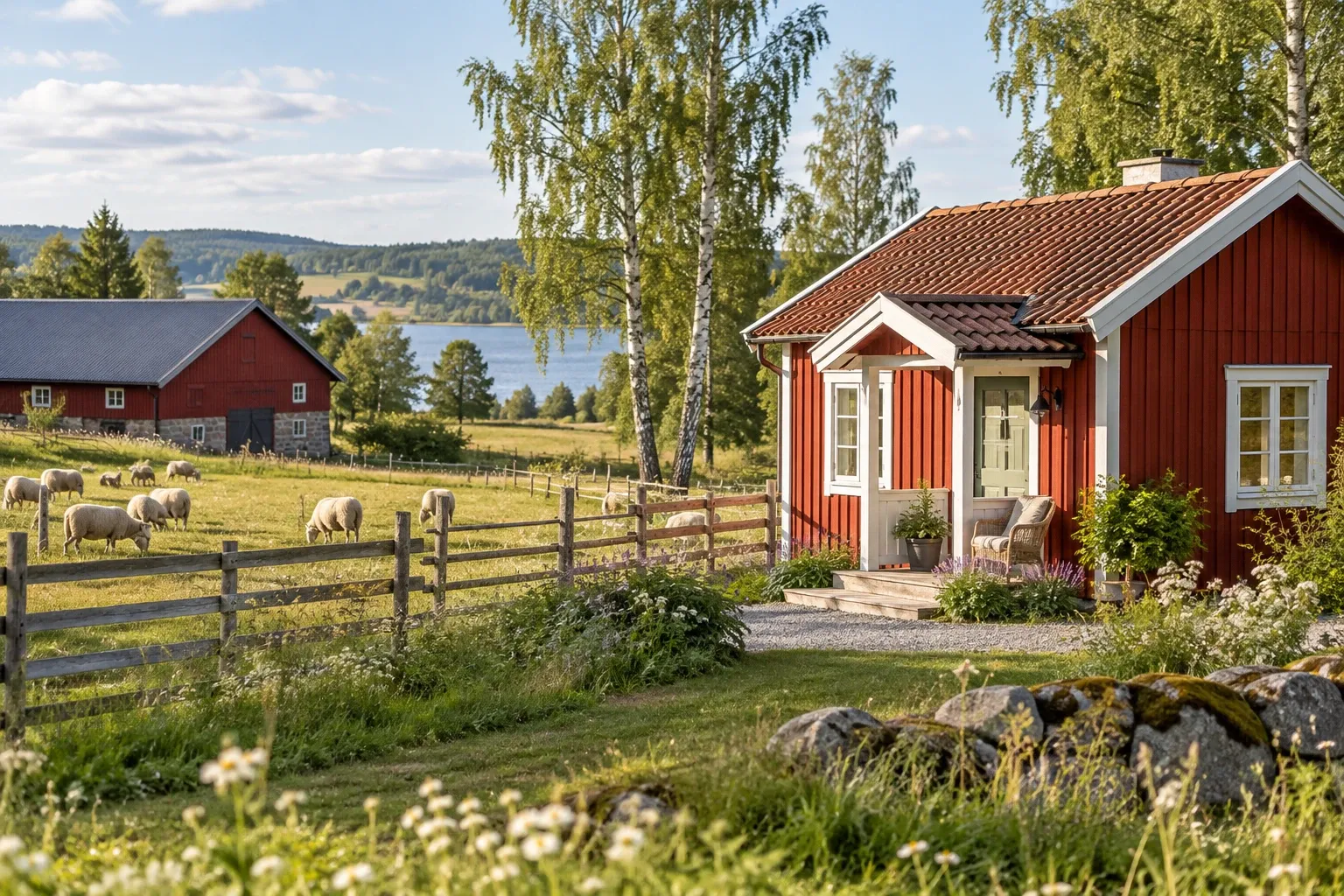
A farm stay is the closest most visitors get to rural Swedish life: a red cottage by a pasture, eggs from the farm, lambs the children can feed. Here is what each type includes, how the grading and booking terms work, and the hygiene rules that apply around the animals.
When you need this
You are planning a countryside holiday with children and want more than a cabin. Or you are reading a Swedish listing full of words like självhushåll and ax. Maybe the host has offered you milk straight from the tank, or you are flying in from a country with African swine fever. You might also be bringing a dog or a horse. This guide covers all of those.
Three kinds of farm stay
Bo på lantgård simply means “stay on a farm”. It is also the name of a non-profit association of farm hosts, Riksföreningen Bo på Lantgård, with member farms in every region from Skåne to Norrbotten, Öland and Gotland included. The farm does not have to keep animals. What defines the stay is a personal host and a look at farm life.
Listings use three main forms:
| Type | What you get | Linen and cleaning |
|---|---|---|
| Self-catering (eget boende med självhushåll) | A cottage, guest house, annex or flat with its own kitchen and bathroom | Usually bring your own sheets and towels |
| Bed & breakfast | A room in the farmhouse or another building, with a farm breakfast | Linen, towels and cleaning included |
| Experience stay (upplevelseboende) | A glamping tent, an old crofter’s cottage or a converted caravan | Varies; may have no running water or electricity |
The linen difference catches visitors most often. In self-catering, the association’s own guidance tells guests to bring bed linen and towels. If you are flying in, ask whether the host hires them out before you arrive. For what an ordinary Swedish holiday cottage is like inside, see what to expect in a Swedish cabin.
What the ax grade means, and why there is no state rating
At many farm gates you will see a sign with one to five ax, ears of grain. That is the association’s own quality grade, not a government one. One ax means the farm meets the basic membership requirements; five is described as first class, close to hotel standard. The detail that matters most is the bathroom. At two ax the toilet and shower may be in another building. From three ax they are in the same building as your room.
There is no state grading for farm stays, and most of them are too small for Sweden’s hotel act to matter. Since 1 January 2025, Lag (2024:1082) on hotels and guesthouses has replaced the old police permit with a simple notification. Only places taking at least nine guests at once, or with at least five guest rooms, have to notify the police. Older guides that talk about a hotel licence are describing a system that no longer exists.
Booking and paying
Farm stays are usually booked directly with the host, and the host’s terms are all you have. Swedish law gives no right of withdrawal for accommodation booked for set dates, so read the cancellation terms before you pay anything.
The association’s standard terms for its members apply unless guest and host agree otherwise:
- The host sends a written booking confirmation.
- You have the room or cottage from 15:00 on arrival day until 11:00 on departure day.
- Single nights are often paid in full on arrival.
- Longer bookings made more than 30 days ahead are secured by a booking fee, with the rest due 30 days before arrival.
- Cancelling late costs most of the rent. Serious illness, an accident or a death in the family, backed by a certificate, limits the cost to the booking fee.
Ask how to pay before you travel. Swish, the Swedish mobile payment app, needs a Swedish bank account and BankID, which visitors cannot get. Agree a card payment or bank transfer in writing. For booking safely and spotting fake listings, see where to book a Swedish cabin.
Animals, children and hygiene: what the rules say
Petting calves and feeding lambs is the highlight for many families, and Sweden regulates it. Under the Swedish Board of Agriculture’s regulation SJVFS 2013:14, a farm that offers the public direct contact with its animals, free or paid, must:
- draw up visitor rules to reduce the risk of disease passing between animals and people;
- tell visitors those rules, and make sure all staff know them;
- provide handwashing with at least cold water, liquid soap and disposable towels, plus hand sanitiser, close to the animals you may touch;
- notify the county board, Länsstyrelsen, unless visits happen fewer than three times a year.
The reason is EHEC. Cattle, sheep and goats can carry it, and small children are especially vulnerable to serious illness. Ringworm and cryptosporidium spread by direct contact too. County boards give visitors the same short advice every summer:
- Wash hands with soap and water before and after touching the animals or their surroundings.
- Help children wash, and keep them supervised for the whole visit.
- Eat and drink away from the animals’ area. A picnic in the pasture is exactly what the rules advise against.
- Follow the hygiene information the farm gives you.
Soap and water come first; the rules require sanitiser as well, not instead. If a farm’s petting corner has no washing point, that falls short of the regulation. Use your own wipes and sanitiser, and wash properly at the house.
Whether you can join the farm’s work is a separate question. Some hosts let guests follow the farm’s work, but always on the host’s conditions; ask when you book. Working in exchange for board is a different arrangement: Migrationsverket, the Swedish Migration Agency, has specific rules for volunteers from outside the EU/EEA, so check your status with it before you agree to work.
Fresh milk: heat it first
On a dairy farm you may be offered milk straight from the tank. Unpasteurised milk can carry EHEC and campylobacter. Livsmedelsverket, the Swedish Food Agency, advises heating it to at least 70 °C before drinking. Never serve it unheated to children, pregnant women, older or sick people. The farm-hygiene regulation’s general advice goes further: farms should not offer unpasteurised milk to visitors at all.
Buying raw milk is also tightly limited. It may only be sold on the farm, tapped into your own container. For that, eggs from unstaffed stands and the rest of Sweden’s farm food, see farm shops and honesty stands.
Arriving from abroad: the 48-hour rule
Visitors can carry animal disease on boots, clothes and equipment. On 30 July 2026, African swine fever was found in wild boar in southern Finland, the seventeenth EU member state with the disease. Sweden’s National Veterinary Institute, SVA, still rates the risk of it reaching Swedish wild boar as low, and domestic pigs as very low. It names people, equipment, clothes and shoes as a possible route.
County boards ask visitors to:
- avoid direct contact with farm animals for 48 hours after visiting an animal facility abroad, and not to wear the same boots;
- wait 48 hours after a hunting trip or a visit to a foreign pig farm before visiting a Swedish farm with pigs;
- put food scraps in the bin and never leave them outdoors. Feeding pigs with food waste is prohibited, so never hand leftovers to farm animals.
Dogs, horses and campervans
Only some farms take pets, so filter for them and confirm when booking. Keep a dog on a lead near livestock and follow the host’s rules. Swedish law requires dogs to be kept from running loose where there is wildlife from 1 March to 20 August, which in the countryside means the lead stays on. More options are in dog-friendly stays in Sweden.
Riders can look for a “Bed & Box” stay: a room for you and a stable box for your own horse. Riding farms are covered in horse riding in Sweden. Some farms also offer a pitch for a motorhome or tent. Ask about water, electricity and how long you may stay.
Around the farm, allemansrätten, the right of public access, still applies to fields: take a detour round growing crops and young plantations. The farmhouse and its garden are the host’s private home, even when your cottage is next door; wait to be invited in. See allemansrätten for the rest.
Fäbodar: Sweden’s summer-pasture farms
A fäbod is a summer-pasture farm, where animals are taken to graze through the summer. The tradition lives on in Dalarna, Jämtland, Gävleborg, Västernorrland and Värmland. Each summer these counties hold a Fäbodveckan (fäbod week), when several active fäbodar open to visitors. In 2026 Jämtland’s ran from 29 June to 5 July, and in 2025 Dalarna’s ran from 14 to 20 July. Activities include petting lambs and learning about haymaking.
The same advice applies there: wash hands before and after touching the animals, and do not eat or drink where they are. Whether a particular fäbod takes overnight guests varies, so ask the fäbod itself. For the decorated farmhouses of the north, see Hälsingland’s farmhouses.
Practical information
| Item | Detail |
|---|---|
| Nightly or weekly rent | Set by each farm; ask the host |
| Booking fee, association standard terms | 500–1,000 kr per week, deducted from the rent (2026 season terms) |
| Late cancellation, association standard terms | 90% of the rent if cancelled 30 days or less before arrival |
| Right of withdrawal | None for accommodation booked for set dates |
| Check-in / check-out (association default) | From 15:00 / by 11:00 |
| Linen in self-catering | Bring your own or ask about hire |
| Hotel-act notification threshold | 9 guests at once or 5 guest rooms (since 1 January 2025) |
| Dog supervision period | 1 March – 20 August |
| Animal contact after farms abroad | Wait 48 hours |
FAQ
What is bo på lantgård?
It means “stay on a farm” in Swedish, and it is also the name of a non-profit association of farm hosts. A farm stay is usually a self-catering cottage, guest house or flat on a farm, or a bed-and-breakfast room with a farm breakfast. Some farms offer simpler stays in glamping tents or old cottages. The farm need not keep animals; the personal host is the point.
Do I need to bring sheets and towels to a Swedish farm stay?
Often, yes, if you book self-catering. The farm association’s own guidance tells self-catering guests to bring their own bed linen and towels. If you cannot, ask whether the host hires them out. Bed-and-breakfast rooms include linen, towels and cleaning in the price. Check the listing or ask the host before you pack, because the rule varies from farm to farm.
Is it safe for children to pet farm animals in Sweden?
Yes, with handwashing. Cattle, sheep and goats can carry EHEC, which is especially dangerous for small children. Farms that offer animal contact must provide soap, water and disposable towels near the animals and tell you their visitor rules. Help children wash with soap and water afterwards, supervise them throughout, and eat only away from the animals.
Can I drink fresh milk on a Swedish farm?
Only after heating it. Unpasteurised milk can carry EHEC and campylobacter. Livsmedelsverket, the Swedish Food Agency, advises heating it to at least 70 °C first and never serving it unheated to children, pregnant women, older or sick people. Swedish farm-hygiene guidance also says farms should not offer unpasteurised milk to visitors at all.
What does the number of ax mean on a Swedish farm sign?
It is the farm-stay association’s own quality grade, from 1 to 5 ax, meaning ears of grain. One ax meets the basic membership requirements; five is described as first class, close to hotel standard. At two ax the toilet and shower may be in another building; from three ax they are in the same building. It is not a state rating.
Can I cancel a Swedish farm stay booking?
Only on the farm’s terms. Swedish law gives no right of withdrawal for accommodation booked for set dates. Under the farm association’s standard terms, cancelling more than 30 days ahead costs the booking fee, and cancelling later costs 90% of the rent; serious illness or a similar event, with a certificate, limits it to the fee. Individual farms can agree other terms.
Can I bring my dog to a farm stay in Sweden?
Some farms welcome pets and some do not, so search for pet-friendly farms and confirm when booking. Keep the dog on a lead near livestock and follow the host’s rules. Swedish law also requires dogs to be kept from running loose where there is wildlife between 1 March and 20 August, which in the countryside means almost everywhere.
Related guides
- Renting a stuga: the ordinary Swedish holiday cabin, if you want the countryside without the farm.
- Treehotel and Sweden’s most unusual places to stay: treehouses, lighthouses and off-grid huts.
- Farm shops and honesty stands: buying eggs, berries and meat from the farm next door.
- Ticks in Sweden: pastures and long grass are tick country; check everyone each evening.
- Glamping in Sweden: the tent-with-a-bed option, on farms and beyond.
Facts verified 2026-10-15. Sources: Jordbruksverket (SJVFS 2013:14), Länsstyrelsen Gotland, Östergötland, Jämtland and Dalarna, Livsmedelsverket, SVA, Migrationsverket, Sveriges Riksdag (Lag 2024:1082, Lag 2005:59, Lag 2007:1150), Riksföreningen Bo på Lantgård — full register in this topic’s source file. Found something outdated? Tell us and we’ll fix it.