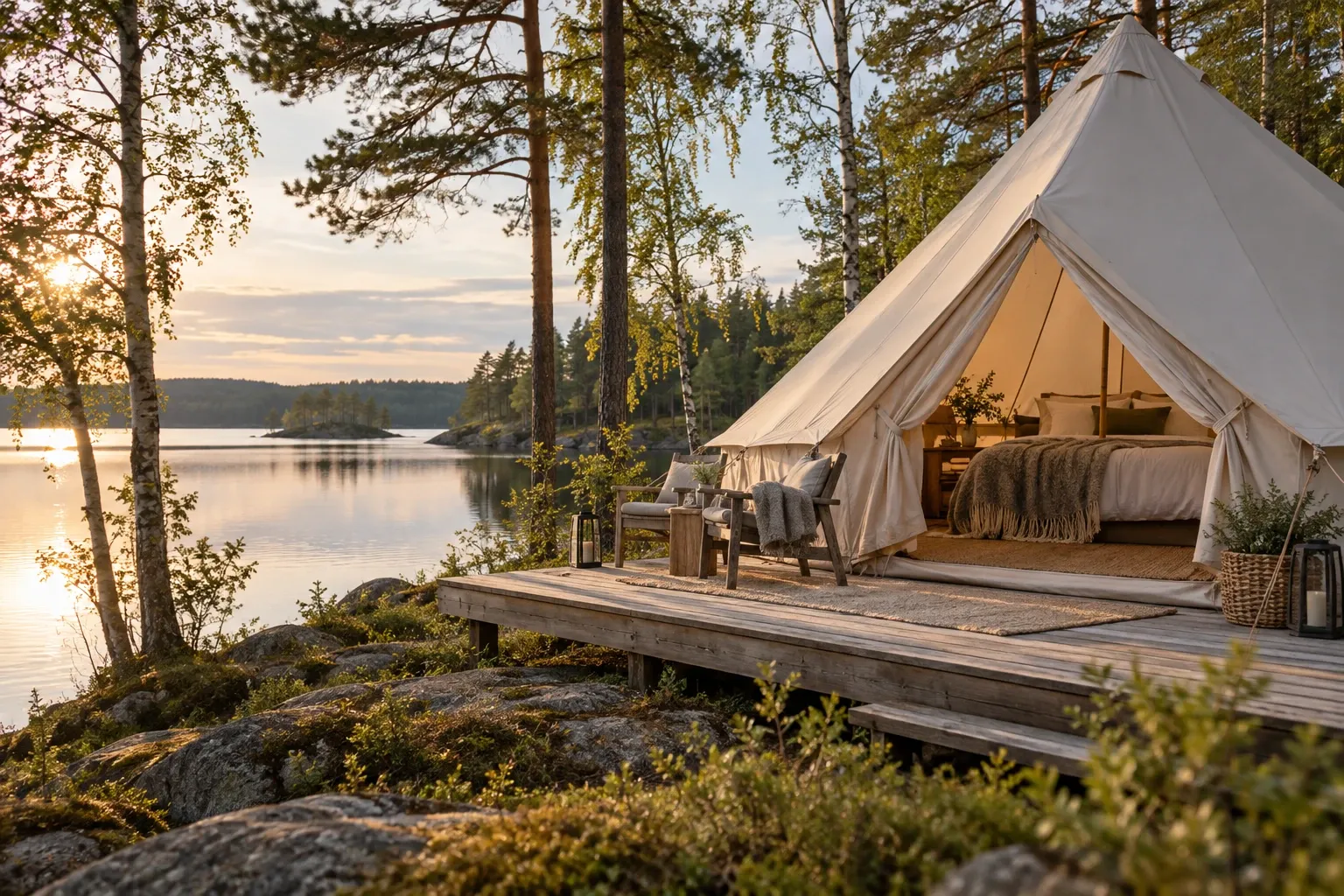
The word “glamping” covers anything from a tent with its own shower and kitchen to a forest tent with an outdoor toilet. Here is how to tell which one you’re booking, when it will be warm enough, and what Swedish consumer law does and doesn’t give you.
When you need this
You want a night in Swedish nature but don’t own a tent, or someone in your party won’t sleep on the ground. You’re weighing a glamping tent against a campsite cabin. You’re planning a September trip and wondering whether canvas will be warm enough. Or the listing says “glamping” and you can’t tell whether that means your own bathroom.
It also matters if the price bundles a boat transfer, dinner or an activity, because that can change your legal rights.
What a glamping tent actually is
Glamping means sleeping in a tent you didn’t carry and don’t pitch. You arrive to standing height, a proper mattress and, usually, hot water somewhere on site.
Sweden’s Environmental Protection Agency, Naturvårdsverket, describes the typical glamping tent as spacious and more or less permanently set up on a wooden deck or levelled ground, with room for a real bed and furniture. In its words it is more like a hotel room than a tent, and toilets and service buildings are usually close by.
That official description has a consequence for guests. A glamping tent is a structure on land the operator controls, not a camping night. Setting up a campsite needs a building permit, and in December 2025 Sweden’s Land and Environment Court of Appeal held that 66 pre-pitched “standby tents” of 30 m² each were permit-requiring buildings. Near water, glamping tents usually also need a dispensation from strandskydd, Sweden’s shoreline protection, and courts have refused several such projects. If you’ve read that glamping is “just camping”, that advice is out of date.
The four types of Swedish glamping
The same word covers four quite different stays. Choose the type first, then the site.
| Type | Where | What it’s like | Watch for |
|---|---|---|---|
| Campsite glamping | Tents or pods inside an ordinary campsite | Campsite showers, pool, playgrounds and shop nearby; five-star campsites often list glamping beside cabins | Bathroom may be the shared service building |
| Farm and field glamping | A few bell tents, globe tents or domes on a farm or meadow | Quiet, few tents; sometimes an outdoor kitchen and fire pit | Facilities vary most here |
| Island glamping | Archipelago tents by the water | Ferry or boat access; dinner or a breakfast basket often included; wood-burning stoves | The boat time decides your arrival |
| Hike-in off-grid | A single equipped tent in the forest | Solitude; GPS coordinates may be sent a week ahead and there may be no trail | Outdoor toilet, fire pit, you carry your bags |
Regionally, the Stockholm archipelago and other island coasts have the water-side tents. The west coast in Bohuslän has some of Sweden’s earliest glamping, with hotel-standard tents at coastal campsites. Småland and Öland have farm tents, globe tents, domes and glamping at many campsites, and forest regions such as Värmland have the hike-in tents. Winter tent camps in Lapland in the Sami tradition are a different experience, covered in our guide to Sami camps and lavvu stays.
For families, campsite glamping is the low-friction choice. Five-star campsites are rated under the industry’s Swedish Camping Standard on sanitation, facilities and activities.
Read the inclusions line by line
There is no legal or industry definition of “glamping” for guests, so the listing is the contract. At the top end, a tent can have floors, heating, a private toilet and shower, a kitchen, a made-up bed and towels, with breakfast at the site café. At the other end, a hike-in tent has an outdoor toilet (utedass) and a fire pit, with an optional food bag.
Check these before you pay:
- Toilet and shower: private (eget badrum) or shared (delad dusch) in the campsite servicehus, or an outdoor toilet
- Bedding: made-up beds (bäddat) and towels, or bring your own
- Food: included dinner or breakfast basket, add-on food bag, kitchen, outdoor kitchen, or a fire
- Extras: firewood and final cleaning (slutstädning)
- Access: ferry or boat times for island sites, the walk in for hike-in tents
A night walk to a dry toilet is fine for some guests and a dealbreaker for others, especially with small children or limited mobility. Ask directly. With a dog, ask before booking: rules are set per site, and our guide to dog-friendly stays covers the wider picture.
Seasons and heating
Summer is peak season. Swedish campsites recorded a record 12.7 million guest nights in June–August 2026 alone. Small glamping sites with only a few tents fill first, so book as soon as your dates are fixed.
Season length varies by site. One five-star campsite with glamping opens only from late May to late August, while others are open all year. For spring and autumn nights, the tents marketed for chilly weather are the ones with wood-burning stoves (vedkamin). Ask how the tent is heated and get the answer in writing.
Pack a warm layer for shoulder-season nights and a headlamp even for a hotel-standard tent. Paths to service buildings and outdoor toilets can be unlit, and nights darken from August.
Stoves, fire pits and fire bans
A stove the operator has installed for the tent is built for it. Carbon monoxide is still the risk to understand. It has no color, smell or taste, and people die of CO poisoning in Sweden every year, according to the Swedish Poisons Information Centre.
- Ask how the stove is vented and whether there is a carbon monoxide alarm (kolmonoxidvarnare).
- Never bring a charcoal grill into the tent, not even one you’ve just finished using.
- Never use an outdoor gas or diesel heater inside.
- Headache and nausea are the first signs. Get into fresh air, and call 112 if symptoms are serious.
The fire pit outside your tent follows the same rules as any other outdoor fire. A fire ban (eldningsförbud) covers wood and charcoal fires and grilling outdoors. Under an ordinary ban some purpose-built fire places may stay open, while a stringent (skärpt) ban closes them too. Gas or liquid-fuel cooking equipment that is safely placed stays allowed even under the stringent model ban.
Bans are issued by counties and municipalities in dry spells, sometimes at short notice, and the decision text is what counts. Lighting the pit anyway can mean a fine. Our guide to campfire rules has the details.
Cancellation and packages: the booking rules
There is no cooling-off period. Sweden’s Distance Contracts Act excludes accommodation booked for a specific date or period from the 14-day withdrawal right, even when you book online. You’re bound by the operator’s cancellation terms, so read them before paying.
A bundle can be a package holiday. Under the Package Travel Act, a package is at least two different types of travel service for the same trip, put together by one trader or sold at one price. Transport plus accommodation counts, so a tent sold with a boat transfer may qualify. A package gives you protection if the organizer changes or cancels the trip.
Accommodation plus an activity only becomes a package if the activity is a significant part of the value or an essential feature of the deal. A sauna or breakfast that comes with the tent doesn’t make one.
Glamping is not allemansrätten
Allemansrätten, Sweden’s right of public access, lets you pitch your own tent for a night or two in nature, free and without permission, away from homes and off farmland. A glamping site is a business. You pay the operator and follow the site’s rules.
The reverse also holds. If you pitch your own bell tent in the wild, it follows ordinary tent rules, however stylish it is. See our guide to wild camping in Sweden.
Practical information
| Item | What to know (checked 2026-10-15) |
|---|---|
| Nightly rate | Varies by site, date, tent and party size; check the operator |
| Meals | Included at some island sites; add-on food bags at some hike-in sites; self-catering elsewhere |
| Bedding and towels | Made-up beds and towels at hotel-standard tents; check other listings |
| Season | Mainly summer; some campsites with glamping open all year |
| Cancellation | Operator’s terms only; no statutory withdrawal right for dated accommodation |
| Package protection | Possible when transport, or a significant activity, is bundled |
| Fire pit | Closed under a stringent fire ban; check county and municipal notices |
| Where to search | Svensk Camping’s campsite search lists glamping as an accommodation type |
FAQ
What is glamping in Sweden?
Glamping is camping in a tent, dome or tipi that is already set up for you, with a real bed and usually heating or hot water on site. Swedish authorities describe a glamping tent as spacious and more like a hotel room than a tent, often on a wooden deck with toilets nearby. It runs from hotel-standard tents at campsites to off-grid forest tents with an outdoor toilet.
Do glamping tents in Sweden have their own bathroom?
Some do, many do not. Hotel-standard tents can have floors, heating, a private toilet and shower and a kitchen. Campsite glamping often means using the campsite’s shared service building, and hike-in forest tents may have only an outdoor toilet and a fire pit. Read the listing for “private bathroom” or ask the operator before you book, especially with children.
When is the glamping season in Sweden?
Mainly summer, when demand peaks: Swedish campsites recorded a record 12.7 million guest nights in June to August 2026. Season length varies by site — some campsites with glamping open only from late May to late August, while others are open all year. For spring, autumn or winter, choose a tent with a wood-burning stove or other heating and confirm it in writing.
Can I cancel a glamping booking in Sweden?
Only on the operator’s terms. Swedish law gives no right of withdrawal for accommodation booked for a specific date, even when you book online, so the 14-day cooling-off period does not apply. Read the cancellation policy before paying. If the booking bundles transport, or an activity that is a significant part of the deal, it may be a package with extra protection.
Is glamping the same as wild camping under allemansrätten?
No. Allemansrätten lets you pitch your own tent for a night or two in nature, free. A glamping site is a business on land the operator controls; its tents are semi-permanent and can need a building permit and, near water, a shoreline-protection dispensation. You pay the operator and follow the site’s rules, not the right of public access.
Is it safe to use a wood stove in a glamping tent?
A stove installed by the operator for the tent is designed for it, but carbon monoxide is the risk to know. Ask how it is vented and whether there is a CO alarm. Never bring a charcoal grill or an outdoor gas heater into the tent. Headache and nausea are early signs; get into fresh air and call 112 if symptoms are serious.
Related guides
- Treehotel and Sweden’s most unusual places to stay — treehouses, glass cabins and lighthouses, the stays this guide leaves out.
- Swedish campsites — where most glamping sits, plus cabins and the free Camping ID.
- Wild camping in Sweden — the free alternative with your own tent.
- Camping with kids in Sweden — what changes with children along.
- Mosquitoes in Sweden — the real comfort question on a summer tent night.
Facts verified 2026-10-15. Sources: Naturvårdsverket, Boverket, Sveriges riksdag (Lag 2005:59, Lag 2018:1217), Konsumentverket, Giftinformationscentralen, MCF (formerly MSB), Svensk Camping, Visit Sweden and regional tourist boards — full register in this topic’s source file. Found something outdated? Tell us and we’ll fix it.