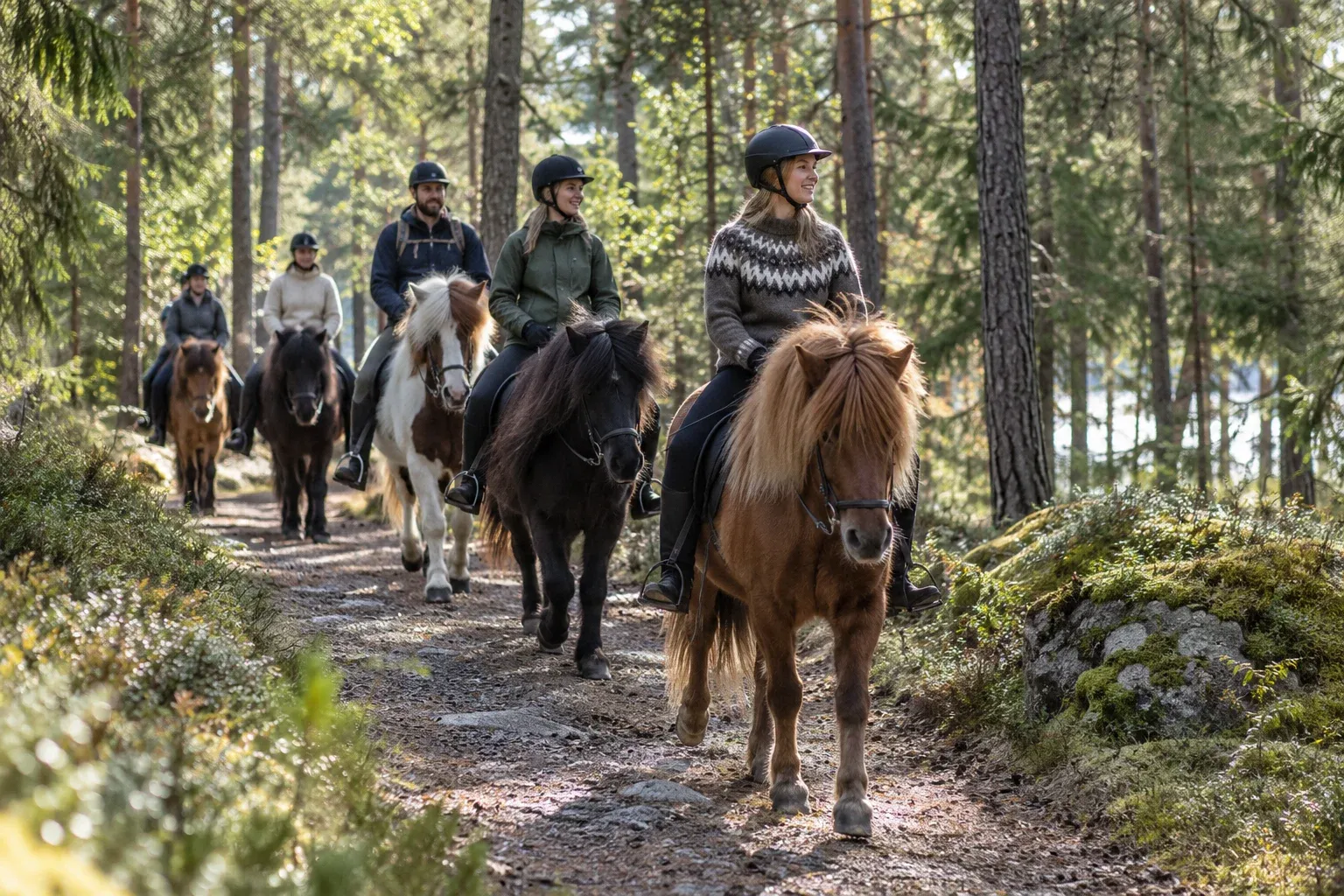
Riding in Sweden is easy to book and well regulated, but not in the ways visitors expect. Here’s how to choose a ride, what stables will ask of you, and where you may ride under Sweden’s right of public access.
When you need this
- You’re planning a family day out with a pony or trail ride
- You’re choosing between an Icelandic-horse trek and a lesson at a riding school
- You want to bring your own helmet or boots and wonder whether they’ll be accepted
- Someone in your group is heavier or less experienced and you’re not sure they can ride
- You’re riding your own or a borrowed horse in the countryside and want to know where you may go
- You’re checking whether your travel insurance covers riding
Trail ride or riding school?
Sweden has two doors into riding, and visitors usually want the first one.
| Trail-riding stable (turridning) | Riding school (ridskola) | |
|---|---|---|
| What you book | A guided ride of one to a few hours, a day ride or a multi-day trek | Weekly lessons in a term-long course |
| Typical horses | Very often Icelandic horses (islandshästar) | Ponies and horses of many breeds |
| Drop-in visitors | Yes, that’s the business | Usually only a prova på (taster) session |
| Who runs it | Mostly private companies | Mostly clubs in the Swedish Equestrian Federation |
Icelandic horses suit nervous beginners. They are small, calm and surefooted, and their extra gait, the tölt, is a smooth four-beat pace that lets you go faster without bouncing. Many stables start with a short arena lesson before heading out.
Riding schools run on terms. In a typical club school the spring term runs roughly from week 3 to week 22 and the autumn term from week 33 to week 50, and trail rides get squeezed into weekends during term. A visitor who turns up on a Tuesday in October is usually steered to a taster session or to a trail stable.
How to book a safe ride, step by step
- Pick the format. For a first ride or a family outing, book a guided trail ride or a taster session.
- Check the stable’s credentials. A club riding school may carry the federation’s quality sign (kvalitetsmärkt ridskola). Icelandic-horse stables often state that the Swedish Icelandic Horse Association (Svenska Islandshästförbundet, SIF) has approved them. Every riding school, and anyone hiring out horses commercially, also needs a permit from the county administrative board under the Animal Welfare Act.
- Read the limits before you pay. Minimum age, maximum weight, experience level and pace are set by each stable.
- Ask the safety questions. Sweden’s Consumer Agency (Konsumentverket) suggests asking before any adventure activity: how big is the group, who leads it, what safety briefing will you get, and can you judge whether you’ll manage?
- Sort out insurance. Ask what covers customers, and check your own policy (more below).
- Dress for it. Long trousers, boots or shoes with a heel, no loose scarves. Take the stable’s helmet if yours doesn’t meet the current standard.
- Arrive early and clean. Many stables have you groom and saddle your horse. Some ask you not to wear clothes you’ve worn in another stable, to stop disease spreading.
- On the ride, follow the guide and the ground. Stay on firm paths, go around fields, and walk past people and dogs.
A quality-marked riding school has met real requirements: the federation’s district inspectors check that the facility and activity are safely designed for horse and human, and at least half of the school’s regular lessons must be taught by instructors with Swedish riding-teacher qualifications.
Helmets, weight and age limits
No Swedish law makes a riding helmet compulsory, for adults or children. The under-15 helmet law you may have heard about covers cyclists only. The Swedish Transport Agency’s rules for horses in traffic say nothing about helmets either.
You’ll wear one anyway. The Swedish Equestrian Federation requires helmets in all its activities, including fetching horses from the paddock, and trail stables lend them. Konsumentverket stresses helmets and body protectors because they absorb the impact in a fall. Since our check found no legal floor, the decision is ultimately yours: refuse to ride without a helmet.
Bringing your own helmet? New riding helmets have been tested to EN 1384:2023 since December 2023. The federation accepts older VG1-marked helmets until the end of 2031, and no longer accepts EN 1384 helmets made before November 2014. If in doubt, borrow the stable’s.
Weight limits protect the horse. Icelandic horses are small, and published limits of about 80–85 kg are common; some stables allow more on certain horses. Give your real weight when booking, because the stable decides at the yard.
Age limits vary. One Icelandic-horse stable we checked takes trail riders from 12, or from 10 with two years’ riding experience. Small children usually start with led pony rides.
Where you may ride under allemansrätten
Riding is part of allemansrätten, Sweden’s right of public access, but with tighter limits than walking because hooves wear the ground. This is the Swedish Environmental Protection Agency’s guidance:
| Where | Can you ride? |
|---|---|
| Paths and tracks with a firm surface | Yes |
| Private roads (enskilda vägar) | Usually, if you cause no damage; regular or group riders should talk to the owner |
| Fields, meadows, pastures, forest plantations | No, go around |
| Newly planted forest | Avoid |
| Soft, boggy or muddy paths | Avoid, especially in spring and autumn |
| Marked exercise tracks and groomed ski tracks | Often banned by local ordinance, signed Ridning förbjuden |
| Pedestrian and cycle paths, motorways | Never (traffic law) |
| National parks and nature reserves | Only as the area’s rules allow |
A “no riding” sign on a private road needs the municipality’s approval to be valid; the municipality can tell you whether a sign is authorised. A blue round sign with a rider means riding is allowed only on that trail.
On roads, keep right. Riders keep to the right edge of the road and use the hard shoulder where there is one. The same rules apply when you lead a horse, so a led horse stays off cycle paths too.
Protected areas override the right. Some ban riding entirely; Abisko National Park is one. Frequent riding in the same place, or riding in a larger group, should be agreed with the landowner, who can otherwise stop it or claim compensation for damage. For the wider rules, see Sweden’s right of public access.
Insurance and liability
Who covers you depends on who runs the ride:
| Who runs the ride | Accident cover |
|---|---|
| A club in the Swedish Equestrian Federation | Members and one-off taster riders are insured against accidents, in Sweden only |
| A commercial trail stable | Its own arrangement; some have a customer accident insurance |
| Your own policies | Check that travel insurance for Sweden doesn’t exclude horse riding |
A stable sign saying riding is på egen risk (at your own risk) doesn’t tell you whether you’re insured, so ask.
Liability is also different from dogs. Swedish law makes a dog’s owner pay for damage the dog causes even without fault; no such rule in that law covers horses. A claim after a riding accident generally turns on whether someone was at fault, and on insurance.
Seasons and regions
| Season or region | What to expect |
|---|---|
| Late May–August | Peak trail season; some stables ride daily only in summer |
| Spring and autumn | Wet ground; avoid boggy paths |
| Autumn in the forest | You share it with the moose hunt; wear visible colours, see hiking during the hunting season |
| Winter | Some stables ride all year; check the booking page |
| South coast beaches | Many towns close bathing beaches to horses in summer, e.g. Simrishamn 1 June–31 August, Vellinge 15 May–31 August |
| Sörmland and Tiveden | Long riding-trail networks, some with farm lodging for horse and rider |
| Mountains and the north | Multi-day summer treks; national park rules can ban riding |
Some beach bans have exceptions: Vellinge permits riding on one stretch between 20:00 and 06:00 in summer, but closes dunes and bird areas in breeding season. For long-distance riders, the Swedish Icelandic Horse Association lists routes such as a pilgrim trail between Sundsvall and Trondheim that can be ridden end to end, with lodging for horse and rider along the way. After any forest ride, check yourself for ticks.
Mistakes to avoid
- Assuming a helmet law exists, and that a stable without one is breaking it. The rule is the federation’s. Insist on a helmet anyway.
- Expecting to drop into a riding-school lesson during term. Book a trail ride or a taster session.
- Booking a “beginner” trek without reading the limits on age, weight and pace.
- Riding a horse across a meadow or new plantation because it looks open. Firm paths only, detours around fields.
- Trotting down a cycle path in town because it’s the smoothest surface. Use the road edge or a riding trail.
- Bringing an old helmet from home that no longer meets the standard.
Practical information
| Item | Detail |
|---|---|
| Riding in nature | Free under allemansrätten; agree frequent or group riding with the landowner |
| Guided trail ride | Priced per ride by length (1–2 hours, half day, full day with lunch); set by each stable and season |
| Multi-day trek | Package price, normally including horse, guide, meals and lodging |
| Helmet | Usually lent free at trail stables |
| Weight limit | Often about 80–85 kg on Icelandic horses; set per stable |
| Federation accident insurance | Club members and one-off taster riders at member clubs, in Sweden only |
| Emergency | Call 112 after a serious fall |
FAQ
Do I need to wear a helmet to ride a horse in Sweden?
There is no law requiring it, for adults or children; Sweden’s helmet law for under-15s covers cyclists only. In practice you will wear one: the Swedish Equestrian Federation requires helmets in all its activities, and trail stables lend them. New helmets are tested to EN 1384:2023; older VG1 helmets are accepted until 2031. Never ride without one.
Is there a weight limit for riding Icelandic horses?
Usually, yes, but it is set by each stable rather than by law. Icelandic horses are small, and published limits around 80–85 kg are common; some stables allow more on certain horses. Give your real weight when booking, because the stable decides at the yard and the limit exists to protect the horse’s back and your safety.
Can I ride a horse anywhere under allemansrätten?
Not anywhere. You may ride on paths and tracks with a firm surface and on most private roads, provided you cause no damage. Go around fields, meadows, pastures and new plantations, avoid soft ground, and ask the landowner if you ride the same area often. Parks, cycle paths, signed exercise tracks and some nature reserves are off-limits.
Do I need riding experience for an Icelandic horse trek?
Not for a beginner ride. Many stables start with a short lesson in the arena before going out, and beginner groups ride mainly at walk and tölt. Longer treks and faster rides often require experience, and stables set minimum ages, typically around 10–12 years for trail rides. Read the level description on the booking page before paying.
Am I insured when I ride at a Swedish stable?
It depends on the stable. Clubs in the Swedish Equestrian Federation insure members and one-off taster riders against accidents, in Sweden only. Commercial trail stables arrange their own cover, sometimes a customer accident insurance. Ask before you ride, and check that your travel insurance does not exclude horse riding as a hazardous activity.
How do I find a safe riding stable in Sweden?
Look for a federation quality-marked riding school, or an Icelandic-horse stable approved by the Swedish Icelandic Horse Association. Commercial stables also need a county-board permit. Before booking, ask about group size, the guide’s training and the safety briefing, as the Consumer Agency advises, and walk away if helmets are optional.
Can I ride a horse on the beach in Sweden?
Outside summer, often yes. In summer many coastal municipalities ban horses from bathing beaches by local ordinance — Simrishamn from 1 June and Vellinge from 15 May, both until 31 August — and some close dunes and bird areas. Signs at the beach and the municipality’s website give the local rule; stables offering beach rides know it.
Related guides
- Sweden’s right of public access — the full rules riders share with walkers
- Hiking in Sweden — same trails, same signs
- Traveling in Sweden with kids — the wider family-trip picture
- Travel insurance for Sweden — check riding isn’t excluded
- Hiking during the hunting season — autumn rides in hunting country
Facts verified 2026-10-01. Sources: Naturvårdsverket, Transportstyrelsen, Konsumentverket, the county boards, Sveriges Riksdag (statute texts), Svenska Ridsportförbundet, Simrishamn and Vellinge municipalities, and stable operators — full register in this topic’s source file. We deliberately publish no ride or trek prices: they are set by each stable and season. Found something outdated? Tell us and we’ll fix it.